
Christmastime is almost here again. It seems like just last month people were resting up after last year’s Christmas-New Year’s rush. But here we are again, and in my mind I can hear Handel’s majestic Hallelujah Chorus.
Questions about Christmas have been asked for centuries, and I would like to give a brief response to two of those questions that people have asked me. Don’t laugh now, because they are serious questions.
Was there really a Santa Claus? My children want to know.
Believe-it-or-not, there was a pastor named Nicholas in the third century AD in what is now Demre, or Kale, Turkey. The one to whom I refer came from a wealthy family, became the Bishop of Myrna, and upon the death of his parents used his inheritance to help the poor. Years after his death he was declared a Saint.
Nicholas became known by many titles in various areas of the world: four of which are Saint Nicholas, Saint ’Ch’las, and Sinterklaas, which were appropriate; and recently Santa Claus. The name Kris Kringle apparently originated in Germany from “Christkindl”, which means Christ Child (sometimes, referred as Christ’s Helper). But the image we have today of a fat, jolly ole St. Nick – Santa Claus – may be attributed to a poem in 1823 by Clement Clarke Moore: ‘Twas the Night Before Christmas (also called “A Visit from St. Nicholas”).
Why do we treat “Santa Claus” as a non-religious person? Post-Christian America builds up Christmas as they do Valentine’s Day or Halloween: it isn’t considered religious, but as a money-making endeavor. Also, it is politically correct to deny the reality of Jesus Christ, Biblical morality, and the intrinsic truth behind Jesus and the real Saint Nicholas.
However, Saint Nicholas was a compassionate pastor who represented a caring, loving God. Nicholas represented Jesus Christ Who died for us, but raised from the dead three days later to redeem us from our sin. For many years, Pastor Nicholas gathered donations of clothing, shoes, and food, and distributed them to the poor; and not just in December. He did this year-round. Yes, there was a Pastor Nicholas whom some people called Saint Ch’las, or Santa Claus.
Who were the three wise men?
Matthew 2:1-2: “…wise men came from the east to Jerusalem saying … we have seen his star in the east….” Matthew 2:11: “When they entered the house, they saw the young child with his mother….”
Many ethnic groups claim the wise men as their own, and the east is a big area so we need to know what eastern societies employed astrologers or astronomers. China, Persia, and India are prime candidates so let’s briefly look at them.
At that time China claimed their leader as god and viewed other national rulers with some contempt. So they are out. The basic religions of India were Jainism and Hinduism, and they were not astronomers nor would they have traveled anywhere to honor a new king. That leaves us with Persia. The main religion in Persia at the time was Zoroastrianism, and their priests were of a class called “Magi” – magician. (Zoroastrianism today is not the same as that in Ancient Persia.)
Until about 220 AD, Zoroastrianism was sympathetic to any religion – including Judaism and Christianity – that taught kindness, justice, righteous thinking, truth, and monotheism. Daniel, Shadrach, Meshach, and Abednego introduced Judaism to Nebuchadnezzar and his empire around 586 BC; and after Nebuchadnezzar recovered from his illness, he declared to his empire that Daniel’s God was the supreme God of heaven (Daniel 4:37).
The wise men of Persia (Magi) were scholars or educated priests. They had various fields of expertise, of which astronomy/astrology was one. When a heavenly sign or star indicated a royal birth (Psalm 19:1), a delegation (minimum of three) was sent to acknowledge that royal event; timing their arrival when the child would be six months to a year old (Matthew 2:11). For safety purposes, the royal delegation traveled with a large trade caravan, and there could have been five to ten Persian scholars or Magi who visited Jesus’ family at the house. The reason our tradition mentions three is because of the three gifts they brought: gold, frankincense, and myrrh.
Today, people ask: “Are you ready for Christmas?” That’s an interesting question, for it reveals their lack of understanding of the celebration. A more pertinent question would be: “Are you ready to publicly acknowledge Christ as did the shepherds and the Magi?”
The good news is: God reveals Himself to whomever truly wants to know him. Jesus is no longer a baby-in-a-manger. He is our living God Who created the entire universe. (John 1:1-4, 14)
 miracle!” I found that rather humorous; but because the man was serious I didn’t want to insult him by laughing. However, that is not a criterion for miracles.
 man can neither create life nor restore life; but God – Who is outside time and space – can. Physical healings are sometimes miraculous. And, of course, one of the greatest miracles is exemplified in our eternal salvation. Looking at a baby reveals the miraculous power – and love – of God. But (don’t think I’m being
 funny here), watching an egg hatch also reveals the miraculous power of God. Think about it: man cannot instill or create life.
 Verse 16 says, “the water above that point began backing up a great distance away at a town called Adam, which is near Zarethan. And the water below that point flowed on to the Dead Sea until the riverbed was dry. Then all the people crossed over near the town of Jericho. (NLT)”

 Although it was totally demeaning, barbaric, and inhuman to the captured Africans, it was a lucrative endeavor. Not only that, it was a joint-effort: black Africans were capturing neighboring black Africans and selling the ones they didn’t kill to the white slave-traders.
 1788, thirty-four years after Newton left slavery, he wrote a pamphlet titled “Thoughts Upon the Slave Trade.” He described the hellish conditions of the slave ships, and said, “It will always be a subject of humiliating reflection to me, that I was once an active instrument in a business at which my heart now shudders.” He joined William Wilberforce, and in 1807 they led the charge of ending the slave trade in England.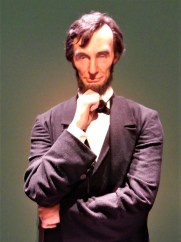
 which are dated only 35-100 years after Jesus resurrected. So, using the same reasoning, we should not doubt them. On the other hand, they are more credible than all the others put together.
 63 BC, have substantiated the Old Testament texts. Archeologists have verified the existence of Biblical towns, civilizations, and events.
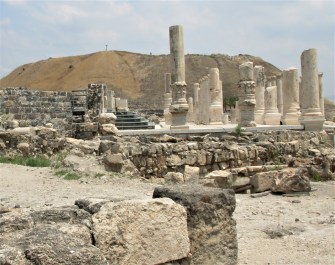 Joshua’s time, Egypt’s conquering of Israel, Pontius Pilate, Herod the Great, and many other events and people named in the Bible. Non-Christian historians like Porphyry, Celsus, Josephus, Pliny, et.al. have confirmed events recorded by the New Testament writers. Tacitus, the leading historian of Imperial Rome wrote: “The author of that name (Christian) was called Christ who in the reign of Tiberius suffered punishment under his Procurator Pontius Pilate.” The Jewish historian Josephus wrote, “There was about this time, Jesus, a wise man….” And many other non-Christian writers have verified the events in the New Testament.
 This question the historical reality of the Bible is often asked by adherents of an evolutionary hypothesis, some of whom are agnostics and atheists. Let me begin with the concept of evolution because that is normally the direction of the question. Let’s look at three words.
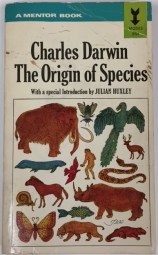 that is not science. In every other scientific endeavor, a concept must be proven to be called a fact. But if you study the evolutionary hypothesis critically, it falls light-years short of explaining how humanity and the cosmos originated.
  3,000,000 of them being rivets, screws, bolts, etc. Each rivet, window, cable, seat, etc. has a position to fill in order to complete the 747. Can there be variations in placement of parts? Yes. Seats are interchangeable. Rivets can exchange places with like rivets. And so on. Every part has a place it must fill; but when like parts are shuffled, the plane does not change.
  If you read this article critically, you find that spontaneous self-materialization is impossible. Rocks cannot become organic. An intelligent designer-creator is mandatory. There must be a first cause and that first cause, by nature, will not be bound by time and space. This first cause will be intelligent because design and order do not result from time plus chance. Chaos is the product of time plus chance. Ask any farmer or botanist.
  eating. As a teenager I had to wait to get my driver’s license. With five sisters and four brothers, even with two bathrooms in the house, we had to wait – sometimes with great apprehension – until it was our turn. Waiting was not always pleasant.
  the host says, “Your waiter will be with you soon.” Then the waiter or waitress asks the customer, “May I bring you something to drink?” Upon returning, he asks, “Are you ready to order?” Later, he asks, “Is the meal to your liking?” or “May I get you some desert?”
  the ones who love me.” The two commandments mentioned by Jesus in Matthew 22:36-40 (love the Lord your God, and and love your neighbor) encompass “The Ten” presented to Moses; and those Ten encompass all of life. So we wait on the Lord by obeying Him. We take His order.
  around within the state. In several towns people cautioned our parents “Watch out: be careful if you have to drive through [a certain part of] town. Lock your doors!” Ethnic prejudice prevailed; but as a child I rejected it, and it never took hold in my mind.
 meaning for me. I viewed the American Civil War in somewhat of a different light. It broke my heart to be deprived of friendship with the black kids. It broke their hearts, too, for apparently, I was the first white kid who ever wanted to spend time with them. I was still in the band, glee club, and the senior play, and I still got along with most the white kids, but my life had changed.
![img_1798[1]](https://genelinzey.com/wp-content/uploads/2018/10/img_17981.jpg?w=136&h=113) interesting and I wanted to hear his reasoning, so I asked again, “What did you say?”
interesting and I wanted to hear his reasoning, so I asked again, “What did you say?”
 with eclipses on Jewish holy days, and comets approaching (or hitting) earth.
![dscn0464[1]](https://genelinzey.com/wp-content/uploads/2018/10/dscn046412.jpg?w=224&h=204) Back to the statement the man said, “It seems like we’re getting ready for Armageddon instead of for Thanksgiving.”
Back to the statement the man said, “It seems like we’re getting ready for Armageddon instead of for Thanksgiving.” less than a statement of faith. Why? Because believing that there is no God is a religious conviction. Hawking was a dedicated scientist with a background in mathematics, physics, and cosmology; not religion or theology. Also Hawking had Lou Gehrig’s disease, was a quadriplegic, was confined to a wheelchair, and had no use for a god who wouldn’t heal him. His humanistic faith was based on the fact that he could not see God and couldn’t prove that there is a God.
 cannot prove is, by definition, faith.
 giant in the kingdom of God. In like manner, Mr. Hawking has credibility in cosmology and physics because of his work in the field (although I don’t agree with him on several scientific issues); but he has no credibility in the realm of Scripture or spiritual matters.
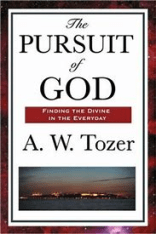 that impacted the 20th Century Church. During a trip by train from Chicago in the late 1940s, Tozer was inspired to write again. When the train pulled into McAllen, Texas the next morning, the rough draft of The Pursuit of God was completed. The depth of that message has made it a book in high demand – about 2 million copies in at least fifteen languages are in print.
 Tozer also said, “The shallowness of our inner experience, the hollowness of our worship, and the servile imitation of the world which marks our promotional methods all testify that we, in this day, know God only imperfectly, and the peace of God scarcely at all.”
 To be an authentic Christian, we must have an in-depth relationship with Jesus Christ. This relationship does not happen by going to church and enjoying the show. It happens by spending time with Jesus Himself through prayer, Bible study, meditating on the Life of Christ, and living in a manner that He would approve.
  Gene Linzey