
So you want to improve your character? Zig Ziglar said: “The foundation stones for a  balanced success are honesty, character, integrity, faith, love and loyalty.”
So how do we improve our character or integrity? Think about the following account.
An acquaintance of mine was on his way to an appointment when his right front tire blew out. He immediately lost control of the car; he hit the guard rail, bounced into another car, and finally came to a stop in the median. It was called an accident.
A legal definition of accident is: an unforeseen event that occurs without anyone’s fault or negligence.
Sooooo, was this truly an accident? The answer is No. Why? It could easily have been prevented! He knew that his tire pressure was very low but he wouldn’t take time to inflate it to the proper pressure. “I’ll take care of it next Saturday.” he said. But he didn’t.
Proper tire care can prevent many automobile calamities, and really, we are never too busy to be safe. My friend understood the benefit of punctuality (honoring others by being on time) but he didn’t quite figure out the benefit of initiative (accomplishing what needs to be done in a timely manner).
While not all problems are this simplistic, many of them are. A fatal situation I read about some time ago was when a father ran over his five-year-old son in the driveway of his own home. Was that truly an accident?
The father said that he didn’t know the child was out of the house. Guess what? The kid is dead! All the dad needed to do was walk around the car to check for children, bicycles, toys, etc. before putting the key in the ignition. If the father had made alertness part of his daily habit (being aware of what is happening around me so I can respond properly), the child might still be alive today. Believe me: he does the walk-around now.
Jesus wants us to be safe and aware of what is happening; so being alert enhances not only our character, but also can make us more like Christ.
So I ask the question again: were these events truly accidents? The answer in a great many situations will be “No.” Instead, these situations were caused by negligence, ignorance, apathy—or a combination of the three. So what is needed to rectify those situations? What does it take for personal growth?
You can call it character, integrity, reliability, or spirituality. I don’t care. Whatever you call it, I call it Godly Character. Character is what determines a person’s response regardless of the situation.
In Reflections On Faith & History [found at https://www.amazon.com/s/ref=nb_sb_noss?url=node%3D154606011&field- keywords=Reflections+On+Faith+%26+History], I addressed numerous questions that many people asked me through the years. My desire was to help people grow both spiritually and intellectually by helping them to gain a more complete understanding of the Bible. I did this by presenting some of the history and culture of the times as it related to the Scriptures. Learning also helps us grow in our character or integrity. It is actually learning to become like Christ.
1) We learn to know and to incorporate the mind of Christ.
2) We learn to interact with others in a wholesome, uplifting manner.
3) We learn to stop being self-centered.
4) We are enabled to fulfill our destiny and enjoy life.
I was a bi-vocational pastor while working at a national laboratory. I had previously worked in the aerospace industry, direct sales, and several other areas. Wherever I went I watched people at work, at play, in the stores shopping, and driving their cars. It was apparent that many people–including Christian–were either uninformed about how to properly conduct themselves, or they didn’t care. It didn’t make sense to me until I began studying about character and integrity.
I found that if we attentively–the key is attentively–read about the Lord and study His integrity, His character, His nature, and diligently apply Biblical principles to life and life’s circumstances, we will be surprised at how our lives will be changed for the better. We will be able to traverse life with less stress, less frustration, more understanding of people, more personal contentment, and live a more fulfilled life. Reading First Corinthians 13:4-7 will help.
So, how does this reduce stress? I’m glad you asked.
As I grow in my understanding of life, I have less reason to get upset over mistakes, errors, or misunderstandings. I am more apt to see things from Jesus’ point of view, and can more easily forgive people. This allows peace to flow through my being and I can share that peace with others.
As you think on the character of Jesus, I pray that you, too, learn to incorporate His integrity into your life.
 are told that nearly all American educational institutions still teach critical thinking; but do they really? My answer is a resounding NO!
  Critical thinkers must take the context of every situation into account and think on a multi-level platform in order to come to proper conclusions. Homeschoolers have an advantage for learning critical thinking skills because they can incorporate these lessons into it their curriculum – as every educational system should do. When a person is able to make correct, intelligent choices on complex matters, he is considered intelligent and competent.
 immorality. But it takes a distinct majority of the Senate and House to change direction or change a law for the better – and even then, one judge is allowed to negate the will of the people. This is wrong. Why doesn’t the US Congress apply the checks and balances which are built into the US Constitution? They are not thinking critically.
 Before 2000 BC (in Abraham’s time), the Babylonian New Year began at the first visible crescent of the New Moon after the Vernal Equinox, and could be the origination of the worship of Allah – the moon god. The moon had many names; the more popular being Nanna, Nannar, Asimbabbar, and Suen. (Suen evolved to Sin, and both are pronounced Seen.) The Babylonian New Year celebration lasted for eleven days, and our modern New Year’s Eve festivities pale in comparison to theirs.
  They celebrated their god of wine and drunkenness, Dionysus, by parading a baby in a basket. The baby represented the annual rebirth of Dionysus who was also the god of fertility. And, of course, public moral debauchery was part of the festivities.
 God’s guidance in making plans. Proverbs 3:5-6 (NCV) says, “Trust in the Lord with your whole life … He will direct your decisions.” The second is to rely upon God for the courage and integrity to fulfill His plans. Don’t get side-tracked. Psalm 111:10 (NLT) says “[Sincere] Reverence for the Lord is the foundation of true wisdom.” And we need wisdom to succeed in doing what is right.


 indicated a royal birth (Psalm 19:1), a delegation (minimum of three) was sent to acknowledge that royal event; timing their arrival when the child would be six months to a year old (Matthew 2:11). For safety purposes, the royal delegation traveled with a large trade caravan, and there could have been five to ten Persian scholars or Magi who visited Jesus’ family at the house. The reason our tradition mentions three is because of the three gifts they brought: gold, frankincense, and myrrh.
 which are dated only 35-100 years after Jesus resurrected. So, using the same reasoning, we should not doubt them. On the other hand, they are more credible than all the others put together.
 63 BC, have substantiated the Old Testament texts. Archeologists have verified the existence of Biblical towns, civilizations, and events.
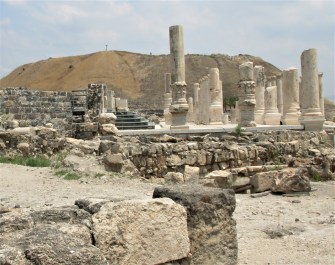 Joshua’s time, Egypt’s conquering of Israel, Pontius Pilate, Herod the Great, and many other events and people named in the Bible. Non-Christian historians like Porphyry, Celsus, Josephus, Pliny, et.al. have confirmed events recorded by the New Testament writers. Tacitus, the leading historian of Imperial Rome wrote: “The author of that name (Christian) was called Christ who in the reign of Tiberius suffered punishment under his Procurator Pontius Pilate.” The Jewish historian Josephus wrote, “There was about this time, Jesus, a wise man….” And many other non-Christian writers have verified the events in the New Testament.
 This question the historical reality of the Bible is often asked by adherents of an evolutionary hypothesis, some of whom are agnostics and atheists. Let me begin with the concept of evolution because that is normally the direction of the question. Let’s look at three words.
 that is not science. In every other scientific endeavor, a concept must be proven to be called a fact. But if you study the evolutionary hypothesis critically, it falls light-years short of explaining how humanity and the cosmos originated.
  3,000,000 of them being rivets, screws, bolts, etc. Each rivet, window, cable, seat, etc. has a position to fill in order to complete the 747. Can there be variations in placement of parts? Yes. Seats are interchangeable. Rivets can exchange places with like rivets. And so on. Every part has a place it must fill; but when like parts are shuffled, the plane does not change.
  If you read this article critically, you find that spontaneous self-materialization is impossible. Rocks cannot become organic. An intelligent designer-creator is mandatory. There must be a first cause and that first cause, by nature, will not be bound by time and space. This first cause will be intelligent because design and order do not result from time plus chance. Chaos is the product of time plus chance. Ask any farmer or botanist.
  less than a statement of faith. Why? Because believing that there is no God is a religious conviction. Hawking was a dedicated scientist with a background in mathematics, physics, and cosmology; not religion or theology. Also Hawking had Lou Gehrig’s disease, was a quadriplegic, was confined to a wheelchair, and had no use for a god who wouldn’t heal him. His humanistic faith was based on the fact that he could not see God and couldn’t prove that there is a God.
 cannot prove is, by definition, faith.
 giant in the kingdom of God. In like manner, Mr. Hawking has credibility in cosmology and physics because of his work in the field (although I don’t agree with him on several scientific issues); but he has no credibility in the realm of Scripture or spiritual matters.
 I was asked about it, I found it is alive, and it’s been thriving for millennia. I don’t believe in hidden messages in so-called Bible Codes, but it is interesting.
 Gene Linzey