
Did you know that the New Year celebration is one of the world’s oldest holidays?  Before 2000 BC (in Abraham’s time), the Babylonian New Year began at the first visible crescent of the New Moon after the Vernal Equinox, and could be the origination of the worship of Allah – the moon god. The moon had many names; the more popular being Nanna, Nannar, Asimbabbar, and Suen. (Suen evolved to Sin, and both are pronounced Seen.) The Babylonian New Year celebration lasted for eleven days, and our modern New Year’s Eve festivities pale in comparison to theirs.
The Romans originally celebrated the New Year in March. In 153 BC the Roman Senate declared January 1 to be the beginning of the New Year, but the date bounced around a bit. Julius Caesar finally established the Julian calendar in 46 BC. However, because emperors had the irresistible compulsion to put their own spin on the calendar, they played with dates and got the calendar out of synchronization with the sun – again. Pope Gregory made corrections and approved the current Gregorian calendar in 1582.
Janus was the Roman god of doors and gates, and had two faces: coming from either direction the traveler saw its face. Julius Caesar felt that the month (January) named after Janus would be the appropriate “door” to the year. One report claims that Caesar celebrated this New Year change by “ordering the violent routing of revolutionary Jewish forces in Galilee, and blood flowed in the streets.” In later years, Roman pagans observed the New Year by engaging in drunken orgies—a ritual they believed constituted a portrayal of the chaotic world that existed “before the gods conquered chaos and recreated order in the universe.”
The early Church condemned the new years’ festivities as paganism – and rightly so. But as Christianity became politically accepted, the Church began adopting many of the pagan customs and the “Christian” New Year’s Day celebration became no different. Hypocritical Christians have always given the world reason to believe that the church was a farce; and that’s a major reason why Christians who are truly devoted to Jesus are often accused of being hypocrites.
January 1 has been celebrated as a holiday by Western nations for over 400 years, and some churches erroneously observed the New Year’s Day festivity as the Feast of Christ’s Circumcision.
The tradition of using a baby to signify the New Year started in Greece around 600 BC.  They celebrated their god of wine and drunkenness, Dionysus, by parading a baby in a basket. The baby represented the annual rebirth of Dionysus who was also the god of fertility. And, of course, public moral debauchery was part of the festivities.
Traditions include using noise to welcome in a new year. This custom goes back to ancient times when people thought noise scared off evil spirits. Some eastern religions still believe this. New Year’s resolutions also date back to the early Babylonians. Their most popular resolution was to return borrowed farm equipment. That’s a good resolution – if they actually returned it.
A 2007 study by Richard Wiseman showed that “88% of those who set New Year resolutions fail. Men achieved their goal 22% more often when they engaged in goal setting, while women succeeded 10% more when they made their goals public.” Frank Ra in his book “A course in Happiness” said: “Resolutions are more sustainable when openly shared with others.” That’s true because we find that peer-support (peer-pressure?) helps us stay on track.
The lyrics of Auld Lang Syne (meaning “old long since” which essentially means “the good old days”) were partly collected and partly written by Scottish poet Robert Burns in 1788. The poem reminisces about and longs for the past. Good, positive traditions and memories are beneficial because they can balance our outlook on life and strengthen our character.
So much for the past; what about the future?
The New Year is often a time people attempt to turn over a new leaf. That means we finished writing on one page, then turn the page – turn the leaf – and write something new. It refers to changing an action, or starting something over.
However, no matter our sincerity, merely deciding to change is meaningless without God’s help. Personal problems and national perplexities are looming on the horizon and we need help. What do we do?
Two factors are necessary in making a substantive, permanent change. One is to seek God’s guidance in making plans. Proverbs 3:5-6 (NCV) says, “Trust in the Lord with your whole life … He will direct your decisions.” The second is to rely upon God for the courage and integrity to fulfill His plans. Don’t get side-tracked. Psalm 111:10 (NLT) says “[Sincere] Reverence for the Lord is the foundation of true wisdom.” And we need wisdom to succeed in doing what is right.
HAPPY NEW YEAR FRIENDS.


 Thinking about that song brought many thoughts to my mind. Allow me to share them with you.
 Iran and Iraq today. One night, one of the astronomers suddenly called to his colleagues, “Look! Do you see what I see?” The others gathered around and were amazed at the startling message unfolding in the sky, for it told them that a new King was born in Israel. Because of the writings left by Daniel back around 560 BC, they had been expecting it, and within six months, they left on a caravan for the Promised Land. Finding the house and kneeling down in front of Mary who was holding the child who was nearly a year old, the noblemen worshipfully said:
 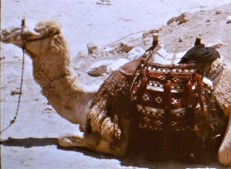 was the Middle-East. They told people in the trade caravans, the scientific community, kings and nobility about the new King. That’s because their lives had been changed.
 Most of them talked about crowds in the stores, traffic-jams, discourteous people, gifts they had to return, the price of the gifts, how much to spend on family members, Christmas debt, and a lot more. Several folks even said that they wish Christmas didn’t exist. For them, the season was merely X-mas. Or more appropriately $$-mas!
 Christmas came from Christ’s Mass – a worship service about Christ. (Christ is a title which came from the Greek Christos. The Hebrew word is Mashiach, translated as Messiah. They both mean anointed, or anointed one.) In the 14th century, Christ’s Mass evolved into Christmas.
  appeared to them (Wise men, Magi), guiding them to Bethlehem. It went ahead of them and stopped over the place where the child was. When they saw the star, they were filled with joy! They entered the house where the child and his mother, Mary, were, and they fell down before him and worshiped him. Then they opened their treasure chests and gave him gifts of gold, frankincense, and myrrh.”
 indicated a royal birth (Psalm 19:1), a delegation (minimum of three) was sent to acknowledge that royal event; timing their arrival when the child would be six months to a year old (Matthew 2:11). For safety purposes, the royal delegation traveled with a large trade caravan, and there could have been five to ten Persian scholars or Magi who visited Jesus’ family at the house. The reason our tradition mentions three is because of the three gifts they brought: gold, frankincense, and myrrh.
 miracle!” I found that rather humorous; but because the man was serious I didn’t want to insult him by laughing. However, that is not a criterion for miracles.
 man can neither create life nor restore life; but God – Who is outside time and space – can. Physical healings are sometimes miraculous. And, of course, one of the greatest miracles is exemplified in our eternal salvation. Looking at a baby reveals the miraculous power – and love – of God. But (don’t think I’m being
 funny here), watching an egg hatch also reveals the miraculous power of God. Think about it: man cannot instill or create life.
 Verse 16 says, “the water above that point began backing up a great distance away at a town called Adam, which is near Zarethan. And the water below that point flowed on to the Dead Sea until the riverbed was dry. Then all the people crossed over near the town of Jericho. (NLT)”

 Although it was totally demeaning, barbaric, and inhuman to the captured Africans, it was a lucrative endeavor. Not only that, it was a joint-effort: black Africans were capturing neighboring black Africans and selling the ones they didn’t kill to the white slave-traders.
 1788, thirty-four years after Newton left slavery, he wrote a pamphlet titled “Thoughts Upon the Slave Trade.” He described the hellish conditions of the slave ships, and said, “It will always be a subject of humiliating reflection to me, that I was once an active instrument in a business at which my heart now shudders.” He joined William Wilberforce, and in 1807 they led the charge of ending the slave trade in England.
 which are dated only 35-100 years after Jesus resurrected. So, using the same reasoning, we should not doubt them. On the other hand, they are more credible than all the others put together.
 63 BC, have substantiated the Old Testament texts. Archeologists have verified the existence of Biblical towns, civilizations, and events.
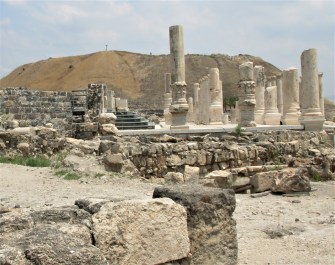 Joshua’s time, Egypt’s conquering of Israel, Pontius Pilate, Herod the Great, and many other events and people named in the Bible. Non-Christian historians like Porphyry, Celsus, Josephus, Pliny, et.al. have confirmed events recorded by the New Testament writers. Tacitus, the leading historian of Imperial Rome wrote: “The author of that name (Christian) was called Christ who in the reign of Tiberius suffered punishment under his Procurator Pontius Pilate.” The Jewish historian Josephus wrote, “There was about this time, Jesus, a wise man….” And many other non-Christian writers have verified the events in the New Testament.
 This question the historical reality of the Bible is often asked by adherents of an evolutionary hypothesis, some of whom are agnostics and atheists. Let me begin with the concept of evolution because that is normally the direction of the question. Let’s look at three words.
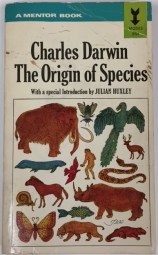 that is not science. In every other scientific endeavor, a concept must be proven to be called a fact. But if you study the evolutionary hypothesis critically, it falls light-years short of explaining how humanity and the cosmos originated.
  3,000,000 of them being rivets, screws, bolts, etc. Each rivet, window, cable, seat, etc. has a position to fill in order to complete the 747. Can there be variations in placement of parts? Yes. Seats are interchangeable. Rivets can exchange places with like rivets. And so on. Every part has a place it must fill; but when like parts are shuffled, the plane does not change.
  If you read this article critically, you find that spontaneous self-materialization is impossible. Rocks cannot become organic. An intelligent designer-creator is mandatory. There must be a first cause and that first cause, by nature, will not be bound by time and space. This first cause will be intelligent because design and order do not result from time plus chance. Chaos is the product of time plus chance. Ask any farmer or botanist.
  Gene Linzey