
A vast majority of you will say “No, I’m not an atheist,” while some will say “Yes, I am.” But why would I ask that question? Back to that in a minute.
Atheism has been defined as a lack of belief in God, a total denial of His existence,  and variations of the theme in between. The word atheism comes from the Greek negative article “a” which means “no,” and “theos” which means “god.” Therefore, atheism is the belief that there is no god. Did you catch that? A belief that there is no God. On the other hand, many of us believe that there is a God, He is knowable, He loves us, and is involved with mankind.
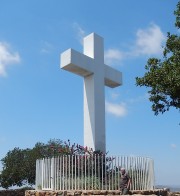
The polytheistic Romans in Jesus’ day, who believed in hundreds of gods, accused Christians of being atheists simply because Christians believed ONLY in the Holy Trinity (Father, Son, Holy Spirit); while the Jews accused Christians of polytheism BECAUSE they believed in the Holy Trinity. The accusations depended on the point of reference. But that’s a story for another time. (This cross is on Mount Helix in San Diego County, just four miles from where I grew up.)
Many atheists probably don’t consider themselves anti-theists, but non-theists. Many are good, ethical, moral citizens, and strong Americans; and most atheists claim that atheism is not a belief system or a religion. But I call atheism a religion. Why?
In the atheist’s belief system: there is no God; nothing formed itself into a well-organized, majestic universe; organic life evolved from rocks; man evolved from … who knows?; there is no life after death; belief in God is wrong; and so on. But all of that is a matter of faith, and that is religion. Simply put: the atheist’s non-belief system is, by definition, a belief system. Biologist George Klein wrote: “I am an atheist. My attitude is not based on science, but rather on faith. The absence of a Creator, the non-existence of God, is my childhood faith, my adult belief, unshakable and holy.”
Many strong atheists are often aggressive in their conversations with theists and try to shoot holes in theistic beliefs. (And, sadly, many Christians are equally argumentative.) Atheists like to use logic and anti-biblical “evidences” to denounce God’s existence. However, I’ve had many interesting discussions with scientific atheists in the past, and most of them are still my friends because we didn’t hammer, degrade, insult, or malign each other. Rather, we expressed our beliefs – yes, religious beliefs – and allowed each other freedom of religion, freedom of thought, and freedom of expression.
Remember, we cannot change anyone’s mind. We must, as simply or as complex as the situation requires, present our beliefs and convictions to them and allow the Holy Spirit to work in their heart and mind.
 But now I have several questions for you: If you are a Christian, are you a practicing atheist? Keep reading.
1. Do you effectively deny God by your lifestyle: your language, actions, thoughts, motivations, work ethics, choice of humor, the places you go, what you watch at the theaters, on computer, or on television?
2. When someone begins to bad-mouth God or another person, do you just sit by? Or worse, do you join in the negative conversation?
3. If you attend church, do you attend for social purposes, out of obligation, or for business contacts?
4. Without being abrasive or overbearing, do you openly proclaim Christ to the world, or do you hide your Christian faith in the social shadows?
5. Would some folk be surprised if you told them you are a Christian?
A “yes” answer shows you are effectively denying God: being a practicing atheist. But if you claim to be a Christian, I want you to think about your relationship with God. Do you truly desire to live for God? I am not encouraging you to cram your religion down someone’s throat; that would be wrong. But we do need to openly, definitively “let our light shine” for the Lord – if indeed we are Christians.
Matthew 10:32-33 says, “Therefore whoever confesses Me before men, him I will also confess before My Father who is in heaven. But whoever denies Me before men, him I will also deny before My Father who is in heaven.”
Let’s not try to intimidate others, but let’s allow them to experience truth and life through our lives. Let’s give them a glimpse of Christ by the way we live.
 equilibria, natural selection, convergent evolution, co-evolution, adaptive radiation, mutation, genetic drift, theistic evolution, intelligent design, Biblical creation, etc., can be confusing! In the midst of this confusion, I’ll attempt to take some mud out of the water.
 from other solar systems or galaxies, while others go straight to the hypothetical Big Bang. But neither hypothesis provides a plausible answer.
 dissolved rocks: a rich soup of dissolved minerals. But without the direct intervention of the divine Creator, God, it is absolutely impossible for organic life to evolve from dissolved rocks. Also, a portion of the 2nd law of thermodynamics (entropy) reveals that nature does not become more complex, but degrades with time.
 planners, engineers, builders, and more. When we study the intricacies of the simple one-cell amoeba or massive 200-billion-star galaxies, it is obvious that there was a dreamer, planner, engineer, and builder. The classic Big Bang hypothesis and humanistic evolution make intriguing science fiction, but do not stand the test of time. Rather they are diversions which turn us away from truth: from Almighty God who created us, and from Jesus Christ who loved us and gave himself for us.
 nor destroyed. Matter can change shape, form, or state (ice, water, vapor, plasma), but matter cannot be made out of nothing or annihilated into nothing. That invalidates any Big Bang hypothesis – scientific or not.
 and all the cosmos were merely a statistically impossible happenstance of nature, and if creatures such as the Spotted Owl, rare New Mexico Jumping Mouse, Northern Hairy-Nosed Wombat, or a kitten were more important than mankind, why do so many well-meaning people who don’t believe in mankind’s importance endorse expensive self-improvement, image-enhancing, and self-esteem seminars? Those would be a waste of time; but negating mankind’s importance does explain their obsession of infanticide by fetal abortion.
 and purpose for our existence, and that we were made in the image of our Creator. Those who accept that fact might understand the dynamic meaning for our existence. So, why are we here? God created us to fulfill HIS purposes. However, we must study the Holy Bible and ask God to reveal His specific purpose for our individual life.
 have been surprised at their moral contradictions. Many who believe in being
 meaning, and God established morality, then our destiny will dynamically involve God. Keep in mind that your and my beliefs neither eradicate nor establish truth. Truth stands on its own foundation and we either accept or reject it. A group of people can sit in a circle for as long as they desire and think world peace as intently as they know how. But judge for yourself: Is it working? Of course not, because the world rejects the Prince of Peace – Jesus. If you don’t believe me, look at the Middle-East today.
 John 3:16 – God so loved the world – that includes you and me – that He gave His only begotten son – Jesus, who died for us – that whosoever believes on Him will not suffer eternal death, but will live eternally in heaven with Him.
 in New Mexico, gave me permission to reprint an article he wrote for his Bible Answers column as a spring-board for discussion. Chuck wrote:
 attempting to spell out who is worthy of grace and who is not, we should remember that “all are sinners and fall short of God’s perfection” (Rom. 3:23).
 worthy of judgment. But God doesn’t want to damn us; that’s why Jesus came to rescue us, and the remedy is given in Scripture. “Jesus did not come to condemn the world; rather, He came so that the world might be saved” (John. 3:17-21).
 were sacrificed, foreshadowed the crucifixion of Jesus; for Jesus, the Christ, was ultimately the true innocent Passover Lamb – not just for one nation, but for the world. Let’s briefly recap the history that led to the Passover Celebration.
 Deprived of his royal background, he became a lowly shepherd for forty years; but God never abandoned Moses, and commissioned him to return to Egypt to be the human element in setting the Israelis free.
![dscn0185[1]](https://genelinzey.com/wp-content/uploads/2019/03/dscn01851.jpg?w=178&h=194) Passover is a picture of the sinless Lamb of God – Jesus – Who suffered the penalty of sin for us (death), raised Himself back to life, and set us free. All we need to do is to accept Jesus into our lives, ask Him to forgive us for our self-centered lifestyle, then purposely live for Him. We will be covered with the blood of the Lamb and forgiven.
Passover is a picture of the sinless Lamb of God – Jesus – Who suffered the penalty of sin for us (death), raised Himself back to life, and set us free. All we need to do is to accept Jesus into our lives, ask Him to forgive us for our self-centered lifestyle, then purposely live for Him. We will be covered with the blood of the Lamb and forgiven. personal reality. For this reason, postmodernism is highly skeptical of explanations which claim to be valid for all groups, cultures, traditions, or races, and instead focuses on the relative truths of each person. In the postmodern understanding, interpretation is everything.”
 discussion of ‘justice’, there is no meaning which we can find. The concept of ‘justice’ exists only as long as we negotiate its meaning between ourselves in our society.” And that makes as much sense as me trying to push around a 300-pound gorilla!
 and objective truth, which has been our proven standard for life for so long, now be wrong? Without a solid foundation in God and the Bible, life is hopeless, worthless, meaningless. That’s why there are so many suicides, murders, drug usage and overdoses: life is void without faith in a caring, loving God.
 . That is the concept that all truth is relative to the individual, time, or place. However, relativism is a faulty philosophy that attempts to negate absolutism. Absolute means: complete; not limited by restrictions; unconditional; unrelated to and independent of anything else. Interestingly, after a short investigation we find absolute truth in math, history, the Bible, and in every-day life. Often, the denial of absolutism is not about life, but is aimed at the reality of God and the deity of Jesus Christ. And the one who claims his own reality actually claims to be the supreme ruler in his own life; but living for just twenty-four hours will prove that is false.
  Another example of absolute reality: God knew you would be born and that you will live forever – somewhere; but it is your choice as to your eternal destination. Whether or not you believe in heaven or hell does not change the reality of either place: our personal belief neither establishes fact nor eradicates truth. Absolute truth stands on its own foundation.
  in every way, which includes His memory, Clarence asked if God can choose to forget. I suggested that we not confuse the issue, but stick to what the Bible says.
![dscn0464[1]](https://genelinzey.com/wp-content/uploads/2018/10/dscn046412.jpg?w=197&h=180) Forgiveness is not about letting the offender off the hook, but returning the right to dispense justice back to God and to the appropriate human authorities. Forgiving others, and asking to be forgiven when we err, keeps our consciences clear.
Forgiveness is not about letting the offender off the hook, but returning the right to dispense justice back to God and to the appropriate human authorities. Forgiving others, and asking to be forgiven when we err, keeps our consciences clear. that “mental claustrophobia” and that’s a tough prison. How do we get trapped like that? Some folk might say life has dictated our fate. If you’ve watched the movie “Anne of Green Gables” you could say it’s because of a lack of imagination. Yet others may actually blame God for it.
 Great benefits could await us if we dare to step outside our comfort zone. No, I am not suggesting that we put safety and common sense aside, and I am not suggesting that we stop providing for our families. But we may have an invention tucked away in our God-given creative mind, we may have an idea that could improve the quality of life, or we may simply want to reach out and expand our horizons; but we must be willing to take a risk. The risk can span the financial, physical, emotional, or reputational realms; but with proper mentoring we can break out of our mental prison. God doesn’t want us stuck. Dependable, yes! But not stuck.
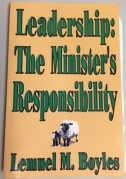 Responsibility, “The need for well-trained, highly qualified leaders in the Christian realm is one of the most critical problems we face in the church today.” I agree, and that also applies to the secular world. Without well-trained leaders, our churches and organizations are faltering. But Dr. Boyles taught that training alone is not sufficient. True leadership entails more than just filling a vocational slot: true leadership involves a higher calling.
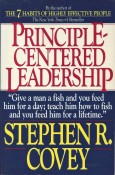 In his book, Principle-Centered Leadership, Stephen Covey said, “…we often attempt to short-cut natural processes–substituting expediency for priority, imitation for innovation, cosmetics for character, style for substance, and pretense for competence.” Although they might not realize it, this is designed failure by incompetent leaders.
 summarized the law in His statements in Matthew 22:37-39; “Love the Lord your God with all your heart, all your soul, and all your mind. This is the first and most important command. And the second command is like the first: Love your neighbor as you love yourself.” This is the foundation for good character and sound leadership.
 Gene Linzey