An Important Question (pt. 1)

I enjoyed a question a reader asked because it prompted me to critically and logically think about my faith and my understanding about God.

Question: How do you determine the difference between 1) what God and Jesus actually said and did, versus 2) what the Bible authors merely reported that God and Jesus said and did?

To affirm what God and Jesus said and did would require eyewitnesses. Therefore, I will not start with faith; I’ll start with what many scholars believe to be fact.
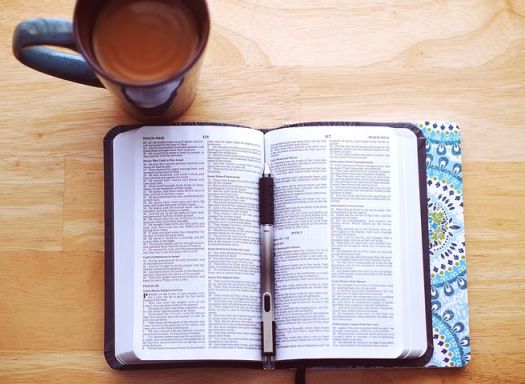
Literary scholars of various religious and non-religious persuasions determined that portions of the Old Testament may have been written as early as 3500 BC, and I think they are on the right track. Why do I agree with them?

According to Genesis chapter three, God had personal interaction with Adam. Therefore, Adam learned about the creation events from God, and most likely wrote about it. And since Adam lived well into Methuselah’s lifetime, he passed the knowledge regarding creation and the beginning of human history to Enoch and his son, Methuselah; and they could have started formally documenting the history of mankind. Since Methuselah died about a week before the flood began, he had time to document what Noah was doing.
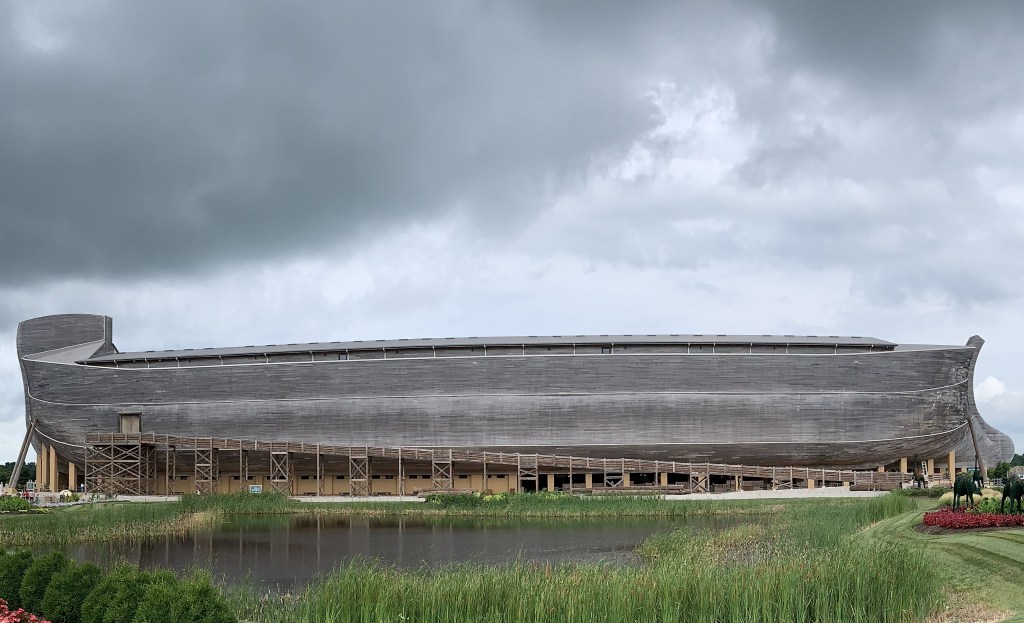
God gave Noah a 120-year warning that the flood was to happen, so Noah wasn’t in a hurry and would have taken all the writings that Methuselah gave him onto the Ark. Noah and Shem may have added more info to the writings.

Those writings (on clay, parchment, paper, or whatever the medium), were passed down to Abraham and eventually reached Moses. All that information was the basis for the first 11 chapters of Genesis.

The information presented in Genesis 12 through 50 was most likely documented by Abraham, Isaac, Jacob, Joseph, and several others while they were in Egypt, and given to Moses. If the writings started around 3500 BC, and we apply the genealogy given us in the Bible, we can see how the actions and words of God – and of Jesus – were documented by eyewitnesses. It takes many guesses out of the equation.

Add to the equation: the Bible is the oldest history book in the world, and much of it has been verified by archeology and other scientific endeavors.

Hundreds of prophecies have been spoken throughout the OT time frame. A few of the prophecies were spoken by seemingly wild-eyed hermits, while many, if not most, were spoken by kings, priests, farmers, shepherds, merchantmen, and other socially accepted people. Most of them have already come true, such as: approximately 356 prophecies in the OT about the coming Messiah have been fulfilled in Jesus.

Quoting from https://www.learnreligions.com/prophecies-of-jesus-fulfilled-700159, Learn Religions – Old Testament Prophecies of Jesus, we read: “In the book Science Speaks, Peter Stoner and Robert Newman discuss the statistical improbability of one man, whether accidentally or deliberately, fulfilling just eight of the prophecies Jesus fulfilled. The chance of this happening, they say, is 1 in 1017 power.”

10 to the 17th power is 10 with 17 zeros after it. Go figure the number.

But there were not 8 prophecies about Jesus that were fulfilled – there were approximately 356. For this, I don’t know how many zeros would be required, the result equals to an impossibility.

But all that deals only with prophecies about Jesus. There were hundreds of other prophecies throughout the 1200 years of writing Genesis through Malachi. They were about people, politics, events, and they were fulfilled, also. If there is no one who knows everything that will ever happen in the course of mankind, this is a staggering impossibility.

Many of those 356 prophecies that were fulfilled in the life, death, and resurrection of Jesus point to the fact that Jesus would be the Messiah, and others pointed to the fact that Jesus would be God in human form.

Now, switch to what is called the New Testament.
What we call the “Church Age” did not begin until the Day of Pentecost. That’s why we say the books of Matthew, Mark, Luke, and John are actually a continuation of the Old Testament. That would change the 1200 years of writing to almost 1600 years. Those four books reveal the life of Jesus and show how Jesus fulfilled many prophecies in the OT.

John, the Gospel writer, was possibly the final Old Testament prophet. Remember, he didn’t die until somewhere around 100 AD – about 60 years after Jesus was crucified. And with everything said about the coming Messiah being fulfilled in Jesus, John informs us in John 1:1 that the Messiah, who had originally been predicted in Genesis 3:15, was and is God.

Let’s continue next week.
A Very Good Question

The following is a question from a dear friend, and my response to her.

“In a short and concise answer, why do you believe Christianity is the true/real religion and others are false?”

Joanna, If I give you a “short and concise answer,” it will answer the question but it will not answer your intent. Here is the short and concise answer, and you’ll see what I mean:

Christianity is based on Jesus, and Jesus is truly God. Other religions are based on false gods. Anything false is not true or real. That’s why I believe Christianity is the true/real religion.

Now you see why a short and concise answer will not tell you what you want to know. Therefore, allow me to go a bit further with a fuller, more complex response.

A major scientific principle states: Matter can be neither created [out of nothing] nor destroyed [resulting into nothing]. It can change shape, form, or appearance, but cannot be created or destroyed. But matter exists. The entire universe is made from matter.

Therefore, we must amend the principle like this: Matter can be neither created nor destroyed – except by a force outside time and space. That force must be an uncreated, eternal, thinking Being. And by nature, He must be a creator. A person such as this can only be God. That outside force – God – is the only one who can make or create substance out of absolutely nothing.

Mankind is a compound creation: body and spirit. Man was created to be autonomously animated: he breathes by himself, he moves by himself, and he thinks by himself – he’s a compound miracle. It has been proven throughout human history that, although man can think up ideas, then invent and manufacture things out of processed material found in nature, man cannot create something out of nothing.

Man was created with the innate desire to worship something or someone, but rebellious or highly independent man does not want to be responsible to his Creator. Therefore, although some have chosen to believe there is no God or gods, others have generated gods from their own fanciful imagination.

Man granted these imaginary gods the ability to create themselves. Man granted them personality, spirit, and some supernatural powers, and decided to worship his own invention. However, man-made imaginations cannot answer prayer, but Jesus does answer prayer. Man-made imaginations cannot heal or speak, but Jesus interacts with us in our minds and spirits daily; and He heals. Man-made imaginations cannot guide us, but Jesus guides us in healthy, wholesome decisions.

Joanna, do you understand what I just wrote? It’s true that I learned much of that by studying various subjects. But let me quote my Grandpa Linzey when I asked him a question. You’ll find this on page 14 of my book, Reflections on Faith & History:

The last time I saw my grandfather, Stanford Linzey, he was ninety-six years old. I asked him: “Grandpa, what is the most important thing in life? I want to pass your thought on to my children as part of their family heritage.” Grandpa looked out into the field and over the horizon for a few minutes as I silently waited with eager anticipation. At last he looked toward me and pensively said, “I suppose the most important thing in life is this: everything you need to know is in The Book. You can know a lot of other things, but everything you need to know is in The Book. Study it.”

I deeply cherish those moments with Grandpa, and I have never stopped studying the bible – The Book. However, although everything we need to know for eternal life is in the Bible, I’ve learned a lot more information so that I can effectively fulfill what the Lord has asked me to do – write to inform and teach people.

You must develop your Christian world-view for yourself in order to solidly establish your faith in Jesus Christ and to be able to adequately talk with others about it.

Remember that I’m available to help. But please read my book, Reflections on Faith & History. (Click on the url at the end of this blog.) It won’t take long to read it, you’ll find several other answers you’re looking for, and I gladly await your next question. You ask very good questions. May the Lord bless you, abundantly, and I look forward to seeing you again soon.

https://www.amazon.com/Reflections-Faith-History-Bringing-Scripture/dp/1793443599

Who Are You?

I recently heard a portion of a conversation. A man named John went to a hospital to visit a bed-ridden, dying man. The name of the man in bed was Tom. (The names have been changed.)

In the early portion of the visit, Tom perceived that his visitor was troubled concerning his vocation. Not wanting to be nosey or pushy, the dying man realized, however, that John was the one who needed to be encouraged. Also, Tom noticed that John was an up-front, forthright kind of man, so Tom jumped right in. As close as I can recall, here is what I heard.

“John, who are you?”

That took John off guard. “Uh, I’m a basketball coach. Why do you ask?”

“If basketball went away, who would you be?”

John thought about it, then mentioned his other vocations, adding that he is a father, a lay-leader at church, and ….”

“John, you’re missing the point of my question. All those things are what you do or have done, and every one of those things will someday not be so any longer. I’m asking you one simple question. WHO are you? If you became an invalid, as I am, who would you be?”

John is like most of us – he never thought of that before. But Tom wasn’t through. He had one more question.

“My friend, here’s how you can figure out who you are. When you die, as I will soon, you will be none of those things you mentioned. As you enter heaven, none of those titles, jobs, and positions you filled will be part of you. None of your importance, influence, prestige, reputation, or money will go with you. Who will you be then? Think about it, John. Who are you?”

John left the hospital perplexed, and that question began rolling around the corridors of my mind. Who am I? I’ll come back to that in a minute.

Dear reader, you and I could spend several days or weeks trying to impress each other about our jobs, our accomplishments, how we’ve changed our company, church, or society. We also have a culturally imbedded idea that what we do is who we are. I am the president of this. I’m the CEO of that. I started this company. I am a pastor. I’m the chief mechanic over this operation. On and on we could go because we strongly identify with what we do.

But is any of that who we are? If we sleep in a garage, does that make us a car?

Bed-ridden, dying Tom was pointing to eternal reality. When all the temporary things in life vanish, when we breath our last, the eternal question is: who will we be? If we can answer that question, we’ll know who we are.

So, who am I? I’ve learned not to tell folks about my accomplishments because it could be considered a matter of pride. Even while I was a pastor, I truthfully said that I didn’t have a ministry. Why? The Ministry belongs to God, and He graciously allowed me to be a part of what He was doing.

Who am I? I am a King’s Kid. I am an adopted son of the Living, Loving, Eternal, Creative, Almighty God. That’s who I am. And I’ll be that forever.

I remember a 1796 song written by Charlotte Elliott. The first verse is: “Just as I am without one plea, But that thy blood was shed for me, And that thou bidst me come to thee, O Lamb of God, I come, I come.”

I asked the Lord to accept me into His family when I was five years old, and I’ve never turned my back on Jesus. Do I sin? Yes, but when I realize it, I ask the Lord to forgive me. And He does. 1 John 1:9 says, “If we confess our sins, he is faithful and just to forgive us our sins, and to cleanse us from all unrighteousness.”

Today, I listened to a 1992 song written by Mosie Lister. In addition to being a song-writer, he was a great pianist. The words to the chorus are, “Beyond the Cross is a tomb that is empty, you won’t find Me there anymore. And beyond the tomb is life ever-lasting, and hope forever more.”

Jesus died for us, but He raised back to life three days later. He is alive, and I’ll be alive with Him forever. Who am I? I am an adopted son of God!

Friend, who are you?

Frustration with the Unknown

I would like to talk coherently about the flu, but with so much conflicting information floating across the world, it’s difficult to know what to say. So, I’ll start by saying that this flu is a real disease.

I don’t know where you lived, but I grew up in Southern California. Flus made the rounds every year, and I probably got the flu every other year. Although I always recovered, every year thousands of people died from the flu.

The common logic for us was: “If you’re sick, stay home!” There was no mandate to push on us. If we had a cold, the measles, the flu, or any other contagious ailment, we stayed home. It’s silly, if not stupid, to go out and share diseases.

Am I afraid of the covid flu? No. I might have had two strains of it while on travel. Guess what? I stayed in the trailer until I got well. I might have gotten a third strain, and I stayed home. I understand the covid is a real sickness. But I did what I did as a kid, and in each event, I got well in record time. Also, after every trip, Carol and I self-quarantine.

Early on in the pandemic, N95 face masks were touted as being a major factor in controlling covid-19. But what do we get at the stores? These flimsy little corrugated paper things we hang in front of our face. Some folks tell us the masks mainly protect the wearer. Others say they primarily protect others. Yet others say they don’t protect anyone at all. And ….

Oh, let’s get off the mask thing. Nothing is for sure about masks, anyway.

Early on, we were told that if 75% of our population gets the shot, we can control the covid. Woops … make that a double shot. Oh, my goodness, perhaps a third round might be necessary. Now we’re talking about annual boosters. But in all instances, the injections are touted as the cure for the disease.

Oh-oh, millions of people are getting the shots and wearing masks, but the pandemic is getting out of hand again.

Now we’re being told that an apparently healthy person with no covid symptoms can make a person who is “fully-vaccinated” sick. How does that work? Aren’t the first, second, and possible third shots supposed to protect people?

For many years, it was common knowledge that when a person got sick and recovered, he or she was naturally immunized against the disease. It’s been verified around the world. Verified in the home in which I grew up, and I have nine siblings.

But now we’re told that the immunity generated from a man-made chemical is superior to the natural immunity created by human bodies after fighting off the real sickness. Incredible.

What if we’ve already had and recovered from covid-19? What if our temperature is normal? We’re told it doesn’t matter, get the injection anyway. Again, incredible. Apparently, many of our citizens never studied critical thinking. Logic is no longer part of our culture.

Covid-19 and the variants are real diseases. Multi-thousands of people have died of it. But flus have killed people for thousands of years. So let’s be wise. If we’re sick, stay home and don’t spread the illness. But let’s also tell the whole truth.

In courts, witnesses formerly were asked, “Do you swear (or affirm) to tell the truth, the whole truth, and nothing but the truth, so help you God?” Most people answered with, “I do.”

What’s that got to do with the pandemic?

The death numbers related to covid are questionable. I’ve recently seen several reports making statements like: “The provisional death count is ….”

Provisional count? We’re not sure what the cause of death was?

And “Thirty-five more people have died of covid-related diseases.”

Covid-related? What does that mean? Hmmmm …They might not have died of covid?

The main problem here is that the real disease, however it got here, has become a political football. Misinformation, misstatements, misunderstanding, and outright false statements have made the rounds from many people, and we’re frustrated with the unknown.

Publicly we don’t have many answers, yet some good guidance is being rejected.

What can I say about all this?

If you need or want medical assistance, get it. But don’t force your choice of remedies on those who don’t want them. And don’t argue about it.

But keep this in mind: fully vaccinated people are dying of covid and the variants while millions of unvaccinated people are getting sick and recovering.

So, what’s really going on?

Why Is It …?

Why is it that Moslems are allowed to spread out their mat then kneel and pray in public, while Christians are told to keep their faith to themselves?

Why is it that the names of Allah, Krishna, Rhea, Ishtar, Zeus, and thousands of other deities are allowed to be mentioned publicly, but we’re told that the name of Jesus should be a private matter?

Why is it socially acceptable to holler out the name of Jesus as a swear word or to use his name in vain, but it is not socially acceptable to use his name publicly in a worshipful manner?

Why is it that homosexuals can demean, denigrate, curse, and threaten a Christian without fear of governmental intervention and even commit vandalism on church buildings, yet if a Christian merely quotes Bible verses about homosexuality, it could be called a hate crime?

Why is it that Moslems are allowed to publicly quote the Quran and Hindus can openly quote the Vedas, but Christians are told that reading the Bible openly is considered offensive, and intolerant?

Why are Hinduism (Yoga, Transcendental Meditation, etc.), Islam, Theosophy, and other forms of religious activity openly taught and practiced in public schools, yet Christians are warned not to openly teach or display Christianity on public property?

 Why is it acceptable to publicly display hundreds of religious symbols and beliefs, yet Christians are challenged to remove Christian symbols from public view?

Why is it that our nation puts aside our foundational Christian beliefs in our own land in order to not be offensive, yet adherents of other religions – from other countries – have the right to openly display their religion in our land?

Why is it that Christians in our own country are commanded to be tolerant of and accept other religions, but those of other faiths on American soil are not required to be tolerant of Christianity?

Why is it that our government, while tolerant of all other religions, expresses contempt for Christianity?

Why is it that we spend money to preserve unhatched spotted owls, forest salamanders, and other animals, while simultaneously spending money to kill unborn humans?

Why is it that our own Congress – consisting of our own United States citizens – tends to limit or outlaw our national freedoms which are guaranteed to our citizens by our own Constitution and Bill of Rights, yet they favor granting freedoms to citizens of foreign countries who live here illegally?

Why is it that our Congress talks about reducing the financial support of our own citizens who have paid into the system for decades, while increasing the financial support of foreigners who have might have paid nothing or very little into it?

Why does our government come against Americans who stand for the foundational principles upon which this great nation was founded, while they defend people – both US citizens and foreigners alike – who would destroy our national heritage?

Why is it that Congress and the Supreme Court allowed presidents to change our nation’s values and economy single-handedly, and the president and Congress allowed the Court to legislate from the bench, without employing the checks and balances established in the Constitution?

I can go on-and-on, but maybe you get the point.

But why is it?

Here’s why. Over the years America has been lied to. We have been told that America must not offend anyone. It doesn’t matter that the world is offending us, and it doesn’t matter that our own government is limiting our own civil liberties, freedom of religion, freedom of speech, freedom of the press, and all the rest. And our President, Congress, and the Supreme Court seem to be unaware that our freedoms are being diluted or deleted. Or is that their intent?

Some folk think if we elect the right man for president things will get better. I have news for you: even if he makes the correct decisions, the president cannot do it alone. Anti-American sentiment crosses political boundaries.

We know that a socialist or ultra-liberal can make things worse; but even a president who adheres to traditional American values cannot help us if we – as a nation, including our own Congress – won’t return to faith in God. It goes beyond government: it’s a matter of spiritual values.

Second Chronicles 7:14 says: “If my people who are called by my name will humble themselves and pray and seek my face and turn from their wicked ways, I will hear from heaven and will forgive their sins and heal their land.”

So, why is it that our nation refuses to turn back to God?

We Start With the Bible

The last time I saw my grandfather, Stanford Linzey, he was ninety-six years old. I asked him, “Grandpa, what is the most important thing in life? I want to pass your thought on to my children as part of their family heritage.”
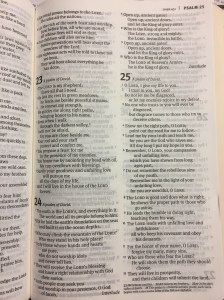
Grandpa looked out into the field for a few minutes as I silently waited. At last he looked toward me and pensively said, “I suppose the most important thing in life is this: everything you need to know is in The Book. You can know a lot of other things, but everything you NEED to know is in The Book. Study it.”

Grandpa Linzey went to heaven in 1987, about four months before his one-hundredth birthday anniversary. And I continue to study The Book.

Today let’s talk about a New Years’ Plan. You could call it a resolution, but I call it: developing a relationship with the Lord. Warning: this might change your life – for the better! And I know that the New Year celebration was a month ago, but that’s okay. What I’m about to say is still true.

Many folk have their own ideas about how to study the Bible, and I have developed my own. I have read many methods, but in order to make it easy to remember, I keep my method simple. It entails three steps, and it goes like this.

  1. What do the words on the page say?

When I was in high school, my father said, “If something in the Bible doesn’t seem to make sense, study it out. Don’t stop until you understand it.” He then referred me to 2 Timothy 2:15 which became my commission in life. “Study to shew thyself approved unto God, a workman that needeth not to be ashamed, rightly dividing the word of truth” (KJV).

It simply means: Study the Bible. You start by reading it. Be sincere. Be diligent. Don’t quit. Don’t embarrass yourself or insult God by being sloppy or half-hearted. Ask for help when you need it.

So I have set aside a time during which I can study without too much interference, and during which time I can concentrate on the topic at hand. For me, this is usually between 9 p.m. and 2 a.m. I read the section of Scripture under consideration, but I also read enough before and after to get a grasp of the context. Without evaluating the context, we can misunderstand the content which can cloud our comprehension of the intent. We could even miss the entire message!

2. What did the writers mean when they wrote it?

Since the original manuscripts that we have were written between 1500 BC and ad 95 AD, many figures of speech, idioms, idiomatic phrases, concepts, and historical knowledge have been forgotten or misunderstood. Also, some of the words and phrases the translators used may not always currently convey the proper meaning. Therefore, in order to understand or “rightly divide” Scripture, we must often study language, history, archeology, or ancient Middle-Eastern culture. This is sometimes difficult and time-consuming, but without this step we can miss what God wants us to know.

Don’t get scared, now. Since most people have neither the time nor the resources to conduct an in-depth study of this nature, the Lord has set in place pastors, teachers, and evangelists to help (Ephesians 4:11–14).

3. How do I apply the principles to my life today?

This is sometimes the hardest part because applying scriptural principles to our lives entails honesty and integrity. We might have to change our way of living. In order to develop a closer, more dynamic relationship with God, we must give up things, activities, or ideas that are offensive to Christ or consume too much of our time. In order to do that, we must reevaluate our priorities in life. Will we continue to live a hedonistic, self-centered life, or will we change our way of thinking (Romans 12:2)? Specifically, we need to become Christ-centered. We must understand that our ultimate purpose in life is to know our Father God, and to honor him.

Now, having said all the above, please remember this:

It is not necessary to be a Bible scholar in order to change your life and honor the Lord. Salvation is received through a relationship with Jesus Christ, the Messiah, by accepting him into your life. Learn to know him by reading the Bible, regularly attending church meetings, attending Bible study sessions, or all three.

My prayer is that you grow in your relationship with Jesus Christ: and we start with the Bible.

Is the Majority Always Right?

That’s a serious question and needs to be answered. But it’s also a dangerous question, because a conniving leader could undermine our social order. Remember, our society consists not only of various levels of government. It includes families, social clubs, churches, and businesses; and to a large extent, our society is based on the “majority rule” principle. That’s what local and national elections are all about.

Before we proceed, please understand I am not advocating a rejection of elections, majority-rule in Congress, congregational government in local churches, and so forth. In any scenario, the first result could be the rise of a dictator, and that is abhorrent. But also understand this: even with majority rule in place, we can still have a dictator, anarchy, or chaos when we elect people who have no fear or reverence for God into office. (Think that one through.)

How can that be? I’m glad you asked. Let’s look at a couple of stories in the Bible. We’ll start with Exodus 32:1-6. Moses was on the mountain getting the rules for living (Ten Commandments) from God. But the majority of the people wanted a god they could see, so they chose a common god of the middle east: a young bull (“golden calf”) to worship. Even Aaron the high priest – Moses’ brother – cooperated with them. But the majority was wrong. In this case, majority-rule was disastrous.

Look at Numbers 13. The Israelites had left Egypt, spent two years hearing from God and getting their society established. They were at the border of the Promised Land, and “home” was in sight. God – who created the world and all that is in it, so He has the right to do what He wants – told Moses to send twelve men across the river to get information.

All 12 gave a good report about the weather, the fertility of the soil (they even brought back figs, pomegranates, and a huge cluster of grapes), the availability of forests for lumber, etc. But 10 of them (83.4 percent) said they should not go into the land, while Joshua and Caleb (16.6 percent) gave the correct report.

The masses agreed with the majority, and God issued judgment: all those over the age of twenty at that time would never enter the Promised Land. All except for Joshua and Caleb, because they agreed with God. The ungodly majority ruled, and they reaped disaster.

However, Proverbs 11:14 says, “Without wise leadership, a nation falls; there is safety in having many advisers.” So what should we do?

We must have wise leadership; but we – the people – must be knowledgeable enough to 1) know who is wise, 2) be courageous enough to elect them, and 3) be wise enough to follow them. How do we gain that wisdom?

Proverbs 9:10 says “The fear and reverence of the Lord is the foundation of all wisdom. Knowledge of the Holy One results in good judgment.” That is beautifully self-explanatory.

Proverbs 11:10a says, “When the righteous [Godly people] do well, the city [society] rejoices [prospers].” Proverbs 29:2 says, “When the righteous [Godly people] are in authority, the people [society] rejoice; but when the wicked [ungodly people] are in power, the people groan [suffer].”

We have seen a lot of that in our nation’s history.

Therefore, since the “majority-rule” concept often gets us into trouble, we should be looking in a different direction. Where should we be looking? Some of you readers may get bothered with me, but the answer is found in the Bible. We should be looking for wise people to lead us.

One man exclaimed, “I am not looking for a Christian to lead me; I want a good politician!” His friend standing nearby mockingly said, “Isn’t ‘good politician’ an oxymoron?” I laughed and said, “I know some good politicians. They are people of high integrity and who cannot be swayed by money, sex, fame, or power. Most of them are Godly folk who pray about their own life, and about pending decisions. But I also know some non-Christian politicians of high integrity.”

We need to understand that the majority is not always right. Therefore, like Joshua and Caleb, we should not be swayed by the opinion of the masses; rather we should study Scripture, pray about decisions, and base our lives on what is right in God’s sight – even if we must stand alone.

But remember: God will be standing with us.

Keep this with you, and read it several times before you vote.

Optimist, Pessimist, or…?

“Hey, dad; I learned something new at school today.” I was happy and wanted to share this new bit of wisdom with my dad. I was twelve years old, in 7th grade, and feeling big.

“Okay, I am sitting down. Enlighten me with this earth-shaking news.” We both laughed.

“An optimist looks one way before crossing a one-way street; but the pessimist looks both ways.” I was proud of myself because I remembered every word of it.

But dad sat there for a few seconds, then popped my bubble when he said, “Maybe the guy who looked both ways before crossing a one-way street wasn’t a pessimist. Maybe he was a realist.”

I felt badly because I didn’t impress dad the way I was hoping to; but in his wisdom, dad broadened my outlook on life – again – for which I am thankful. Dad always did his best to help me view life with a deeper, more complete understanding. He was a great dad, and a wise man.

By the way, pessimist comes from “pessimisme” which means “worst”, and could have originally meant “bottom-most”. But optimist comes from “optimisme” which means “the good” with an alternate meaning of “seeing the greatest good”.

Well, I learned something else today about optimists and pessimists. Since dad graduated to heaven 10 years ago, I can’t tell him about it. But I can tell you folk. (I can imagine dad in heaven saying, “Okay; enlighten your readers with this earth-shaking news.”)

This axiom was possibly stated by Winston Churchill. “A pessimist sees the difficulty in every opportunity; an optimist sees the opportunity in every difficulty.”

If you read it again and ponder on it, you’ll see the inherent wisdom. Optimism is the reason some people accomplish so much amid ongoing hardship, while others achieve so little even with no resistance. Yes, I know: you might say the poor achiever may not be a pessimist, but a lazy or a non-motivated person. You have a point there, so that would be two more reasons some people accomplish so little.

The story is told of a rancher taking his twin nephews to the barn. Jerry was a pessimist and his twin, Jack, was an optimist. When the uncle opened the first door, he said, “Jerry, I am giving you a horse.” Jerry looked at the horse standing there, saddled and ready to ride, but said, “Oh no!” then sat down – dejected.

“What’s the matter?” His uncle asked. The boy said, “If you give me a horse, I’ll have to clean out the stall!”

The uncle shrugged his shoulders and motioned for Jack to open the second door. Upon opening it, all Jack saw was a pile of horse manure. “Oh Boy!” shouted Jack, and he grabbed a shovel and started digging a pathway to go inside.

His uncle asked, “Jack, what are you doing?” The optimistic twin shouted, “With this much horse manure, there’s just GOT to be a horse in there somewhere!”

Please don’t misunderstand me. I am not putting down pessimists, for they help optimists through life. When people like me see the opportunities in the difficulties, the pessimists point out the potential land-mines which we need to avoid. And, of course, we optimists help the others to realize that some of those potential mines are not armed, and work should proceed. If we purposely work together without deriding each other, both pessimist and optimist can be a productive team.  

But I think Dad’s idea of the realist presents a balanced viewpoint. One definition says “a realist looks at things as they are and deals with them in a practical manner.”

Thinking I was either an optimist or realist, I took an online quiz to see what that shrewd computer program thinks I am. The computer surprised me with: “You are a gentle pragmatist.” Thank you, intelligent computer.

A definition of a pragmatist is: “One who has a reasonable and logical way of doing things, or practical way of handling problems; a realist.”

We need both optimists and pessimists; but both should be realistic about life, for that’s where the rubber meets the road. We shouldn’t ignore the difficulties in life, but neither should we see them as stumbling blocks.

Whether you are an optimist or pessimist, be a team player – a realist – and your organization will be blessed. Ecclesiastes 9:10a instructs us, “Whatever work you do, do your best.”

How’s Your Drag Set?

In the late 1990s, Carol and I were visiting her mother and step-dad in Pagosa Springs, Colorado where they owned a cabin on Pagosa Lake. Charles and I had become life-long friends and we enjoy fishing together. (My mother-in-law has since graduated to heaven, and the cabin was sold.)

“You want to go fishing out on the lake?” Charles asked.

“Sure, I suppose so; but we always catch our limit of Rainbow trout from your dock. Why fish from a boat?”

Charles’ neighbor, Frank, had a trolling boat and took Charles fishing in it somewhat often. The limit from the boat was still the same, but Charles said they catch bigger ones out on the water.

Within the hour, the boat was ready, we had our poles, tackle-boxes, bait, nets, and Coca Cola, and we headed out for an adventure.

Frank told me, “Throw your line out in back of us.” I had a new pole called an “Ugly Stick” with a Shakespeare reel, and the yellow and green Rooster Lure flew about 100 feet. Frank’s next order was, “Now, just hold the pole perpendicular to the direction of your line and wait for the trout to visit you. When he hits, don’t point the pole in the trout’s direction; keep it pointed 90 degrees from him. Just reel him in steadily and let the flexing pole do the work.”

We were trolling slowly, and within three minutes I felt a tremendous yank and my pole doubled over. But just as quickly, it popped back straight.

Frank had fished Pagosa Lake for many years and caught his limit every time. He said, “I know what’s out here, and the way your pole bent over, that was a 20-incher. Reel in your line.” When I found the end of the line, the lure was gone.
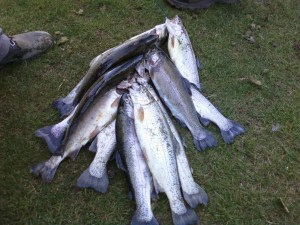
“That critter broke your line.” Frank exclaimed. “How’s your drag set?”

I asked, “What’s drag?”

Perplexed, Frank asked, “You’ve fished northern New Mexico for ten years, and you don’t know what drag is?”

“No, but I always catch fish.”

Frank and Charles started laughing. No they weren’t mocking me; they just thought it was funny that a man in his 50s could fish for years and never know what drag was. I began laughing, too, and handed my Ugly Stick with a Shakespeare reel to Frank.

The drag is actually an apparatus made from a pair of friction plates inside the reel. The tension has to be set to release quickly to keep the line from snapping when the big ones yank on it. Then as we reel the critter in and the fish puts up too much of a squabble, the friction is overcome, allowing the reel to rotate backwards just enough to keep the line from breaking.

Frank explained drag, and showed me how to set it. He then set it for the trout we were after and said, “You’ll need to adjust it for stream-fishing back home.”

We proceeded to fish for an hour, and each of us and several friends caught our limit of three Rainbow trout. The two 17-inchers I caught put up a fuss and took a minute or two to bring in. And yes, the drag function worked properly. But an 18-incher put up a fight! Taking almost three minutes to reel it in, I was grateful that Frank set the tension for me. Back at the cabin, Carol cooked the big one like a salmon, and it was GOOD! The left-overs were made into trout-fish sandwiches which tasted much better than tuna-fish.

By the way, the little ones – eight to thirteen inchers – don’t pull hard enough to break the line, and I have never reset the drag.

Reminiscing on that recently reminded me of everyday life. Do you find that the pressures of life are too much, and you feel like snapping? Do you feel like giving up? How’s your emotional drag set?

Don’t trust your own wisdom, for you’ll be disappointed.  And don’t give up because help is just a prayer away. So trust in the Lord with your entire life. In everything you do, acknowledge the Lord, and He will guide you (Pro. 3:5-6). You are secure in God’s hands because He will help you set your emotional drag.

Ability versus Availability

In mid-June several years ago, Carol and I were returning home after visiting Jeremy (our son) and his family in Perkins, Oklahoma. We were on highway 33 about halfway between Perkins and Tulsa when I suddenly stopped the car and turned around. Carol asked, “What are you doing?”

Pulling onto the shoulder on the north side of the road, I said, “Look.”

Carol incredulously exclaimed, “Oh no, a fire!”

I was already calling 9-1-1. When the operator asked about my specific location, I said, “I am on Oklahoma highway 33, east of the intersection of highway 48; but I don’t know how far.”

The operator said, “No problem: we’ve got you pegged. Stay there; a truck will be on the way.”

When Carol asked how they knew where we were, I said, “GPS on my cell phone.” (That’s another story.)

Fires generate their own weather-patterns and can produce fierce winds. That becomes a major factor in the growth of wild fires, and is why they need to be spotted and put out early. In the past several years, fires had ravaged that portion of the state.

It was after 10:00 pm, dark, and we had nothing with which to douse the fire; so we were merely a landmark, waiting for someone who could extinguish the growing blaze. About six minutes later, a fire-truck pulled up in back of us. The driver said, “Thank you for calling it in, and thank you for waiting for us. You are free to go now.” That was a hint to get out of his way.

Carol and I didn’t have the ability to quench the fire, but we were available to contact those who could do the job.

Ability versus availability.

Another time, in the summer in 1976 in the heat of the day, Carol, the kids, and I were heading south on Arizona highway 89. We were almost to the little town of Congress when we saw a small brushfire beside the road. We surmised that the fire was caused by a foolish person throwing a cigarette out the window. It was hot, and a lot of dried vegetation (fuel for the fire) covered the country-side.

Cell phones were not invented until the mid-1980s, and I didn’t have one until the mid-90s. With no way to call for help, 6-year-old Ron, 4-year-old Jeremy, and I used a cardboard box, dirt, and our 5-gallon container of water to extinguish the small-but-growing blaze. In that situation, we were available and had the ability to complete the task.

What is the common denominator in those two events? Availability.

Without our presence and alertness in each of those situations, both fires might have caused great physical damage and possible bodily harm.

No, I’m not bragging; merely explaining the concept of availability. The idea is: no matter what you know or what you think you know, your knowledge cannot benefit anyone unless you are available to apply it.

“Available” means: Present and ready for use; at hand; accessible.

What about you? Are you available to mankind and to God? Although an unlikely candidate, Abraham Lincoln was available. God, Himself, doesn’t need our skills and abilities, but He does give us the privilege of exercising our gifts and abilities—what He gave us or enabled us to learn—to fulfill our portion of His plan: thus, growing His kingdom and helping mankind. You may be a computer technician, auto mechanic, writer, pastor, secretary, lawyer, politician, policeman, or fireman. Whatever your vocation, God calls each of us to work as though He (God) is our supervisor. He then helps us to be alert to situations, such as the fires, and directs us as to our part in putting them out.

Psalm 147:10-11 says, “His pleasure is not in strong horses, nor his delight in brave soldiers; but he takes pleasure in those who honor him, in those who trust in his constant love” (GNT).

The psalmist tells us that God does not rejoice in our strength and ability, but He finds pleasure in our attitude. Are we available to Him and mankind, or are we stuck on our own desires? It is our attitude that determines whether or not we are available.

I am not inferring that you need to accept every offer that comes your way. You need to pray about all that. But we can take a hint from Jesus’ parable of The Good Samaritan. Are you available to help? Are you available to put out various “fires” (physical, emotional, relational, etc.) that you encounter?

Pray about it. It is great to be part of God’s team.