
This year, 2019, Passover begins at sunset on April 19, and ends at sunset on the 27th.
I know most calendars mention Easter but I prefer to call the event by the correct historical term: Pascha, derived from Pesach: which is Passover.
The eight-day festival is a celebration which dates back roughly to 1450 BC when the Israelites were set free in Egypt and left in that famous mass-exodus. And by following the customs or traditions of Passover, the Jewish church has the ability to relive and experience the freedom that their ancestors gained.
But as you read through Scripture, you find that the Passover, in which innocent lambs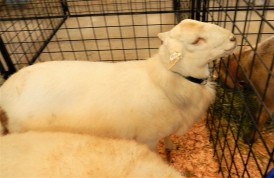 were sacrificed, foreshadowed the crucifixion of Jesus; for Jesus, the Christ, was ultimately the true innocent Passover Lamb – not just for one nation, but for the world. Let’s briefly recap the history that led to the Passover Celebration.
Ten of Jacob’s sons were jealous of young Joseph because Jacob had given Joseph the coat of many colors – the robe of authority denoting family leadership. Eight of the brothers sold Joseph to a trade caravan and Joseph was taken to Egypt.
Rising in authority in Potiphar’s household, he was falsely accused of attempted rape and sent to prison – probably under Potiphar’s jurisdiction. Joseph interpreted dreams and was taken to the reigning Pharaoh – probably of the Hyksos people who were not native to Africa.
After Joseph died, the native Africans (probably Cushites and Nubians) defeated the Hyksos and regained control of Egypt. But because the descendants of Jacob ethnically resembled the Hyksos, the Egyptians thought the Israelites would rise up and fight for the Hyksos. Therefore, the “Pharaoh who knew not Joseph” ordered them enslaved.
Eventually, Moses was born, placed in the Nile, rescued by Pharaoh’s daughter, and raised in the Egyptian court. He was schooled in every phase of Egyptian aristocracy, could speak several languages, and traveled throughout the kingdom.
However, although becoming a general in the Egyptian army, Moses never forgot his roots and killed an Egyptian task-master who was brutalizing an Israeli. But killing an Egyptian officer without the Pharaoh’s permission was a capital offence – even for the esteemed Moses – and he fled for his life.
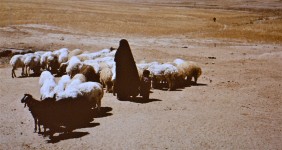 Deprived of his royal background, he became a lowly shepherd for forty years; but God never abandoned Moses, and commissioned him to return to Egypt to be the human element in setting the Israelis free.
It was understandable why the Pharaoh refused to free his subjects: by now, economics prevailed. So God began to apply leverage to force Pharaoh’s hand. The last straw was the tenth plague. God set the day when this would take place.
God gave Moses specific instructions about how to prepare the last meal in Egypt, for each item and its preparatory procedure would reflect, in some way or other, on the death of the final Sacrificial Lamb. So Moses gave the order to put blood on three places outside the door, and eat the meal with their traveling clothes on. After the meal, they would head out.
The tenth plague that Egypt experienced was death of the first-born male. Cows, mules, and horses also suffered this fate. The term passover derives from pesach which essentially means to pass over something; and in the Land of Egypt, the death angel passed over the houses which had the blood applied to the doorposts. The people who were covered with the blood of the lamb were spared.
Pharaoh’s son died, so Pharaoh finally submitted to Moses, allowing Moses to lead the people out of bondage and into freedom. (Many tumultuous years were in store for the Israelis, but that’s another story.)
In Israeli history, Moses became their servant-ruler, which reflects on our Savior, our Redeemer.
The Temple Sacrifice was instituted to reveal the severity of sin (disobeying God), and also pointed to the final Sacrifice – Jesus, the Messiah.
But there is a significant difference between the traditional sacrificial lambs and our final Sacrificial Lamb. Where the yearly lamb died to gain forgiveness of sin for a year, Jesus died and raised from the dead to grant us forgiveness forever, and inherit eternal life.
![dscn0185[1]](https://genelinzey.com/wp-content/uploads/2019/03/dscn01851.jpg?w=178&h=194) Passover is a picture of the sinless Lamb of God – Jesus – Who suffered the penalty of sin for us (death), raised Himself back to life, and set us free. All we need to do is to accept Jesus into our lives, ask Him to forgive us for our self-centered lifestyle, then purposely live for Him. We will be covered with the blood of the Lamb and forgiven.
Passover is a picture of the sinless Lamb of God – Jesus – Who suffered the penalty of sin for us (death), raised Himself back to life, and set us free. All we need to do is to accept Jesus into our lives, ask Him to forgive us for our self-centered lifestyle, then purposely live for Him. We will be covered with the blood of the Lamb and forgiven.
Passover points to Calvary.
Next time we’ll get a glimpse of happened during that famous Passover Week leading to Jesus crucifixion.
 In 2014 we were in Southern California visiting my Aunt Betty and the family as we celebrated her 91st birthday anniversary. We had an enjoyable time interacting with cousins whom we seldom see.
 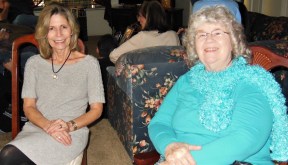 views of Linzey family history. It was a full-house, and I enjoyed interacting with all the cousins. You know how it is at family reunions: since we don’t get together very often, we all try to catch-up on the latest. I even got many of their phone numbers on my cell phone. (Alas: the phone hiccupped and I lost most of them. I’ll eventually get them all back.) The cake was outstanding: beautiful, as well as tasty! The 91st birthday party was a wonderful event.
  The mystery was growing until several of us looked outside, and VOILÀ! The power in the entire neighborhood was out. Taking it in good humor, Aunt Betty said, “Oh that happens whenever someone around here has a party. It was our turn this time.”
  overshadow, or drown out our emptiness and hurt; or we can reach for the true source of light: Jesus Christ, the Light of the world (John 8:12). This light, Jesus, can expel all darkness and restore power and life if we turn to Him. Jesus said, “I’ll never leave you nor forsake you. (Hebrews 13:5)” There is still life when the power goes out; so share God’s light and life with others who are in the dark.
  I remember Valentine’s Day in 1965. Valentine’s Day was on Sunday that year, and Carol and I were attending SCC (Southern California College: now VUSC – Vanguard University of Southern California). I remember thinking: “If Carol accepts my invitation to the Valentine Banquet, I’ll know that she is the girl I will marry.” So, nervously, I asked her.
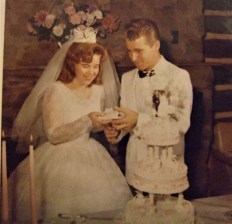 decide whom to marry, but we DID get married a year and a half later — August 22, 1966 — and 52+ years later, we are still in love.
  Carol explains it this way: “Marriage is made in heaven. But it comes in a kit that must be assembled here on earth.” She also says, “Marriage is like a pyramid: God is at the top, with husband and wife at the bottom corners. When husband and wife focus on each other, they tend to repel each other. But if they both focus on God and grow toward Him, they inevitably grow closer together. And growing toward God helps us to become more like Him. Therefore, we find ourselves loving each other more with the pure love of God. That’s why God should be at the center of every marriage.”
 Before 2000 BC (in Abraham’s time), the Babylonian New Year began at the first visible crescent of the New Moon after the Vernal Equinox, and could be the origination of the worship of Allah – the moon god. The moon had many names; the more popular being Nanna, Nannar, Asimbabbar, and Suen. (Suen evolved to Sin, and both are pronounced Seen.) The Babylonian New Year celebration lasted for eleven days, and our modern New Year’s Eve festivities pale in comparison to theirs.
  They celebrated their god of wine and drunkenness, Dionysus, by parading a baby in a basket. The baby represented the annual rebirth of Dionysus who was also the god of fertility. And, of course, public moral debauchery was part of the festivities.
 God’s guidance in making plans. Proverbs 3:5-6 (NCV) says, “Trust in the Lord with your whole life … He will direct your decisions.” The second is to rely upon God for the courage and integrity to fulfill His plans. Don’t get side-tracked. Psalm 111:10 (NLT) says “[Sincere] Reverence for the Lord is the foundation of true wisdom.” And we need wisdom to succeed in doing what is right.
 indicated a royal birth (Psalm 19:1), a delegation (minimum of three) was sent to acknowledge that royal event; timing their arrival when the child would be six months to a year old (Matthew 2:11). For safety purposes, the royal delegation traveled with a large trade caravan, and there could have been five to ten Persian scholars or Magi who visited Jesus’ family at the house. The reason our tradition mentions three is because of the three gifts they brought: gold, frankincense, and myrrh.
 Gene Linzey