The Disappearing Light Beam

I’m sure many of you have seen a cat chase things. Butterflies, moths, mice, strings, almost anything that is small that moves. Kittens and cats do that, and I call that one of the many “cat antics.”

Our daughter had my laser pointer and was playing with her cat – Tiggy. Tig was in her 4-wheel-drive mode with all claws extended to get traction so she could make split-second turns on the carpet. Rebecca finally allowed Tig to “catch” the light beam. But you should have seen the perplexed look on the cat’s face when she lifted her paw only to find that the “bug” had escaped. After looking around for a minute, she walked away.

But our dog, Tyke, had been watching. He knew better than to interrupt the cat because Tig was older and had seniority in the family. Rebecca gave me the laser pointer because I had a different plan.

I put Tyke through the same maneuvers as Rebecca put Tiggy, but with Tyke’s size and slower reactions, I went slower. The dog tired out quicker than the cat and Tyke finally just laid down on the carpet. That’s when I employed my second thought.

I moved the light beam slowly just out of Tyke’s reach as the critter watched. I gave jerky movements with the light and Tyke’s head jerked each time. Then I did it. I ran the beam up and touched his paw.

You should have seen it! Tyke yelped and jumped off that carpet as though a big rock dropped on his foot. Then he looked at me, back at the light beam, slowly went up to sniff it, but I turned it off before he got to it. He looked back at me, then, using his natural sniffer, tried to find it. He never did.

Tiggy’s and Tyke’s perceptions were that the light beam was a solid object, and they reacted according to their perception of reality. Do you know that people do the same thing?

Years ago, I read of a professional basketball player who playfully pointed his gun at a friend. Sincerely believing the gun was not loaded, he acted on his perception of reality and pulled the trigger. When the resounding explosion subsided and the smoke cleared, his friend was dead.

Perceptions can be beneficial, a diversion, or a devastating error, and we must always get a reality check before we make a decision. I understand it’s quite difficult to give Tiggy and Tyke a reality check, but we can help people. Let’s look at two concepts.

Financial security. There’s nothing wrong with gaining financial stability. We are wise to plan for the future, including for retirement. But throughout history, money has disappeared like that light under my pine tree. Stock markets around the world have crashed. Expenses due to sickness have soaked up saving accounts. Casinos have gladly emptied people’s bank accounts. You can think up many other scenarios.

Millions of entrepreneurs have created companies that have given financial blessings to countless millions of people around the world. A great many business owners became prosperous and retired with an abundance of wealth. But many businesses fail. The average failure rate is 20% within the first year, and up to 50% within five years. Like the light the critters chased, businesses disappear.

Tree branches. I cut several branches off the trees in our back yard. When the grand kids saw them two weeks later, the younger one exclaimed, “Grandpa, the branches are still alive. We could plant them and make some new trees.” I explained that the needles on pine tree branches will stay green for almost a month after it was cut off the tree. The branches look alive, but they’re really dead. Appearances are deceiving.

Financial security and business ownership are wonderful, and grants freedom from worry.

But when our blessings disappear, when our securities vanish, when our health turns sour, when our lives become unstable, when a lot of what we perceive to be real dissipates, what should we do?

For those of us who have a dynamic relationship with God and have been trusting Him for our REAL security, the disappearing lights are disappointments but are not personally destructive. Our faith is not in temporal things that can vanish, but in Jesus Christ. In Hebrews 13:5, Jesus is quoted as saying, “I will never leave you nor forsake you.”

And He won’t. Therefore, get to know Jesus and put your trust and your faith in Him. He is no disappearing light beam. He is Alive!

Rocky Mountain National Park

Have you ever seen the Rocky Mountains? No, I don’t mean in a picture, on television, in the theater, or on IMAX. Have you ever driven through the Great Rocky Mountains? Perhaps many of you have driven through a portion of them, but did you observe the grandeur of these magnificent granite formations?

Carol and I visited the Rocky Mountain National Park, just after viewing the total solar eclipse in Glendo, Wyoming, as we celebrated our 51st wedding anniversary. It was a spectacular trip. The word “spectacular” is the keynote for this trip.

The Rocky Mountains, commonly called the Rockies, start in northern British Columbia, Canada, and extend about 3,000 miles south to New Mexico, USA. Several facts about the spectacular Rocky Mountain features are: 1) the Sangre de Christo Mountains run from New Mexico through Colorado; 2) the Rio Grande has its headwaters near Wolf Creek in Southern Colorado; 3) Pikes Peak is near Colorado Springs and Manitou Springs; 4) the Grand Tetons and Big Horn Mountains are located in Wyoming; 5) Branff National Park is in Alberta, Canada; and there are many more! This mountain range should not be confused with the Pacific Coast Ranges, the Cascade Range, or the Sierra Nevadas.

Some geologists say the Rockies are well over 55 million years old on a 4.54 billion-year-old earth; some say they were created about 6,000 years ago when the earth was created; and others say the Rockies were created just after the great flood about 4,500 years ago. But whatever age is ascribed to them (only God knows their true age), my Precious and I had a great trip.

The original Native American Cree name was probably “as-sin-wati”; loosely translated as “seen across plains, look like rocky mass.” But their present name was given by Frenchman Jacque Legardeur de Saint-Pierre in 1752 when he called them “les Montagnes de Roches” (pronounced: lay Montanye de Rosh) – or, the mountains of rocks. And that evolved into the Rocky Mountains. Seventy-four peaks in the Rocky Mountain National Park (RMNP) are over 12,000 feet; twenty-three more top out over 13,000 feet; and two peaks are over 14,000 feet (called 14ers). That’s a total of 99 spectacular peaks in only 415 square miles.

This continental ridge is 70 miles wide at its narrowest, and 300 at its greatest span. I read that the lowest elevation of the Rockies is 3,400 feet above sea level where the Arkansas River flows from Colorado into Kansas; but I didn’t know the base of the Rockies reached that far. And the highest point is magnificent Mount Elbert in Colorado at 14,400 feet.

Driving through Boulder, CO, we started our tour through the RMNP in the town of Estes Park, CO. situated at 7,522 feet. The east entrance to the park is on highway 36, only 3.5 miles from town. If you are driving from the south or west, you can take exit 232 on I-70, west of Denver, and drive north on highway 40. Follow the signs.

Hiking is a common activity. Starting at the parking lot near Bear Lake at 9,475 feet altitude, seven lakes are within 4.7 miles walking distance. That is: 4.7 miles – ONE WAY. Save your energy because you probably want to come back. We walked around Bear Lake – only 256 feet away – and back to the car.

We drove down Devil’s Gulch but couldn’t figure why the name because it’s a spectacular drive. The next day, we left Estes Park, drove to I-70, took exit 232, and entered the Park from the other side. Did I say the scenery was spectacular? Well, it WAS!

Going through Idaho Springs, Granby, and Grand Lake, the west entrance was 145 miles from Estes Park and the views were breath-taking. We visited the Alpine Visitor Center and the Trail Ridge Store above the tree line at 11,796 feet and took pictures of a coyote pouncing on an unseen rodent – probably a mountain vole, yellow-bellied marmot, or some other high-altitude critter. Words and pictures cannot adequately describe our emotions and experiences as we saw God’s handiwork in the high Rockies.

This trip caused me to focus more intently on my relationship with Almighty God: the Creator of every natural thing we saw. The song by Stuart Hamblen sums it up: “How big is God, how big and wide his vast domain, to try to tell these lips can only start. He’s big enough to rule the mighty universe, yet small enough to live within my heart.”

If you get the opportunity, I encourage you to visit the Rocky Mountain National Park. And you can call them les Montagnes de Roches if you prefer.

Happy Traveling.

Lesson from the Flock: Wisdom

Chickens are curious creatures: they want to get into everything, fly over anything their limited flight ability will allow, and go where no chicken has gone before. But while they will run from a person who is trying to catch them, and run from another animal coming at them, their little minds cannot understand the inherent danger involved in leaving the protection established by their keeper.

The birds in our flock cluck their way around the yard as they scratch for bugs, hop onto the trailer, crawl under the BBQ grill, and fly up to look into our windows. But what got my attention was when I found three hens sitting atop the gate of our chain-link fence. Obviously, their wings are getting stronger. (This took place a week before we were given Elona – the fourth pullet.)

“You might need to clip their wings” Carol prophetically intoned. I shouldn’t have been surprised the next day when I went out to feed them, but found only Fred – the rooster.

Oh, I forgot to mention the names of the pullets. The bird with thin white feathers along her neck is Whitey. The one with a dark red neck on top a lighter colored body is Red-Head. The even-colored bird is Goldie. And, as I said, the rooster is Fred. (Don’t ask – I don’t know why.)

As I said, the three girls were gone. Carol reminded me that, when I found them, not to attempt to chase them back into the yard because with their non-rational reactions they will scatter like cockroaches – creating a ruckus in the process.

I found them in the neighbor’s front yard and called them. Getting their attention, I dropped grain – which they dearly love – behind me as I walked toward the gate. Carol was right. When they saw the grain falling from my hand, they ran to me and willingly gobbled the grain as they followed me home. The situation reminded me of the Pied Piper, but my motives were good.

The four birds have a quarter-acre to roam, eat, run, fly, scratch, lay eggs, fuss with each other, eat more, cluck to their heart’s content, and enjoy life. So why do they spend an inordinate amount of time at the gate looking out? Within the yard, they have all they will ever need. They are safe from all kinds of predators … and cars. Yet with their half-inch-long brain, there is no way they can understand the dangers outside the fold. Neither safety nor danger enters their little minds, so they roam wherever they feel like it at the moment.

Surprisingly, I know some people who act in the same irresponsible manner – and they have a three-pound brain. So, the problem doesn’t lie in the size of our brain, or even with the ability to rationalize; but with wisdom and understanding.

Wisdom can be defined in many ways. One definition is: the soundness of an action or decision with regard to the application of experience and knowledge. Another definition is: the ability to apply what I have learned to life’s situations. Some folk say wisdom is common sense. Properly understood, I agree.

But wisdom depends on something else. Proverbs 9:10 (KJV) says, “The fear of the LORD is the beginning of wisdom: and the knowledge of the holy is understanding.” The NCV says, “Wisdom begins with respect for the Lord, and understanding begins with knowing the Holy One.”

As the space shuttle needs a base from which to launch, and as a building needs a solid footing, wisdom needs a firm foundation. So Proverbs 9:10 informs us that knowing, respecting, revering, and obeying God is the foundation upon which wisdom is built. The emphasis is on obedience. Sacrifice was the highest form of worship in the Old Testament, but I Samuel 15:22 tells us that obedience is far better than sacrifice.

God gave humans our three-pound brain to operate our bodies. Within that brain, our mind thinks, analyzes, and ponders; but wisdom goes beyond that.

Wisdom enables us to see through problematic situations; to understand and heal wounded relationships; to formulate a plan of action. Wisdom enables us to avoid hurting others and helps us to understand and love more completely. Wisdom enables us to accomplish our God-given goals. Wisdom helps us to understand Who God, what He desires of us, and to obey Him. As we remain obedient to the Lord, He grants us wisdom to understand and enjoy life.
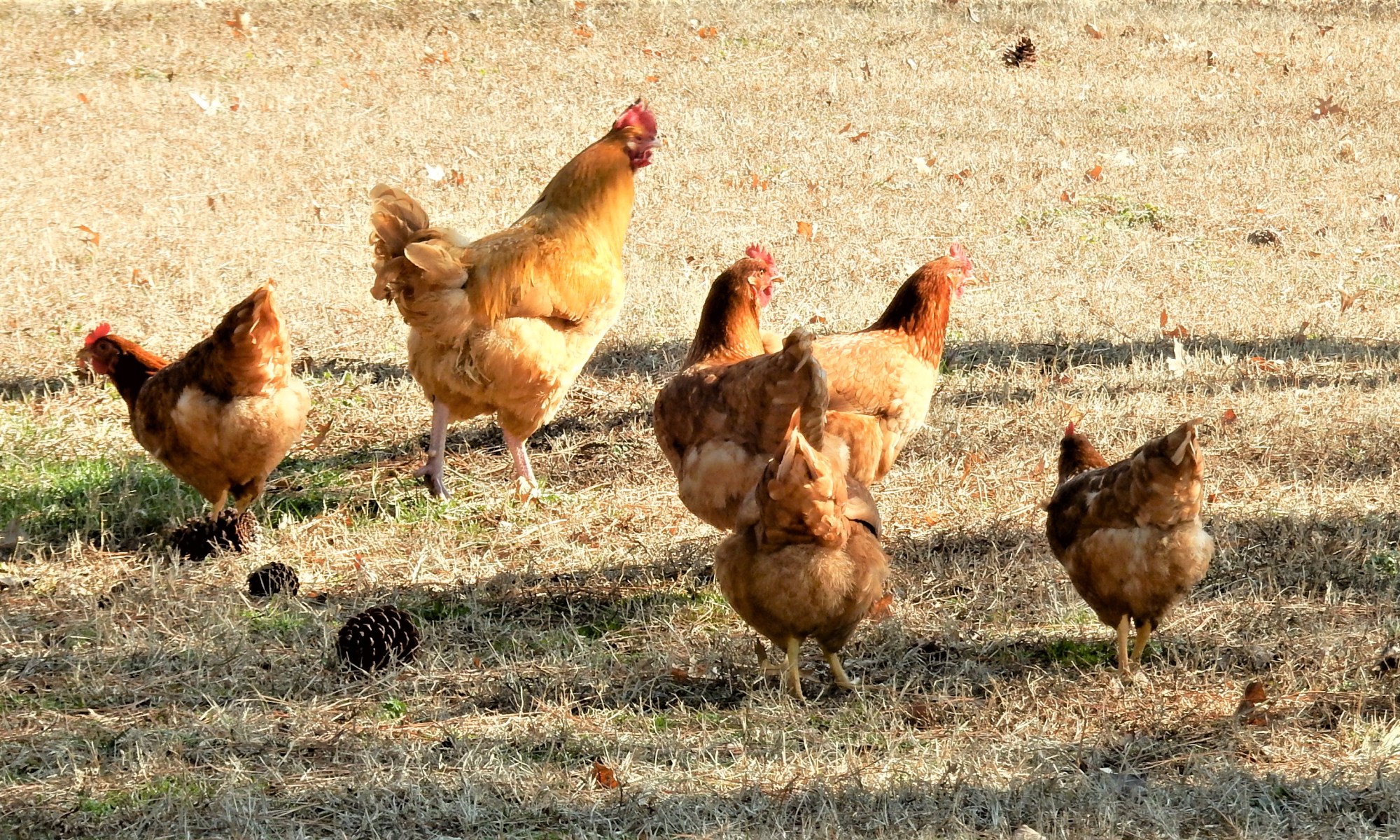
The chickens finally learned to stay home. In like manner, we need stay close to God.

Lessons from the Flock – Vision

“You’re a bird-brain!”

Did you ever hear that? It’s a derogatory statement and meant to degrade someone. But I identify with it because I am learning a lot from my fowl friends – my five chickens.

I’ve noticed that the birds often gather at the fence and look in the direction of the kitchen window. When I move around in the room, their heads follow my movements and they seem to be waiting for me to come out. But when they are standing in bright daylight, how can they see me through a window in a room with subdued lighting?
It was research time.

Of the many documents on the internet, I found an article by Cynthia Berger published on July 19, 2012 titled “True Colors: How Birds See the World.” That was an eye-opener. Using a device called a spectrophotometer (it measures light that is reflected from a surface), researchers found colors in the UV range that most birds can see.

Quoting from her second paragraph, “…systematic testing of bird vision revealed something unexpected: many bird species can see UV light. Scientists also have learned that many birds have plumage that reflects UV light.”

I had never thought about chickens being able to see differently from humans. Oh, I know chickens have enhanced hearing and smelling, but enhanced sight? Amazing.

I’ve always wondered how a bird can distinguish a male from a female, but now I know. Both males and females of barn swallows, mockingbirds, western meadowlarks (and many others) look remarkably alike to humans. But viewing them through the spectrophotometer we find they look totally different from each other. They, of course, have the same shape but different coloring. Another example: To humans, the blue tit male looks identical to the female. But looking at the UV reflection, we find a bright spot on the males’ head. The female spots that immediately and says “That’s my man!”

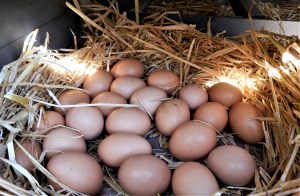
Female birds know which eggs are hers because various eggs reflect UV light differently. Choosing to raise her own offspring, some females either break or eject foreign eggs from her nest.

Birds will more readily eat food that reflects greater amounts of UV light. That explains another question I had: why do my chickens go for corn more than wheat? Corn reflects more UV. Also, insects reflect a higher amount of UV than green grass. Watch out, moths and bugs; my chickens are loose in the yard and you are doomed!

Speaking of moths, it’s fun to watch a hen run at full speed then half jump and half fly with neck fully extended to grab a moth or other flying insect out the air.

But all that helps to explain why the birds are at the fence looking in my direction: some of my clothing is reflecting UV light. They see me through the window, and they assume that I’ll bring food out to them. Sorry, chicks. I’ll feed you later.

When I think of birds’ ability to see what humans cannot see, it reminds me of spiritual sight. In Ephesians 1:18, the Apostle Paul said, “I pray that the eyes of your heart may be enlightened, so that you may know the hope to which God has called you, the riches of his glorious inheritance in the saints.”

“Eyes of your heart”? Sounds strange because blood-pumping hearts don’t have eyes. What Paul means is we have inner understanding, insight, the discernment or comprehension of spiritual reality as it pertains to Almighty God, and verified in the Holy Bible. I am not referring to Hinduism, Buddhism, spiritism, spiritualism, other religions, or any New Age idea. I am not talking about mindless concepts that exalt man, nature, familiar spirits, or demons.

An example of a mindless statement – proclaimed to be spiritual insight by Matshona Dhliwayo – is: “The Universe is one body; love is its heartbeat.” Not understanding either the universe or love, Dhliwayo is wrong on both counts.

True spiritual insight comes from God, and enables us to understand real life – both temporal and eternal – from God’s perspective. Second Corinthians 2:16 informs us that we can “have the mind of Christ”; that is, receive His thoughts. This requires us to stop being self-centered, and to become God-centered or Christ-centered.

As birds can see some of what humans cannot see, we can ask God to grant us wisdom and insight which would enable us to understand what we normally cannot “see”. That’s not being a bird-brain; it’s being in tune with God.

Lessons from the Flock: Joy

I could hardly believe my eyes!

Normally when I walk out the back door of the house, the four hens come running to me. They think I’ll have a treat for them, and they are usually correct. So, they run to me, stand as tall as they can, and sometimes jump as they try to get goodies out of my hands. One time I put my open hand down to their level. When they saw the wheat kernels in the palm of my hand, they rushed forward. As they began eating it, I found out what it feels like to be hen-pecked. (No, it didn’t hurt at all.) By the way, chickens have a 300-degree field of vision without turning their heads.

But today as I walked out the back door, I was quieter than usual; and the birds, who were out of sight, didn’t hear me. I stood there for a minute with no visible activity in the yard. I then began to hum a song. No words; I just softly hummed.

Pandemonium erupted in the back yard!

I don’t know how to accurately spell what I heard, so I won’t try. But these birds exploded from behind the 10 x 12 barn! They came half-running and half-flying as fast as I have ever seen a chicken move. With wings spread straight out like a hawk on the attack, the little head making more noise than seemingly possible, the four birds came racing to see what their benefactor had for them.

It amazes me to see the joy the birds express when they know I am near. When they either see or hear me, they stop everything they might be doing and come running. If they even see me through the kitchen window they come running. (In addition to seeing all the colors that humans do, chickens also see ultraviolet – but that’s another story.)

Stop and think about it: theses chickens joyfully interact with me, their loving benefactor. How many Christians do you know who joyfully interact with our loving Benefactor – Almighty God?

Okay, you might say that we cannot see God. Well, most the time our chickens cannot see me either because I am out of sight. But they LOOK for me. Are we “looking” for God?

The birds love me because of what I do for them. On a much higher level, do we love God for what He does for us? We don’t have to look far to see His blessings. In fact, if we don’t see them, we are blind because God’s blessings are so abundant and prevalent.

Sadly, some Christians are oblivious to what God has done for them. But on the other hand, many Christians do see the blessings – but still are not joyful. Why not? Let’s look at two definitions.

One definition of Joyfulness is: the emotion evoked by well-being, success, good fortune, or by the prospect of possessing what one desires. (Actually, that is the definition of happiness which deals with circumstances; but the modern world , including Christians, confuses joy with happiness.)

A definition and application that is more appropriate is: the spontaneous enthusiasm I experience when I am in fellowship with the Lord (Psalm 16:11). If God never did anything else for me, I would be satisfied because 1) my relationship with Him is intact, 2) my eternal future is secure, and 3) I have everything I need to fulfill God’s will for my life.

So, let’s look back at the chickens. Are they joyful or happy? They are a little of both: they get their treats, but they also walk with me as I traipse around the yard. The birds really enjoy being with me.

Dear reader, are you enjoying your relationship with God, your Supreme Benefactor, or are you worried, mired in the “mud” of everyday life? Do you invest time observing and enjoying the blessings God has heaped upon you, or are you immersed in some level of self-pity because things don’t go your way?

If we are purposely doing something – thought, word, or deed – that is contrary to Biblical principles, we will not have the Joy of the Lord. Could that apply to you?

So “Run to the Lord” with your whole heart. Be satisfied with what He gives you. Even while experiencing financial or material loss, God still blesses us. First Timothy 6:6 says, “Godliness with contentment is great gain.”

So, look for God; He is watching you.

Total Solar Eclipse at Glendo

I enjoy reading articles about solar eclipses from others, but today I’ll tell a portion of our own story.

Carol and I were on our 51st wedding anniversary trip and decided to visit our daughter (Darlene) and her family in Colorado, then visit the Rocky Mountain National Park just outside Estes Park, Colorado. But we timed our visit to coincide with the total solar eclipse.

We had seen partial solar eclipses and several total lunar eclipses; but never a total solar eclipse, so we didn’t know what to expect.

Darlene and her son went with us as we drove three and a half hours north of Denver. Arriving at Glendo, Wyoming around 4:30 on Monday morning, we easily found a place to park in an open grassy area, and took a nap in the car. Darlene and I awoke a couple of hours later and walked to the lake in time to take some great sunrise pictures over the water.
It was a warm day with planes flying overhead and hot-air balloons lazily hovering nearby. The count-down for the total eclipse began around 10:22 a.m., and our anticipation grew.

Thousands of people, including professional photographers, had their telescopes and cameras ready. Many were set up on tripods, but most of us simply held cameras in our hands.

I took several pictures with the camera pointing directly at the full sun with no filter, but shot most of the pictures with the solar-viewing lens covering the camera lens. I took a picture every 10 minutes until the eclipse was near 90%, then changed battery and began taking quite a few.

It was light enough to read with only 10% sunlight, but it got dark quickly after that. Then, as someone said: “BAM! Darkness!” And with the sudden darkness, the temperature suddenly dropped, making the hot-air balloons rise.
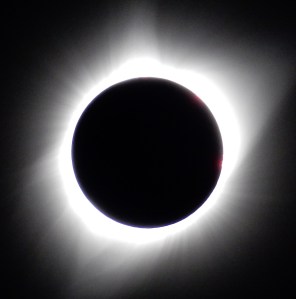
As noon-day brightness turned to night, hundreds of people shouted, cheered, and cried. I didn’t expect the sudden emotion that swept over me. All I could do and say was, “Oooooooooh Wow! God, you are amazing to arrange this kind of phenomena.” I took turns looking at the corona and taking pictures: taking 15 shots of the corona during blackout.

Then, again, “BAM!” The light came back on – but differently.

As the eclipse was increasing, the sunlight was dull-yellow; but the instant the sunlight reappeared, it was a bright, diamond, crystal color! What a surprise! I’ll never forget it. Again, very emotional. Cheering, yelling, crying spontaneously erupted from the crowd.

We didn’t wait for the eclipse to unwind. At about 20%, we packed up and began heading out … but another surprise popped up.

It took only 3.5 hours to drive from Denver and park on the grass at Glendo Park; but it took 4 hours to drive the 3 miles from the grassy spot to I-25. Then it took another 2 hours to drive 26 miles south. That is where we escaped the unending line of red break-lights and headed east for Scotts Bluff, Nebraska. After a snack in Scotts Bluff, we headed south, getting back to Aurora just after midnight; but it was much better than the projected 6:00 a.m. if we stayed on I-25.

As I write this Reflection, I am reviewing the pictures I took. Someone told me that taking a picture directly at the sun without a filter would hurt the camera. I am not bragging, but it didn’t affect my Nikon 9900. My wife also shot the sun directly with her Nikon 9400, and they both continue to work wonderfully.

We are now looking forward to watching the next total solar eclipse in Little Rock in 2024.

God didn’t have to put the moon in such an orbit that we would have lunar and solar eclipses. But He must have thought ahead and said, “I’ll make life interesting for my special creation – man. Not only will I give him animals to make life interesting, I’ll also show my creativity in the heavens for him to enjoy.”

Psalm 19:1-2 says, “The heavens proclaim the glory of God. The skies display his craftsmanship. Day after day they continue to speak; night after night they make him known.”

God is an awesome God. He loves you and desires to have a living relationship with you through Jesus Christ. Read about Him in the Bible. God would like you to spend eternity with Him.

How’s Your Drag Set?

In the late 1990s, Carol and I were visiting her mother and step-dad in Pagosa Springs, Colorado where they owned a cabin on Pagosa Lake. Charles and I had become life-long friends and we enjoy fishing together. (My mother-in-law has since graduated to heaven, and the cabin was sold.)

“You want to go fishing out on the lake?” Charles asked.

“Sure, I suppose so; but we always catch our limit of Rainbow trout from your dock. Why fish from a boat?”

Charles’ neighbor, Frank, had a trolling boat and took Charles fishing in it somewhat often. The limit from the boat was still the same, but Charles said they catch bigger ones out on the water.

Within the hour, the boat was ready, we had our poles, tackle-boxes, bait, nets, and Coca Cola, and we headed out for an adventure.

Frank told me, “Throw your line out in back of us.” I had a new pole called an “Ugly Stick” with a Shakespeare reel, and the yellow and green Rooster Lure flew about 100 feet. Frank’s next order was, “Now, just hold the pole perpendicular to the direction of your line and wait for the trout to visit you. When he hits, don’t point the pole in the trout’s direction; keep it pointed 90 degrees from him. Just reel him in steadily and let the flexing pole do the work.”

We were trolling slowly, and within three minutes I felt a tremendous yank and my pole doubled over. But just as quickly, it popped back straight.

Frank had fished Pagosa Lake for many years and caught his limit every time. He said, “I know what’s out here, and the way your pole bent over, that was a 20-incher. Reel in your line.” When I found the end of the line, the lure was gone.
“That critter broke your line.” Frank exclaimed. “How’s your drag set?”

I asked, “What’s drag?”

Perplexed, Frank asked, “You’ve fished northern New Mexico for ten years, and you don’t know what drag is?”

“No, but I always catch fish.”

Frank and Charles started laughing. No they weren’t mocking me; they just thought it was funny that a man in his 50s could fish for years and never know what drag was. I began laughing, too, and handed my Ugly Stick with a Shakespeare reel to Frank.

The drag is actually an apparatus made from a pair of friction plates inside the reel. The tension has to be set to release quickly to keep the line from snapping when the big ones yank on it. Then as we reel the critter in and the fish puts up too much of a squabble, the friction is overcome, allowing the reel to rotate backwards just enough to keep the line from breaking.

Frank explained drag, and showed me how to set it. He then set it for the trout we were after and said, “You’ll need to adjust it for stream-fishing back home.”

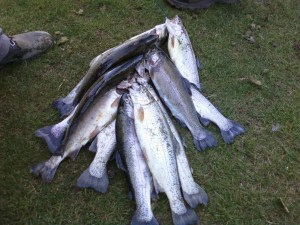
We proceeded to fish for an hour, and each of us and several friends caught our limit of three Rainbow trout. The two 17-inchers I caught put up a fuss and took a minute or two to bring in. And yes, the drag function worked properly. But an 18-incher put up a fight! Taking almost three minutes to reel it in, I was grateful that Frank set the tension for me. Back at the cabin, Carol cooked the big one like a salmon, and it was GOOD! The left-overs were made into trout-fish sandwiches which tasted much better than tuna-fish.
By the way, the little ones – eight to thirteen inchers – don’t pull hard enough to break the line, and I have never reset the drag.

Reminiscing on that recently reminded me of everyday life. Do you find that the pressures of life are too much, and you feel like snapping? Do you feel like giving up? How’s your emotional drag set?

Don’t trust your own wisdom, for you’ll be disappointed.  And don’t give up because help is just a prayer away. So trust in the Lord with your entire life. In everything you do, acknowledge the Lord, and He will guide you (Pro. 3:5-6). You are secure in God’s hands because He will help you set your emotional drag.

The Cracked Windshield

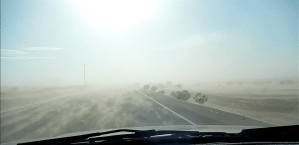
As we were driving near the Salton Sea in Southern California, a blinding sandstorm lightly sandblasted our windshield. Afterward, when the sunlight hit the windshield at the right angle, or if a car came toward us at a critical angle at night, it created a visual difficulty. But we could still see well enough to drive safely so we didn’t replace it.

But this is a different story.

In October of 2016, a truck about 300 feet ahead of us lofted a rock that landed on our windshield – right in front of Carol. In addition to startling Carol and eliciting a yelp from her, it created a crater in the windshield with five or six cracks radiating outward.

What could I do? There is no need to stop. No sense in getting aggravated, worried, or upset; and the truck driver didn’t do it intentionally. Change lanes if possible, continue on course and take care of it later. But be assured: if not repaired soon, the cracks will grow and the windshield will become what I call “spider-webbed”.

Here’s some background information.

The dashboard was created to prevent mud and horse excrement from “dashing” the legs of the driver and passengers. Dashboards on buggies were originally vertical or at an angle, but lower on the carriage.

Windscreens (early name for windshields) may also have had their beginnings on horse-drawn carriages or buggies. They were made of glass, were mounted on top of the dashboards, and provided protection for the upper body and face.

Since many early cars were manufactured without tops, the windscreen provided some protection from the wind as well as from stuff being splattered by horses and other vehicles. In the US, the windscreen became a shield from the wind as the vehicles began going faster; so it took on the name of windshield.

In a car, the “shelf” between the driver and the windshield kept the title of dashboard, and the windshield could be laid down on the dashboard on dry and non-windy days. But the glass broke easily, so improvements in glass quality and safety were needed.

A process called “tempering” was utilized to make a safer glass, but it was soon replaced by “safety-glass.” Safety-glass is a laminated glass that is made like a sandwich: two layers of tempered glass with a layer of plastic in between.

Today, the major components of windshields or windscreens are silica, soda ash, dolomite, limestone, and cullet. Often potassium oxide and aluminum oxide are added; but silica (sand) comprises well over 60% of the material.

Also, modern windshields can have more than two layers of tempered glass with layers of plastic (usually polyvinyl butyral or ethylene-vinyl acetate) in between. This allows the windshield to be considerably more flexible and more resilient to blows from rocks or other objects.

Because of the flexibility and lamination, when an object hits the windshield, potential damage is usually confined to the outer glass layer. It may still need to be repaired or replaced, but the lamination prevents the glass from shattering.

Back to the cracked windshield.

I called Safelite AutoGlass Company. They said if the break was smaller than a credit card and has three or fewer radiating cracks, the insurance companies will not provide a replacement. Well, the break with cracks was smaller than a card, but it had five or six radiating cracks that I call spider-legs – and they were growing. So we set up an appointment for the next day; and while we shopped at Sears, the car received a new windshield.

Wow! What a joy it is to see super-clearly as we drive throughout the California country-side – and on interstate highways.

Do you know that our spiritual vision can be damaged by bumps in life? Someone can purposely or inadvertently hurl a spiritual stone at us and crack our mental or spiritual “shield”. Then, without the badly-needed protection, we become vulnerable to other dangers. Our damaged vision robs us of wisdom, and our poor reactions make things worse.

What should we do? Safelite AutoGlass cannot help us here; but Almighty God can. Ephesians 6:16 says, “Above all, take the shield of faith which will protect you from all the fiery darts of the wicked.”

Place your faith in Jesus: in Almighty God. He will give you clear vision and help you make correct decisions in life.

So, enjoy life – both the rough and smooth parts – and stay clear of those who would throw things that could hurt you. But if you do get a crack in your shield, turn to God immediately for help. Jesus promised never to leave us or forsake us.

The Plestiodon

What do you think a plestiodon is? It sounds like it might be a giant dinosaur, and perhaps it’s the topic of the latest archeological find hidden deep in central Africa. Or maybe this giant skeleton was uncovered in a dinosaur graveyard in the hills of Morrison, Cripple Creek, or Cañon City – all in Colorado.

But, you don’t know what a plestiodon is? Neither did I until I looked it up.

It’s not a giant lizard or a dinosaur, and it’s not the focal point of archeology. It’s a little lizard with a bright blue tail. They are also called skinks, which derives from “Scinc” in the Scincidae family.

I saw this lizard one hot summer day when it crawled into the garage to cool off. The problem developed when it crawled onto one of the glue traps I use to reduce the spider, cricket, and beetle populations of the world.

I placed a few drops of WD-40® around its entrapped form. Then, using a twig, I gently lifted its body to allow the oil to dissolve the glue under it, and in a few minutes it was free. But its bright blue tail didn’t make it, and was left wiggling on the glue trap. I placed the reptile in the grass beside the garage. But before it waddled away, it turned and, not moving, looked directly at me for almost a minute. Maybe it was thanking me for saving its life? I don’t know … maybe.

When God designed this critter, He gave it a bright blue tail which can be released in danger. The blue attracts predators; and when they grab it for breakfast, the lizard sheds it and runs for cover. When the tail grows back, it is shorter, and is usually the same color as the rest of the body – but sometimes pink.

08-19-14bThis episode in the garage reminded me of another reptilian visit in New Mexico back in 1993. When it tried to hide, it reminded me that many people think they can hide from God, and I wrote a poem about it.

THE LIZARD

A young lizard came into my shop today;

Left to himself, I thought he’d go away.

But he just stood there looking at me,

Hoping beyond hope that him, I wouldn’t see.

Earlier that day it had been quite warm,

And to open the door would be the norm.

Then the rain began, and I love the sound.

It was then I saw my friend on the ground.

I looked in my shop, but no food was in sight

To give to my friend. But I understood his plight:

It was storming outside and he had discovered

A place of refuge. He knew he’d be covered.

I tried to catch him and take him outside,

But he was too smart and from me he did hide.

“You can’t catch me – you can’t reach under there!”

It was then that I heard my unspoken prayer.

“Lord, am I attempting to hide from You?”

And of course, He answered as if on cue:

“My kids seem to think since they can’t see Me

That I can’t see them; and think they are free.

“I want you to know that I see you today –

At work, at home, at church, and at play.

Go tell My Church that I see them, too.

But oh, how I desire to be in their view!

“If they keep withdrawing themselves from Me,

Whatever they think, they’ll never be free.

Like the lizard, if they don’t want to die,

They must trust in Me; and escape, not to try.”

I searched again to find my small friend.

Then I saw him – heading around the bend!

Using wisdom and stealth, I aimed him outside

Using my right foot as a peculiar guide.

“Lord, unlike this lizard, let me never hide;

Abiding in You may I always confide.

Self-sufficient, I never want to be,

But always believing, and trusting in Thee.

Believe it or not, that episode has stayed with me all these years, and has reminded me to07-29-15b.jpg always be transparent to God and to others. I will never hide my faith in Jesus, and I will never hide who I am in Christ. I want to safely rest in the palm of His hands.

As a Christian, my prayer is summarized in Psalm 19:14 – “Let my words and thoughts be acceptable to you, Lord.”

I pray that the church at large will also live by that Psalm.

Trip to Palomar Mountain

I asked young Fred if he knew what a telescope was. He responded, “It’s something you look through to see things wiggling in a drop of water.”

When I said that was a microscope, he asked “Aren’t they the same thing?”

After I described the difference, he gave a good summary: “Okay. One helps you see tiny things that are up close; and the other one helps you see big things that look tiny because they are far away.” I laughed, and said, “You got it.”

Mount Palomar, August 2016

Mankind has used both microscopes and telescopes to help us understand more about life, and that leads us to today’s Reflection on Life.

“When we go see mom today, is there anything else you would like to do?”

When Carol asked that question four years ago, I responded, “I’ve wanted to visit the observatory at Palomar for years. It’s about forty miles from Mom, so let’s go early to Palomar Mountain, then visit mom afterwards.” And so we did.

The Spanish name “Palomar” means “place of the pigeons” or “pigeon roost”; for in the early 1800s, Spaniards found multiplied thousands of band-tailed pigeons on the mountain.

The nearest town to the observatory is Rincon, California. Its altitude is 1,030 feet above sea level. But make sure your car is in good condition because you will drive up a steep, narrow, winding road to an altitude of 5,616 feet. It is sixteen miles by road, but almost one mile straight up.

The Palomar Observatory

There, gracing the mountaintop is a glistening, white dome: the Palomar Observatory operated by the California Institute of Technology, known as Caltech.

George Ellery Hale conceived of the idea and wrote about it in 1928. The Rockefeller Foundation gave $6,000,000 toward the project, and the Corning Glassworks company created the 200-inch object that would become the primary mirror. Originally weighing twenty tons, Corning had a railway flatbed modified to transport it; and it took sixteen days to safely ship it from New York to Pasadena, California.

Receiving it on Palomar Mountain in April of 1936, Caltech personnel spent thirteen years cutting, grinding, and polishing the mirror. Finally weighing about fourteen tons, the concave mirror was installed and the telescope was put into operation in January of 1949. American astronomer Edwin Powell Hubble (after whom the Hubble telescope was named) was given the honor of being the first person to use the Palomar Telescope.

The observatory operates several telescopes: the 18-inch Schmidt scope, the 48-inch Samuel Oschin scope, a 60-inch scope, and the 200-inch Hale telescope which was the largest in the world for 45 years. The Gran Telescopio Canarias (Great Canary Telescope on the Spanish Canary Islands) is largest now, with a 409-inche mirror, which is 34 feet in diameter.

Using the Hale telescope on Palomar Mountain, we’ve discovered many things, among which are millions of distant galaxies and quasars, and we’ve studied the structure and chemistry of intergalactic clouds.

Jean Mueller, the first woman hired as a telescope operator at Palomar Mountain in 1985 (also the first woman to operate the Hooker telescope at the Mount Wilson Observatory near Los Angeles), discovered over 100 supernovae by studying Palomar data. A supernova is the explosion of a giant star with the resultant brightness of about ten billion suns.

Several recent projects – among many – include studying near-Earth asteroids, Kuiper Belt Objects, star formation, planets in other solar systems, and black holes.

The Observatory up close

Because of light pollution, the observatory has reduced its major operations, shifting more work to the Hubble Space telescope. Prior to the covid-19 pandemic, the observatory was open every clear night of the year except December 24 and 25. Sections of the Palomar Observatory were open to the public during the day where visitors could take self-guided tours daily from 9 a.m. to 3 p.m. Guided tours of the dome and portions of the observing area were available Saturdays and Sundays from April through October. I strongly recommend a visit to the site, and you will be amazed at what you learn. Information is available at the Observatory’s web site: http://www.astro.caltech.edu/palomar/homepage.html and http://www.astro.caltech.edu/palomar/visitor/.

I find it interesting that Job 9:9 and 38:32, written over 3,500 years ago, names Arcturus, Orion, Pleiades, and refers to nearby astronomical bodies. Psalm 8:3-4a tells us that Almighty God created the vastness of the seemingly infinite cosmos, but also reveals that God is concerned about mortal humanity. Scripture says, “When I consider thy heavens, the work of thy fingers, the moon and the stars, which thou hast ordained; What is man, that thou art mindful of him?”

Think of it: the ultimate Supreme, Sovereign God is concerned about finite, mortal man; and you don’t need a telescope to find Him, for He’s only a prayer away.