What’s Over the Next Hill?

“Daddy, what’s over that hill?”

“What do you think you’ll see?” Dad chuckled. He must have been humored at my numerous questions. He continued, “If you sit still for a minute, we’ll be on that hill, then we’ll both find out.” Dad knew but wanted the view to be a surprise.

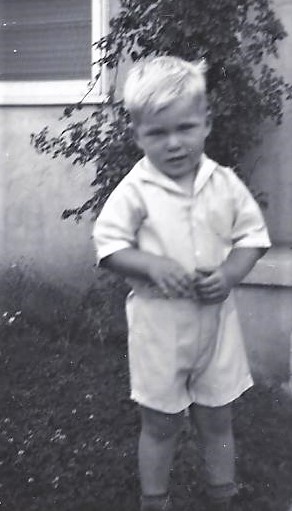
From my earliest memories at almost 3-years old, I’ve always wondered: What’s around the corner? What’s in the box? How did the mountain get there? What’s fire made out of? What’s over the next hill? I’ve always had an unquenchable thirst for knowledge. I still do.

That was a special trip for me. I was 5 years old, and seldom had the privilege of spending time with dad and mom by myself. Eventually, I had five sisters and four brothers, and this trip would be the first of three trips where I was the only one dad and mom took with them.
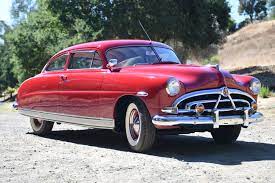
Mom was taking a nap in the front seat of the Hudson Hornet, my four sisters (two older and two younger) were left with elders in the church, and I was leaning over the front seat looking with eyes wide open. I had never seen mountains and valleys like this. Seat belts hadn’t been invented yet, but we never had a problem.

There were no freeways where we lived in 1951, and our highways allowed us to travel at the break-neck speed of 55 miles per hour. However, some of these mountain roads allowed only 35-45 mph. Our destination was about 400 miles away, and we left home long before daylight.

As we approached the crest of the hill, dad asked, “Eugene, do you know where we’re going?”

“Yes, we’re goin’ campin’.”

“That’s right. But do you remember where mother said we’re going?”

While I was trying to remember that hard word, we reached the top of the hill. Dad pulled over to the side of the road.

“Ooooohhhhh Daddy! Someone broke that mountain in half!” I was stunned to see half a mountain standing on the side of the valley.

Dad already had his camera in hand and was opening the door. “Son, that broken mountain is called ‘Half-Dome’ and this is called Yosemite Na… Eugene? Where are you?”

Dad found me hiding inside the car, not wanting to get out. I was scared spitless of heights, and when I saw the valley floor WAY DOWN THERE, I panicked. But peeking out the window, I couldn’t take my eyes off that broken mountain.

“Okay, Eugene. Would you get out of the car if I hold your hand?”

I shook my head, “Hu-uh.”

When mom said, “Daddy will let you look through his binoculars if you get out of the car,” I agreed to hold daddy’s hand and get out.

That was my introduction to Yosemite National Park.

We drove down into the canyon and dad took me on a few short hikes. I enjoyed playing in the heavy mist of Bridal Veil Falls, then helping dad set up camp. I don’t remember how much of a help I was, but it was fun being with daddy and mommy.

My favorite part was watching the fire fall down the face of Glacier Point. The park ranger gave a talk each evening, and an entertainment group sang as others prepared a roaring fire on top of Glacier Point. Then at 9:00 PM, the ranger hollered, “Let the fire fall!”

Several men then pushed the burning material over the edge with bulldozers, and a river of glowing embers fell more than a half mile (some 3,000) feet to the valley floor. Little boys never forget things like that. (The final “fire-fall” was on January 25, 1968.)

The question of “what’s over the next hill” has never left me. I might see an elk, a river, a glowing sunset, the wide expanse of the ocean, or another mountain. I never tire of it. And I am blessed with a wife who shares the same adventurous spirit.

We’ve been in every state of the Union and have driven over many hills. But there is one “hill” I cannot experience yet, and I can only imagine what the other side looks like. I’ll go over that hill after I take my last breath here on earth and enter heaven. I’m not in a hurry to get there, but God, dad, and mom are waiting for me, and I won’t be afraid of that height. Who knows: God might have thousands of hills over there for me to experience.


Water!

“Water, water, everywhere, and all the boards did shrink; Water, water, everywhere, nor any drop to drink.” So states the 29th stanza of the The Rime [Rhyme] of the Ancient Mariner by Samuel Taylor Coleridge. The somewhat confusing poem is too long for me to remember, but those lines stick with me.

One of Bob Nolan’s songs sung by the Sons of the Pioneers is Cool Water. The first stanza is: “All day I face the barren waste without the taste of water; Cool water. Old Dan and I with throats burned dry and souls that cry for water, Cool water.” By the way, Old Dan is the mule or horse.

There’s much water in the poem and no water in the song – but in both situations, drinkable water is not available. Mankind has fought for thousands of years over water rights, but what’s the reason for this obsession?

Simply this: Humans can live for four or five weeks without food; but barely a week without water.

However, earth is a watery world. Earth is the only planet in our solar system that is naturally and readily habitable for mankind. Water is found almost everywhere either on or under the surface of the earth: from the polar ice caps to boiling geysers.

The oceans are an integral part of our lives because their influence dominates the world’s weather systems. About 96% of earth’s water covers approximately 71% of the earth’s surface. I read that under current atmospheric conditions, the atmosphere can hold approximately 37 million, billion gallons of water – enough to cover the entire surface of the world, including oceans, with one inch of water.

But if the solid earth were a smooth, round ball, one estimate is that the existing surface water – from oceans, lakes, and rivers – would be about 1.5 miles deep.

A water molecule is made of 2 hydrogen atoms and 1 oxygen atom – H2O – and water aids in sustaining a breathable atmosphere and a viable temperature. It is water that keeps vegetation, animals, and people alive.

Solar radiation heats the atmosphere, land, and oceans. As the warm air rises, water vapor rises with it. As the moisture enters the upper atmosphere, it cools, forms clouds, and spreads the live-sustaining liquid across the world as rain, hail, and snow.

Water is the world’s greatest solvent – humorously, but correctly, called dihydrogen monoxide (H2O). It is called the universal solvent because it dissolves more minerals and compounds than any other chemical known. Scientists have proven this by extracting gold, silver, lead, copper, and a host of other elements from sea water. Water from rain and snow dissolves those minerals from mountains and prairies and deposits them into lakes and oceans.

As corn, beans, wheat, potatoes, and all the other crops grow, their root systems absorb these minerals, and they become part of us as we eat the food. It takes water a long time to break down organic material; therefore, the body creates HCL (hydrochloric acid) to break down or digest food, and the watery blood system distributes food, vitamins, and minerals to every cell of the body.

Water is a major component of the human body. Bodies of newborn babies average 78% water but the adult body averages about 60%. The average water content in adult blood is 80%, and lungs are about 90% water.

Water has enabled mankind to build or advance civilization in many ways. Rivers, lakes, and oceans have been major highways of the world for thousands of years. Dams have been built across major rivers around the world, and the rushing water turns huge hydroelectric turbines to produce electrical power for untold millions of homes and factories. The oceans provide food for people and help to regulate climate by redistributing heat around the world.

Water is critical for life; and without water, live cannot exist.

But there is another kind of water that is critical for humanity. As H2O is mandatory for human life, Jesus has provided “living water” that is mandatory for Eternal Life. Jesus said in John 4:14, “Those who drink the water I give will never be thirsty again.”

How? That means He will sustain or help us throughout life. We “drink” of this living water by learning to know Jesus, purposely obeying Him, and living to please Him. This water includes wisdom that we need as we interact with others; and this water is necessary in every other aspect of human life.

Without this living water, we cannot enter the kingdom of God. Have you partaken of God’s living-water? Quench your spiritual thirst. Start by reading the Gospel of John. Follow it up by reading the book of Romans.

Memories of Dad

I was five years old, we lived in El Cajon, California, and the church building dad and the deacons built was completed. I was allowed to run in and around the building during certain phases of construction; but after completion, running in church was not allowed.

But I didn’t always obey my parents.

Reddy was my best friend, and when daddy wasn’t watching, we liked to run up the long flight of stairs on one side of the sanctuary, race in the upstairs hallway, and run down the stairs on the other side.

Dad warned me with, “I’ll tan your hide if you don’t obey me.” But for some reason, I did it anyway. I also went into his church office whenever I wanted to. After all, I was the pastor’s kid.

One Sunday morning dad had a personnel issue to handle, and told me to stay out of his office. I could obey that order. Until …

I told Reddy that Daddy was busy so we could run. “Goody!” Reddy almost shouted.

Up one side we ran, down the hall we raced, and ran down the steps on the other side. But getting ready to run down the steps on the second round, I tripped on the top step.

I tumbled head-over-heels all the way down. Miraculously, not a bone was broken and I wasn’t even bleeding anywhere. But my breathing mechanism had totally shut down!

In that situation, there was only one thing to do – Go See Daddy!

Not breathing, I burst into his office. Dad turned and was about to order me back out but saw that my face was turning blue and my mouth was wide open.

“Oh, my Lord!” I remember hearing dad say.

He quickly placed me over his knee, gave me a hard whack on the back which restarted my breathing, and said, “That’ll take care of you ‘til we get home!”

Now I had a different problem.

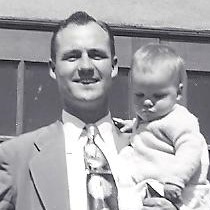
Back home after the church meeting, dad asked me what had happened. Fearfully, I admitted that I disobeyed him and tumbled down the stairs as I was running. (The picture is dad holding my sister, Sharon.)

I was amazed – and relieved – when dad pronounced, “Tumbling down the stairs was your punishment – this time.” Then pulling me to himself and wrapping his arms around me, he gently said, “Eugene, that fall was a hard lesson. Do you think you can remember not to run in church?”

There was only one answer: “Yes, daddy. I won’t run in church again.”

And I never did.

Three years later, we lived in Baldwin Park, California, and dad was in his final year of preparation to re-enter the US Navy as a chaplain. His schedule of seminary classes, being a pastor-husband-father, and sneaking in a few hours of sleep whenever possible, was quite full.

One Friday when I was sitting at the kitchen table with dad as he was finalizing his sermon for the coming Sunday, mom told me it was time for bed.

“Can I stay up with Daddy for a while?”

“No; it’s time for bed. Come on.”

“Can I PLEASE stay up for a little while? I don’t get to see Daddy very much.”

Dad looked up and said, “Eugene, if you want to stay up with me, you need to be very quiet. Don’t make a sound.”

“I’ll be quiet.” I never said something that fast before in my life.

Mom gave me a pencil (no pens back then), and dad gave me some paper. I was in heaven for another hour with my daddy. I have no idea what I wrote, scribbled, or doodled that night, but I remember the extreme joy of being with my daddy. And the well-worn Bible that dad was using that night is now in my office.

Dad is in heaven and our communication is over until I get there. But I do have the extreme joy of spending time with God – my eternal Father in heaven. He enjoys my visits.

God has an open-door policy, and continually invites us into His presence. Have you visited Him lately?

Are You Color-Blind?

Years ago, I suspected that one of my friends might have a vision difficulty, so I asked him: “Are you color-blind?” He surprised me by asking if I referred to ethnic identification. We laughed, and he told me he was partially color-blind. But he had a point to which I will return later.

So, optically-speaking, what does it mean to be color-blind? Normally, color-blindness is an inherited genetic vision problem; but aging, disease, sickness, or an injury can also trigger it. Sometimes color-blindness can be a side-effect of medicine.

A color-blind person has difficulty seeing primary colors, or a mix of these colors from which every other conceivable color comes. Three theories potentially define primary colors. One basic concept identifies red, blue, and green; and another theory classifies red, blue, and yellow as primary. A third theory includes red, blue, green, and yellow.

A popular belief is that color-blind people cannot see any color at all, but that isn’t always correct. Therefore, the term is actually misleading, but we’ll use it for ease of understanding in this Reflection. And let me add here: very seldom will people even with excellent vision see colors exactly the same as others do.

As various mixes of primary colors produce the different colors and hues, the light-receiving cones in the retinas of our eyes sense variations of the light spectrum which the brain interprets as the hundreds of possible colors. The highest concentration of these color-receiving cones is in the macula – the central part of the retina. Color-blindness occurs when the cones don’t function properly.

One common method of diagnosing color-blindness is by looking at patterns of variously colored dots and trying to decipher numbers, letters, or other patterns embedded therein. The patterns the person can or cannot recognize reveal the area of difficulty.

Inherited color-blindness cannot be treated at present, but sometimes an acquired deficiency can be treated. And I found it interesting that men (about 8%) are more likely to have the color-recognition problem than women (half a percent); but more women are carriers of the deficiency.

Color-blindness may make people ineligible for some vocations, such as flying planes. But during World War II, the Army Air Corp (predecessor to the United States Air Force) hired color-blind people to be “spotters” in planes because they would not be fooled by the camouflaging that was used to hide trucks, cannons, supplies, and soldiers.

What I found to be even more interesting is that some “color-blind” people are not really color-blind. Their eyes function properly and the retinas receive all available colors; but the individuals do not recognize color. The problem here is perception, not vision.

Many folks take the handicap in stride and get on with life. Some artists such as Australia’s Clifton Pugh overcame his handicap by focusing on shades of light and dark rather than on overt color; and France’s Charles Méryon overcame color-deficiency by focusing on etching rather than on painting.

Let me get back to ethnic identification.

My eyes have been tested for color reception, and they came out very good. Also, with my eye-glasses, I have near 20-10 (near perfect) vision. But I am somewhat “color-blind” regarding ethnicity. Many of my friends are not Caucasian or White, yet we call each other brother or sister. Ethnicity is not an issue and the love of Christ flows between us. As I interact with people from around the world, I see people made in the image of God. Even if the person isn’t a Christian, I still see someone whom Jesus loves and for whom Jesus died.

But there is another type of “color-blindness”. As our spotters in the Army Air Corp in World War II were not fooled by enemy camouflage, God’s “color-blind” people are not fooled by Satan’s deception in education, politics, and in the church.

True Vision

They are not fooled by anti-Biblical teaching that is camouflaged by religious, philosophical, political, or educational rhetoric. They are not fooled by so-called political-correctness that squelches Christianity while uplifting other religions, philosophies, and lifestyles.

These folks are blessed by the Lord, but they often come under attack. The world rejects or hates them and misguided Christians misunderstand them. But these color-blind people, like the Apostle Paul and Billy Graham, are the ones who keep the faith in Almighty God alive, and spread it around the world. If you have that kind of vision, as I do, don’t back down. People need to hear us.

You Can Rule With God

The following is an excerpt from the chapter on Humility in my book, Charter of the Christian Faith.

Years ago, Tom Whittlesey, a life-long friend and author in Tulsa, Oklahoma, wrote and gave me a proverb that helps me stay on track:

“God is not impressed with our ability; God is not disappointed with our inability; God is only gratified with our availability.”

With that in mind, think about the following people who were available to God.

  1. Noah wasn’t a ship builder, but he obeyed God and saved mankind from total annihilation.
  2. Abraham was trained to be an idol-maker but became the father of the Faith.
  3. Sarah was Abraham’s pampered half-sister, but she became the mother of the Jewish nation.
  4. Moses grew up in the Egyptian palace, became a general in the Egyptian army, and committed murder. Nevertheless, he prompted Pharaoh to set the people free.
  5. Rahab was an innkeeper, and perhaps a prostitute; but she assisted the Israelites as they crossed the Jordan River. Then marrying an Israelite, she became one of the ancestresses of Jesus.
  6. King David committed adultery and ordered a murder, but he wrote many of the Psalms while making Israel a mighty nation.
  7. Deborah, the judge, was not a soldier, but she gave Barak the battle plan.
  8. Peter was an uncouth, impulsive fisherman, but he is the one who declared Jesus to be the Christ, the Son of the Living God! and became a leader in the early Church.
  9. Saul arrested Christians to be tortured or killed, but he became the Apostle Paul, ministered to the gentile nations, and wrote at least thirteen of the New Testament books.
  10. Martin Luther was a depressed monk, but he rediscovered, “By faith you are saved; not by works lest any man should boast.”
  11. Corrie ten Boom was a watchmaker’s daughter; but surviving the holocaust during World War II, she shared her testimony of love and forgiveness around the world.
  12. Billy Graham was raised on a dairy farm, but he took the Bible and the Gospel of Jesus Christ to the world.

Did you notice how each of the people on that list helped build the kingdom of God? They were not trained to do what made them famous, and all of them would have remained in the shadows of history had they not obeyed God. However, because they responded to the Lord, their influence is still being felt in the world, and that is one way by which they are rulers in God’s Kingdom.

Because of God’s promises, their rulership has been increased in heaven. The principle is in Luke 19:17 where Jesus was telling a story. “The king said to the servant, ‘You are a good servant. Since I can trust you with small things, I will let you rule over ten of my cities” (NCV). When we humbly avail ourselves to the Lord, and obey Him, God is not hesitant to expand our reputation in order to build His Kingdom. Let me repeat: God is not impressed with our ability; God is not disappointed with our inability; God is only gratified with our availability.

God created us to rule with Him. His response to our humble availability is likely to be, I am indeed pleased. After a maturing process, you shall become a ruler in My Kingdom, beginning in this earthly life.

Read more in Charter of the Christian Faith – available at Amazon.com.

The Beatitudes are Progressive

This is a follow-up to last week’s blog. It gives a little more insight into the book, Charter of the Christian Faith.

I began seriously studying the Beatitudes while attending the Oklahoma Baptist University in 1985. At the end of the semester, I had to choose one of five topics for my thesis, and I chose Matthew 5:1-12. As I began the research, I experienced almost as much confusion as I did when I read the Beatitudes as a child. But the more I dug into the topic, the more interesting it became, and the greater impact it had on my life.

A major concept I discovered is that the Beatitudes are progressive; they are sequential steps to godliness. It wasn’t obvious when I compared Blessed are the poor in spirit, for theirs is the kingdom of God with Blessed are they that mourn, for they shall be comforted. The words didn’t adequately convey the intent of the Beatitudes; that’s why it’s difficult to comprehend the depth of the message. But when I realized that poor in spirit is sincere humility and mourning is deep sorrow because I have offended God, it became clear that there is an order to these concepts.

This example will clarify my point. When we want to learn math, we don’t begin by studying lambda calculus or advanced trigonometry. We start with adding and subtracting, and progress from there. In like manner, we’ll find out that everything we need to know, or even want to know, about enhancing our relationship with Jesus, starts with humility: the first Beatitude.

As we study the Bible, we find that the Beatitudes, and how God uses them to change and mature us, flow in magnificent sequence—in perfect order.

As we often climb stairs one step at a time to enter a house, mankind has known for thousands of years that we learn one step at a time. Jesus knew it and was a master teacher. That’s why these are not random thoughts to mull over; they are sequential. Following a logical order, each Beatitude is the step to reach the next one.

The goal that God the Father set before all of us is for us to become like Christ, but He knows it will be a life-long endeavor. Therefore, He provided the eight-step process the Church calls the Beatitudes to make the spiritual journey more understandable. In fact, the Sermon on the Mount, prefaced by the Beatitudes “is considered to be the most important sermon Jesus ever preached and starts with what is considered to be the most important attitudes that we need to have, The Beatitudes.”11

Preceding each chapter, is a pictorial illustration of the journey. The man represents humanity, the donkey represents the human mind without Christ, and the lion represents the Lion of Judah, and that is Jesus who is available to help us.

How did Jesus begin this teaching?

And seeing the multitudes, He went up into a mountain; and when He was set, His disciples came unto Him. And He opened His mouth, and taught them, saying….

Whoa! Stop there. Let’s think about this.

There were 5,000 men, plus possibly another 5,000 women and children. How could a multitude that large hear, let alone understand, someone sitting down? Something doesn’t seem right about this picture.

That’s why we study. Let’s read further and analyze the scene.

Although Jesus spoke to large crowds at other times, Matthew 5:2 reveals that Jesus may not have been speaking loudly to thousands, or even hundreds of men, women, and children in this setting. Others may have heard, but the entire Sermon on the Mount—three chapters—was spoken primarily to these twelve men. Why do I say that?

The phrase He opened His mouth is a solemn pronunciation. This is in contrast with verses such as Mark 15:1 which says, And they cried out again, Crucify him! To cry out is to shout! But the phrase He opened His mouth is an important, quiet activity. Jesus was teaching His followers personally, quietly, and without the interference of a noisy crowd.

According to the end of chapter seven, there were many people on the hillside, and some listened in and learned from the Master. (Jesus also taught these same truths to others in different places.) But in this setting, although others may have heard, Jesus purposely addressed a small group of twelve men.

Learn more about Jesus’ primary teaching in the New Testament, and how you can become an effective representative of Almighty God by reading Charter of the Christian Faith.

Note: The book Charter of the Christian Faith has been rewritten under the title Truth not meant to be Hidden. You may find the book on Amazon.

THE BE-WHATITUDES?

For many years I’ve taught about the Bible and from the Bible. One of the series I’ve been asked to teach on quite often is found in the 5th chapter of Matthew. Because of the profound nature of that section of Scripture, I call this teaching, Charter of the Christian Faith. Today’s blog is a portion of the preface of my book by the same name, and will give you a feel for what’s in the following pages. The foreword is written by Rev. David Ravenhill.

I remember as a child in Sunday School, one of my teachers wanted us to memorize the be-something-or-others; but for the life of me, I couldn’t figure out why. I hated memorizing, and these things didn’t make any sense to me. Not only did I not understand them, but the teacher also couldn’t adequately explain them, either so I never got a gold star for learning those be-whatitudes.

But I did mentally retain other verses that made sense to me. Luke 19:10, “For the Son of man is come to seek and to save that which was lost.” And John 3:16, “For God so loved the world that He gave His only begotten Son that whosoever believeth in Him should not perish but have everlasting life.” I understood those verses, even in the King James Version. In fact, most of what I committed to memory was from the KJV.

Also, Acts 1:11 clearly told me that while the people stood watching the incredulous sight of Jesus ascending into the sky, angels told them how Jesus will return. Men of Galilee, they said, why are you standing here staring into heaven? Jesus has been taken from you into heaven, but someday He will return from heaven in the same way you saw Him go! (NLT). That gave me confidence that Jesus would come back, and it told me how He would return. No questions, no guesses. No less than 67 famous people, and more than five hundred others, have claimed to be the returned messiah; but people should have understood they were fake messiahs because not one of them came the way the Bible says Jesus would return.

Nevertheless, I had a hard time with the Beatitudes, but I wasn’t alone. Author Philip Yancey said in his book, The Jesus I Never Knew, “I learned the Beatitudes [as a teenager] yet I never faced the fact that none of us—I above all—could make sense of those mysterious sayings, let alone live by them.” He later said, “If I fail to understand this teaching, I fail to understand Him [Jesus].” That is a powerful statement.

Teacher and song-writer Bill Gaither said, “What we call the Beatitudes still challenge our value systems every day.” Many people—including many in the Church—view the Beatitudes merely as lofty ideals: holy-sounding platitudes which are beyond our grasp. Some people think of them as verses or sayings to comfort the spirit in time of trouble. But is this the primary intent of the first major teaching that Jesus gave us in the New Testament? I don’t think so.

I believe Matthew 5:3-12 is the Charter of the Christian Faith, and this Charter is developed in the full Sermon on the Mount in chapters five through seven.

Again, quoting E. Stanley Jones, “Years ago when I asked Mahatma Gandhi what we could do to naturalize Christianity in India so that it would cease to be a foreign thing, among other concepts he replied: ‘Practice your religion without adulterating it or toning it down’—and he had in mind the Sermon on the Mount.… This fresh discovery, by a Hindu, of a truth long buried beneath the armaments of the fighting West, has been one of the most important spiritual discoveries of modern times.”

In order to properly understand the Beatitudes, we must realize they were not originally intended for our consolation, and they’re not statements to make us sound spiritual. Rather, they comprise one of the most important sets of instructions we could ever receive.

I’ll share more highlights in weeks to come, but you can order your copy on Amazon today. Also, check out my website at genelinzey.com.

Let Freedom Ring!

After the American eight-year War of Independence ended in 1784, the colonists were finally free! Well, I suppose they weren’t colonists any longer; they were citizens of a new country. But they were free!

They were free from tyranny. Free from taxation without representation. Free from the hated Redcoats! And free from a host of other problems – both real and imagined.

But what were they free to do? They were free to worship according to conscience and free to choose their own religion, but let’s come back to that in a minute. What else were the colonists – I mean, Americans – free to do?

Political freedom was a major item. Not desiring any over-arching government, they wouldn’t bow to any state but their own. This was a problem because there were thirteen new governments to consider. So, the former colonies – now sovereign states – agreed to a limited government under a federation called The United States of America.

They were free to tax themselves with “in-house” representation. That was a fight! The local towns didn’t want the states to tax them, and the states didn’t want the feds to tax them. They were also free to print their own money. Oops … that didn’t work too well. Each state created its own currency, with some states having several currencies. Banks issued their own money; and by 1836 over 1,600 banks were issuing thousands of varieties of paper money. Many were “not worth a continental.” Believe-it-or-not, standardized currency wasn’t established until 1929.

Back to freedom of religion.

In order to have a workable government, compromises are made. However, these concessions need to be in the civil arena; not in matters of faith. In colonial legislation, Thomas Jefferson said in the Virginia Statute for Religious Freedom (written in 1779):

“No man shall be compelled to frequent or support any religious worship, place, or ministry whatsoever … nor shall otherwise suffer, on account of his religious opinions or belief; but that all men shall be free to profess, and by argument to maintain, their opinions in matters of religion, and that the same shall in no wise diminish, enlarge, or affect their civil capacities.”

Jefferson made sure the First Amendment carried the same idea: “Congress shall make no law respecting an establishment of religion, or prohibiting the free exercise thereof….”

President Eisenhower said on January 20, 1953, “History does not long entrust the care of freedom to the weak or the timid.” And on November 25, 1981 the United Nations General Assembly passed the “Declaration on the Elimination of All Forms of Intolerance and of Discrimination Based on Religion or Belief.”

With that in mind, why is our government limiting or restricting the free, open exercise of the Christian religion? Why are we disregarding our religious freedoms that are protected in our own national documents? I am referring, of course, to openly reading and teaching from the Holy Bible.

When Scripture teaches that marriage is between a man and a woman, why do we cower before those who disagree? Without a constitutional amendment, Congress doesn’t have the right to revoke our constitutional rights of freedom of speech, freedom of religion, or deny our right to preach the truth as found in Scripture.

I don’t hate homosexuals; I have worked alongside several, and some of my friends are homosexuals. There is no hate involved when I tell them that the Bible teaches against homosexuality. But hate is involved when “gay” people angrily hurl insults and epithets at me.

It is unconstitutional, immoral, and unethical to allow the “gay” person his first amendment rights, yet disallow the “straight” person the same rights. Gay folks, as American citizens, have the freedom to speak their mind, so why would he or she deny me, an American citizen, the same freedom to speak my mind without fear of reprisal? Whoever dares to eliminate my freedom puts his own freedoms in jeopardy.

Proverbs 25:26 says, “A good person who gives in to evil is like a muddy spring or dirty well.”

     Christians have the same guaranteed, blood-bought, constitutional freedoms to teach and worship according to conscience, and to express our beliefs as does anyone else – and that includes teaching everything in the Bible. To deny that freedom would be discrimination, bigotry, and intolerance on the highest level – and would be un-constitutional. Remember, even the UN denounces intolerance – at least, on paper.

Christians, Pay Attention

This week, all non-Christians may disregard this blog because I’m not talking to you. I am speaking to the Church.

Well, okay. As long as you’re here, you may continue reading if you so desire.

It appears to me that many in the Christian Church have corrupted their understanding of their position in Christ, or with Christ. More and more people imagine that Christ exists for our sake; that He came to earth to bless us and give us a wonderful life; that the riches and authority of the world belong to us – or should belong to us. Many folks have been taught that we can even tell God what we want, and out of His love for us He will grant our desire.

When I worked for an automobile dealership in 1980, a well-known pastor came to me and told me he wanted a Cadillac. He specified all the details, how much he would pay for it, and wanted me to order it so I could “get in on the blessing.” When I said I could get it for him but that it would cost him approximately $8,000 more, he laughed and said, “I told Jesus what I want; and because of my faith, I’ll get it.” Walking away, he said he would offer the blessing (of getting it for him) to someone else.

About three weeks later he drove back to see me – in a new Cadillac. As he was bragging about it, I pointed out several major details that conflicted with the itemized list he handed to God. He said, “Well, I got most of it.” But when I asked him how much he paid for it, he looked down and muttered something like, “It was several thousand more than I wanted to pay” and quickly drove away.

This man had probably been listening to a song from a well-known writer that included the words: “Say it, believe it, receive it, tell Jesus.” But that theology is totally backwards, and is an affront to God. That is deciding what we want, convincing ourselves it is right to have, claiming it as ours, then – THEN – telling Jesus to get for them. This is wrong.

 The truth is: Christ does not exist for us; we exist for the sake of Christ. We have no business itemizing our demands, then handing the demand to God as though He was waiting on our table at the local restaurant.

Yes, Jesus came to earth as a baby, born of a virgin, lived a sinless life, was crucified, died, and buried. He rose back to life on the third day, and spent the next forty days walking among people, ministering to them, proving he was alive – and proving His divinity. He came to earth in order to remove the breach between man and God that was placed there when Adam sinned. But although Jesus taught us to be servants to each other, Almighty God is not our servant.

In the late 1890s, the theologian/politician/scholar Abraham Kuyper (Abraham Kuijper) said, “We Christians regularly fail to acknowledge our true place in creation. We aren’t just God’s creation; we are God’s possession.” I agree. We need to understand that the book of Job clarifies that no one tells God what to do.

Yes, we need to remember James 4:2-3 which says, “And yet the reason you don’t have what you want is that you don’t ask God for it. And even when you do ask, you don’t get it because your whole motive is wrong—you want only what will give you pleasure” (GNT). What it does not say is that sometimes we “ask God” for something, but then we bypass God and appropriate it with human efforts. That is not trusting God. Rather, that is works of the flesh, and Scripture has a strong admonition against that.

Reflecting on Kuyper’s thought, what IS our place in creation?

I think it is summed up quite succinctly in Jesus’ words in John 4:34. “My meat [sustenance] is to do the will of him that sent me, and to finish his work.” Since Jesus is our example of how we are to serve and honor Almighty God, we can truthfully say that OUR job is to do the will of Him that sent us, and to finish what He has asked us to do.

God didn’t ordain that we become crucified; but individually, our job is to discover what God wants of us, and do it. God’s will includes a vocation of some kind; but specifically, it is to honor Him in everything we do in life.

Our place in creation is not to tell God what we want. Rather, it is to discover what God wants of us, and obey.

What has God asked you to do?

Old Things Pass Away …

What’s the rest of the axiom? You got it: Behold, All Things Become New.

That comes from 2 Corinthians 5:17 which says, “Therefore if any man be in Christ, he is a new creature: old things are passed away; behold, all things are become new.”

That verse is talking about turning away from sin and selfishness, and deciding to live to honor Jesus Christ. And we need to remember that. But this week I will use the verse in a different context.

Three days ago was New Year’s Day. And if you’re reading this, you survived. Wonderful! But what’s next? Did you make any resolutions?

Grandpa Linzey was born in February of 1888 and graduated to heaven in 1987, three months before his 100th birthday anniversary. He was a practical man, and didn’t have much use for celebrations. His days were wrapped around tending his animals, and Grandma’s job was to tend the garden. One day when I asked Grandpa if he ever made New Year’s resolutions, he said: “Son, resolutions are empty, and most people break ‘em on the day they make ‘em. It’s just another day. The sun will rise, and the troubles we have today will be with us tomorrow.”
That sounded rather bleak.

But it reminded me of a friend in New Mexico who made a resolution every year. Every December 31st he said he would stop smoking cigarettes starting January 1st. And he did stop—for four or five hours. I finally told him, “You have decided not to quit. Why make a pretend resolution?”

“Oh, it gives me something to look forward to. It makes me feel good to say it. And I can teach the kids that smoking is bad for us.” That was over two decades ago, but now his son smokes, too.

Grandpa was right. Perhaps most resolutions are not meant to be kept. And perhaps my friend was right: it just made him feel good to say it.

But even if someone wants to make a change, there might be a built-in flaw in waiting until January 1st to incorporate the change. The flaw is in waiting because waiting to make it is a subconscious affirmation that the change might not be necessary.

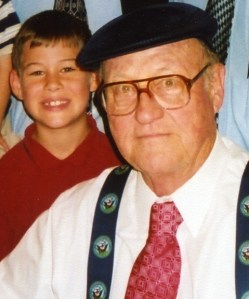
Dad, also a practical man, once told me, “If you are serious about wanting to change, don’t wait until New Year’s Day. Start the change now, and ask the Lord to help you.” And through the years I have proven Dad’s statement to be true.  (That’s my grandson, Caleb, next to dad.) Dad continued, “Don’t make a statement and call it a resolution.”

If you think a change is needed, resolve, or determine to change. Make up your mind, ask God to help you, then set your will to cooperate with God. When you are tempted to resume your former ways, remind yourself that God is ready to help. Ask the Lord for emotional strength to keep your promise. The key is to be honest! Be honest with God and with yourself.

What was it that Polonius said in Hamlet, Act 1, Scene 3?  “This above all: to thine own self be true, and it must follow, as the night the day, thou canst not then be false to any man.”

God did a marvelous thing when He created us in His image. He created us with will-power, and He wants us to use it for His purposes. It shouldn’t surprise you to know that we can do whatever He empowers us to do.

Do you want to change something this year? Don’t be hypocritical. Make sure it’s in line with God’s will, and then ask God for help. If you are honest, God will help you make that change. This year can be a New Beginning for you. I know the covid-19 stuff has turned the world upside down, but God is willing to help you. Ask Him – He’s listening.

Then you can rejoice and say with 2 Corinthians 5:17, “Old (unnecessary, improper, wrong, harmful) things have passed away, and behold, all (needed, good, wholesome, healthy) things have become new.”

Oh yes: if you find that Grandpa was right and you broke the resolution, Don’t Give Up! Things don’t normally change with one statement or in one day. It took time to form bad habits, and it will take time to change. So, don’t quit. With God’s help, you can make, and keep, good resolutions.

Happy New Year, Friends … 3 days late.