Enjoy the Trip

SWOOOOOOOOSH!! It seems that a powerful gust of wind blew into our house, flipped 1280px-Strommast2the pages on the calendar, turned our hair a little whiter, took money out of our wallet, and blew back out of the house leaving us a little off balance. The birthdates of our kids and grandkids seemed to be but a blip on the radar screen. Does time fly that fast for you? Time seemed to 0go a lot slower when we were younger.
When Rebecca, our younger daughter, was in high school she asked me, “Daddy, how can I make time go faster?” I said, “Either learn to like what you are doing, or become very busy.” That didn’t quite satisfy her at the time. But when she went to college and loved her time there, time began to fly. Now that she is a wife and mother of five children (four girls and one boy), she is wondering how to slow time down.  However, she told me recently that she is learning to make the most of each day with her kiddos – and logging the life-enriching memories.

With the days and months seemingly whizzing by, is there something you have been intending to do? A project waiting for you? A book you want to read? A trip you want to take? Maybe something you want to write? Don’t wait too long because we never know what tomorrow brings.

Some years ago, Carol and I found a way to slow time down – a little. We refrain from putting too many items on our calendar, and we spend more time with each other, helpingjanuary-2019-calendar2 each other. Relating life to a cross-country trip, Rev. Chuck Swindoll summed it up in six syllables: “Stop, and smell the roses.” He informed us that merely putting miles behind us does not enrich our lives. We must stop! Get out of the car. Walk around. “Smell the roses.” In other words: Don’t just finish the trip – enjoy the trip. Learn something. Do something meaningful for yourself.

Make your life count or be significant within the context of other lives. This doesn’t require a New Year’s Resolution, a Masters’ Degree, or $25,000 in the bank. Instead it requires the desire to really live life fully – in a Godly context, of course. And it produces peace, less stress, a gentler pace of life, and most likely a longer life.

All that is sometimes difficult to do because we have a hard time deciding what to eliminate from our hectic, overcrowded schedule. You’ve probably heard the statement: “When you’re up to your neck in alligators, it’s easy to forget that the initial objective was to drain the swamp.” But you can ask for help getting back into the boat, and seek counsel to make better plans.

Some of the best counsel you can receive is found in the Bible. When my grandfather was 96 years old, he told me, “Everything you need to know is in the Bible. You can learn a lot of things, but everything you NEED to know is in the Bible. Study it.” He is right. Read the Psalms and Proverbs. You will be surprised at the wisdom for everyday decisions you will find there. The added benefit is reading, studying, and living by the Godly principles there enables us to experience a more peaceful and enjoyable life.

So, cut out a lot of the unnecessary busyness, and think about that project to do, book to image00771read, trip to plan and take, or book to write. Lighten the load by eliminating unimportant things. Keep the important items. Don’t make your life more hectic, but more valuable.

Spend time with family. Attend worship services regularly. Stop and smell the roses.

And all year long remember this: God loves you.

The Caterpillar and the Butterfly

Monarch CaterpillarThe caterpillar emerged from its egg and opened its twelve eyes. It didn’t know what to expect; all it did was to crawl out on its leaf and see what the world was all about. But the leaf turned over, and the caterpillar lost its footing and fell onto the grass. “Wow! That was fun!” it said.

The caterpillar has sixteen legs, but only six of them are true legs. The others assist in holding onto twigs and leaves.

The worm was starving, so it began eating the green things it fell on.  He liked grass, but he also ate some big flat things that fell off the trees. Leaves were stiffer and tasted better.

The little guy spent most of its waking hours eating. Over the next week, he crawled all around the yard to experience life, eating every step of the way. Then it discovered a bush – the one he fell from, but didn’t know it. “Wow! If I can get up there, I could see EVERYTHING.”

So it spent the next half hour climbing up the intertwining twigs of that three-foot bush. When it reached the summit, it looked out over the yard. “Wow! I didn’t know I could see the whole world. This is great!”

The little worm had hatched on this bush that was planted in a small enclosure that served as a safe play lot for the four-year-old human. To the worm, this was a huge world; but to an adult human, the 15’ x 15’ play lot surrounded by a six-foot wooden fence was very small.

The caterpillar looked over the world often, and was amazed at the size of it.

After several days it began thinking, “I wonder what’s on the other side of the world?” So it climbed off the bush and began climbing up the six-foot wooden fence to take a look. In a few hours it reached the top. “Wow! There are more worlds to see.”

Then something orange and black floated above its head. Monarch

“What are you doing down there?” asked the orange thing.

“I am trying to see other worlds. I’ve been searching my world and ….” The worm suddenly realized that the orange thing was flying.

“Hey! How do you do that? How did you get up there?”

“I am a monarch butterfly, just like you will be in a few days. After you crawl for the last time and wrap yourself in a blanket, you will die. But, don’t worry, you will come back alive. It will be difficult climbing out of the blanket because it gets real hard after you die. But when you come back alive, you will look different – like me. The world you know now is only a tiny part of the bigger world. You will fly like I am, and you will like it! Well, I have to go now. I am flying with hundreds of my friends to a far-away place. Don’t forget what I said. Bye.”

 “Wow! I didn’t know any of that. How did she figure it out? Well, I will think about that later because I am starving!”

About five days later, the caterpillar began feeling sick. Then it thought, “Maybe what the butterfly said is happening. I better go to the bush and start making a blanket.”

So it did. It was in the pupa stage, or chrysalis, for ten to twelve days. And it had a difficult time breaking out of its hard blanket – like the butterfly said. But that terrible ordeal was planned by God in order to make its wings strong, and able to fly.

We’re like caterpillars. We crawl around, viewing life like the worm does, thinking this DSCN0402.Bphysical life is all there is. We’re oblivious to the reality “beyond the fence.” But our world is very small, and God wants us to see “the bigger world” from his perspective – more like the butterfly.

The secret to understanding reality is to die to ourselves. Galatians 2:20 says, “I have been crucified with Christ; it is no longer I who live, but Christ lives in me; and the life which I now live in the flesh I live by faith in the Son of God, who loved me and gave Himself for me” (NKJV).

Dying to ourselves means we learn to know God and put his desires ahead of our own, and do what he wants us to do. Then we begin to see and understand from his perspective. And at the end of life, we fly to the bigger world: God’s home in heaven.

And that’s only the beginning!

A Labor of Love

gene's info 120For over three years we were pastors of a church in Springer, New Mexico that was 200 miles from our home. Some routes went through winding mountainous roads and took longer. Living in the hills in northern New Mexico and driving the 6-8 hour trip to church and back every weekend – while working 50-60 hours a week at a national laboratory – we were late for church only twice. You may ask “Why did you accept that challenge?” That, and the results of our efforts, is another story for another time. Today’s story is about the trips; and of the eight possible routes to church, we found six that we took quite often.

In all our travels in over 52 years of marriage, we have had fun. Even when we made a wrong turn or were detoured due to highway work, we made a mini-vacation out of it. Last December, traveling from Missouri to home, we decided to take some roads we had never been on. We discovered only one problem: highway 221 turned into a gravel road. We laughed, turned around, and went another direction which took us through Eureka Springs; so we stopped and had dinner before resuming our trek. We make enjoyable memories out of potential irritations in life. But back to the story.

One Sunday morning, one of our deacons asked, “Pastor, what’s on your hands?” I told him I was bleeding. He said, “Blood isn’t that color. What’d you do?” Carol quickly said, “We went through Mora, and picked raspberries yesterday.”

mora, nmOne of our routes to Springer was through Espanola and up the canyon through which flowed the Rio Grande. At La Cienaga we turned east toward Sipapu then over the mountains and down into Mora. And that is where my hands turned red – or maybe, purple. Mora is well-known for its raspberry farm, and Carol had often asked me to stop and pick raspberries. Each time I said something like: “I’m going to be preaching and teaching, and berry-picking isn’t on my mind.” Although that was true, it was also a smoke-screen: I didn’t want to pick berries.

Now, for all you who have never picked blackberries, raspberries, strawberries, etc., let me tell you: I don’t enjoy that activity. We reach inside the foliage to find the berries, and these bushes have thorns containing toxin. Picking berries was both painful and made my arms itch for over a week. Now you might understand why I don’t like picking berries.

But one weekend my Precious wife was so desirous for those delicious, reddish-purple clumps ofraspberries juice, and she was so gentle in her running commentary about how delicious those berries would be in ice cream or made into a berry jam, that my mouth drooled and I just had to stop. When Carol excitedly asked, “Are we going to pick berries?” I said, “Yes. I don’t want to, so this will be a labor of love.”

“Yeah, right! You just want berries and ice cream!”

She was at least partly correct.

That time of year the berries were ripe, and many of them leaked their contents because they split or crushed easily as we picked them. But we left with five quarts, and Carol kept her word: they were GOOD over ice cream, over angel-food cake, in fruit salads, and made into jam. In the long run, I was glad I stopped. (But my hands did get stained with the juice, and I itched for a week.)

But do you know that someone else performed a labor of love that far surpassed anything I could dscn0464do ever for Carol? Where I merely paused on my trip and received a few scratches on my arms, Jesus deliberately left His home in heaven and came to earth to rescue mankind from an eternal separation from God the Father. Jesus didn’t have mere scratches on His arms; the soldiers made a wreath containing inch-long needle-sharp thorns and jammed it onto His head. Jesus purposely allowed Himself to be killed in a gruesome manner in order to reveal the depth of the pain we would suffer eternally without God.

But Jesus doesn’t want us to suffer, and because of Jesus’ labor of love, we can have a home with Him forever. (Romans 8:35-39)

The results of my labor lasted only several months; but the results of Jesus’ labor will never end. I hope you accept God’s Love through Jesus Christ, our Savior. (Luke 19:10, John 3:16)

Guided by GPS

navigation-system-147970I’ll never forget the first time I asked to be guided by a GPS gizmo. Ron, our oldest son, and his family were with Carol and me as we were traveling. It was night time, and we were looking for the motel. Ron said, “I’ll look it up on my cell phone.” That was a bother for my wife who had been my navigator all of our married life.

Carol said, “I can find it on the map like I’ve always done.” But I wanted to try out a new scientific gadget for the first time.

“Okay, Ron-ole-boy; find the motel.” So he programmed in the address, and we drove up to the side gate of an army base. As I turned the car around, Carol said, “I can find the right street by using the map.” But I wanted to try the GPS.

Ron reprogrammed and we drove around town, only to find a different gate to that army base. By this time Carol was a little irritated.

Ron reprogrammed once more, and we found the main gate … to that same army base. So I drove up to the soldier and asked him for assistance. He directed us to a 7-11 store. There, the clerk informed us that there were four (yes: 4) streets in town with that name, and the primary street was on the army base.

Have you ever been stabbed with a visual “I Told You So!”? Carol found that motel for us, but the “weather” remained cool for a while. (She forgave me the next day.)

GPS programming improved dramatically in the ensuing decade, and it seems that a great many folk have a GPS unit of some sort. I heard on the news that presently, there may be 10 billion cell phones with GPS apps installed. But what is GPS?

The Global Positioning System (GPS) is a satellite-based navigation system consisting ofearth a network of at least 24 satellites placed into orbit by the U.S. Department of Defense. GPS was originally intended for military applications, but in the 1980s, the government made the system available for civilian use.

These satellites circle the earth twice a day transmitting signals to earth. Receivers triangulate this information to calculate our precise location. The more satellites that are involved, the more accurate the results, and GPS units today are very accurate. Carol even likes using them now.

It’s fun watching the little blue dot (we call it the Blue Bug) moving across the screen of the cell phone as we drive across country. Carol often says, “The Blue Bug is staying with us.” But at times she will say, “The Bug is getting lost.” That’s when I make a correction and get back on the right street.

However, since the GPS units know our location, they also know our altitude. They enable precise operation for our interactive maps and our compass apps. The little gizmo can tell us where the restaurants, motels, and gas stations are, and can even tell us the temperature outside – all within seconds.

When we take pictures with our cell phones, the built-in GPS units record when and where they were taken. And when we cross a time zone, Carol and I always have a contest: whose phone changes time first?

Some folk worry that these technological advancements are a way for the government to keep track of us. That is correct. But they are also a great help to us. Many vehicles are equipped with OnStar which has helped a great many folk. OnStar located my car several years ago after it had been stolen.

But another GPS is available to those of us who honor Almighty God. I call this GPS “God’s Protective Service”.

Bible.docxAs I live by Godly principles that are found in the Bible, as I live for the Lord, as I as I honor God in every way that I know how, the Holy Spirit guides me. He knows where I am every second of the day, and knows what kind of difficulties I am facing. He sees what lies ahead of me, and gives me precise directions. If I am about to make a wrong decision, God sends a signal to get me back on track – if I’m listening.

Have fun with the GPS gizmos; but tune in to Almighty God for both temporal and eternal directions.

Introduction to Prejudice

For all but two years of my childhood, I lived in Southern California; but we did move DSCN1743around within the state. In several towns people cautioned our parents “Watch out: be careful if you have to drive through [a certain part of] town. Lock your doors!” Ethnic prejudice prevailed; but as a child I rejected it, and it never took hold in my mind.

There were not many black kids in my schools, but the ones who did attend were usually lonely, and I chose to befriend them. Several times I saw adults insult people of a different ethnicity, and I disrespected them for their ignorance. Although dad was born and raised in South Texas, he taught me that we all are equal in God’s sight – and that was good enough for me.

But living in Charleston, S.C. in 1963-1964 presented an eye-opener for me. In my senior year in high school I was in the school band, glee club, and in the senior play.

But my life changed around 1:45 PM (ET) on Friday, November 22, 1963 when an uproar broke out throughout the high school. It sounded like our football team had just scored the winning touchdown.

President John Kennedy had just been murdered in Dallas, Texas.IMG_1564

I was flabbergasted, stunned, and didn’t believe it. I didn’t want to believe it! Why would anyone want to murder the president of the United States? And why would any American citizen cheer when our president was killed? Even Christian kids were cheering!

My feelings of disbelief quickly changed to hatred of those who would raucously cheer over our President’s murder. The only animosity toward a people I had ever experienced previously was in reading about the Nazis and Japanese whom we fought in WWII, and the Communists – although I never disliked them personally.

But now, I experienced a deep-seated hatred for some of my own countrymen. Not black, but white! At seventeen years of age, being raised in Church and in the military, I disdained anyone who treated human life as a disposable item. Voicing my feelings, my reputation took a turn. You see, I also had the stigma of being a Californian, and California supported the North in our Civil War. But President Kennedy, a Northerner, was hated by many in the South because he had been endorsing ethnic integration which the Deep South rejected.

My black friends in Charleston had been nervous about being seen with me. But now several of them took me aside and said: “We can’t spend any more time with you. You are not one of us, and you being with us is making our life harder. We are going to get hurt if we don’t stop being with you.”

I said, “I don’t understand. You are my friends, and I will fight anyone who tries to hurt you!”

Then the clincher. One of them said, “But next year you will be gone, and we will still be here. Who will protect us then? Don’t come around us anymore!”

THAT is when ethnic bigotry and prejudice took on a new – and contemporary – PICT0942meaning for me. I viewed the American Civil War in somewhat of a different light. It broke my heart to be deprived of friendship with the black kids. It broke their hearts, too, for apparently, I was the first white kid who ever wanted to spend time with them. I was still in the band, glee club, and the senior play, and I still got along with most the white kids, but my life had changed.

When that school year was over, I rode the Greyhound Bus back to Southern California. At midnight, I was the only passenger from Charleston to Atlanta; but from Atlanta to New Orleans, the bus was as full as a sardine can.

With only two seats available (one in the middle of the bus near a white woman, the other in the back near a black man), all eyes were on me as I walked to the back of the bus. The black man told me that I couldn’t sit there because that was the black section; but speaking so that everyone could hear me, I informed him that this was America and I could sit anywhere I chose. When he said, “You could git awful hut if you sit heah.” I said, “I’ll take my chances.”

I couldn’t see them, but in retrospect, I am sure that several Angels were accompanying me on that bus ride.

On our way to New Orleans, that black man taught me, a naïve teenager, a college course on the plight of black Americans – a lesson I have never forgotten. Prejudice is a manifestation of ignorance at best, and demonic hatred at worst – depending on how people act – and I dedicated my life to teaching truth; for it is the truth of Jesus Christ that sets people free. 

 Jesus said in John 8:33; “You are truly my disciples if you remain faithful to my teachings. And you will know the truth, and the truth will set you free.”

Remember The Goal

Have you ever reached your destination, but found out it was the wrong date?  Dad Tabernacles 50th Anniversary18bdid. On October 13, 2002, Dad and Mom drove seven hours to speak at a Minister’s Retreat. He checked into the motel and called the pastor to let him know he had arrived. Guess what? It was the right place, but the wrong time. Dad was one week early. What could he do? He turned around and drove the seven hours back home. That was an inconvenient 14-hour round trip on his birthday.

Have you ever arrived on time, but found out it was the wrong place?  I did. I wasDSCN9071B working for Metropolitan Insurance Company in 1979. My appointment was two hours from Tulsa on a Saturday morning. I followed the directions – except for one thing: I was supposed to drive two hours SOUTH, but I drove two hours NORTH. I turned around and went back home. That was only a 4-hour round trip and I missed sale that would have netted me $100. Dad was at the right place at the wrong time. I was at the right time at the wrong place.

But have you ever started a project and forgot why you were doing it? That’s a tough one! Let me tell you about Christopher Columbus.

Columbus has been described as: one of the greatest sailors in history, a genius, a man of faith, a hero, an administrative failure, and a greedy imperialist. It depends on who you talk to. Columbus’ confidence in finding a westward route to India grew out of the practical experience of a long maritime career, as well as out of his knowledge in geography and cartography (map-making).

His journey to sail and chart the route to foreign lands took place just after a long war had been fought between Muslims (the Moors) and Christians in Spain and Portugal. (This kind of war is not new.)

In ancient times sailors knew that the Earth was round, Columbus had studied cartography with his brother, and scientists of the day had even estimated the earth’s size and its volume. (Their incorrect estimate of the earth’s diameter was about 3,000 miles, but of course, today we know the diameter is about 7,900 miles.)

Further examination of Columbus’s writings, and related sources, reveal that Columbus had a very important reason for sailing to India. Christoferens (Christ-bearer) was another version of his name. He believed that he was divinely ordained to carry Christianity across the westward ocean to the people of the Orient. Columbus’ desire was that “the Indian nations might become dwellers in the triumphant Church of Heaven.” That was his goal. That was his calling in life.

What happened to the potential Missionary? He got side-tracked. He got Gold Fever and missed God’s will for his life. He was also deprived of the conditional promises the king had made: riches, his own naval fleet, a title of nobility, and the prestige of having the new lands named after him.

His first trip was in 1492; his 4th trip was in 1504; he died in 1506. To his dying day, he tried to rebuild his fortune, his reputation, and his status in life; but he died a broken man. He had put God’s will aside, and went after the gold. He forgot that Scripture said, “Thou shalt have no other gods before Me.” He took his eyes off the goal that God gave him, and focused on another god: gold.

Hebrews 12:1-2 says, “Noting that we are surrounded with such a great a cloud of witnesses, let us put aside everything that might take our eyes off the goal, and the sin which so easily distracts us, and let us persevere as we run the race that God has set before us. Lock your sights onto Jesus the author and completer of our faith; who, because of the joy He would receive, endured the cross, ignored the shame, and now is seated at the right hand of the throne of God.”

Find out what God’s goals are for you. Do what it takes to fulfill them, and your life will take on a richer and deeper meaning.

How Should We Respond?

A friend asked recently, “How do you respond with a good attitude when things go wrong?” I’ve chosen the following examples from personal experience to help answer the question.

It was a cold, moon-lit February night in 1970, north of Seattle, Washington. GettingDSCN3918DSCN2635B off work at the Boeing Aircraft Company just after midnight, I was heading home looking forward to the chocolate cream pie my wife had made. No one else was in sight on the road. I was driving carefully because it had snowed earlier that day, and now a gentle, slushy rain was falling. The temperature was around 30 degrees.
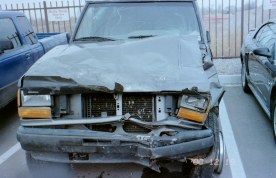
Driving over a small hill, I saw a car stopped beside the road about a quarter mile away. I activated my 4-way emergency flashers and began slowing down. Pulling up alongside the stopped car I noticed a partially frozen stream flowing beside the road. I leaned over, rolled down the passenger window and asked the man standing there, “Can I help you?”

The man said, “No, everything is under control.” Suddenly he looked up. His eyes widened in panic and he yelled “WATCH OUT!!” as he jumped, and tumbled downPICT0027 the embankment into the freezing water. Within seconds, a Ford going about 45 miles per hour slammed into the back of my Toyota. But at that moment another man, who had also stopped to help, walked unseen in front of me. The impact hurled my car and me about seventy feet down the slick road; but my car hit the unseen helper. He was flung around like a rag doll, and wound up under the car we had stopped to help.
My immediate thoughts were: What should I do? How should I respond?

Believe it or not, my only injury was a sprained neck which still gives me mild frustration today. As other cars arrived, I asked the first driver to go call for help (no common cell phones in 1970). I directed traffic until the police arrived. The police at first didn’t believe that the driver of my crunched car could walk away – let along direct traffic. But I did. We didn’t discover the man under the other car for another ten minutes.

 [Note: The police report verified that the driver of the Ford was careless. His insurance company paid for everything; and yes, the fifty-seven year old man under the car survived. However, he had a massive heart attack, spent four months in the hospital, endured additional years of physical therapy, and was crippled for life.]

After giving my report to the police and undergoing three visits from other lawyers for depositions, my lawyer asked, “What would you like out of this?” That puzzled me. Again, how should I respond?

The lawyer could not believe it when I said, “I do not want to sue anyone; I just want my car repaired. If I honor the Lord, He will meet all my needs.” My car was repaired. Five months later Boeing had a massive layoff, so we moved to New Mexico.

DSCN8505BI thought the ordeal was over, but about a year later I was summoned back to Seattle. The crippled man was suing (rightfully so) and a more detailed deposition was required from me. This time I underwent something like an FBI interrogation, and the interrogators’ questions were leading me to spin the 1970 incident in favor of the crippled man. Desiring to support the injured man but maintain total honesty, once again how should I respond?

Asking for my original deposition to refresh my memory, I answered the questions openly and truthfully, and added other details that came to mind. I didn’t bad-mouth the driver of the Ford, but I did remind them the driver was neither alert to what was going on around him nor aware of road conditions. My desire was to be totally open with information and honest in detail. The man won his lawsuit.

In every situation in life we can spin things to our favor, but that would dishonor God and ultimately dishonor ourselves. So to answer the my friend’s initial question (How should we respond?), I determine to be honest and helpful in every situation, regardless of the outcome; and I ask God to help me to make right decisions. That enables me to maintain an accurate memory, a clear conscience, and a good attitude.