The Purpose of prayer?

I’ve encountered three major concepts, with variations in each theme, which affect our prayer life. The following is a very brief overview.

First major viewpoint: Everything has been pre-determined by God, and we have nothing to say on any issue. In this scenario God has decided everyone’s fate in every situation, and all living beings (from amoeba to humans) merely play a role in a pre-planned, pre-scripted life resembling a Broadway play. I don’t agree with this, and there would be no need to pray.

Second: God has given everyone the authority to determine his/her own fate in every situation. In this scenario God doesn’t intervene. He may or may not foreknow our decisions or the outcome of our decisions. Again, there would be no need to pray. And again, I don’t agree.

Third: God desires every person to interact with Him (Deut. 30:19, Joshua 24:15, John 3:16). God created mankind with the authority and ability to make his own choices, but God gave the Holy Spirit, prophets, and eventually the Bible to mankind to enable us to know God’s desires (I Corinthians 2:16b). God knows everything that will happen, every decision that we will make, as well as the results and consequences of our decisions. However, not willing to impose His will on us, He is available to assist us in making the right decisions when we ask. I agree! God allows us to decide for ourselves because He does not want robots to worship Him. Making someone worship Him will never bring honor to Him. (See step #3 below.)

Prayer is not for the purpose of trying to change God’s mind. James 4:2b-3 says; “You do not have what you want because you do not ask God for it. And when you ask, you often do not receive it, because your motives are wrong; you ask for things to use for your own pleasures.” Nevertheless, our Father God wants to graciously act on our behalf.

God wants us to pray, but not selfishly. Jesus stated in John 16:23-24 that we are to pray to God the Father in Jesus’ name. Don’t think in terms of changing God’s mind, and don’t demand anything of Almighty God. Rather ask God to reveal to you how you should pray in each situation; then pray confidently, knowing He will hear and answer your prayers. So, what is the purpose of prayer?

  1. The purpose of prayer is to teach us to align ourselves with God.

Jesus said in John 17:22-23: “I have given these people the glory that you gave me so that they can be one, just as you and I are one. I will be in them and you will be in me so that they will be completely one.” This unity develops as we pray, study the Bible, and worship together.

  1. God’s purpose in answering prayer is to reveal our alignment with Him.

Jesus said in John 14:12: “I tell you the truth, whoever believes in me will do the same things that I do. Those who believe will do even greater things than these, because I am going to the Father.” (I’ll address the purpose of miracles another time.)

  1. The purpose of being in alignment with God is to put into effect God’s will on earth.

And Jesus said in John 14:13: “If you ask for anything in my name, I will do it for you so that the Father’s glory will be shown through the Son.” (I’ll address this another time.)

  1. The purpose of effecting God’s will on earth is to prepare ourselves for ruling with God later.

1 Corinthians 6:2-3: “Surely you know that God’s people will judge the world. So if you are to judge the world, are you not able to judge small cases as well? You know that in the future we will judge angels, so surely we can judge the ordinary things of this life.”

  1. What is the purpose of ruling with God in Heaven? I don’t know; the Bible doesn’t say.

Prayer is simply talking with and hearing from God. Philippians 4:6-7; “Do not worry about anything, but pray and ask God for everything you need, always giving thanks. And God’s peace, which is so great we cannot understand it, will keep your hearts and minds in Christ Jesus.”

True prayer is attempting to align our desires with God’s desires. Our lives in eternity will not be measured by what we do or what is done for us. Rather, our lives will be measured by the quality of our relationship with God.

So pray to God … and listen.

Life When the Power Goes Out

dscn3249In 2014 we were in Southern California visiting my Aunt Betty and the family as we celebrated her 91st birthday anniversary. We had an enjoyable time interacting with cousins whom we seldom see.

Aunt Betty had her sense of humor and her memory was good. When she asked if I remembered staying with her family when I was small, I surprised her with stories of several escapades with her sons Jim and Richard. Betty’s husband (Uncle Garnett) was already in heaven with my dad (Garnett’s older brother) and Aunt Betty still lived close to where my grandparents lived decades ago. When I related stories of my stay with the grandparents when I was seven, she addressed me by the name she gave me sixty-five years ago, and asked, “Little Blue-Gene, how do you remember all of that from so long ago?” I laughed and asked, “Aunt Betty, you are twenty-four years older than I am; how do YOU remember the past so well?” She laughed as we enjoyed the bantering, and she gave me an “Aunt Betty” hug.

My wife, Carol, spent time with my cousin Dave’s wife, Cheryl, and they shared some of theirdscn3268b views of Linzey family history. It was a full-house, and I enjoyed interacting with all the cousins. You know how it is at family reunions: since we don’t get together very often, we all try to catch-up on the latest. I even got many of their phone numbers on my cell phone. (Alas: the phone hiccupped and I lost most of them. I’ll eventually get them all back.) The cake was outstanding: beautiful, as well as tasty! The 91st birthday party was a wonderful event.

Suddenly, in the midst of the camaraderie, it happened! The lights began to flicker, got dim, then totally went out! Happy talking morphed into “What happened?” Laughter subsided. A touch of bewilderment set in. Several cousins lit candles and continued a different level of conversation while others got out the flashlights and checked the breaker-box. The breakers had not tripped. Some of the family became concerned about walking around in a darkened, crowded house because physical safety was now an issue. Basically, the big party was over.

dscn3272cThe mystery was growing until several of us looked outside, and VOILÀ! The power in the entire neighborhood was out. Taking it in good humor, Aunt Betty said, “Oh that happens whenever someone around here has a party. It was our turn this time.”

Some of the family decided to go home, but others of us stayed for a while because there is life when the power goes out. With candle light, we ate more cake, looked at more pictures, and told more stories. But gradually the energy level began fading and we all went home. That is not bad; it’s part of life. Carol and I eventually left with cousin Jim.

But isn’t it interesting how fear can creep into our minds when we are in the dark? Also interesting is how folk respond differently to the same power-outage. Some people might withdraw in fear and have difficulty reaching out to others; some leave the darkness for a lighter environment; yet others reach for the flashlight and help others find their way.

But there are other ways our “power” goes out. Sometimes life is going smoothly—we have a good-paying job, the grown children love us, our retirement income is covering our needs, we are in good health, etc.—and we have sufficient energy to get through and enjoy life. But suddenly, darkness descends and tries to suffocate us like a wet shroud: a family member dies, we develop cancer, the stock market plunges, or some other catastrophe thrusts us into the darkness of life. What should we do?

We can withdraw in fear and avoid others; we can fill our life with noise and activity toimg_1578 overshadow, or drown out our emptiness and hurt; or we can reach for the true source of light: Jesus Christ, the Light of the world (John 8:12). This light, Jesus, can expel all darkness and restore power and life if we turn to Him. Jesus said, “I’ll never leave you nor forsake you. (Hebrews 13:5)” There is still life when the power goes out; so share God’s light and life with others who are in the dark. 

An added benefit is: Jesus also supplies more power in life. You can trust Him.

Valentine’s Day

image00771I remember Valentine’s Day in 1965. Valentine’s Day was on Sunday that year, and Carol and I were attending SCC (Southern California College: now VUSC – Vanguard University of Southern California). I remember thinking: “If Carol accepts my invitation to the Valentine Banquet, I’ll know that she is the girl I will marry.” So, nervously, I asked her.

Laugh if you want. I am chuckling now as I write because I was somewhat immature at the time, and I was overcome with “puppy-love.” (Yes friends, she accepted.) I know that isn’t the way to1966 wedding decide whom to marry, but we DID get married a year and a half later — August 22, 1966 — and 52+ years later, we are still in love.

Someone asked Carol several years ago, “What’s it like being married to the same person for all those years?” Carol responded: “Oh, he’s not the same person I married. He’s changed.” She is right. Through time we all change — hopefully for the better. For one thing, my puppy-love grew into a true, full-fledged love for Carol. Maybe not fully-mature even now, but definitely going in that direction. I have learned (and am still learning) to love her with the love of Jesus Christ; and His love supersedes or surpasses any love humans think they have. But how do husbands and wives keep their love and devotion vibrant through the problem-laden decades?

Bishop Valentinus, or Saint Valentine as he is remembered, gave us a hint by manifesting a two-fold love: An undying, obedient, irrevocable love for God, and a deep, loyal commitment to people. And that’s what Carol and I have applied in our marriage through the years.

dscn7495Carol explains it this way: “Marriage is made in heaven. But it comes in a kit that must be assembled here on earth.” She also says, “Marriage is like a pyramid: God is at the top, with husband and wife at the bottom corners. When husband and wife focus on each other, they tend to repel each other. But if they both focus on God and grow toward Him, they inevitably grow closer together. And growing toward God helps us to become more like Him. Therefore, we find ourselves loving each other more with the pure love of God. That’s why God should be at the center of every marriage.”

That reminds me of a song written in Pasadena, California by Frederick Lehman; but the lyrics are based on a Jewish poem titled “Haddamut” written in Aramaic in 1050 AD by Meir Ben Isaac Nehorai, a cantor in Worms, Germany. The words to the chorus are: “Oh Love of God, how rich and pure! How measureless and strong! It shall forevermore endure the saints and angel’s song.”

Another supporting factor in keeping your love going strong is to let your spouse be your very best friend. That way, NO one can ever come between you! Carol has been my best friend for these 52 years, and she will never be deposed from that position as long as we both shall live.

Our friends Gary and Carol Kroah, formerly Associate Pastors of the Siloam Spring (Arkansas) Assembly of God Church say, “To start out, it’s not hard to love someone who is lovable. But our love for one another has endured through the years because of our mutual commitment to Jesus Christ and to one another. The closer we have been to Him, the closer we are to each other. Our determination to care for one another has motivated us to stay together, and love with unconditional love.”

Unconditional Love—growing toward God—growing closer together. It sounds like Bishop Valentine’s two-fold love: an undying, obedient, irrevocable love for God, and a deep, loyal commitment to people.

You’ve probably figured out that I like the Valentine’s Day celebration, but I do not subscribe to the superficiality ascribed by the world. Using the celebration as an enhancement in courting and marriage is fine, but don’t use it for defrauding someone or for sexual immorality.  A person who truly loves someone will act honorably toward that person. Acting selfishly or dishonorably is devoid of true love. Read 2 Samuel 13.DSCN0185

Jesus exhibited the purest love by sacrificially giving Himself in order that we may receive eternal life. (John 3:16 says, “For God so loved the world that He gave His only begotten Son [Jesus], that whosover believes on Him will not perish [eternally] but have everlasting life”. Respond to Jesus. Receive His love, and live. Happy Valentine’s Day.

Guided by GPS

navigation-system-147970I’ll never forget the first time I asked to be guided by a GPS gizmo. Ron, our oldest son, and his family were with Carol and me as we were traveling. It was night time, and we were looking for the motel. Ron said, “I’ll look it up on my cell phone.” That was a bother for my wife who had been my navigator all of our married life.

Carol said, “I can find it on the map like I’ve always done.” But I wanted to try out a new scientific gadget for the first time.

“Okay, Ron-ole-boy; find the motel.” So he programmed in the address, and we drove up to the side gate of an army base. As I turned the car around, Carol said, “I can find the right street by using the map.” But I wanted to try the GPS.

Ron reprogrammed and we drove around town, only to find a different gate to that army base. By this time Carol was a little irritated.

Ron reprogrammed once more, and we found the main gate … to that same army base. So I drove up to the soldier and asked him for assistance. He directed us to a 7-11 store. There, the clerk informed us that there were four (yes: 4) streets in town with that name, and the primary street was on the army base.

Have you ever been stabbed with a visual “I Told You So!”? Carol found that motel for us, but the “weather” remained cool for a while. (She forgave me the next day.)

GPS programming improved dramatically in the ensuing decade, and it seems that a great many folk have a GPS unit of some sort. I heard on the news that presently, there may be 10 billion cell phones with GPS apps installed. But what is GPS?

The Global Positioning System (GPS) is a satellite-based navigation system consisting ofearth a network of at least 24 satellites placed into orbit by the U.S. Department of Defense. GPS was originally intended for military applications, but in the 1980s, the government made the system available for civilian use.

These satellites circle the earth twice a day transmitting signals to earth. Receivers triangulate this information to calculate our precise location. The more satellites that are involved, the more accurate the results, and GPS units today are very accurate. Carol even likes using them now.

It’s fun watching the little blue dot (we call it the Blue Bug) moving across the screen of the cell phone as we drive across country. Carol often says, “The Blue Bug is staying with us.” But at times she will say, “The Bug is getting lost.” That’s when I make a correction and get back on the right street.

However, since the GPS units know our location, they also know our altitude. They enable precise operation for our interactive maps and our compass apps. The little gizmo can tell us where the restaurants, motels, and gas stations are, and can even tell us the temperature outside – all within seconds.

When we take pictures with our cell phones, the built-in GPS units record when and where they were taken. And when we cross a time zone, Carol and I always have a contest: whose phone changes time first?

Some folk worry that these technological advancements are a way for the government to keep track of us. That is correct. But they are also a great help to us. Many vehicles are equipped with OnStar which has helped a great many folk. OnStar located my car several years ago after it had been stolen.

But another GPS is available to those of us who honor Almighty God. I call this GPS “God’s Protective Service”.

Bible.docxAs I live by Godly principles that are found in the Bible, as I live for the Lord, as I as I honor God in every way that I know how, the Holy Spirit guides me. He knows where I am every second of the day, and knows what kind of difficulties I am facing. He sees what lies ahead of me, and gives me precise directions. If I am about to make a wrong decision, God sends a signal to get me back on track – if I’m listening.

Have fun with the GPS gizmos; but tune in to Almighty God for both temporal and eternal directions.

Forgive, and … What?

I overheard Clarence give the following advice to a mutual friend in Tulsa, “Forgive and forget, then forget what you forgave – otherwise you have not forgiven.” (A colleague had lied to the boss about Richard’s ability to do the job.) Later I told Clarence, “If the Bible says that, I will believe it.” Within a day or so he came up with the following verses:

Isaiah 43:25 – “I, I am the One who forgives all your sins, for my sake; I will not remember your sins.

Psalm 25:7 – Do not remember the sins and wrong things I did when I was young. But remember to love me always because you are good, Lord.

Hebrews 8:12 – I will forgive them for the wicked things they did, and I will not remember their sins anymore.

However, according to my studies, they did not verify Clarence’s statement, so the discussion turned to God’s character and the word “remember” in these verses. Agreeing that God is perfectIMG_1799B in every way, which includes His memory, Clarence asked if God can choose to forget. I suggested that we not confuse the issue, but stick to what the Bible says.

The word “remember” means “to be mindful or cognizant of” and “to hold in continual remembrance.” So, if God “remembers my sin no more” it means, based on my repentance, God forgives me and does not keep thinking about my error. Another way of saying it is: He does not hold that sin against me. I’ve been pardoned.

We then moved to the word “forgive.”

 “To forgive” means “to remove the blemish on the record resulting from the wrongdoing” or “to pardon.” The act of forgiving does not erase the offense or the event in real time because we cannot erase the past; but it is focused on purging the legal record related to the offense.

When President Obama pardoned seventeen people, he “… granted these individuals clemency because they have demonstrated genuine remorse and a strong commitment to being law-abiding, productive citizens and active members of their communities.” Obama did not eradicate what they did, but removed legal liability. That’s what God does for us, and is what we are supposed to do for those who offend us. The offense or event in real time is not erased, but the judicial verdict or sentence related to the event is expunged from our record.

When we allow the Lord to heal us from hurts caused by others, the memory of the offense may actually become clearer and the details of the offense take on sharper focus; yet the pain will be substantially lessened – and possibly erased. Nevertheless, although the offense often IS forgotten, forgiving does not necessarily include forgetting.

Forgiveness is a decision based on our attitude towards God and relationship with Him. One woman in California fabricated a rumor about someone she was jealous of in church. With the intent of damaging the woman’s reputation, the rumor made its predictable circuit and grew substantially in the process. Not yet knowing the outcome of the rumor, the perpetrator’s conscience began to bother her so she went to her victim, confessed, and asked to be forgiven.

The victim said, “I will forgive you, but first let me tell you what you did.” As she recounted the repercussions (which included the breakup of her marriage) of the rumor, both women were deeply sobbing with their arms around each other and the two women became life-long friends.

Personal forgiveness does not always set people free from legal mandates or from physical consequences on the human level. For these two women, repentance was deep, forgiveness was genuine, reconciliation was complete, but the memory remained for life.

In the later 1960s a man in Southern California was arrested for murder. The family of the victim showed up in court and in Christian love truthfully told the judge, “We forgive this man and would like to set him free.”DSCN5212

The presiding judge wisely said, “It is good for you to forgive him, and both God and I honor you for it. Your forgiveness clears the record between you and God. However, this man has also offended the United States of America and justice must be dispensed.”

dscn0464[1]Forgiveness is not about letting the offender off the hook, but returning the right to dispense justice back to God and to the appropriate human authorities. Forgiving others, and asking to be forgiven when we err, keeps our consciences clear.

Clarence and I cleared up the allegations about Richard’s abilities, and the slander backfired on the perpetrator. But the memories remain; so along with the Apostle Paul, we are to humbly forgive others, and use those memories as stepping stones for personal and spiritual growth.

You Can Change Your World

Do you feel trapped? Stuck in a rut? Has life penned you in with no wiggle-room? I calldscn9807 that “mental claustrophobia” and that’s a tough prison. How do we get trapped like that? Some folk might say life has dictated our fate. If you’ve watched the movie “Anne of Green Gables” you could say it’s because of a lack of imagination. Yet others may actually blame God for it.

But: Is it possible that you’ve been afraid of stepping out of your comfort zone to accept a new challenge? Has God been asking you to do something for which you feel unqualified? Please know that not following God’s leadership, for whatever reason, will generate a “stuck syndrome” and the only cure is to step out and obey the Lord. God may want you to change your world.

Here are a few of the brave souls who stepped out of their comfort zone and cooperated with God to change or preserve their world:

  1. For 100 years Noah obeyed God, preached, and endured mental and physical persecution while building the boat to save both humanity and land animals from total annihilation.
  2. Joseph, sold as a slave by his own brothers, obeyed and preserved Jacob’s family to allow it to become the Nation of Israel.
  3. Moses, the prince demoted to a fugitive shepherd, obeyed and led the fledgling nation back to the Promised Land, and compiled the first five books of the Old Testament.
  4. The Apostle Paul obeyed and gave us over half the New Testament.
  5. Martin Luther, standing against the established church, obeyed and reestablished the doctrine of “The just shall live by faith!”
  6. George Washington and Abraham Lincoln fought king and country, and obeyed to give us and preserve for us the United States of America.
  7. Hudson Taylor, one of the greatest missionaries since the Apostle Paul, stepped outside conventional wisdom and founded the China Inland Mission.
  8. Pastor William Boothe resigned his pastorate, obeyed and gave us the Salvation Army.
  9. Blind Fanny Crosby obeyed and gave us over 8,000 hymns.
  10. The Wright Brothers, willing to sacrifice their reputations, gave America the airplane.
  11. Henry Ford stepped outside conventional wisdom and gave mankind the automobile assembly line.
  12. Unknown Billy Graham picked up a Bible and started preaching.
  13. Harland Sanders challenged the restaurant industry and created KFC.
  14. President Kennedy announced the “impossible” and sent man to the moon.
  15. University student Michael Dell built and sold computers from his university dorm room, then his garage, and created the DELL Company.
  16. Robert Jarvik disregarded church doctrine and conventional wisdom and created the Jarvik artificial heart.
  17. And it is our Lord Jesus Christ who descended from heaven, sacrificed his human life, was crucified, died, but rose again, to offer us eternal life.

These people stood up and created a better world for us.

pict0268Great benefits could await us if we dare to step outside our comfort zone. No, I am not suggesting that we put safety and common sense aside, and I am not suggesting that we stop providing for our families. But we may have an invention tucked away in our God-given creative mind, we may have an idea that could improve the quality of life, or we may simply want to reach out and expand our horizons; but we must be willing to take a risk. The risk can span the financial, physical, emotional, or reputational realms; but with proper mentoring we can break out of our mental prison. God doesn’t want us stuck. Dependable, yes! But not stuck.
Now, if you are happy and content where you are and with what you are doing, don’t make a change for the sake of change; God may want you right where you are. And if you place a higher priority on security than on adventure, then stay where you are. There is nothing intrinsically wrong with that. But if for some reason you are unsettled with life as-is, talk with a counselor or a mentor you trust, and pray about it. God may have something in mind for you to do. And if the Lord does lead you to change your direction in life, don’t give a half-hearted effort; be diligent in what you do.pict0848

But remember, God doesn’t choose those who are self-reliant for His tasks; rather He chooses those who will cooperate with Him.

There is no need to feel trapped or stuck. Pray about your situation. As you cooperate with God, you might change your world.

What Does it Take ….?

I’m sure you’ve heard the question many times: What does it take to be a good leader? Of course, the answer depends on who is responding to the question.

Two major concepts are: a leader is born; and training produces a leader. Government and many large organizations lean toward the latter: proper training makes a good leader. And if someone fails, just retrain him or refresh his training. If he fails big-time, replace him and start over.

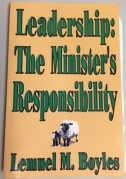
The late Dr. Lem Boyles, Col. ChC. USAF (Ret.) said in his book, Leadership: The Minister’sIMG_1819 Responsibility, “The need for well-trained, highly qualified leaders in the Christian realm is one of the most critical problems we face in the church today.” I agree, and that also applies to the secular world. Without well-trained leaders, our churches and organizations are faltering. But Dr. Boyles taught that training alone is not sufficient. True leadership entails more than just filling a vocational slot: true leadership involves a higher calling.
So, what does it take to be a good leader? I have an interesting book by Hans Finzel titled The Top Ten Mistakes Leaders Make. In other books we find many formulas and lists of qualities such as: “10 Keys to Successful Leadership” (different sets of ten by Sonya Shelton, Jill Geisler, Jonas Clark, and others). There are other sets of three, five, seven, twelve, and more. Various writers call out attributes such as emotional intelligence, influence, or authority as the key. But although those qualities are involved in leadership, they fall far short of being the keys.

John Marks Templeton stated a good point in his book Discovering the Laws of Life, “Someone who possesses good leadership abilities can accomplish much more [by leading] than one who pushes.” A leader is not one who stays in the background pushing for his agenda, but is out in front leading by example. Pushing people is similar to herding cats–it doesn’t work.

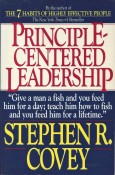
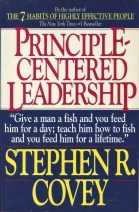
PrinciplesIn his book, Principle-Centered Leadership, Stephen Covey said, “…we often attempt to short-cut natural processes–substituting expediency for priority, imitation for innovation, cosmetics for character, style for substance, and pretense for competence.” Although they might not realize it, this is designed failure by incompetent leaders.
Covey stressed that true leadership is practiced or manifested “from the inside out.” Ruth Simmons, 18th president of Brown University, emphasized “There is no formula for inner work. Leadership is a habit of mind.”

Covey and Simmons point us to the true person: the core of our being: character, integrity. Character is involved in every aspect of our lives. Poor character is based on a façade of some sort, but good character is based on a foundation of truth. And good character is built into our lives by habitually choosing proper responses in every situation. As living and working safely is a result of good habits, so is good character.

So, what does it take? It takes a person of Godly character; one who listens to counsel but is not swayed by pressure. It takes a person who has committed to live by a high moral standard no matter what the circumstances are. Whether one is to be a leader in church, scouting, military, local or national politics, school, or business, the multiple and diversified qualities that are required can be boiled down to one word: Character. Make that two words: Good Character. Good leadership is character-based leadership.

So, what is good character based on? Humanism? No, that includes relativism. Reliable or trustworthy character can never be based on a “whatever is right for you” philosophy. That denies leadership. Is good character based on “all religions lead to the same destiny”? No. Various religions contradict each other; and some religions mandate killing people. That generates confusion and results in tyranny.

The bottom line is: Good character, integrity, is based on God’s law. And JesusCross summarized the law in His statements in Matthew 22:37-39; “Love the Lord your God with all your heart, all your soul, and all your mind. This is the first and most important command. And the second command is like the first: Love your neighbor as you love yourself.” This is the foundation for good character and sound leadership.

Do you desire a leadership position? Establish your relationship with God and ask Him to guide you. Establish a wholesome relationship with people. Take proper training. Excel in your vocation. Don’t push people. And when the opportunity arises, humbly accept the responsibility and remain accountable to others.

Detours in Life

Have you ever encountered a road-block or a detour? Is it frustrating? Aggravating? Do you wish you could give someone a piece of your mind?

Throughout our many travels, Carol and I find ourselves on detours periodically. For example,thFS0NDQ2Y several years ago we were minding our own business heading west on Interstate 70 when, suddenly, the dreaded sign appeared: Detour Ahead.

Carol had been napping, and although I was tired, I decided to stay awake – primarily because I was driving. But when the monotonous road noise changed, she woke up.

“Where are you going?” she asked.

“Well, I was making a bee-line to Denver, but at present, your guess is as good as mine.” Watching the actions of other drivers, it appeared that they might not have been as nonchalant as I was about the turn-of-events. I chuckled.

Carol asked, “What’s funny?”

“Precious, those poor drivers have not learned that emotional upheavals cannot change the way the highway departments do things – either good or bad. And they haven’t yet learned the value of detours in life.”

“Yeah, I suppose you are right. But where ARE we going now?”

“We’re heading north on Kansas State Road 232. Anything interesting on the map?”

After a few minutes of confirming our location, she said, “There is something called ‘The Garden of Eden’ on highway 18 between Lucas and Luray. Wanna go?”

“Sure; why not?”

We discovered Wilson Lake, and the scenery was beautiful. We stopped at The Garden of Eden to check it out. (We don’t recommend it; it’s not what the name infers.) After a bite to eat, we continued to Walde, Kansas. There we could have followed the detour signs and headed south toward Russell, resuming our monotonous freeway noise again. But since we were having such a good time seeing part of the country we had never encountered, we continued going through the towns on highway 18 until we arrived at Bogue, Kansas.

There we got onto highway 24 and drove another 100 miles to Colby where we were reacquainted with I-70. Carol and I thoroughly enjoyed our detour and learned more about our country. The detour set us back almost 3 hours; but that was not lost time–it was time invested together. And more importantly, my Precious and I made new memories together.

IMG_1434On another trip, we were returning from Missouri where we spent several days with two of my sisters and a brother. We had a good time. On the way back I said, “Let’s go home on some roads we’ve never been on. Carol chimed in: “Then let’s go to the War Eagle Craft Fair.” I agreed.

We turned onto Missouri highway 86. At a small town called Blue Eye, we headed south and found Arkansas 221. Again, Carol and I were enjoying the beautiful scenery. But at one point without warning, the asphalt highway morphed into a gravel road.

“Are you lost?” Carol asked.

“No, but we ran out of 221.” We laughed.

When we stopped at a cabin for advice, the man told us how to get back to civilization, eventually getting to Rogers, AR.

“Where will that route take us?” I asked.

“That’ll take ya through Eureka Springs, less you wanna either truck on the way yer goin fer nuther two hours throwin gravel, or back-track cupla hours.”

I thanked him and got back in the GMC Envoy. After discussing our options, we laughingly headed up to Eureka Springs–on a road we didn’t even know existed–and had dinner at one of our favorite places. We barely got to the War Eagle Craft Fair in time to check it out.

Detours don’t upset or aggravate us. They’re part of life. Our traveling motto is: “If we hit a detour, make a vacation out of it.” We’ve learned, however, to schedule into our plans extra time to allow for such excursions. And if we encounter no detours, we arrive early. Yay!

Some time ago I learned the following: “Inner peace begins the moment you choose not to letPICT0033 another person or event control your emotions.” I cannot control you or the highway department, but I can control my plans and reactions. I do this by asking God for direction in life which enables me to face life’s uncertainties with confidence.
Proverbs 3:5-6 says, “Trust in the Lord with all your heart and lean not on your own understanding; in all your ways acknowledge Him, and He will direct your paths.” Who knows? Maybe God purposely arranges some detours to gauge our maturity level.

Happy traveling, friends. 

Seven Helpful Habits

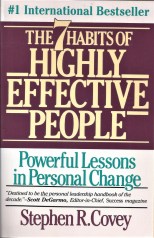
From 1994 to 2005 I was an operations officer in the Nuclear Physics division at the Los Alamos7 Habits National Laboratory. One of my responsibilities was to assure that our staff’s training was up-to-date. One day I read about a seminar titled, “The 7 Habits of Highly Effective People: Powerful Lessons in Personal Change.” That intrigued me, and I attended the seminar to see if I should recommend it to our staff. I’m glad I did, and it was my privilege to meet and talk with the speaker, Dr. Stephen R. Covey. Dr. Covey condensed his seminar into a book titled by the same name: “The 7 Habits of Highly Effective People.” (He passed away in July of 2012. America misses him, but his teaching will go on. And yes: I recommended this course to our staff.)
Covey taught that developing good habits presents more long-term benefits than trying to build a good image – corporate or personal. He said:

“The difference between the two approaches is similar to the difference between cramming for an exam and taking care of a farm. ‘Cramming’ is an image-based approach that nets temporary results, whereas taking care of a farm requires continuous, daily attention that will provide long-term dividends.”

And ‘taking care of the farm’ is the phrase he used for developing good habits for living.

The first three habits deal with the Personal Level. Individuals develop Independence by adherence to these habits.

Habit One focuses on taking control of life: Be Proactive. Don’t create or accept excuses for failure or lack of progress. Blaming or accusing doesn’t help anyone. And stop being overly concerned about things over which you have no control, but respond properly to situations. Covey called this: “response-ability”.

Habit Two is the development of a Personal Mission Statement: Begin with the End in Mind. Leisure time? Travel? More efficient teamwork? More effective sermons? Quicker meals? Whatever it is, define it. Whether you are a husband, wife, business owner, student, pastor, etc., develop goals to define your direction. This can be difficult; but once accomplished it will help you develop more effective leadership qualities needed in your personal or business life. It makes life easier and more enjoyable.

Habit Three is the essence of personal time management: Put First Things First. Separate tasks or projects under “urgent” – “important” – “necessary” – “desired.” This takes insight, planning, preparation, and promotes efficiency. It also greatly reduces time spent in crisis-management. That, in itself, is rewarding.

The next three habits deal with the Interpersonal Level. This section is more complex because practice of these habits leads to valuable Interdependence, which leads to personal and corporate maturity.

Habit Four is the philosophy that creates more productive, long-lasting relationships: Think Win/Win. We do not have to step on someone in order to succeed (except for sports games: one team must win). We need to fix in our mind that in order to truly get ahead we must depend on and help others. No one ever succeeds by himself. We must ignore our competitive instinct and help others succeed. The Win/Win concept requires courage and trust, but pays big dividends.

Habit Five is the skill that allows Win-Win to work: “Seek First to Understand, Then to Be Understood.” This concept made a long-lasting impression on me. Learning to actively understand someone else and his/her point of view is mandatory in order to effectively communicate our thoughts. If the other person realizes that I am concerned about him, he will be open to hear from me and perhaps willing to help me.

Habit Six is Synergize. Often (but not always) a corporate concept produces a better solution than our individual ideas. And this is actually the fruit of Habits four and five.

And Habit Seven is Sharpen the Saw. Our skills and methods are never perfect. Therefore, we need to continually hone or refine them.

PrinciplesThe information I gained at the seminar, and in reading the book, did not guarantee quick fixes to any personal, interpersonal or business problems. But I was supplied with tools to improve my communication skills, my outlook on life, and reduce unnecessary friction.

I also recommend two other books: “The Leader In Me” and “Principle-Centered Leadership.” To learn more about the “7 Habits” and other Covey books, contact Franklin Covey Co., Debra Lund, 801-244-4474; Debra.Lund@FranklinCovey.com.

Enhanced Character Reduces Stress

So you want to improve your character? Zig Ziglar said: “The foundation stones for a Dad's 85th0009balanced success are honesty, character, integrity, faith, love and loyalty.”

So how do we improve our character or integrity? Think about the following account.

An acquaintance of mine was on his way to an appointment when his right front tire blew out. He immediately lost control of the car; he hit the guard rail, bounced into another car, and finally came to a stop in the median. It was called an accident.

A legal definition of accident is: an unforeseen event that occurs without anyone’s fault or negligence.

Sooooo, was this truly an accident? The answer is No. Why? It could easily have beenPICT0027 prevented! He knew that his tire pressure was very low but he wouldn’t take time to inflate it to the proper pressure. “I’ll take care of it next Saturday.” he said. But he didn’t.

Proper tire care can prevent many automobile calamities, and really, we are never too busy to be safe. My friend understood the benefit of punctuality (honoring others by being on time) but he didn’t quite figure out the benefit of initiative (accomplishing what needs to be done in a timely manner).

While not all problems are this simplistic, many of them are. A fatal situation I read about some time ago was when a father ran over his five-year-old son in the driveway of his own home. Was that truly an accident?

The father said that he didn’t know the child was out of the house. Guess what? The kid is dead! All the dad needed to do was walk around the car to check for children, bicycles, toys, etc. before putting the key in the ignition. If the father had made alertness part of his daily habit (being aware of what is happening around me so I can respond properly), the child might still be alive today. Believe me: he does the walk-around now.

Jesus wants us to be safe and aware of what is happening; so being alert enhances not only our character, but also can make us more like Christ.

So I ask the question again: were these events truly accidents? The answer in a great many situations will be “No.” Instead, these situations were caused by negligence, ignorance, apathy—or a combination of the three. So what is needed to rectify those situations? What does it take for personal growth?

You can call it character, integrity, reliability, or spirituality. I don’t care. Whatever you call it, I call it Godly Character. Character is what determines a person’s response regardless of the situation.

In Reflections On Faith & History [found at https://www.amazon.com/s/ref=nb_sb_noss?url=node%3D154606011&field-Front cover - finalkeywords=Reflections+On+Faith+%26+History], I addressed numerous questions that many people asked me through the years. My desire was to help people grow both spiritually and intellectually by helping them to gain a more complete understanding of the Bible. I did this by presenting some of the history and culture of the times as it related to the Scriptures. Learning also helps us grow in our character or integrity. It is actually learning to become like Christ.

1) We learn to know and to incorporate the mind of Christ.

2) We learn to interact with others in a wholesome, uplifting manner.

3) We learn to stop being self-centered.

4) We are enabled to fulfill our destiny and enjoy life.

I was a bi-vocational pastor while working at a national laboratory. I had previously worked in the aerospace industry, direct sales, and several other areas. Wherever I went I watched people at work, at play, in the stores shopping, and driving their cars. It was apparent that many people–including Christian–were either uninformed about how to properly conduct themselves, or they didn’t care. It didn’t make sense to me until I began studying about character and integrity.

I found that if we attentively–the key is attentively–read about the Lord and study His integrity, His character, His nature, and diligently apply Biblical principles to life and life’s circumstances, we will be surprised at how our lives will be changed for the better. We will be able to traverse life with less stress, less frustration, more understanding of people, more personal contentment, and live a more fulfilled life. Reading First Corinthians 13:4-7 will help.

So, how does this reduce stress? I’m glad you asked.

As I grow in my understanding of life, I have less reason to get upset over mistakes, errors, or misunderstandings. I am more apt to see things from Jesus’ point of view, and can more easily forgive people. This allows peace to flow through my being and I can share that peace with others.

As you think on the character of Jesus, I pray that you, too, learn to incorporate His integrity into your life.