
 “Carol, look in the back yard!” I called to my wife. A large cat was lying motionless on the lawn intently observing something. But why was it there? What was it looking at?
Many animals visit our yard: squirrels, rabbits, lizards, opossums, racoons, over thirty varieties of birds, and four varieties of snakes. At times we are visited by deer, turtles, the neighbor’s pets, and this stray cat.
We’ve always been partial to cats and rabbits because they are soft and cuddly. Well, I  was partial to rabbits until I planted our garden. The furry little creatures seem to have a taste for my beet greens, Carol’s pea plants, and our broccoli. As I was chasing one rabbit out of the garden, I hollered, “Have you ever heard of rabbit stew?” The leporid probably didn’t hear me as it darted through – yes, THROUGH – the chain link fencing. I didn’t know they could fit through the diagonal openings. From the next yard it stopped, turned around, and looked at me as if to say, “You can’t catch me!” only to run for its furry life as the neighbor’s barking dog took up the chase. Good dog!
In deference to Carol, I decided not to shoot the furry critters; but I also announced that I would no longer run out and chase them out of the organic grocery store. And in time the rabbits felt safe and became more lethargic as they regained emotional control of the yard. This brings us back to the motionless cat in the back yard.
Carol and I observed the cat’s posture and the direction it was facing. It was flat on the ground, ears laid back, eyes just above the grass-line – reminding us of a lion on the prowl. Then Carol asked, “Is that a dog in the garden?” I saw a brown animal, but from my vantage point of looking through the tomato bush, I couldn’t tell. Then, the brown thing moved.
“It’s a … is it an … owl?” I asked incredulously? Then it raised its head, and with a three-foot wingspan it gracefully flew away. 
“It’s a big hawk!” Carol exclaimed. It was a beautiful, mature Broad-winged Hawk. These birds can see a rabbit from two miles away, but with our trees surrounding the yard, it must have been a mile straight up. And with a deathly-quiet diving velocity of almost 200 MPH, the unwary rabbit didn’t have a chance. Why did the Broad-wing leave without finishing its dinner?
Then the large cat stood up and … large cat? It was a normal-sized critter. What happened? The feline apparently had several things going through its cunning little mind: “I’ve never seen a bird that big! Is it edible? Make myself look as large as possible for protection. Proceed with caution!”
The critter flattened and made itself look as wide as possible and was inching its way toward the hawk; but the hawk finally saw the “large” cat approaching, got nervous, and flew for safety. The cat walked up to where the bird had been, saw the rabbit’s carcass, decided it wasn’t that hungry, then it also left the scene of the crime. That left just the lifeless intruder and me. At that point I wasn’t upset with the rabbit, and actually felt sorry for it.
As I buried it, I began thinking about the situations we humans get into. The hapless rabbit merely wanted a tasty salad, and ventured out into the open where it was unprotected. What is it that misguided humans want? People often venture into areas of life that God has declared off limits because they are dangerous physically, emotionally, and spiritually. Our conscience and the Holy Spirit try to keep us out of the “garden” but as we focus on the “beet greens, pea plants, and the broccoli” of life, we tune out the warnings and gradually become insensitive to the dangers accompanying our actions. Then judgment  appears “out of the blue,” like that Broad-winged Hawk after the rabbit. Then we ask, “How did I get caught?”
We have no excuse because Romans 2:15 tells us, “In their hearts they [people] know what is right and wrong, just as the law commands. And they show this by their consciences. Sometimes their thoughts tell them they did wrong, and sometimes their thoughts tell them they did right.”
The rabbit let its guard down, lived carelessly, and died. Let’s not make that mistake: but obey Scripture, honor Jesus Christ and others, and live.
 green, but four weeks later the entire tree was a desert brown. It was fascinating because all our other trees were in great shape. Well, I do need to tend the crepe myrtles and prune them a bit. Back to the pine tree later.
 male and female he created them” (Genesis 1:27). God is a spiritual being, and we are spiritual beings – inside human bodies. Mankind was the high point of God’s creative work here on earth. God created us as an entirely new species, quite different from animals. And to emphasize this distinction, God placed man over the animals. In Genesis 1:28 God told Adam, “Rule over the fish of the sea and the birds of the air and over every living creature that moves on the ground.” Animals can’t do that.
 interaction. Evolutionist Julian Huxley noted that “Only humans possess true language, conceptual thought, art, humor, science and religion.” And only humans can record and direct the course of history. Humans can express themselves analytically. And it is obvious that only humans have the ability to communicate through complex, multi-lingual skills. All this sets mankind apart from the animal kingdom.
  humans do care for the elderly. Animals do not have the intellectual,
 emotional, and relational mentality, or the skill or ability to interact and build an enhanced society; but man has been to the moon and back. Instead, animals have continued their lives without change for the past recorded 6,000 years. When you hear or read some scientist say that 98% of our genes are shared with some animals, don’t get excited about it. They also say we share about 50% of our genes with bananas. So the statistics are meaningless.
  In 2014 we were in Southern California visiting my Aunt Betty and the family as we celebrated her 91st birthday anniversary. We had an enjoyable time interacting with cousins whom we seldom see.
  views of Linzey family history. It was a full-house, and I enjoyed interacting with all the cousins. You know how it is at family reunions: since we don’t get together very often, we all try to catch-up on the latest. I even got many of their phone numbers on my cell phone. (Alas: the phone hiccupped and I lost most of them. I’ll eventually get them all back.) The cake was outstanding: beautiful, as well as tasty! The 91st birthday party was a wonderful event.
  The mystery was growing until several of us looked outside, and VOILÀ! The power in the entire neighborhood was out. Taking it in good humor, Aunt Betty said, “Oh that happens whenever someone around here has a party. It was our turn this time.”
  overshadow, or drown out our emptiness and hurt; or we can reach for the true source of light: Jesus Christ, the Light of the world (John 8:12). This light, Jesus, can expel all darkness and restore power and life if we turn to Him. Jesus said, “I’ll never leave you nor forsake you. (Hebrews 13:5)” There is still life when the power goes out; so share God’s light and life with others who are in the dark.
 One of our routes to Springer was through Espanola and up the canyon through which flowed the Rio Grande. At La Cienaga we turned east toward Sipapu then over the mountains and down into Mora. And that is where my hands turned red – or maybe, purple. Mora is well-known for its raspberry farm, and Carol had often asked me to stop and pick raspberries. Each time I said something like: “I’m going to be preaching and teaching, and berry-picking isn’t on my mind.” Although that was true, it was also a smoke-screen: I didn’t want to pick berries.
 juice, and she was so gentle in her running commentary about how delicious those berries would be in ice cream or made into a berry jam, that my mouth drooled and I just had to stop. When Carol excitedly asked, “Are we going to pick berries?” I said, “Yes. I don’t want to, so this will be a labor of love.”
  do ever for Carol? Where I merely paused on my trip and received a few scratches on my arms, Jesus deliberately left His home in heaven and came to earth to rescue mankind from an eternal separation from God the Father. Jesus didn’t have mere scratches on His arms; the soldiers made a wreath containing inch-long needle-sharp thorns and jammed it onto His head. Jesus purposely allowed Himself to be killed in a gruesome manner in order to reveal the depth of the pain we would suffer eternally without God.
 . That is the concept that all truth is relative to the individual, time, or place. However, relativism is a faulty philosophy that attempts to negate absolutism. Absolute means: complete; not limited by restrictions; unconditional; unrelated to and independent of anything else. Interestingly, after a short investigation we find absolute truth in math, history, the Bible, and in every-day life. Often, the denial of absolutism is not about life, but is aimed at the reality of God and the deity of Jesus Christ. And the one who claims his own reality actually claims to be the supreme ruler in his own life; but living for just twenty-four hours will prove that is false.
  Another example of absolute reality: God knew you would be born and that you will live forever – somewhere; but it is your choice as to your eternal destination. Whether or not you believe in heaven or hell does not change the reality of either place: our personal belief neither establishes fact nor eradicates truth. Absolute truth stands on its own foundation.
  in every way, which includes His memory, Clarence asked if God can choose to forget. I suggested that we not confuse the issue, but stick to what the Bible says.
![dscn0464[1]](https://genelinzey.com/wp-content/uploads/2018/10/dscn046412.jpg?w=197&h=180) Forgiveness is not about letting the offender off the hook, but returning the right to dispense justice back to God and to the appropriate human authorities. Forgiving others, and asking to be forgiven when we err, keeps our consciences clear.
Forgiveness is not about letting the offender off the hook, but returning the right to dispense justice back to God and to the appropriate human authorities. Forgiving others, and asking to be forgiven when we err, keeps our consciences clear. that “mental claustrophobia” and that’s a tough prison. How do we get trapped like that? Some folk might say life has dictated our fate. If you’ve watched the movie “Anne of Green Gables” you could say it’s because of a lack of imagination. Yet others may actually blame God for it.
 Great benefits could await us if we dare to step outside our comfort zone. No, I am not suggesting that we put safety and common sense aside, and I am not suggesting that we stop providing for our families. But we may have an invention tucked away in our God-given creative mind, we may have an idea that could improve the quality of life, or we may simply want to reach out and expand our horizons; but we must be willing to take a risk. The risk can span the financial, physical, emotional, or reputational realms; but with proper mentoring we can break out of our mental prison. God doesn’t want us stuck. Dependable, yes! But not stuck.
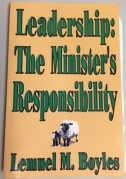 Responsibility, “The need for well-trained, highly qualified leaders in the Christian realm is one of the most critical problems we face in the church today.” I agree, and that also applies to the secular world. Without well-trained leaders, our churches and organizations are faltering. But Dr. Boyles taught that training alone is not sufficient. True leadership entails more than just filling a vocational slot: true leadership involves a higher calling.
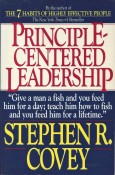 In his book, Principle-Centered Leadership, Stephen Covey said, “…we often attempt to short-cut natural processes–substituting expediency for priority, imitation for innovation, cosmetics for character, style for substance, and pretense for competence.” Although they might not realize it, this is designed failure by incompetent leaders.
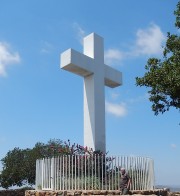 summarized the law in His statements in Matthew 22:37-39; “Love the Lord your God with all your heart, all your soul, and all your mind. This is the first and most important command. And the second command is like the first: Love your neighbor as you love yourself.” This is the foundation for good character and sound leadership.
 several years ago we were minding our own business heading west on Interstate 70 when, suddenly, the dreaded sign appeared: Detour Ahead.
 On another trip, we were returning from Missouri where we spent several days with two of my sisters and a brother. We had a good time. On the way back I said, “Let’s go home on some roads we’ve never been on. Carol chimed in: “Then let’s go to the War Eagle Craft Fair.” I agreed.
 another person or event control your emotions.” I cannot control you or the highway department, but I can control my plans and reactions. I do this by asking God for direction in life which enables me to face life’s uncertainties with confidence.
  Gene Linzey