Set Beneficial, Wise Goals

An acquaintance was driving on a cross-country trip and spotted something vaguely familiar beside a barn. He stopped at the farm house to enquire about it. The farmer hadn’t thought about selling it, but gave George permission to check it out.

As George approached the car, his eyes saw a rusty, dilapidated, 1958 Buick Roadmaster. The leather seats were shredded with springs protruding, covered with animal fur and chicken feathers – in much the same condition as pictured here.. Two windows were broken with the other two down. The chrome was peeling, and all four tires were cracked like a dried up lake bed, and flat. As he managed to open the hood, the scared cat hissed and jumped off the engine, and George saw what used to be radiator hoses and electrical wiring dangling uselessly: they had long-ago deteriorated.

But in George’s mind, he saw something else.
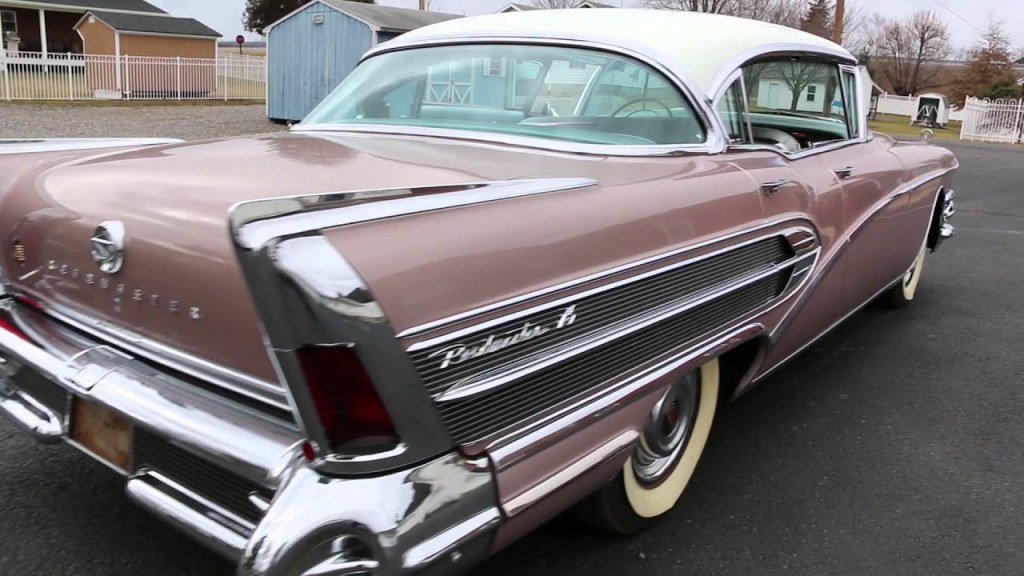
He saw a bright, shiny, light-burgundy, 1958 Buick Roadmaster with a circled V on the front grill, and a gleaming white roof. In his mind he saw the shiny chrome all around the car with sunlight glinting off it, the electric windows working, and new soft and pliable leather seating inviting him. Ultimately, he saw himself slowly cruising through town, smiling as the men oohed and aahed over it. In George’s mind, it looked just like the one his dad owned when George was in elementary school. THIS is what he longed for.

George’s new years resolution was to make this dream come true.

George had a garage where he would do most of the work himself. He would buy the books for body, engine, and electrical work; he knew a painter in a nearby town who would paint it that beautiful light-burgundy color; and knew a man who could replace the windows.

He made the farmer an offer, and after a little negotiating the deal was done. In two days, the cat had to find a different hiding place as a truck hauled the soon-to-be-renovated-beauty to George’s garage. He was ecstatic!

That was four years ago.

How many times had his wife said, “George, when are you going to stop procrastinating.” It wasn’t a question – it was a demand. “Why did you bring it here in the first place! Will you please do something with that rusty hulk?” That last one was a plea.

What happened? Very simply, George found himself not wanting to do the work. With all the right intentions and a dream to be fulfilled, George set unrealistic goals for himself. In the vernacular, he bit off more than he could chew.

He envisioned the finished product, but he didn’t know how to go about it. He also found out that he didn’t have the desire to get out the sander and throw sparks all around the garage and smelling ozone while sanding every square inch of the rusty hulk (the title given to it by George’s wife). Every time he looked at the ghost-of-the-past, he mentally sunk lower.

Why did I ever bring it home? He wondered.

When he finally prayed about it, asking the Lord if he should start the project, or perhaps if there was something else he should do with it, an interesting idea came to him. Perhaps it was from the Lord. He made an appointment with the pastor and shared the idea with him.

“Great idea!” boomed the clergyman, and he called in the youth director.

“This could be the answer to one of my prayers.” the youth pastor said. “I’ve been looking for a project for the high school boys.”

George gave Rusty Hulk to the church as a gift, and George’s wife got her garage back. Borrowing tools from their parents, the teen-age boys had a ball removing old seats, stripping the rusty shell of everything that was possibly removable, and throwing sparks as shiny metal emerged.  

To make the story short, George wasn’t procrastinating. Desiring to fulfill a childhood dream, George attempted to do something that was not his calling. When he finally realized it, he was able to let it go.

When the church youth group was through, it wasn’t the Light-Burgundy Blazing Beauty that George imagined, but it was nice. The church sold the Roadmaster, and the substantial profit was used to set up a workshop where the youth group could do other projects. George’s gift kept on giving.

Do you find yourself procrastinating when it comes to finishing a project or reaching a goal? The solution might be to create a workable New Year’s Resolution. Pray about each project, and see if that’s what the Lord wants you to do. See if it’s something you really want to spend your time doing … or even have the skills to do. Setting goals too high might not be compatible with your God-given creativity. So, don’t do that.

May the Lord bless you as you wisely set goals this year.

Happy New Year!

Tales From the Road: Tillamook Cheese

Years ago, I saw a movie about a woman who wrote for a newspaper. She ran out of ideas, so she began writing about different uses of cheese. After five weeks, the editor called her into his office. When the writer revealed what amounted to burnout or loss of imagination, the editor blurted out: “You’re a good writer – write about anything. But no more cheese, lady!”

That was the best line in the movie.

However, since I hadn’t written about that use of milk, since Carol and I were in the town of Tillamook, Oregon, and since I really like cheese, I decided it was time to write about it. When my editor read it, he approved, so I sent him some.

Tillamook is a Native American tribal name, but that’s another story.

Mankind has been making cheese for over 4,000 years, and I read that there are 1,831 kinds of cheese. Cheese is classified by geographic origin, what animal gave the milk, the animal’s diet, age of cheese, texture, added ingredients, butterfat content, and a lot more, and by combinations of all the above. Most milk used in cheese production is from cows, but cheese is also made of milk from goats, camels, sheep, yaks, buffalo, and even reindeer. I wonder if anyone tried giraffe milk.

Tillamook is my favorite brand of cheese, and Colby Jack (marbled yellow & white) is my favorite kind. Don’t ever confuse Colby Jack with Pepper Jack. That stuff is hot! (My editor liked it.)

The Tillamook Cheese Factory is a dairy cooperative that was founded in 1909. My first visit was in the summer of 1991 with Carol and the younger two kids (Rebecca and Michael), and this is my third visit. Over a million people a year must have the same taste for cheese as I do and visit the Tillamook Cheese Factory, so they built a new visitor center, updated its name to Tillamook Creamery, and added a food court.

There is no admission price. You walk in and learn while you enjoy all the free cheese samples.

So, how is cheese made? If you already know, skip the next four paragraphs.

Milk is poured into a vat and an enzyme, rennet, is added to coagulate it. (But juice from fruit, fig leaves, melons, safflower, vinegar, lemons, and other vegetation can be added instead.) This causes the milk to curdle and separate from the liquid whey. Tillamook’s vats hold 53,500 pounds (over 6,300 gallons) of fresh milk. As the milk is stirred, the curds and whey separate. The whey is drained into another container while the curds begin to stick or knit together. This is called cheddaring.

Ten pounds (1 gallon plus 2.5 cups) of cow milk will produce one pound of cheese, while six pounds of sheep milk will produce a pound of cheese because of its much higher fat content. Goat cheese production is similar to cows.

I hope this isn’t boring you. The whole process fascinates me.

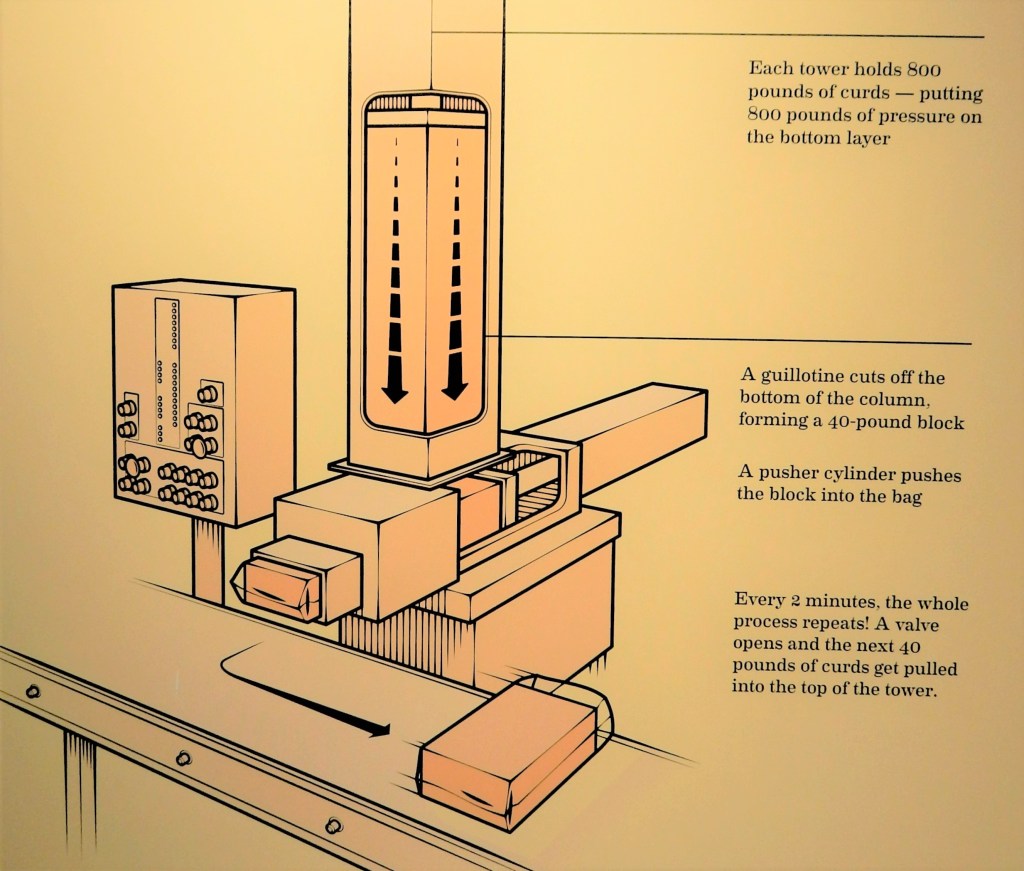
The curds are chopped, cut, and pressed to release more liquid. Then the cheese curds are poured into a square column and pressure is slowly increased. When pressure finally reaches 800 pounds, it is held for two minutes then cut into 40-pound blocks. The blocks are stored and aged from 60 days to five years – depending on their intended use.

After the proper aging, the blocks are cut into smaller blocks – normally, half-pound, pound, and two-pound blocks. Mis-shaped or broken pieces are made into shredded-cheese. The Tillamook Creamery packages about a million pounds of cheese a week, and that takes about 1,160,000 gallons of milk each week.

There are hundreds of uses for the whey. It is commonly used as an ingredient in some drink mixes, protein bars, and other foods. Whey powder is often added to smoothies and other workout foods for its protein.

The Tillamook Creamery center is a 38,500-square-foot building that allows visitors the privilege of learning about each step of the milk-to-cheese process and allows them to actually see production from the second-floor level.

We visited the facility twice this week and really enjoyed learning. We ate lunch there, but the best part was the large Tillamook ice cream cones! Carol got huckleberry and chocolate-peanut butter, while I got chocolate and vanilla. That, with the free cheese samples on the second floor, topped off our meal.

If you get a chance, visit the Tillamook Creamery in Tillamook, Oregon.

Tales From the Road: An Easy Pull

I am happily surprised at how easily our 8-gear GMC Yukon pulled the trailer over the mountain passes.

I faced my first major concern of the trip as we drove over Wolf Creek Pass, just north of Pagosa Springs, Colorado. I had gone over the pass many times, but not while pulling a trailer. However, my concerns were unfounded. We easily climbed the mountain as we passed other over-heated cars on the side of the road that were not pulling a trailer. Our 5400-pound Yukon pulled the 5,000-pound trailer over the steep 8-mile incline to almost 11,000 feet altitude with no problem. Normally driving in either the 6th or 7th gear while pulling the trailer, we dropped only to 4th and 5th gears during the climb, and the engine temperature raised only about 25 degrees. I was a happy camper! (I didn’t need to stop and help the stalled drivers, for their help had already arrived. We were not callously ignoring them.)

We encountered several minor climbs and passes on our way to Buena Vista, Colorado, and several stiff climbs from there to Denver; but we were not in a hurry and the engine worked wonderfully.

We didn’t encounter any harsh winds, and thanks to the sway bars, the trailer has swayed very little. We check the weather report every day to see what kind of weather we might encounter, but if we are caught off-guard and if the trailer begins to sway, all I have to do is to push two levers near the steering wheel and power will be applied to the trailer’s brakes which will stop the motion. This car was built from the bottom up to handle the load.

The Yukon has … let me interrupt myself. I am not paid to advertise the GMC Yukon. I am merely relating my experiences, feelings, and thoughts.

Now, where was I? Oh yes …

The Yukon has many features that make it an ideal vehicle to pull a trailer. Although it is built to pull up to 8,000 pounds, the trailer is only 5,000 pounds with all of our stuff in it. Therefore, as long as I treat the car properly, change oil regularly, keep air in both trailer and car tires to the proper pressure, etc., the car should last quite a while.

Yes, I understand that unforeseen events happen. Mechanical things sometimes break down and many kinds of problems can occur. But with our 8-year GMC warranty and our AAA insurance coverage, I should have no major problems.

Towing the trailer is an easy pull for the Yukon.

But all this reminds me of our human life.

Do you know that God made humans to normally last a long time? The Bible infers that God originally made us to live forever. However, since Adam introduced sin into the human race, the Bible says in Psalm 90:10, “Seventy years are given to us. Some live to eighty. But even the best years are filled with pain and trouble; soon they disappear, and we fly away.”

My mother and grandparents lived into their 90s, and my father lived to 89, but some folks overheat and stall out along the side of life much earlier. Longevity of life often depends on genetics – I understand that. But many people seem to just give up on life.

I’ve read that some soldiers in World War II with seemingly mortal wounds survived because they were determined to survive; while some others with no wounds pulled the cover over their heads and died. They just gave up, and that is disgusting.

As long as we are alive, most of us have the abilities to accomplish amazing feats. Like the Yukon, God made us to be resilient.

Life can present a temporary stall out, a long-term burnout, or a fatal crash – it often depends on our outlook on life. And we must remember that until Jesus returns, this physical life will come to an end. But when we look at life on the positive side of the picture, life can be a relatively easy pull up the mountain.

Of course, we need to take care of ourselves. Eat properly, rest adequately, exercise, keep worry to a minimum – or don’t worry at all – and keep a joyful attitude during tough times. The Bible says a joyful attitude is good medicine. So, cooperate with God and take care of yourselves.

Happy Trails To You, ‘Til We Meet Again – next week.

Tales From the Road: Road Hazards

Carol and I enjoy traveling. We drive the speed limit, observe traffic rules and cautions, and watch out for hazards. Watching out for hazards is sometimes nerve-wracking because there are many kinds of them.

Potholes and broken sections of pavement which can destroy tires account for most of our hazards. I’ve seen one accident that was caused by a driver who swerved to miss a big hole but hit another car.

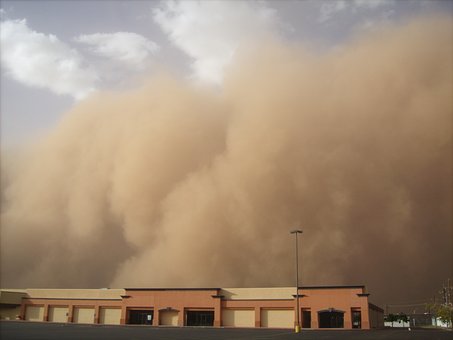
Another hazard that drivers sometimes face in the deserts of Southern California, Nevada, and Arizona, are sandstorms. We didn’t encounter those storms on this trip, but four years ago we got caught. The sand was blowing at 40 mph and was so thick that I couldn’t see more than 20 feet in front of me. When that storm was over, the windshield needed to be replaced.

Yet other hazards crop up: animals on the roadway. Rabbits, racoons, squirrels, and other small game just get squashed, and it’s over. Dogs, deer, coyotes, and the like can present more of a challenge, but elk, cattle, and horses can prove to be fatal – for man and beast.

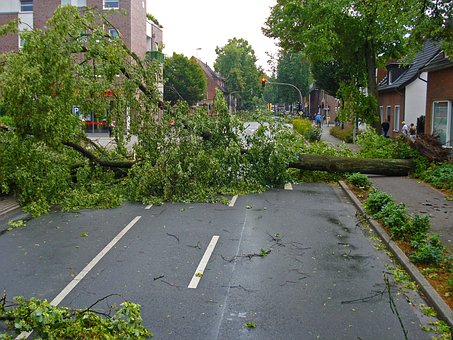
Another hazard we’ve seen – but haven’t been affected by – are downed trees across the roads. Nature has been acting up lately and high winds have been howling through the forests. About a mile from where we are staying, a large tree fell across the road after midnight. It was still dark, and by the time a tired driver saw the tree, he didn’t have time to hit the brake. It took over two hours for the ambulance crew to remove the body, and the highway department to remove the wreck and the tree.

But of all the hazards we face on the highways, one stands out like a sore thumb. It is a high-speed hazard called a Motorcycle!

 All over the United States we see signs reminding us about them. “Be courteous: share the road.” “Watch out for motorcycles.” “Save a life.” “Start Seeing Motorcycles.” And others.

But the more ominous problem is that many of the motorcyclists are not watching out for themselves! I hear the complaints from many RVers across the country. At medium to high speeds, motorcyclists disobey traffic rules. At high speeds, they weave in-n-out of traffic and zip past us between the lanes. The interstate freeway speed limit may be 70mph, and we may be going 65mph while most cars buzz past us doing 70-80. But many cyclists shoot past us doing 80-90 or higher!

When I want to change lanes, I turn on my signal, check my side mirrors, rear-view mirror (if I’m not pulling a trailer), and ask Carol if the way is clear. When I hear and see that all is clear, I pull over. But several times as I was about to change lanes, a motorcycle zoomed out of the distance at over 100 mph ignoring my turn signal. I would’ve been hit if I completed the lane-change, and the cyclist probably would have been dead. Complicating the problem is: if we collided, the default verdict would normally be against the driver of the car.

On one of our trips, we were driving 45 mph east on I-8 up Mission Valley in San Diego. The traffic was heavy. A motorcycle passed me at high speed on the inside shoulder between the concrete highway dividers and my car. I told Carol, “I hope he doesn’t kill himself.”

This photo is that of a different fatality.

About ten minutes later, traffic came to a crawl as the two left lanes began merging into the two right lanes. We eventually passed a damaged car, the mangled bike, and the rider’s broken body. The ambulance had not yet arrived.

There are many hazards on the highways and byways that we watch out for. But we must make sure that we don’t become the hazard.

Do you know that living according to Biblical principles can make our life safer? In Romans 13:1-5, Paul teaches us about obeying those in authority over us. That would include obeying speed limits, wouldn’t it? It includes being courteous drivers and giving others room to enter our lane without crowding them. And according to the principle in Matthew 25:40, if we show kindness to other drivers, we are showing kindness to Jesus.

We also should pray before we get out on the road. God can warn us of danger, remind us to be safe, and can protect us from unsafe drivers.

Tales From the Road: Danger Warnings

How many of you have a trailer, 5th wheel, or motor home? Perhaps I should also ask, how many of you formerly had one? You folks know there are many things to consider while living in an RV and things can go wrong.

While setting up in a campground or park, we need a level spot, or we need to use various items to level the rig. We need to connect to the proper power – 20, 30, or 50-amp service – and include a heavy-duty surge-protector in the circuit. We never know when rain and a thunderstorm will descend on us, or if other catastrophic electrical surges will hit. And as we connect to the water supply, we need to have a pressure-limiter to protect the plumbing. Believe-it-or-not, many campgrounds have high water pressure which can rupture plastic pipes.

When setting up the drain for the gray and black tanks, we need to assure that the tube cannot come loose during the draining operation. That would be a mess, especially with the black tank, and could cause a political or environmental mess. Oh yes: the gray water is from the shower, bath, and sinks. The black water is from the toilet. And when draining both tanks, we drain the black water first and let the gray water flush everything else down the drain. Of course, you want to have an attachment to rinse the tube with fresh water after you drain both tanks.

Until we bought our RV, we didn’t realize how much water evaporates in the trailer. Cooking, boiling water, making coffee, washing dishes, and cleaning ourselves all puts water in the air. But even when we don’t do any cooking, washing, etc., in the trailer, we still found heavy condensation on the windows on cold mornings. We learned that on the average, each person perspires and breathes out between three to five and a half cups of water a day. So, in humid areas, it’s beneficial to have dehumidifiers in the RV.

Hopefully your RV has an outside hose to rinse off sand and mud, so you don’t track it inside. You can use another garden hose if you have multiple faucets or use a splitter on a single faucet.

Most RVs I’ve seen use propane for cooking. When propane burns, it produces heat, water, and carbon dioxide (CO2). CO2 is not poisonous but can kill by displacing oxygen – it suffocates us. But when propane doesn’t burn properly, it produces heat, water, CO2, and carbon monoxide (CO). CO is absorbed into the body much more easily than oxygen and is poisonous. So, check your burners periodically, and make sure that you open windows and use the exhaust fan while cooking.

One time while toasting bread in the microwave oven, we over did it. When we opened the door, the smoke alarm exercised its sound system. In a regular house, the beeping is highly irritating. But in a trailer, it is LOUD and hurts the ears! That’s when we learned the smoke detector works.

That reminds me: once while we were washing dishes after breakfast (Carol washes and I dry), the propane sensor began screaming. That’s loud enough to wake up someone in the trailer next door! But it has to be loud in order to save lives. We discovered that while we were cleaning the stove, we lightly bumped the burner knob and turned on the propane. It wasn’t enough to cause a hiss as the propane escaped, and we don’t have an electronic ignition; but enough gas was escaping to set off the danger warning. That’s when we found out the propane sniffer works.

As I said earlier, there are many things to think about while living in an RV, and our enjoyment and satisfaction depends on our attention to detail. I’m happy to report that after our year-long trip in the RV, we arrived home safely.

But did you realize there are many things to think about while living on this huge RV called Planet Earth? Although we must learn to live safely, we’ll all die sometime, and we need to think about where we’ll go.

God has supplied us with numerous warnings to let us know when we’re in spiritual danger. We receive advice from our parents, spouse, friends, and authorities; but most of our best cautions, counsels, and admonitions are easy-to-read in the Bible. The Psalms and Proverbs are primary sources of wisdom, and our safety depends on our attention to detail. If we read the Bible daily and learn to live for and honor Jesus, He will guide us, and we’ll get to our ultimate “Home” – heaven – safely.

Counting Calories – Again

Although I knew my belt had slowly been getting tighter, I was surprised on May 18, 2014, to find that I weighed 182 pounds. I am five feet, eight inches tall with my shoes on, and I shouldn’t weigh more than 165.

We had been in California from December of 2013 through February of 2014, and my brother fed us well!

I told Carol, “Precious, I am disgusted!”

“What’s the matter?”  

“I am having trouble with my jaws.”

“What do you mean?”

“My jaws are processing way too much food and my tummy is revealing the consequences.”

Laughing, she asked, “Are you going on a diet?”

“No, and Yes. No: I’m not going on a traditional diet that people make and break twelve times a year. And Yes: I am going to count calories.”

And so I did. The weight calculator said my caloric intake should not exceed 1,948 calories daily, so I decided on 1,900 calories for easier figuring. If I went over one day, I stayed under the next day.

I started limiting calories – not food types, but caloric intake – on May 18, 2014; and five weeks later, June 25, I was down to 160 pounds. My plan worked. Ice cream, pies, and cookies were part of my diet, but only in limited quantities, and only after a hearty – not large, but hearty – meal.

If you want to know: my daily caloric intake for the 5 weeks averaged 1,713.

Oh, I almost forgot: Carol also experienced significant weight reduction because we both disciplined ourselves to a new way of eating.

That was eight years ago. But as you know, we again took a prolonged road-trip around our grand country; and guess what? My belt slowly-but-surely got tighter. When we returned home on May 16, 2019, the scale lied: it said I weighed 191 pounds! Not to be outsmarted, I replaced the battery, and the truth was revealed: my true weight was 182 – again. I remembered that tried-and-true “counting-calorie” regimen, and I decided to do it again. Because I was five years older, the weight calculator limited me to 1916 calories daily. So, I limited myself to 1850.

Limiting calories while sitting on the couch or at the computer helps only a little. So in addition to sitting at my desk doing a lot of writing, I exercised. I didn’t have the time yet to go to the gym to work out, so I worked outside.

Tree-trimming, shredding the limbs, weed-whacking around our half-acre, mowing the lawns, burning pine-needles and branches, ridding the premises of unwanted vegetation such as poison ivy, etc., was work! It wouldn’t have mattered if I went over the caloric intake because I burned it off. Nevertheless, I kept track and kept Jaws under control. Or did I keep my eating under control?

Either way, I got the weight down to a healthy level – again. (My average daily caloric intake after 6 weeks averaged 1625.)

I ate mashed potatoes and gravy, hamburgers and steak, chicken and turkey. I really like fish. And I ate fruit and vegetables. I just didn’t over-eat. Yes – milk-shakes, ice cream, pies, and cookies were still in! But in limited quantities.

I’m not a vegetarian, but I found myself asking for more fruit and vegetables, and I lost interest in some foods that are low on nutrition. (Some – not all.) Therefore, I felt better quickly and regained a lot of energy.

By the way: I didn’t LOSE the weight because I knew where it was hiding: in the refrigerator, the food pantry, and at my favorite restaurants. The key is discipline.

Our next short adventures were to Dallas to see our newest grandbaby, and to Pagosa Springs, Colorado, to be with our daughters and friends, and I made sure I didn’t over-eat.

Well, I might need to retract that statement. I caught plenty of 16-inch to 18-inch rainbow trout up there, and I tend to over-eat on fish. However, wild trout has between 202-270 calories for a 6-ounce fillet (depends on how it’s cooked). Compare that with approximately 394 for 6 ounces of hamburger, and approximately 400 for steak. Fish meat is obviously healthier for us.

It wasn’t difficult to reduce my waistline and weight. I just had to WANT to reduce, and I had to want to stay healthy.

By the way, you may use my plan if you want to: it works.

Bon appétit, mes amies.

It All is Beauty to Me

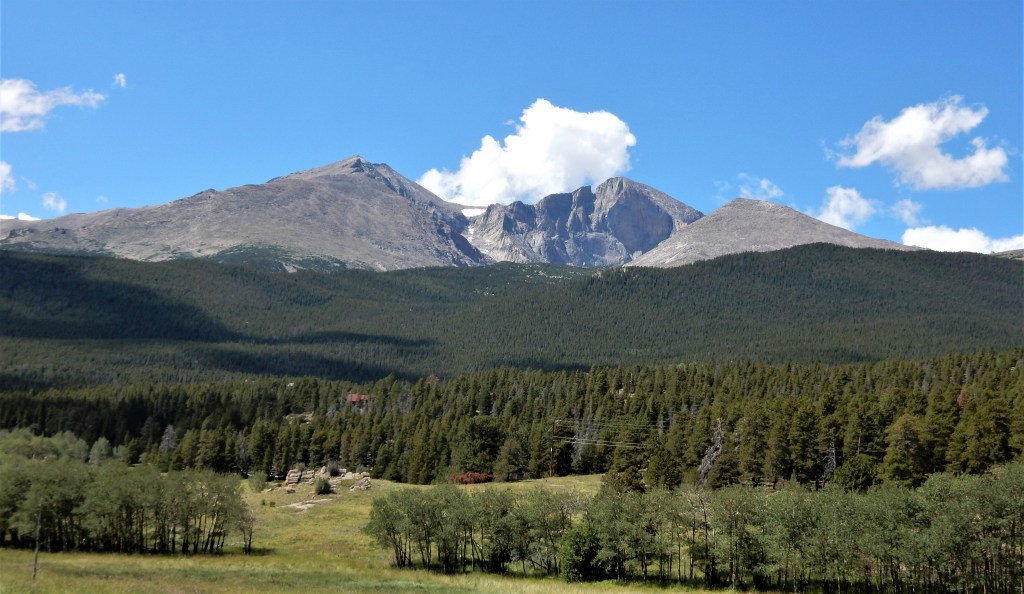
Driving over a hill, I wonder what I’ll see.

It may be a rock or a rill, it all is beauty to me.

Magnificent valley below, flowering bush and tall tree,

Swaying as the wind does blow, it all is beauty to me.

Climbing the mountain high with my head up in the cloud,

Breathing deeply, I sigh, and praise the Lord out loud.

Seeing the vista so wide, away from the noisy crowd,

With only birds at my side, I praise the Lord out loud.

Sailing along the coast, the wind and rain I brave,

I thrill with Jesus, my host, and with the freedom he gave.

Sitting on sandy shore, watching the crashing wave,

Thinking of God I adore, and the freedom He gave.

Walking through forest green, quiet meadow and lake,

I thrive in nature serene with each breath that I take.

Turning to go home, I plant my stake,

Planning again to roam with each breath that I take.

When Things Go Wrong

Today started out wonderfully. I woke up at the normal time, although my Precious was up two hours previously. Why she wakes up around five in the morning, I don’t know. But she had coffee ready, so her early schedule is fine with me.

We had eggs, sausage, orange juice, and toast—and Coffee with cream and sugar. Of Swedish descent, Carol is a great cook. She would probably be a world-class cook if I could eat pepper, spices, and all the other stuff that comes with being a world-class cook. But she’s fed me well for almost 56 years. I love her and I thank the Lord for her every day.

This morning as we were reading the Bible after breakfast, my ears were pierced by an alarm.

We have a propane stove in the trailer, and we always open a window and turn on the exhaust fan while cooking. That greatly reduces the potential for CO and CO2 in the air and prevents the shrill alarm from offending my ears.

But breakfast was over, what we thought was an emergency was taken care of, window was closed, and the fan was off. Why the alarm?

I jumped up to turn off the sonic ear-buster near the ceiling, but it wouldn’t turn off. That’s when I discovered the propane sniffer at the base of the wall. I forgot that we have two ear-busters in the trailer.

I quickly opened the door, and within five seconds the ear-piercing beeping stopped. What a relief! But now I needed to find the propane leak.

As I began checking all the connections, Carol said, “I found the problem.” and pointed to the stove. “I must have bumped the knob as I was cleaning and turned it on. I turned it off now. But we never tested that sniffer before, and now we know that it works.”

“Yay; it’s always good to know that our equipment works.” We didn’t blame anyone, we were alive, and we finished our Bible-reading.

That was the in the morning. With no internet at our son’s home up in the mountains, I went to the church building in town to do my work.

In the late afternoon as I was heading home, a pickup approached me on the dirt road, raising dust everywhere. “The road’s blocked by a downed pole and power lines. You can’t get home!” the woman hollered as she drove by. I pulled off the road.

Where is the road blocked? How far away? It’s over 45 miles if I try to go around the other way. But would that get me home?

The questions pummeled my mind. As I sat there, four other vehicles ignored the warning and continued on their way. Those same drivers looked aggravated as they came back five minutes later. My silent prayer was, Lord, what should I do?

Then I heard in my mind: Go ahead. It’s okay. So I started the engine and continued. As I reached the area where the car had plowed head-long into the telephone pole, I could see the splintered pole and power-lines strewn across the road.

“Sir, you can’t go any further on this street. The road’s closed until morning, most likely.” the state patrolman said plaintively.

“My friend, I only need to get to Swiss Ranch Road. Is that open?”

His face broke into a smile. “Well now, that’s the only road that’ll be open for a while. The accident happened just past that turn. Have a good evening.” And he waved me through the blockade.

There were no lights in any of the homes or ranches along that road—power was out. So when I reached the house, I prepared for another procedure: power the trailer with the car.

Power had been out for six hours, and the RV battery was nearing depletion, so I backed the car up to the trailer, connected the power cable, and charged the RV battery with my engine for twenty-minutes. I charged it again at 4:30 the next morning, and community power was back on at 5:35 am.

Afterwards, I remember thinking: When things go wrong, it’s good to know my equipment, and know the procedures to keep things running.

And that reminded me of something else: BEFORE things go wrong, we need to be familiar with Holy Scripture, and have an active relationship with the Lord Jesus. Scripture and the Lord give us knowledge and wisdom for life. It was the Lord Who prompted me with, “Go ahead. It’s okay.” Jesus is never wrong.

The Donkey Spoke

In the year 2000, I filled in as interim pastor for a couple of months in a small New Mexico town while the leadership searched for a new pastor. Then in December, the elders surprised me by asking me to be their pastor. I said “No.”

The church had a history of ups-and-downs with a poor reputation, and it couldn’t afford to give me a salary. It was 200 miles from where I lived, and I was already working 60-hour-per week; so you might understand why I didn’t want to accept the call. Part time at that distance was okay, but I didn’t want to commit to full-time.

The elders and I discussed the logistics, and they eventually offered a parsonage we could use; agreeing that I would keep the current employment.

But a 400-mile round-trip every weekend? Huh-uh!

They asked me to pray about it. Now I was trapped. Christians, especially pastors, can’t refuse to pray – that’s against the rules.

I found out that God must have a sense of humor, because after praying about it, it seemed like the Lord was prompting me to accept. So on January 7, 2001, I hesitantly accepted the call.

Now my attitude was different. Why? Instead of merely filling the position while they were supposed to be looking elsewhere for a pastor, my new objective was to find out why the church was having ongoing problems. Maybe I should have already known, but I had decided to let the next pastor figure it out. Now I was that next pastor.

However, as I did my pastoral homework, it didn’t take long to discover the problems. To put it mildly: a lack of Christian love ruled the roost. The owner of the local grocery store told me the church was known as “the Fighting Church.” That didn’t make me feel any better.

Part of the problem was, as is common in many local churches, poor communications and unwillingness to compromise on small issues in order to make headway on larger concerns. How was I going to turn it around?

Did I mention that God has a sense of humor? Keep reading.

After the service one Sunday morning, two of the elders and I were discussing an idea that I thought would help the church. They didn’t agree, so I invited them outside the church building to look at the situation. I hoped that by looking at the problem, it might help them understand my point of view.

Reminding me that they disagreed, they politely listened anyway.

The church building was in the countryside, and a ranch was across the fence. Choosing my words carefully, I laid out my thoughts, and I was convinced I had won them over. But at the very moment I said my last word, the donkey in the adjacent field spoke!

I haven’t heard a donkey bray that loudly before in my life! Of course, the elders and I began to laugh at the timing of the interruption. But to make matters worse, my lead elder said as loudly as the donkey, “My Sympathies, Exactly!”

The three of us broke out in an uproarious laughter. We had been friends for over a year and disagreements never hurt us. But that event brought us even closer together.

When I muttered, “Dumb donkey!” the other elder said, “He’s not dumb. He spoke his mind quite clearly.” More laughter ensued, and we went back into the building to get some coffee—mine with cream and sugar.

Then Romans 12:3b came to mind. “Don’t think you are better than you really are. Be honest in your evaluation of yourselves, measuring yourselves by the faith God has given us” (NLT).

Over coffee, I asked them to state their opinion—again—and I would listen carefully. In the next half-hour, I realized they were right, and we worked out an alternate plan.

That incident did more than settle a disagreement. As word got around to the church members that they now had a pastor who was willing to listen, they began to trust me.

Still working on the other problems, I preached on forgiveness four times a year for three years—that’s what it took to settle the other personnel issues. And when I eventually resigned as pastor, that same groceryman told me, “Your church has a new name in town: the Loving Church.”

I thanked God for prompting the donkey to speak.

In Case You’re Interested ….

There are three books on Amazon that I wrote, and one that five of my siblings and I wrote. I’ll tell you about them in a minute, but first I need to tell you where to find them. Go to Amazon.com: S. Eugene Linzey: Books, Biography, Blog, Audiobooks, Kindle and scroll down to see them. All four are treasure-troves of information, insight, and good reading. You can order either print copies or kindle versions – or both.

I’d been taught that all Christians go to heaven. But how was a Christian supposed to live while on earth? I didn’t see much difference in many people’s lives when they became a Christian or joined a church. On Sundays, most people talked about the Lord, sang, bowed heads in prayer, listened to the pastor – most of them – but something was missing.

Why would the Church of Jesus Christ—including all divisions and denominations–need a charter? Simply because I know many Christians who don’t seem to understand the Faith they claim to believe. Going to church and joining it is not the same as understanding the faith.

The Church, including each member of it, needs to keep in mind that our goal in life is not merely to get to heaven. Our goal in life, both on earth and in heaven, is to be a member of Jesus’ team and grow the Kingdom of God throughout eternity. It is by becoming an adopted child of God, and growing into a mature spokesman for God, that we can fully take our place in the Kingdom. That is why we need to know and understand the teaching in Matthew 5:1-12.

This book, Charter of the Christian Faith, addresses this topic.

Absolute truth is something that is true at all times, in all places, for all people, and in all circumstances. For example, there are no round squares, and there are no triangular circles. We may change the descriptive terms, but that won’t change the facts. On the other hand, temporal truth changes with the passage of time. As an example, I am temporarily not hungry. That is true. But tomorrow, I will be hungry. That also is also true.


But why are so many people on both sides of all fences worked up about the differences in viewpoint? A difference in viewpoint can be healthy as long as we don’t fight over them. To use a verse from Isaiah 1:18, “Come, let us reason together.” However, in reasoning or discussing our viewpoints, we must have a standard against which to measure truth. That’s the crux of the matter. The problem is that too many people on both sides of many fences make mistakes.


Our worldview is the basis for how we live: how we think, how we act, how we respond, what we believe, and how we worship. But a worldview produced with limited input produces a restricted or narrow outlook. I endeavor to write about a variety of topics which, over time, can enable the reader to expand his or her horizons. A person doesn’t even need to agree with me, but reading what I write gets him or her to think; and that is the key to maturing both mentally and spiritually. These are my thoughts, my reflections on life, my beliefs. Read them and compare them with your worldview.

Over the years, we have seen a lot of change in the church. We have seen it change from the big central church of downtown in the 1950s to the outlying mega-church in the 1980s. We have seen hippies who accepted Christ in the Jesus Movement of the 1970s become yuppies in the 1990s. We’ve seen a major shift from mainline denominations to inter- and non-denominational organizations. But our desire through it all has been to teach people both in and out of the church to develop a relationship with Christ. Although we believe that church involvement is necessary, it is the personal relationship with Jesus Christ that will see us through both the problems and the blessings of life.

The Bible is a book about civilization, government, war, and intrigue. It contains drama, history, culture, and a lot more. However, it is primarily a book about faith and spirituality. This book was written to answer many questions to help people sift through the sands of time to gain a better understanding of the Word of God.

This book was written by three brothers and three sisters (six siblings in all) who realized after their parents had passed away, that the family was divided into factions. They also admitted there was much they didn’t know about each other, and they decided to do something about it.


The memories they wrote about prompted spontaneous email conversations and phone calls among the siblings. They found themselves saying things like, “I didn’t know you felt that way!” Or, “I never knew that!” Or even, “Me too!” They started learning about one another and seeing each other in a whole new light, and the conversations that occurred every week became highly therapeutic. They accepted one another, and in the process, learned to love each other more deeply than any of them had ever experienced.


Join them on a journey that spans the past 70+ years, as they tell you the stories of family, faith, and friendship. This is a memoir about love and laughter, anger and attitude, groaning and growing. In many ways, it is a story about coming of age.


“Whether you are a family member, a distant relative, a neighbor, friend, or even a complete stranger, we invite you to join us on this journey as we share our lives with you. We hope you enjoy the stories. Welcome to the family.”

Find these books and order them on Amazon.com: S. Eugene Linzey: Books, Biography, Blog, Audiobooks, Kindle.