Slow Down and Live

Some years ago, I was sitting at my typewriter – actually at my computer – looking out the window. It was cold with a light breeze blowing. The clouds, which are usually water vapor, looked more like swirling snow ready to grace our countryside. My snow shovel was ready, my boots were at the door, and Carol could have hot coffee or hot chocolate ready within five minutes if I needed to leave my comfort zone to clear the sidewalk and driveway.

We lived in a community of 3,000 people in the hills of northern New Mexico at 7,825 feet above sea level. (For comparison, Albuquerque, NM is about 5,000 feet in altitude.)  

A winter storm would often drop two to three feet of snow at a time, sometimes up to five feet,PICT0181 and we would be temporarily locked in the house. That was great for the skiers, and it made the landscape look more beautiful than words can tell. And if there was no wind while the snow was falling, the big fluffy snowflakes absorbed all the background noise which created a living Winter Rockwell Painting. Beautiful!

If the snow was less than two feet deep, my 4-wheel drive vehicle with good tires would get me anywhere I wanted to go. But if it was deeper than two feet, we just stayed home. Carol would get out the coffee or hot chocolate; maybe bake several dozen cookies. We would start a fire in the fireplace, make sure the cat and dogs were warm if they weren’t playfully romping out the in the field; and Carol and I would do what we enjoyed doing best: Spend Time With Each Other.

With our schedules jammed and our lives so full of activity, being snowed-in gave us time to tell each other what we meant to say several days or weeks previously. We had time to actually LISTEN to each other.

PICT1265With critters in front of the fireplace, a table nearby with a puzzle or a scrabble game on it, steam rising from two cups of hot chocolate or coffee, a big window across the room with snow gently falling outside–we have another Rockwell Painting. Periodically I would go out and clear the walks and uncover the car before the snow got too deep.

Carol and I understand the value, and the need, to spend time together; so at times we still declare a “snow-day” and stay home. Years ago, we decided to slow down and live. Slowing down can actually make our lives fuller and richer. Not fuller with more things to do or richer with more money in the bank; but fuller and richer with what really counts in life.

Since we don’t have a guarantee that we will be alive on earth tomorrow, why not invest our time and our lives into people now? After all, material possessions can give satisfaction for a little while, but healthy, wholesome interaction with family and friends can last a lifetime–and beyond.

It’s called making memories together, and it’s more enjoyable than watching a football game.

When family members or friends that we love leave this life, we will miss them. We will be sad, and tears can flow. But if we invest our lives into them while they are here, we will have those memories to hold on to, and those memories will help sustain us in our sorrow.

More importantly, we should invest our time studying the Bible and learning to know Jesus. First Thessalonians 4:13-14, which applies to those who live for the Lord, says “But we do not want you to be uninformed about those who have died, so that you may not grieve as others do who have no hope. For since we believe that Jesus died and rose again, even so, through Jesus, God will bring with him those who have died. (NRSV)” What a promise! Therefore, even in sorrow we can experience joy.PICT0192B

Well, it didn’t snow that day, but my boots and the shovel were ready just in case it did. 

Oh, Carol just told me that lunch is ready. I think I’ll turn off the computer and spend time with her. Maybe we’ll play scrabble. We like that game. As of this writing, we are tied at 368 wins.

Detours in Life

Have you ever encountered a road-block or a detour? Is it frustrating? Aggravating? Do you wish you could give someone a piece of your mind?

Throughout our many travels, Carol and I find ourselves on detours periodically. For example,thFS0NDQ2Y several years ago we were minding our own business heading west on Interstate 70 when, suddenly, the dreaded sign appeared: Detour Ahead.

Carol had been napping, and although I was tired, I decided to stay awake – primarily because I was driving. But when the monotonous road noise changed, she woke up.

“Where are you going?” she asked.

“Well, I was making a bee-line to Denver, but at present, your guess is as good as mine.” Watching the actions of other drivers, it appeared that they might not have been as nonchalant as I was about the turn-of-events. I chuckled.

Carol asked, “What’s funny?”

“Precious, those poor drivers have not learned that emotional upheavals cannot change the way the highway departments do things – either good or bad. And they haven’t yet learned the value of detours in life.”

“Yeah, I suppose you are right. But where ARE we going now?”

“We’re heading north on Kansas State Road 232. Anything interesting on the map?”

After a few minutes of confirming our location, she said, “There is something called ‘The Garden of Eden’ on highway 18 between Lucas and Luray. Wanna go?”

“Sure; why not?”

We discovered Wilson Lake, and the scenery was beautiful. We stopped at The Garden of Eden to check it out. (We don’t recommend it; it’s not what the name infers.) After a bite to eat, we continued to Walde, Kansas. There we could have followed the detour signs and headed south toward Russell, resuming our monotonous freeway noise again. But since we were having such a good time seeing part of the country we had never encountered, we continued going through the towns on highway 18 until we arrived at Bogue, Kansas.

There we got onto highway 24 and drove another 100 miles to Colby where we were reacquainted with I-70. Carol and I thoroughly enjoyed our detour and learned more about our country. The detour set us back almost 3 hours; but that was not lost time–it was time invested together. And more importantly, my Precious and I made new memories together.

IMG_1434On another trip, we were returning from Missouri where we spent several days with two of my sisters and a brother. We had a good time. On the way back I said, “Let’s go home on some roads we’ve never been on. Carol chimed in: “Then let’s go to the War Eagle Craft Fair.” I agreed.

We turned onto Missouri highway 86. At a small town called Blue Eye, we headed south and found Arkansas 221. Again, Carol and I were enjoying the beautiful scenery. But at one point without warning, the asphalt highway morphed into a gravel road.

“Are you lost?” Carol asked.

“No, but we ran out of 221.” We laughed.

When we stopped at a cabin for advice, the man told us how to get back to civilization, eventually getting to Rogers, AR.

“Where will that route take us?” I asked.

“That’ll take ya through Eureka Springs, less you wanna either truck on the way yer goin fer nuther two hours throwin gravel, or back-track cupla hours.”

I thanked him and got back in the GMC Envoy. After discussing our options, we laughingly headed up to Eureka Springs–on a road we didn’t even know existed–and had dinner at one of our favorite places. We barely got to the War Eagle Craft Fair in time to check it out.

Detours don’t upset or aggravate us. They’re part of life. Our traveling motto is: “If we hit a detour, make a vacation out of it.” We’ve learned, however, to schedule into our plans extra time to allow for such excursions. And if we encounter no detours, we arrive early. Yay!

Some time ago I learned the following: “Inner peace begins the moment you choose not to letPICT0033 another person or event control your emotions.” I cannot control you or the highway department, but I can control my plans and reactions. I do this by asking God for direction in life which enables me to face life’s uncertainties with confidence.
Proverbs 3:5-6 says, “Trust in the Lord with all your heart and lean not on your own understanding; in all your ways acknowledge Him, and He will direct your paths.” Who knows? Maybe God purposely arranges some detours to gauge our maturity level.

Happy traveling, friends. 

Seven Helpful Habits

From 1994 to 2005 I was an operations officer in the Nuclear Physics division at the Los Alamos7 Habits National Laboratory. One of my responsibilities was to assure that our staff’s training was up-to-date. One day I read about a seminar titled, “The 7 Habits of Highly Effective People: Powerful Lessons in Personal Change.” That intrigued me, and I attended the seminar to see if I should recommend it to our staff. I’m glad I did, and it was my privilege to meet and talk with the speaker, Dr. Stephen R. Covey. Dr. Covey condensed his seminar into a book titled by the same name: “The 7 Habits of Highly Effective People.” (He passed away in July of 2012. America misses him, but his teaching will go on. And yes: I recommended this course to our staff.)
Covey taught that developing good habits presents more long-term benefits than trying to build a good image – corporate or personal. He said:

“The difference between the two approaches is similar to the difference between cramming for an exam and taking care of a farm. ‘Cramming’ is an image-based approach that nets temporary results, whereas taking care of a farm requires continuous, daily attention that will provide long-term dividends.”

And ‘taking care of the farm’ is the phrase he used for developing good habits for living.

The first three habits deal with the Personal Level. Individuals develop Independence by adherence to these habits.

Habit One focuses on taking control of life: Be Proactive. Don’t create or accept excuses for failure or lack of progress. Blaming or accusing doesn’t help anyone. And stop being overly concerned about things over which you have no control, but respond properly to situations. Covey called this: “response-ability”.

Habit Two is the development of a Personal Mission Statement: Begin with the End in Mind. Leisure time? Travel? More efficient teamwork? More effective sermons? Quicker meals? Whatever it is, define it. Whether you are a husband, wife, business owner, student, pastor, etc., develop goals to define your direction. This can be difficult; but once accomplished it will help you develop more effective leadership qualities needed in your personal or business life. It makes life easier and more enjoyable.

Habit Three is the essence of personal time management: Put First Things First. Separate tasks or projects under “urgent” – “important” – “necessary” – “desired.” This takes insight, planning, preparation, and promotes efficiency. It also greatly reduces time spent in crisis-management. That, in itself, is rewarding.

The next three habits deal with the Interpersonal Level. This section is more complex because practice of these habits leads to valuable Interdependence, which leads to personal and corporate maturity.

Habit Four is the philosophy that creates more productive, long-lasting relationships: Think Win/Win. We do not have to step on someone in order to succeed (except for sports games: one team must win). We need to fix in our mind that in order to truly get ahead we must depend on and help others. No one ever succeeds by himself. We must ignore our competitive instinct and help others succeed. The Win/Win concept requires courage and trust, but pays big dividends.

Habit Five is the skill that allows Win-Win to work: “Seek First to Understand, Then to Be Understood.” This concept made a long-lasting impression on me. Learning to actively understand someone else and his/her point of view is mandatory in order to effectively communicate our thoughts. If the other person realizes that I am concerned about him, he will be open to hear from me and perhaps willing to help me.

Habit Six is Synergize. Often (but not always) a corporate concept produces a better solution than our individual ideas. And this is actually the fruit of Habits four and five.

And Habit Seven is Sharpen the Saw. Our skills and methods are never perfect. Therefore, we need to continually hone or refine them.

PrinciplesThe information I gained at the seminar, and in reading the book, did not guarantee quick fixes to any personal, interpersonal or business problems. But I was supplied with tools to improve my communication skills, my outlook on life, and reduce unnecessary friction.

I also recommend two other books: “The Leader In Me” and “Principle-Centered Leadership.” To learn more about the “7 Habits” and other Covey books, contact Franklin Covey Co., Debra Lund, 801-244-4474; Debra.Lund@FranklinCovey.com.

Enhanced Character Reduces Stress

So you want to improve your character? Zig Ziglar said: “The foundation stones for a Dad's 85th0009balanced success are honesty, character, integrity, faith, love and loyalty.”

So how do we improve our character or integrity? Think about the following account.

An acquaintance of mine was on his way to an appointment when his right front tire blew out. He immediately lost control of the car; he hit the guard rail, bounced into another car, and finally came to a stop in the median. It was called an accident.

A legal definition of accident is: an unforeseen event that occurs without anyone’s fault or negligence.

Sooooo, was this truly an accident? The answer is No. Why? It could easily have beenPICT0027 prevented! He knew that his tire pressure was very low but he wouldn’t take time to inflate it to the proper pressure. “I’ll take care of it next Saturday.” he said. But he didn’t.

Proper tire care can prevent many automobile calamities, and really, we are never too busy to be safe. My friend understood the benefit of punctuality (honoring others by being on time) but he didn’t quite figure out the benefit of initiative (accomplishing what needs to be done in a timely manner).

While not all problems are this simplistic, many of them are. A fatal situation I read about some time ago was when a father ran over his five-year-old son in the driveway of his own home. Was that truly an accident?

The father said that he didn’t know the child was out of the house. Guess what? The kid is dead! All the dad needed to do was walk around the car to check for children, bicycles, toys, etc. before putting the key in the ignition. If the father had made alertness part of his daily habit (being aware of what is happening around me so I can respond properly), the child might still be alive today. Believe me: he does the walk-around now.

Jesus wants us to be safe and aware of what is happening; so being alert enhances not only our character, but also can make us more like Christ.

So I ask the question again: were these events truly accidents? The answer in a great many situations will be “No.” Instead, these situations were caused by negligence, ignorance, apathy—or a combination of the three. So what is needed to rectify those situations? What does it take for personal growth?

You can call it character, integrity, reliability, or spirituality. I don’t care. Whatever you call it, I call it Godly Character. Character is what determines a person’s response regardless of the situation.

In Reflections On Faith & History [found at https://www.amazon.com/s/ref=nb_sb_noss?url=node%3D154606011&field-Front cover - finalkeywords=Reflections+On+Faith+%26+History], I addressed numerous questions that many people asked me through the years. My desire was to help people grow both spiritually and intellectually by helping them to gain a more complete understanding of the Bible. I did this by presenting some of the history and culture of the times as it related to the Scriptures. Learning also helps us grow in our character or integrity. It is actually learning to become like Christ.

1) We learn to know and to incorporate the mind of Christ.

2) We learn to interact with others in a wholesome, uplifting manner.

3) We learn to stop being self-centered.

4) We are enabled to fulfill our destiny and enjoy life.

I was a bi-vocational pastor while working at a national laboratory. I had previously worked in the aerospace industry, direct sales, and several other areas. Wherever I went I watched people at work, at play, in the stores shopping, and driving their cars. It was apparent that many people–including Christian–were either uninformed about how to properly conduct themselves, or they didn’t care. It didn’t make sense to me until I began studying about character and integrity.

I found that if we attentively–the key is attentively–read about the Lord and study His integrity, His character, His nature, and diligently apply Biblical principles to life and life’s circumstances, we will be surprised at how our lives will be changed for the better. We will be able to traverse life with less stress, less frustration, more understanding of people, more personal contentment, and live a more fulfilled life. Reading First Corinthians 13:4-7 will help.

So, how does this reduce stress? I’m glad you asked.

As I grow in my understanding of life, I have less reason to get upset over mistakes, errors, or misunderstandings. I am more apt to see things from Jesus’ point of view, and can more easily forgive people. This allows peace to flow through my being and I can share that peace with others.

As you think on the character of Jesus, I pray that you, too, learn to incorporate His integrity into your life.

Do You Worry?

IMG_1791Over 13 million Americans worry every day. The worries range from national, state, county and town issues. People worry about school, grades, war, the economy, home finances, children, grandchildren, their job, retirement, and so much more.

But worrying causes problems. One third of all visual problems are caused by worrying. Worriers get sick more easily. Worriers don’t get good-quality sleep. Worriers have a harder time digesting their food. Most worriers have difficulty trusting others.

Many years ago, the director of the YMCA in Pittsburgh, Pennsylvania, had worried himself almost to a nervous breakdown. He was working about 85 hours a week while worrying about the myriad of problems that surrounded him. He couldn’t sleep well and was having a difficult time making proper decisions. Sad and depressed, he finally went for counsel.

The doctor said, “George, you’re going to ruin your health – or kill yourself – with worry unless you back20100208_172053 off. I know it will be difficult, but you must cooperate with God. You must turn all your worries over to God – and let them go – and learn to trust your staff.” George always thought his feelings and actions were directed by the Lord, so that surprised him.

After thinking it over, George took a long walk in the woods. Sitting down against a tree, he got out his pencil and paper, and wrote:

Dear God, I hereby resign as Executive Director and General Manager of the Universe.

Love, George

 “Wonder of Wonders,” George said, “God accepted my resignation!” Now eating and sleeping better, within days his strength returned and he could think more clearly. And within a few months the YMCA operations improved dramatically.

Worrying dishonors God and actually generates problems for ourselves. Why? Believing that we must personally control everything, we take our focus off God and place the focus onto ourselves. But note this:

            40% of things we worry about never happen.

            30% are in the past, and cannot be changed.

            12% are about criticism.

            10% are about health problems (and worrying makes it worse).

            Only 8% may be legitimate.

God’s prescription for our worry and stress is in Philippians 4:1-8.

     Verse 1: Stand Fast in the Lord. (Accept God’s teaching as your foundation for life.)
     2: Live harmoniously with others. (Avoid disputes and arguments.)

     3: Help others. (Remove your focus from yourself.)IMG_1799B

     4: Rejoice in the Lord in every way. (Live cheerfully. Romans 8:28 says that everything works for our good IF we cooperate with God.)

     5: Let your moderation (mild manner, appropriate actions, gentle and understanding attitude) become manifest in your everyday life.

     6: Be careful for nothing. (Don’t be concerned over what you can do nothing about. Train yourself to stay focused on the issues at hand (Rom. 12:2). Through prayer and thanksgiving, talk with God about your concerns. Converse with Him as you would a friendly counselor. Talk or pray aloud; it is okay.)

     7: The Peace of God, which no man fully understands, shall keep your hearts and minds.

(Keep = Protects or guards you in the presence of the enemy. HOW? We must REFUSE to worry, but place our lives in God’s hands.  God can’t protect us if we refuse to cooperate with Him.)

8.    Whatever is true (not hidden or imagined, but obvious),

Whatever is honest (worthy of honor and respect),

Whatever is just (right; innocent, without speculation. Don’t waste time guessing about people’s motives),

Whatever is pure (sacred, consecrated, not mixed with evil. Seriously pray about the books you read, the movies you watch, and your daily activities),

Whatever is lovely (friendly toward God, accepted by God. If God doesn’t approve of something, it isn’t lovely: leave it alone),

Whatever is of good report (reputable, wholesome),

If there be any virtue (excellence, moral goodness, high regard. This again warns us to stay away from movies, videos, books, magazines and activities that promote ungodliness),

If there be any praise (something commendable),

Think on these things (reckon, meditate, dwell).

I Thessalonians 5:16-18 says: Rejoice evermore. Pray without ceasing. In everything give thanks: for this is the will of God in Christ Jesus concerning you.

This is how we live without worry. This is how we live without stress. We must not attempt to take God’s place as the Executive Director and General Manager of the Universe – or even of our own lives. We don’t have the credentials for the job. And we must live within the boundaries that Jesus would accept.

Stop worrying; seek help if necessary.

Critical Thinking

When I was a teenager, people told me, “Stop being so critical!” Have you ever been told that? “Stop being so picky!” is another version. Yet another exhortation, “Listen to that he means, not what he says.” Wow! Since I cannot read minds, THAT’S a tricky one. 

However, we must intelligently analyze life to understand life.

For over a century our educational system diligently taught critical thinking as part of its mission. And wePICT1473 are told that nearly all American educational institutions still teach critical thinking; but do they really? My answer is a resounding NO! Several years ago, we found that “post-modernism” discarded critical thinking. Let’s look into it.

Critical Thinking: “Disciplined thinking that is clear, rational, open-minded, and informed by evidence. The mental process of actively and skillfully conceptualizing, applying, analyzing and evaluating information to reach an answer or conclusion.” The word “critical” comes from “kriticos”, a Greek word meaning “discerning judgment.” So, a critical thinker is searching for truth. My father taught me how to think critically, yet without being condemning.

Ruth Mayhew of Demand Media said, “Critical thinking is ‘self-guided, self-disciplined thinking which attempts to reason at the highest level of quality in a fair-minded way. People who think critically consistently attempt to live rationally, reasonably.’”

Clear thinking is essential for making appropriate decisions about what to believe and do, whether for personal decisions such as religious beliefs and who to marry; and vocational decisions, or civic decisions such as voting or serving on a jury. Without a well-informed, critically-thinking citizenry, freedom and democracy will falter and justice will be non-existent. Have you assessed our judicial and political systems recently? Many Judges and lawyers often discard truth in favor of procedures, word-games, personal agendas, or intimidation. I saw on the news yesterday [as of this writing] that a man on death row for murder – who had testified that, indeed, he murdered the girl – was released by a judge because of a technicality in the judicial process.

We should employ critical thinking during conflict resolution which requires understanding issues from several viewpoints. Understanding people’s needs requires critical thinking. Socrates talked about the important role critical thinking plays in our ability to consider an issue and decide what to do or believe. Critical thinking should be employed while shopping or caring for children.

DSCN1300Critical thinkers must take the context of every situation into account and think on a multi-level platform in order to come to proper conclusions. Homeschoolers have an advantage for learning critical thinking skills because they can incorporate these lessons into it their curriculum – as every educational system should do. When a person is able to make correct, intelligent choices on complex matters, he is considered intelligent and competent.

Critical thinking is required in deciding whether a claim is true, partially true, or false. It is a tool we use to arrive at reasoned conclusions based on a reasoned process. Fortunately, as with all skills, we can learn to think critically.

Now let’s apply the principle.

We read that: 1) It’s possible for a “rogue planet” to hit the earth and wipe out humanity. 2) If we vote for this person he’ll stop the problem in Congress. 3) It’s inferred that this automobile will get you the prettiest girl. Let’s address the politician first.

Regrettably, it takes only one person (US President or a judge) to negate good morals and legalizeDSCN5212 immorality. But it takes a distinct majority of the Senate and House to change direction or change a law for the better – and even then, one judge is allowed to negate the will of the people. This is wrong. Why doesn’t the US Congress apply the checks and balances which are built into the US Constitution? They are not thinking critically.

Thinking critically would entail: How will this bill or law affect the people in my district, my state, and the nation? Do the people understand the repercussion of the bill? If they don’t, I need to tell them. To say, “Let’s pass this thing so we can see what is says” does not display critical thinking. Rather, it was one of the most absurd and ignorant political statements in the history of our nation.

How about a “rogue planet”? Thinking critically we should ask: “Is this a hypothesis, theory, or fact? Is this someone’s imagination, or is there substantiation for the fear? Does he have solid evidence on which to base his claim?” Well, [thinking critically] since Scripture says that Jesus will rule this earth for 1,000 years, I don’t think we need to worry about an imaginary rogue planet.

And the car? THINK! Is the girl attracted to you or to the car? If she is attracted to a nifty or spectacular car, you won’t want her unless you are a flake. It takes more than a car to attract an intelligent girl.

Critical thinking produces information on which we can base our lives. Psalm 111:10 says, “The fear of the Lord is the beginning of wisdom.” And Godly wisdom is mandatory in critical thinking.

New Year’s Ruminations

    Did you know that the New Year celebration is one of the world’s oldest holidays? DSCN2635BBefore 2000 BC (in Abraham’s time), the Babylonian New Year began at the first visible crescent of the New Moon after the Vernal Equinox, and could be the origination of the worship of Allah – the moon god. The moon had many names; the more popular being Nanna, Nannar, Asimbabbar, and Suen. (Suen evolved to Sin, and both are pronounced Seen.) The Babylonian New Year celebration lasted for eleven days, and our modern New Year’s Eve festivities pale in comparison to theirs.

     The Romans originally celebrated the New Year in March. In 153 BC the Roman Senate declared January 1 to be the beginning of the New Year, but the date bounced around a bit. Julius Caesar finally established the Julian calendar in 46 BC. However, because emperors had the irresistible compulsion to put their own spin on the calendar, they played with dates and got the calendar out of synchronization with the sun – again. Pope Gregory made corrections and approved the current Gregorian calendar in 1582.

     Janus was the Roman god of doors and gates, and had two faces: coming from either direction the traveler saw its face. Julius Caesar felt that the month (January) named after Janus would be the appropriate “door” to the year. One report claims that Caesar celebrated this New Year change by “ordering the violent routing of revolutionary Jewish forces in Galilee, and blood flowed in the streets.” In later years, Roman pagans observed the New Year by engaging in drunken orgies—a ritual they believed constituted a portrayal of the chaotic world that existed “before the gods conquered chaos and recreated order in the universe.”    

The early Church condemned the new years’ festivities as paganism – and rightly so. But as Christianity became politically accepted, the Church began adopting many of the pagan customs and the “Christian” New Year’s Day celebration became no different. Hypocritical Christians have always given the world reason to believe that the church was a farce; and that’s a major reason why Christians who are truly devoted to Jesus are often accused of being hypocrites. 

January 1 has been celebrated as a holiday by Western nations for over 400 years, and some churches erroneously observed the New Year’s Day festivity as the Feast of Christ’s Circumcision.

     The tradition of using a baby to signify the New Year started in Greece around 600 BC. PICT0012They celebrated their god of wine and drunkenness, Dionysus, by parading a baby in a basket. The baby represented the annual rebirth of Dionysus who was also the god of fertility. And, of course, public moral debauchery was part of the festivities.

     Traditions include using noise to welcome in a new year. This custom goes back to ancient times when people thought noise scared off evil spirits. Some eastern religions still believe this. New Year’s resolutions also date back to the early Babylonians. Their most popular resolution was to return borrowed farm equipment. That’s a good resolution – if they actually returned it.

     A 2007 study by Richard Wiseman showed that “88% of those who set New Year resolutions fail. Men achieved their goal 22% more often when they engaged in goal setting, while women succeeded 10% more when they made their goals public.” Frank Ra in his book “A course in Happiness” said: “Resolutions are more sustainable when openly shared with others.” That’s true because we find that peer-support (peer-pressure?) helps us stay on track.

     The lyrics of Auld Lang Syne (meaning “old long since” which essentially means “the good old days”) were partly collected and partly written by Scottish poet Robert Burns in 1788. The poem reminisces about and longs for the past. Good, positive traditions and memories are beneficial because they can balance our outlook on life and strengthen our character.

     So much for the past; what about the future?

     The New Year is often a time people attempt to turn over a new leaf. That means we finished writing on one page, then turn the page – turn the leaf – and write something new. It refers to changing an action, or starting something over.

     However, no matter our sincerity, merely deciding to change is meaningless without God’s help. Personal problems and national perplexities are looming on the horizon and we need help. What do we do?

     Two factors are necessary in making a substantive, permanent change. One is to seekBible.docx God’s guidance in making plans. Proverbs 3:5-6 (NCV) says, “Trust in the Lord with your whole life … He will direct your decisions.” The second is to rely upon God for the courage and integrity to fulfill His plans. Don’t get side-tracked. Psalm 111:10 (NLT) says “[Sincere] Reverence for the Lord is the foundation of true wisdom.”  And we need wisdom to succeed in doing what is right.

HAPPY NEW YEAR FRIENDS.

HEAVEN

     You have politics coming out your ears, but have you thought about heaven? The word “heaven” is in the Bible (KJV) 457 times so it must be important. What is Heaven?

Dumbbell nebula
Dumbbell nebula from NASA’s Spitzer Space Telesco

Heaven is contemplated on three levels: The firmament, or atmosphere; (Gen. 2:19); the stars or outer space (Matt. 24:29); and God’s throne (Deut. 10:14). Heaven has various names: New Jerusalem (Rev. 3:12), Everlasting Kingdom (2 Pet. 1:11), Eternal Inheritance (Heb. 9:15), a Better Country (Heb. 11:16), and My Father’s house (John 14:2). There is neither suffering nor evil in heaven (Rev. 21:4). 

     Where is Heaven? This is difficult to answer because the Bible doesn’t tell us. However, heaven is where God the Father is, and is where Christians go when our bodies stop breathing. But heaven is not a million miles away. Heaven isn’t “out there” somewhere. When believers close their eyes in death, they immediately wake up in Heaven.

     1Thessalonians 4:13-18 says (NLT) says:

DSCN0508B
Total solar eclipse from my camera

“And now, brothers and sisters, I want you to know what will happen to the Christians who have died so you will not be full of sorrow like people who have no hope. For since we believe that Jesus died and was raised to life again, we also believe that when Jesus comes, God will bring back with Jesus all the Christians who have died. I can tell you this directly from the Lord: We who are still living when the Lord returns will not rise to meet him ahead of those who are in their graves. For the Lord himself will come down from heaven with a commanding shout, with the call of the archangel, and with the trumpet call of God. First, all the Christians who have died will rise from their graves. Then, together with them, we who are still alive and remain on the earth will be caught up in the clouds to meet the Lord in the air and remain with him forever. So comfort and encourage each other with these words.”


     One little commentary on that Scripture: It appears that the Christians’ spirits will come back from heaven with Jesus and be reunited with their bodies coming out of the graves.

     How do we get to Heaven? Whenever we want to go somewhere: we know where we are, we decide where we want to go, we enter a vehicle and GO. So where are we? In a sinful world. Where do we want to go? To Heaven. How do we get there? Jesus is the only way to Heaven (John 14:6). We must accept Jesus into our life, and live for Him. And until Jesus returns, we go through the door called “death”. But for believers it is the “Door to Life”.

     Jesus said in John 14:1-3 (NLT) says: “Don’t be troubled. You trust God, now trust in me. There are many rooms in my Father’s home, and I am going to prepare a place for you. If this were not so, I would tell you plainly. When everything is ready, I will come and get you, so that you will always be with me where I am.”

     Jesus died to redeem mankind. Defeating death, He returned to life and will live forever. He wants you to live forever with Him. You will never have to lock your doors again. You will never be afraid again. You will never be hurt again. But if Jesus does not return soon, we all will die.

     What does that feel like? Many times our kids fell asleep on the couch or on the floor of the living room but woke up in their bed. In the morning they asked, “How

PICT0033
Our children – decades ago

did I get here?” And my Precious Wife told them, “After you fell asleep, your father picked you up and took you to your room.”


     That is what death is like for the Christian. Whether we leave this life because of sickness, an accident, or old age; we merely fall asleep here in our “living room”, but we wake up in Heaven because our Father took us to our new home.”

     Are you living the way God wants you to live? If you died today would you go through the door that I call LIFE and live with Jesus, or go through the other door? Is there anything you need to ask God to forgive you for? Don’t be afraid to talk to God about it. He loves you very much and wants to forgive you. He wants you in Heaven with Him.

A BLESSED CHRISTMAS

Said the shepherd boy to the little lamb, “Do you see what I see?”

Way up in the sky little lamb, “Do you see what I see?”

A star, a star, shining in the night, it will bring us beauty and light.

It will bring us beauty and light.

    DSCN4172Thinking about that song brought many thoughts to my mind.  Allow me to share them with you.

     The shepherds, watching their flocks out in the field, looked up into the cool fall sky. Suddenly, one of the shepherds jumped up and cried out, “Look! Do you see what I see?” The others quickly looked – and in Luke 2:10-12 the lead angel made the announcement as the other shepherds shielded their eyes from the bright light:

“Do not be afraid. I am bringing you good news that will be a great joy to all the people. Today your Savior was born in the town of David. He is Christ, the Lord. This is how you will know him: You will find a new-born baby wrapped in white cloth, lying in a manger.”DSCN0574

     The shepherds, following the heavenly directions, quickly went to the cave or animal stall where Joseph and Mary were. When they saw the new-born baby who was declared by the angels to be God, one of the shepherds slowly knelt down, and incredulously asked, “Do you see what I see?” And their lives were changed forever!

     Anna, the 84-year old prophetess, was in the temple when Joseph and Mary brought Jesus in to be circumcised and blessed. When Anna saw the 8-day old Baby in Mary’s arms, she said gently and worshipfully, “Do you see what I see? I thank you, O Great Jehovah, for allowing my eyes to see the salvation of Israel.” She then prayed over baby Jesus, and began telling everyone what she saw: “People listen. This Little One is the Messiah for whom we all have been waiting. Let’s Worship the King!” And her life was changed forever!

     The Wise Men spent much time studying the sky. They were the scientists of their day and were advisors to their king. They were probably from Persia, which would include DSCN0309Iran and Iraq today. One night, one of the astronomers suddenly called to his colleagues, “Look! Do you see what I see?” The others gathered around and were amazed at the startling message unfolding in the sky, for it told them that a new King was born in Israel. Because of the writings left by Daniel back around 560 BC, they had been expecting it, and within six months, they left on a caravan for the Promised Land. Finding the house and kneeling down in front of Mary who was holding the child who was nearly a year old, the noblemen worshipfully said:  
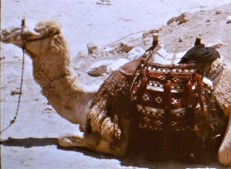
   Here, most highly honored King, exalted by God in the heavens. We give you Gold: a treasure which does not tarnish or rust, it is a gift to royalty and conveys our life-long worship to you.

   We give you Frankincense: an aromatic treasure which we hope conveys the aroma of our love and adoration of You to the exalted God in the heavens.

   And we give you Myrrh: to make Your life on earth sweet.

And their lives were changed forever!

     Do you see what happened? Whenever people encounter the Living God, their lives are changed! And when someone’s life is truly changed, that person will change the world around them.

     As the shepherds went back to their flocks, they told everyone they met about the new Messiah for months to come because their lives had been changed. And they changed their world as they spread the Good News.

     At eighty-four, you know that she told people about the new Messiah for the rest of her life because her life had been changed. And she changed her world as she told folk who came to the Temple to worship.

     And the Wise men made an international impact, for they changed their world whichPICT0057 was the Middle-East. They told people in the trade caravans, the scientific community, kings and nobility about the new King.  That’s because their lives had been changed.

     Has your life been changed? Do you tell people about Jesus our Savior, or are you afraid of offending someone? God is calling you to change your world by being a faithful witness about what you have both seen and heard. Go ahead – people need to hear the Good News.

     Have you seen what I have seen?

Christmas – X-Mas?

Through the years I’ve asked many folks what they thought about Christmas, and I was saddened at many of their responses. PICT0077Most of them talked about crowds in the stores, traffic-jams, discourteous people, gifts they had to return, the price of the gifts, how much to spend on family members, Christmas debt, and a lot more. Several folks even said that they wish Christmas didn’t exist. For them, the season was merely X-mas. Or more appropriately $$-mas!

Very seldom did I hear a response about Jesus, the Holy Son of God, His entry into the world, going to a Christmas Cantata, or worshiping the Lord for HIS gift to humanity. I’ll come back to this in a minute, and in more depth next week; but let’s look at some of the data related the seasonal stress.

Do you know how much a family spends during Christmas? Here are a few numbers – admittedly several years old, but it gives you an idea of the problem.

According to an MSN article in December of 2011, Americans planned to spend approximately $271 per child. When one mother was asked about that amount, she said that wasn’t nearly enough. In that survey, almost 10% of the responders planned to spend over $500 per child.

One father figured $50-$75 per infant or toddler, $100-$150 per elementary age kid, and $200 or more for high school age. Others said $400 per child is not bad.

Of course, the amount of spending can depend on where you live. Some shoppers in New York City (families of four) planned to spend a total of about $1200, while same-sized families in Texas wanted to top out around $700. I also found that some lower income families spend as much as upper middle-class families – they just go deeper into debt.

I read that the average spending in 2001 was $1,052 per family; dropping to a low of $417 in 2009; but back up to $882 per family in 2015. Please remember, those are averages.

Recently there has been a decline in the complaints of crowds, traffic-jams, and the rest because a tremendous amount of buying is done online. That does save money for the buyers. Another benefit is that it reduces traffic, which, in turn, which reduces traffic accidents. But buying online has also caused thousands of business – including many Sears stores across the nation – to close down. That eliminated many thousands of jobs.

But I have a question: Is any of that truly about Christmas?

To answer that, let’s look at the word.

DSCN4498Christmas came from Christ’s Mass – a worship service about Christ. (Christ is a title which came from the Greek Christos. The Hebrew word is Mashiach, translated as Messiah. They both mean anointed, or anointed one.) In the 14th century, Christ’s Mass evolved into Christmas.

So, is all the hustle-and-bustle of shopping really about Christmas? Is all the debt, stress, worry, gift-giving, traffic-jams and all the rest truly about Christ? The answer is a resounding No! It’s a terribly expensive misunderstanding. Apparently true worship of Almighty God has devolved into a financial, secular frenzy which brings disgrace on the name of the Lord.

How do we get back to the truth? We start by reading the Truth.

 Luke 2:8-15 says, “That night some shepherds were in the fields outside the village, guarding their flocks of sheep. Suddenly, an angel of the Lord appeared among them, and the radiance of the Lord’s glory surrounded them. They were terribly frightened, but the angel reassured them. ‘Don’t be afraid!’ he said. ‘I bring you good news of great joy for everyone! The Savior—yes, the Messiah, the Lord—has been born tonight in Bethlehem, the city of David! And this is how you will recognize him: You will find a baby lying in a manger, wrapped snugly in strips of cloth!

“Suddenly, the angel was joined by a vast host of others—the armies of heaven—praising God: ‘Glory to God in the highest heaven, and peace on earth to all whom God favors.’

“When the angels had returned to heaven, the shepherds said to each other, ‘Come on, let’s go to Bethlehem! Let’s see this wonderful thing that has happened, which the Lord has told us about.’”

Regarding an event that took place almost a year later, Matthew 2:9-11 says, “The starDSCN0309 appeared to them (Wise men, Magi), guiding them to Bethlehem. It went ahead of them and stopped over the place where the child was. When they saw the star, they were filled with joy! They entered the house where the child and his mother, Mary, were, and they fell down before him and worshiped him. Then they opened their treasure chests and gave him gifts of gold, frankincense, and myrrh.”

Getting stressed out over buying and giving causes us to miss the joy of Christ. We miss the purpose of Jesus coming to earth. We join the secular world in actually disgracing the Lord Jesus Christ.

But Christmas, if we celebrate it, is supposed to be about worshiping Almighty God. Jesus’ purpose in coming to earth was to give US a gift – the gift of eternal life. We can give gifts to others, but our primary response is to give God a gift – the gift of ourselves. 

We’ll talk more about this next time.