
Carol and I love nature. We both were raised “in-town”, but we thoroughly enjoy driving along the coastlines, through forests, prairies, mountains, and even deserts. There is beauty in all of nature even though some people cannot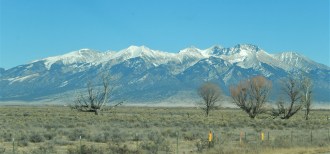 see it.
The first time Carol’s mother drove from Washington State to New Mexico, she thought New Mexico was a wasted desert. However, after living there for several years, she learned to enjoy its beauty and didn’t want to leave. New Mexico is called “The Land of Enchantment” for good reason.
But we are also farmers at heart. We enjoy planting seeds, flowers, bushes, and trees and watching them grow. In 1974 we planted a Banana-Apple tree sapling in our front yard in Los Alamos, NM. We moved to Tulsa in 1978 so we didn’t have the privilege of eating its fruit at the 5-year mark. But in 1988 we moved back to Los Alamos (not to the same house) and visited the old place. Believe-it-or-not, the tree had grown so large that it nearly overshadowed the front yard! We had done a good job in preparing the ground prior to planting it,  and the underlying soil was good for the tree. The owners gladly allowed us to take as many apples as we wanted, and we belatedly enjoyed the fruit of our labors. The apples were delicious in pies, strudel, crisp – and eating raw. They were good!
Even though I understand nature and farming, something always surprises me. I plant anything that crosses my fingertips in the same dirt. I give them all the same water. I treat them all with the same care. But different things sprout out of that same dirt. Although the same environment may be used, onions, potatoes, corn, yams, cucumbers, zucchini, beets, carrots and the rest are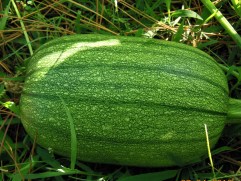 programmed to grow at different rates, to different sizes, to look differently, and to taste differently. The same ground produces different results.
The environment is basically the same – dirt, water, air, cultivation, weeding, debugging, etc. – but with minor variations, the results can be remarkable! We fertilize the ground and adjust the nutrients and minerals to match the needs of the seeds or bulbs, and that produces a difference in the quality of the product. If I kept everything exactly the same, something would still grow; but seeds respond differently to variations in the environment.
Do you know that we plant seeds into our own minds? Day after day we watch or listen to television, radio, the theater, DVDs, CDs, etc. We listen to all kinds of music and bombard our bodies with various levels of noise. We read books, magazines, newspapers, advertisements. We listen to audio books, gossip, slander, political debates, classroom teaching, sermons. What goes into the eyes and ears enters our minds and becomes part of us. Stuff is being planted into the garden of our minds day after day, and what we fertilize grows the best. The method of “fertilizing” what is in our mind is called “meditation”; and a simple definition of meditation is: “spending time thinking about what we have seen and heard.”
Psalm 19:14 says, ‘Let the words of my mouth and the meditation [thoughts] of my heart [mind] be acceptable to you, O Lord, my rock and my redeemer.”
You should ask yourself: Is God pleased with my thoughts?
 We also “plant” seeds into other people’s lives. What we say to others – whether good or bad – produces a harvest. We either help others live a higher quality, more productive life, or we stunt their growth to where they don’t live up to their God-given potential. We must assure that we make positive comments for people to meditate on.
However, don’t confuse “negative comments” with “corrective statements.” Life doesn’t consist of a “Pollyanna World” or a 100% positive environment; therefore, we should learn to make necessary corrective statements in the proper attitude. Also, we should learn to make corrective adjustments in our own attitude. This is a lifetime process and I am still working on it.
I hope you understand that our minds are fertile ground, and what we see and hear eventually produces a harvest: some good fruit and some bad. Our character may be blossoming and maturing to where we can bless God and man, or it may be stunted as a sterile tree planted in contaminated ground. Sometimes a sterile tree looks wonderful until “harvest time”. That’s when the real nature of the tree is revealed. (Read Matthew 13:25-30 about the wheat and tares.)
Friend, what’s growing in the garden of your mind? What do you meditate on?
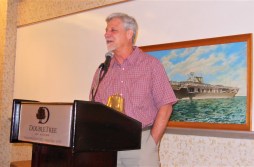
 Yorktown Survivor’s Club Reunion. The keynote speaker, Rear Admiral Mac McClaughlin, spoke at our banquet on the USS Midway in San Diego Harbor.
  But the bridge! Straight from London, it is redeemed history! When you look at the bridge you are looking at part of London in 1831AD. But you see the Stars and Stripes and the British Jack flying alternately on poles on the bridge because it is also now part of American history.
 stones were shipped through the Panama Canal to California, then hauled by truck to Lake Havasu, Arizona. The Sundt Construction Company laboriously reassembled it, but modified the plan and reassembly procedure to meet current safety code for bridges. Therefore, the bridge is hollow with substantial steel reinforcement, and was fully reassembled in 1971. The weight of the modified bridge is about 30,000 tons.
 mankind had become useless to God. But God, in the person of Jesus Christ, died on the cross for us and provided redemption for “whosoever will.” All that’s required of us is to stop living to please ourselves, ask God to forgive us for our sin and selfishness, live for Jesus Christ, honor God with our whole life, and help others.
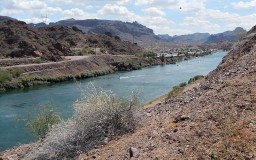 know we won’t be far from the Salton Sea?”
 “If you get there by driving on the freeways through Riverside, it is about 182 miles; and if you go through the mountains through Julian, it is about 138 miles. But if you get there by helicopter, it is only about 70 miles.”
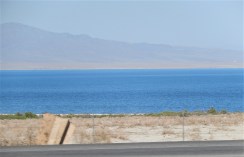 Development Company were trying to increase water flow from the Colorado River into the valley for farming. But the powerful river overcame their barriers, gouged deep channels into the land, and poured into the Salton Sink basin for eighteen months. The engineers were finally able to stop the flow in 1907. Interestingly, the Salton Sea sits squarely on a portion of the San Andreas Fault.
  vacated houses with broken windows. We did see a few sandy residential areas with very small town centers, but the thriving resort and retirement communities I had read about years ago seemed to be non-existent. The lake had been receding in the past several decades but more rapidly during the recent California drought. The badly-receding shoreline was salt-encrusted, and badly deteriorated boats were rotting in the salty sand.
 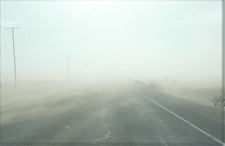 in the midst of the length of the storm to Brawley, or drive across the storm for twelve miles. Either way, we would drive slowly for we couldn’t see very well more than 75 feet ahead of us. We chose the shorter hazard.
  Martin Luther was quoting the Apostle Paul, so you might be pitting the Apostles Paul and James against each other (and James was Jesus’ half-brother).
 said good works and Godly living will be a result of our faith in Jesus Christ.
 “Think not that I am come to destroy the law or the prophets: I am not come to destroy, but to fulfil. For verily I say unto you, ‘till heaven and earth pass, one jot or one tittle shall in no wise pass from the law, ‘till all be fulfilled.” So, am I a legalist? Perhaps – in the correct meaning of the word. I do believe in the law.
 Gene Linzey