
 The caterpillar emerged from its egg and opened its twelve eyes. It didn’t know what to expect; all it did was to crawl out on its leaf and see what the world was all about. But the leaf turned over, and the caterpillar lost its footing and fell onto the grass. “Wow! That was fun!” it said.
The caterpillar has sixteen legs, but only six of them are true legs. The others assist in holding onto twigs and leaves.
The worm was starving, so it began eating the green things it fell on. He liked grass, but he also ate some big flat things that fell off the trees. Leaves were stiffer and tasted better.
The little guy spent most of its waking hours eating. Over the next week, he crawled all around the yard to experience life, eating every step of the way. Then it discovered a bush – the one he fell from, but didn’t know it. “Wow! If I can get up there, I could see EVERYTHING.”
So it spent the next half hour climbing up the intertwining twigs of that three-foot bush. When it reached the summit, it looked out over the yard. “Wow! I didn’t know I could see the whole world. This is great!”
The little worm had hatched on this bush that was planted in a small enclosure that served as a safe play lot for the four-year-old human. To the worm, this was a huge world; but to an adult human, the 15’ x 15’ play lot surrounded by a six-foot wooden fence was very small.
The caterpillar looked over the world often, and was amazed at the size of it.
After several days it began thinking, “I wonder what’s on the other side of the world?” So it climbed off the bush and began climbing up the six-foot wooden fence to take a look. In a few hours it reached the top. “Wow! There are more worlds to see.”
Then something orange and black floated above its head. 
“What are you doing down there?” asked the orange thing.
“I am trying to see other worlds. I’ve been searching my world and ….” The worm suddenly realized that the orange thing was flying.
“Hey! How do you do that? How did you get up there?”
“I am a monarch butterfly, just like you will be in a few days. After you crawl for the last time and wrap yourself in a blanket, you will die. But, don’t worry, you will come back alive. It will be difficult climbing out of the blanket because it gets real hard after you die. But when you come back alive, you will look different – like me. The world you know now is only a tiny part of the bigger world. You will fly like I am, and you will like it! Well, I have to go now. I am flying with hundreds of my friends to a far-away place. Don’t forget what I said. Bye.”
“Wow! I didn’t know any of that. How did she figure it out? Well, I will think about that later because I am starving!”
About five days later, the caterpillar began feeling sick. Then it thought, “Maybe what the butterfly said is happening. I better go to the bush and start making a blanket.”
So it did. It was in the pupa stage, or chrysalis, for ten to twelve days. And it had a difficult time breaking out of its hard blanket – like the butterfly said. But that terrible ordeal was planned by God in order to make its wings strong, and able to fly.
We’re like caterpillars. We crawl around, viewing life like the worm does, thinking this  physical life is all there is. We’re oblivious to the reality “beyond the fence.” But our world is very small, and God wants us to see “the bigger world” from his perspective – more like the butterfly.
The secret to understanding reality is to die to ourselves. Galatians 2:20 says, “I have been crucified with Christ; it is no longer I who live, but Christ lives in me; and the life which I now live in the flesh I live by faith in the Son of God, who loved me and gave Himself for me” (NKJV).
Dying to ourselves means we learn to know God and put his desires ahead of our own, and do what he wants us to do. Then we begin to see and understand from his perspective. And at the end of life, we fly to the bigger world: God’s home in heaven.
And that’s only the beginning!
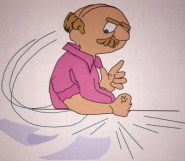 That took me by surprise. John and I were having an interesting discussion; but when we touched on an idea about which he disagreed, he spat out, “You are wrong!”
  evolutionary synthesis, natural selection, cosmic evolution, and population genetics. Several creation concepts are: intelligent design, the six [24-hour] day creation, the six [1,000-year, or more] day creation, punctuated equilibrium (although a version of this hypothesis is also accepted in evolution); and myriads of pagan creation stories. Here is an Egyptian myth:
![dumbbell-nebula1[1]](https://genelinzey.com/wp-content/uploads/2019/03/dumbbell-nebula11.png?w=239&h=156) ago. So far, so good. But John came to a mental roadblock when I said, “In the infinity preceding the creation of life on earth, I wonder how long God thought about and planned His proposed creation.”
ago. So far, so good. But John came to a mental roadblock when I said, “In the infinity preceding the creation of life on earth, I wonder how long God thought about and planned His proposed creation.”  a good understanding of Scripture and history. Second Timothy 3:15-16; “Study [the Bible] to receive God’s approval as you correctly understand and teach the word of truth. But avoid useless arguments: for they will drive people further away from God.”
  personal reality. For this reason, postmodernism is highly skeptical of explanations which claim to be valid for all groups, cultures, traditions, or races, and instead focuses on the relative truths of each person. In the postmodern understanding, interpretation is everything.”
 discussion of ‘justice’, there is no meaning which we can find. The concept of ‘justice’ exists only as long as we negotiate its meaning between ourselves in our society.” And that makes as much sense as me trying to push around a 300-pound gorilla!
 Do you know anything about wisdom? Wisdom is defined as: the ability to discern or judge what is true or right; the ability to make practical applications of truth or knowledge in everyday life.
 ![dscn6647b[1]](https://genelinzey.com/wp-content/uploads/2019/03/dscn6647b1.jpg?w=525) a while for us to grow out of our youthful foolishness. That’s why Scripture says young people should learn from the older folk: they have been around for a while, and have a wealth of information and wisdom to pass on.
a while for us to grow out of our youthful foolishness. That’s why Scripture says young people should learn from the older folk: they have been around for a while, and have a wealth of information and wisdom to pass on. against imaginary people, and the result is barbarianism and cruelty against real people. We also extol the virtues of drinking alcohol, then try to figure out why we have so much death, mangled cars, destroyed lives, lost jobs, and wrecked marriages. I could go on, but that will suffice.
 On December 4, 1965 Captain Charles White was flying an Eastern Air Lines Lockheed Super Constellation from Boston to Newark International Airport. At the same time, Captain Thomas Carroll was flying his TWA Boeing 707 from San Francisco to Kennedy International Airport. Both aircraft had passed a thorough inspection within the past year, and the pilots and crew had recently passed their annual physical exams. Both pilots were
 instrument-rated and both aircraft had up-to-date for IFR flight.
  As they approached Carmel, New York, the Constellation was flying at 10,000 feet altitude in-and-out of an inclined cloud bank while the 707 was above the clouds at 11,000 feet. But they collided over Carmel. What caused the mid-air collision? Quoting from one of the reports:
  Losing its vertical stabilizer, the Constellation briefly continued gaining altitude but quickly became unstable. Captain White, skillfully manipulating engine thrust, regained control of the plane to some degree. Not having the luxury of choosing airports, he had to put the plane down right away. Expertly using engine thrust to guide the plane, he landed the plane in a field near Danbury, Connecticut, and the captain immediately began helping passengers to safety.
 says, they show that in their hearts they know right from wrong. They demonstrate that God’s law is written within them….” That’s why verse 20 informs us that no one has an excuse for not living according to God’s law.
 “Carol, look in the back yard!” I called to my wife. A large cat was lying motionless on the lawn intently observing something. But why was it there? What was it looking at?
 was partial to rabbits until I planted our garden. The furry little creatures seem to have a taste for my beet greens, Carol’s pea plants, and our broccoli. As I was chasing one rabbit out of the garden, I hollered, “Have you ever heard of rabbit stew?” The leporid probably didn’t hear me as it darted through – yes, THROUGH – the chain link fencing. I didn’t know they could fit through the diagonal openings. From the next yard it stopped, turned around, and looked at me as if to say, “You can’t catch me!” only to run for its furry life as the neighbor’s barking dog took up the chase. Good dog!
 appears “out of the blue,” like that Broad-winged Hawk after the rabbit. Then we ask, “How did I get caught?”
  green, but four weeks later the entire tree was a desert brown. It was fascinating because all our other trees were in great shape. Well, I do need to tend the crepe myrtles and prune them a bit. Back to the pine tree later.
 male and female he created them” (Genesis 1:27). God is a spiritual being, and we are spiritual beings – inside human bodies. Mankind was the high point of God’s creative work here on earth. God created us as an entirely new species, quite different from animals. And to emphasize this distinction, God placed man over the animals. In Genesis 1:28 God told Adam, “Rule over the fish of the sea and the birds of the air and over every living creature that moves on the ground.” Animals can’t do that.
 interaction. Evolutionist Julian Huxley noted that “Only humans possess true language, conceptual thought, art, humor, science and religion.” And only humans can record and direct the course of history. Humans can express themselves analytically. And it is obvious that only humans have the ability to communicate through complex, multi-lingual skills. All this sets mankind apart from the animal kingdom.
  humans do care for the elderly. Animals do not have the intellectual,
 emotional, and relational mentality, or the skill or ability to interact and build an enhanced society; but man has been to the moon and back. Instead, animals have continued their lives without change for the past recorded 6,000 years. When you hear or read some scientist say that 98% of our genes are shared with some animals, don’t get excited about it. They also say we share about 50% of our genes with bananas. So the statistics are meaningless.
  Gene Linzey