What’s on Your Mind?

One day when I was 12 years old, dad asked me, “What are you thinking about?”

“I was just remembering the trip you and mom took me on when I was five. We went to Yosemite, and we watched the fire fall from the top of the cliff.”

“You remember that? Seven years ago? Can you tell me about it?”

I surprised dad with all that I remembered. About driving through the park, where we camped, and the park ranger talking with the visitors. Then at nine o’ clock at night, the ranger hollered to the men up on Glacier Point, “Let the fire fall!” And when the rangers up on the cliff began pushing the burning wood and hot coals over the edge, it looked like a glowing waterfall.

I found out later that the men on Glacier Point couldn’t hear the ranger; everything was timed.

“Why don’t you write about that vacation?”

“Dad, I hate writing, and my handwriting is terrible.”

“A typewriter can fix your writing, but only you can fix the desire to write. Writing will be important to you someday, so you may as well start now.”

He told me to get a sheet of paper and a pencil. I did. He then said something funny. At least it seemed strange to me. “Make the pencil move and make the lines mean something. Start with today’s date, and the name of something you are interested in. You can even write about watching the fire fall.”

I knew the day’s date, and dad knew I loved kittens. “I have an idea, write what you like about kittens.”

That didn’t make me like to write, but I enjoyed talking about cats. So dad is the one who jump-started me in my writing career and the desire to study the Bible. But it took several more years and a few more nudges to get the ball rolling.

My seventh-grade teacher, Mr. Beharka, and my college history professor, Dr. J.C. Holsinger, are the two who propelled me into studying history. When I realized that I could merge history with the Bible, I came alive.

Years later, friends and acquaintances began asking me questions about history, the Bible, science, a few other topics, and I discovered that I enjoyed writing my thoughts to share with them. In time, my writing became a teaching tool.

How about you who are reading this note? Have you thought about writing? No, you don’t have to attend a Dale Carnegie writing course, attend the university, or take an online writing class. But someone – could be your children, grandchildren, church friends or social club – is interested in you. Someone is interested in what you’ve experienced, what you’ve learned, who you are inside. You are important.

You don’t even have to join a writers guild, although that could help. My wife, Carol, said for decades that she wasn’t a writer until she finally accepted my challenge. She agreed to write about something and let the guild members read it. Guess what? She wrote it very well, they enjoyed it, and encouraged her to write more. It surprised her to no end when she won a $200 award in a writing contest.

Your experiences, your world-view, your outlook on life can help others learn how to face a challenge, learn how to overcome a problem, even learn how to enjoy life. Someone needs to hear from you, and you can start with getting a pencil … no, let’s come up to date. You can start with turning on your computer, typing your name and date, and the name of something you’re interested in.

What’s on your mind? Write about it. Encourage others with your thoughts. You are more important than you think you are. And if you need help or have questions, you can contact me through the connect page. Have a great week.
Happy New Year, Friends

On December 31, 2020, Carol and I spent a quiet New Year’s celebration together. It was relaxing because from 2008 through 2022, we had been home on December 31 only five times and on the road ten times. Hey, I just realized that we’ll stay home this year, too. YAY1

Several friends asked, “Can’t sit still, can ya?” My response is normally, “You find no moss under my wheels.” For example, in 2021 we drove over 29,000 miles and almost 21,000 in 2022.

It’s well-known by our families, friends, and those who read my articles, that we enjoy living in Siloam Springs, Arkansas. All cities, towns, and villages have their problems, but we’ve found this town to be one of the most pleasant places we’ve ever lived. With that in mind, why do we “hit the road” so often?

One quick answer is: our five kids live in five different states, and our siblings are spread out from the West Coast to the Mississippi Valley. We enjoy visiting them. We also have the privilege of preaching and teaching in our travels.

A second answer is: we enjoy seeing God’s creation first-hand. Seeing nature in books and on video is great. But nothing beats driving through the Sierra Nevada Mountain Range, seeing the Space Needle in Seattle, WA, the amazing Oregon Coast, Puget Sound in the great northwest, Niagara Falls, the red granite beaches of Maine, the snow-white beaches of Siesta Beach in Florida, seeing Yellowstone and Yosemite National Parks, and HUNDREDS of other places.

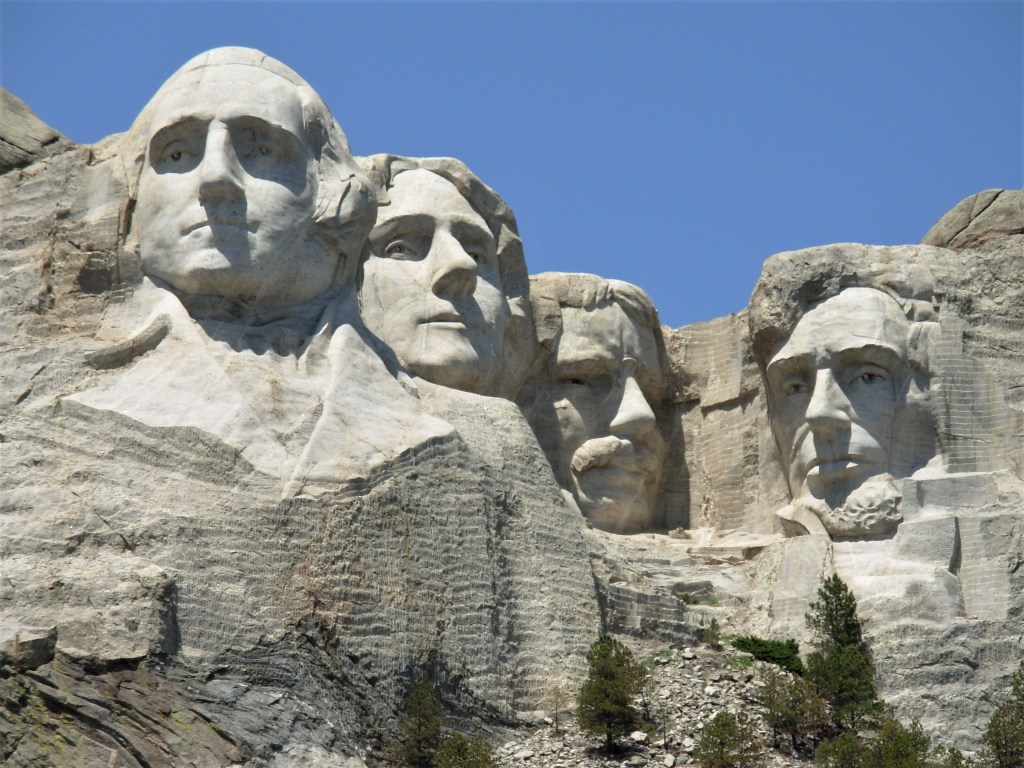
We also enjoy seeing the marvels of man’s creation, such as Mount Rushmore in South Dakota, the 605-foot tall Space Needle in Seattle, and the 630-foot tall Arch in St. Louis.

Historic sites such as the Yorktown, Virginia battlefield, the Gettysburg Battlefield, and Pearl Harbor cause me to stop and contemplate how different life might have been if the political and military tide had turned the other way.

The third answer is: we’re getting older, and some day our travel days will be over. So let’s travel while we can.

As we travel, we take thousands of pictures to document where we’ve been and what we saw. We’re grateful for digital photography because that’s a lot less expensive than the film we bought in the past. We often get our pictures out (on computer or other devices) and through our memory, we take those trips again.

The ability to remember amazes me. When I get to heaven, I want to ask God how He created memory. But I think He’ll simply say: That’s My secret.

As I mentally gaze on our blessings this past year, I read that approximately 3,273,707 people died in 2022 in the United States (around 69,163,777 worldwide), others have gotten sick, many have lost homes and businesses due to pandemics, government mistakes, the natural flow of economics, ongoing wars, and natural disasters. But sickness, wars, governmental problems, business failures, and all the other problems and catastrophes have been going on since shortly after Adam and Eve left the Garden of Eden. As we read in Ecclesiastes 1:9, “The thing that hath been, it is that which shall be; and that which is done is that which shall be done: and there is no new thing under the sun.”

The emphasis is: there’s nothing new under the sun. We have modern means of traveling, conducting war, studying, and getting work done, but the essence of life hasn’t changed throughout man’s history. Sickness, death, and all other problems related to life on earth will continue until Jesus stops it. And He will return one day.

But if He doesn’t return soon enough, I will die too. I don’t know by what means, but I will die, and the thought doesn’t bother me at all because death is part of life, and I know where I’ll go – to heaven to be with Jesus.

In the same concept as midnight on December 31 starts a new year, or a baby being born starts a new life, when my traveling days are over and I breathe my last on earth, I will start a new year, a brand-new life in heaven. It’s part of the Christian’s cycle of life.

However, as badly as I feel for those who have been hurt by various events on earth, I feel worse for those who die while not believing in Jesus Christ. We can start over after a catastrophe on earth, but when we die without faith in Jesus, there is no recovery. Think about it.

And I do wish you a Happy New Year.

The Undulating Seascape

I’m from San Diego, California, and Carol’s from Seattle, Washington. We both are ocean-loving kids. Carol’s family visited the northern Pacific coast often; and my parents took us to the Southern California beaches often during my childhood, and to the Atlantic seaboard in my later high school years. Carol and I can sit on the beach or on a pier jutting into the water and watch the undulating seascape for hours on end and never tire of it.

Friends and acquaintances don’t understand, and ask, “How can you just sit there and look at the same thing for hours? Isn’t that totally boring?”

The answer is a resounding NO. The sea is never the same.

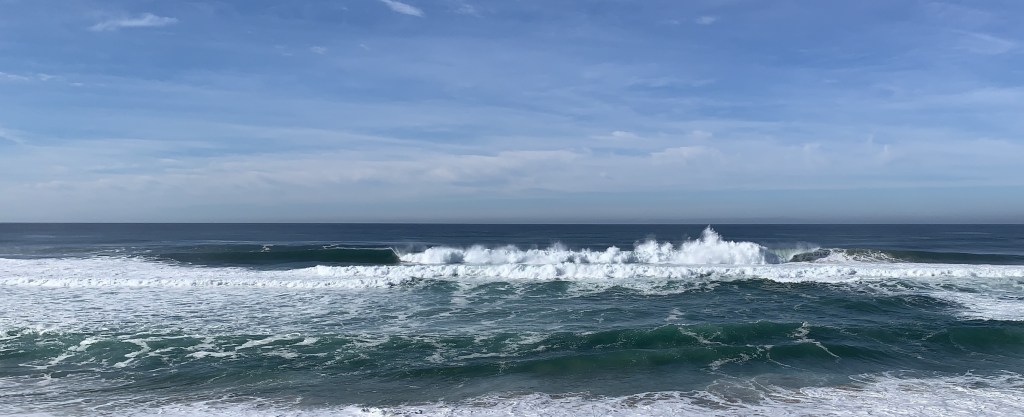
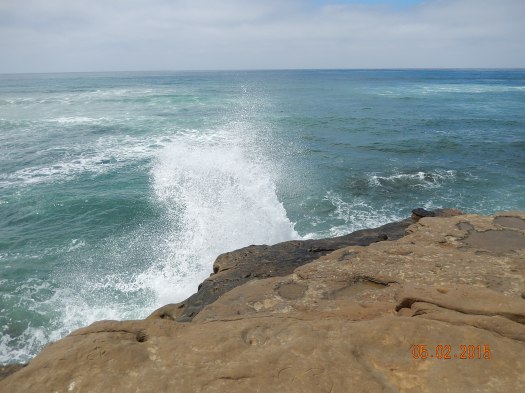
The swells that eventually morph into waves are always changing; and believe-it-or-not, the waves never crash the same. Sometimes the waves merely topple over, other times they mount up and trap enormous amounts of air as they prepare to pound the sand. That’s when the compressed air sends water exploding every which way. Other waves relax and melt into the surrounding water. Often several swells, which are moving at different speeds, will combine and create a much larger, more dynamic wave. And we get thrilled when a several hundred-foot-wide wave curls and breaks in one unified action.

The winds offshore create whitecaps out at sea, and the color of the water – based on the color of the sky and how the sunlight reflects off the water – changes continuously.

Sea animals often come into view. In Puget Sound in Washington State, Orcas (killer whales) are often present; but on our last trip up there we saw and filmed a humpback whale. That humpback must have gotten lost because they normally don’t enter the Sound.

Up and down the coast, we often see dolphins, sea lions, sea otters, gray whales, elephant seals, humpback whales, harbor seals, and other sea critters. In fact, on our last visit to the Oregon coast, we saw hundreds of sea lions floating off the coast, barking their greetings and, quite often, their disapprovals to each other.

We watch seagulls fight for food floating or near the surface of the water. And pelicans have an interesting way of circling to spot their underwater prey, then dive like spears to get their fresh fish feast. Periodically, we see jellyfish – and portions thereof – washed up on the beach. If you see any of these, please don’t touch them because the poison on the tentacles can still hurt you.

We like to go fishing on the coast. An interesting rule is: if we stand on shore or even in the surf, we need a license. But if we stand on the pier, no license is required. I caught a lot of fish from the pier.

One interesting non-sea-life viewpoint was Face-Rock at the State Park in Bandon, Oregon. The huge rock just off-shore resembles the head of a person looking up to the sky, and carries the legend of Indian Princess Ewauna who was lured out into the water by Seatka, the evil spirit of the sea.

At Monterey, California, we nearly lost track of time. After visiting the fascinating Monterey Aquarium, we went to the shore several miles away. The tide was coming in, the waves were crashing in spectacular form with dynamic results! We watched for several hours without realizing it was getting dark. Although both of us had taken over 150 pictures, we kept taking them because every time we looked, the scene was different.

By the way, it was the Monterey Aquarium staff who discovered that octopi (plural of octopus) kill sharks. Look it up on the internet for the whole story.

But just as the undulating seascape is ever-changing, life is ever-changing. Every time we wake up, turn around, go the to store, or meet someone, things change. Our health changes, businesses close, people lose jobs, someone dies. We sometimes emotionally feel like corks tossed about on turbulent water. We need an anchor. What can we do?

As a ship in a storm needs a safe harbor, we can find peace and safety in Jesus. The song declares: “I’ve anchored my soul in the Haven of rest.”

The Bible informs us that Jesus understands everything we experience, has endured every kind of temptation, pain, and hardship we face, and is willing to help us – if we let Him.

Be Ready for Surprises

Carol and I have an exciting life. We often don’t know from one day to the next what we’ll encounter – whether we’ll enjoy the events or be disappointed that we got out of bed. However, we understand that every day and in every situation in life, we have choices about how we’ll respond to circumstances. Sometimes events may be planned, but often they seem to pop up out of the blue. But we choose to respond in ways that honor the Lord.

For example, I wanted to visit my brother in California who was having health problems. Stopping for the weekend to visit with a dear, life-long friend who is a pastor, at 5:30 on Saturday evening, the pastor asked, “Would you be willing to preach for us tomorrow?”

I could have reacted with, “This is too short of a notice. I need more time to prepare.” But that’s not how God works. God had a plan in mind for both the church and for me, and I didn’t need much time to prepare. God had already been preparing the message in my mind and heart.

Another example developed as we were planning our route west from Albuquerque. Snow was forecast for Flagstaff, and pulling a trailer uphill in snowy weather is not my idea of safe traveling. So, we decided to take the southern route through Las Cruces, NM, and west through Mesa and Phoenix, Arizona.

However, we found out that God guided us in choosing the southern route because another friend who lived in Mesa had passed away. Her husband, Bill, called and asked if we could be with him at the home-going ceremony which would be at 10:00 AM on Monday. We agreed and arrived in Mesa on Saturday and stayed with Bill through the weekend.

Arriving at the cemetery at 9:30 AM on Monday, we interacted with Bill and the other family members, but the pastor hadn’t arrived yet. Finally, at 9:55 AM, I asked Bill, “Where’s your pastor?”

“Oh, didn’t I tell you? You’re him.” Surprised, I asked if he had an agenda. He said, “You’re it.”

I turned to the funeral director and asked him about his agenda. He responded, “I was told you’d have it.”

Again, I could have complained about not being informed beforehand. But if we are truly followers of the Lord Jesus Christ, our lives and schedules are in His hands, and He has the freedom to guide our paths. That eliminates a lot of potential stress.

I took a deep breath, sent up a quick prayer, and reprogrammed my mind. Four minutes later we began our Celebration of Life service. It didn’t take any time for preparation because God was in charge, and Jo had been Carol’s and my friend since the early 1990s. I opened the meeting with prayer, then related an interaction with her when I was music minister where she played trumpet in the orchestra. Other friends who had known Jo since the 1980s were there, along with Jo’s husband and family. They, and others, added stories from their past. We truly celebrated her life, and it seemed like it was all planned.

Guess what? It WAS all planned – in the mind of God.

When a surprise springs up in front of us, all we need to do is ask the Lord for guidance. God likes that, and always has an answer. He’s in charge, and all we need to do is communicate with Him and be ready to obey.

That reminds me of another interaction many years ago.

In 1978 when Carol & I, with our 3 older kiddos were getting ready to relocate from New Mexico to Oklahoma, an older pastor in Albuquerque gave me this admonition:

“Gene, don’t open your own doors. You, and others who are like you, have a tendency to open doors that God doesn’t want open. Keep your hands off the doorknobs. Let God open the doors for you, but be sure to go through the ones He opens.”

“May I try the doors and see if they’re unlocked?”

“You may lightly push – with one finger. But keep your hands off the knobs.”

I’ve lived by that rule and God has led in wonderful ways.

Many surprises await us, so trust God for His guidance. Psalm 28:7a says, “The Lord is my strength and shield. I trust him with all my heart. He helps me, and my heart is filled with joy.” Be ready to obey, and enjoy the surprises.

Thanksgiving Day

I lean back in my La-z-Boy chair, prop up my feet, turn on the 10 motors in the chair to massage my tired back, and relax. I like football, but I don’t feel like watching a game right now. Carol brings me a cup of coffee with the right amount of milk and sugar. I take a sip, ahhhhhhh, close my eyes, and thank God for the wonderful life He has ….

“Sweetheart. Gene, where are you?”

“Huh … wh … what’d you say?”

“You must have fallen asleep.”

“Yeah … I guess I … was … dreaming.”

Thanksgiving Day is almost here, and I’m in front of the computer where my hand fell on the keyboard. I looked at the screen and saw a page of Js. I deleted them. I looked over to where my La-z-Boy chair is beckoning me in real life.

“The reason I called you – oh, sorry that I had to wake you up – but we got a call from family in California. The fires are raging, and many houses, barns, and businesses have gone up in flames. Are you sure we should go out west?”

I thought back on the dream I was enjoying.

Not many bad things have happened to us, and I’m thankful. But what about my friends and family members? We are mourning for the family whose father and daughter recently drowned. Fires have ravaged multi-thousands of acres and several towns, and tornados have created havoc in many places. How will those whose lives have been turned upside down celebrate? Or can they truthfully celebrate Thanksgiving with the turmoil they’re experiencing?

I thought about the smoke would encounter if we went west. That shouldn’t be too bad, and we probably would not meet up with any flames. At least, I hope not. The smoke is devastating for some folks with bronchial problems, but my allergy pills should help me.

“Precious, I think we should go to our daughter and family south instead of our son and family out west.”

Years ago, two of my sisters lost houses in fires, and some friends are currently without electricity. Friends whose houses were damaged by the twisters are waiting for the repairs or reconstruction to take place. With that in mind, a question hung heavily in my mind, so I asked the Lord. “Father, how can people be thankful in the face of disaster? How can they actually be grateful when so much has been taken from them?”

Then I remembered asking my sister, Jan, how she felt when her house was destroyed. She responded, “Eugene, it’s only stuff. Whatever we want to replace, we can. But it’s only stuff. We’re still alive. That’s what counts.” That was an excellent, mature response.

I asked our friends how they’re doing after the tornado damaged their house. One of them responded, “We’re doing fine. It was hard to sleep afterwards, but it’s only a house. God has taken care of us.” The other said, “We’re doing fine. It’ll get repaired, and we are thankful to the Lord.”

I’ve never heard God speak out loud, but He answered my prayer with the following thoughts.

I give many kinds of blessings, many of them are material. Most people, even those who don’t know Me, are generally happy about what they have. But those who know Me are grateful for our relationship, and they don’t wait for this day of the year to show it. Their gratefulness, their thankfulness, is not based on what they have, but what they are. They are thankful for life. And when their human life is over, they will thank Me face-to-face.

Some time ago, a missionary couple at church told us about a poor family overseas. With barely enough money to buy food, they received a gift of $70. They were excited, but they knew another family who had no food at all. Following God’s leadership, they joyfully gave that $70 to the other family. Their generosity revealed not only a grateful spirit, but a deep, mature relationship with God.

“Precious, I called to see if the repairs on the trailer were complete. It’s almost ready.”

“What if the weather gets stormy?”

“We’ll go without the trailer.”

It isn’t what we have or don’t have that produces joy, and it isn’t whether or not we’ve experienced hardship in life that prompts us to be thankful. What engenders gratefulness is knowing Jesus Who offers us eternal life.

James 1:17 tells us that every good gift comes from God. Let’s express our gratitude to God every day. Let’s be generous to others. And let’s be compassionate and help those who are experiencing hardship and tragedy. Allow God to bless others through you.

Two Trees … Two Lives

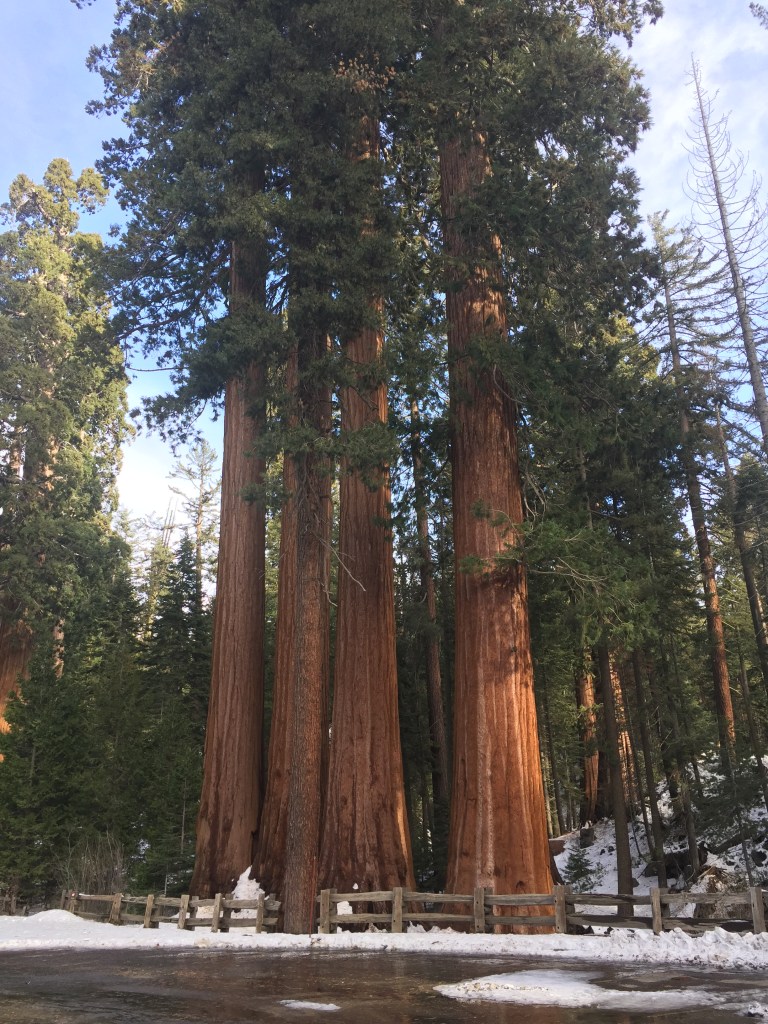
As we walked through the Redwood Forest in Northern California, we were awed by the beauty, the grandeur of these magnificent trees that average 240 feet in height. I grew up in Southern California but rarely did my parents have opportunity to go that far north. Eight hundred miles was a long way in the 1950s, and I saw the Redwoods only one time in my childhood.

But this was 2018, Carol & I were on our year-long jaunt around the US of A, and childhood memories came flooding through the canals of my mind. On November 14 we visited the Humboldt Redwoods State Park, and on December 8, we visited the Calaveras Big Trees State Park – in the snow, of course – with our son, Ron, and his family.

There are basically two divisions of giant Redwoods: Giant Sequoias (sequoiadendron gigantem) are found in the California Sierra Nevada Mountains, and Coastal Redwoods (sequoia sempervirens) grow near the Northern California coast.

Some Giant Sequoias grow 300 feet tall, have a diameter up to 35 feet (that’s almost 110 feet in circumference!), have a root system which can cover several acres, and be more than 3,000 years old. For history buffs: a tree that old sprouted about the time Saul was crowned King of Israel and about 100 years prior to the beginning of the Neo-Assyrian Empire. The Coastal Redwoods can grow 370 feet tall – the tallest trees in the world – with trunks up to about 30 feet in diameter (95 feet in circumference).

Loggers had cut about 90% of these colossal trees for housing, furniture, etc.; but various conservation groups appealed to Congress to preserve the Redwoods, and the state and national park systems succeeded in rescuing the remaining 10%.

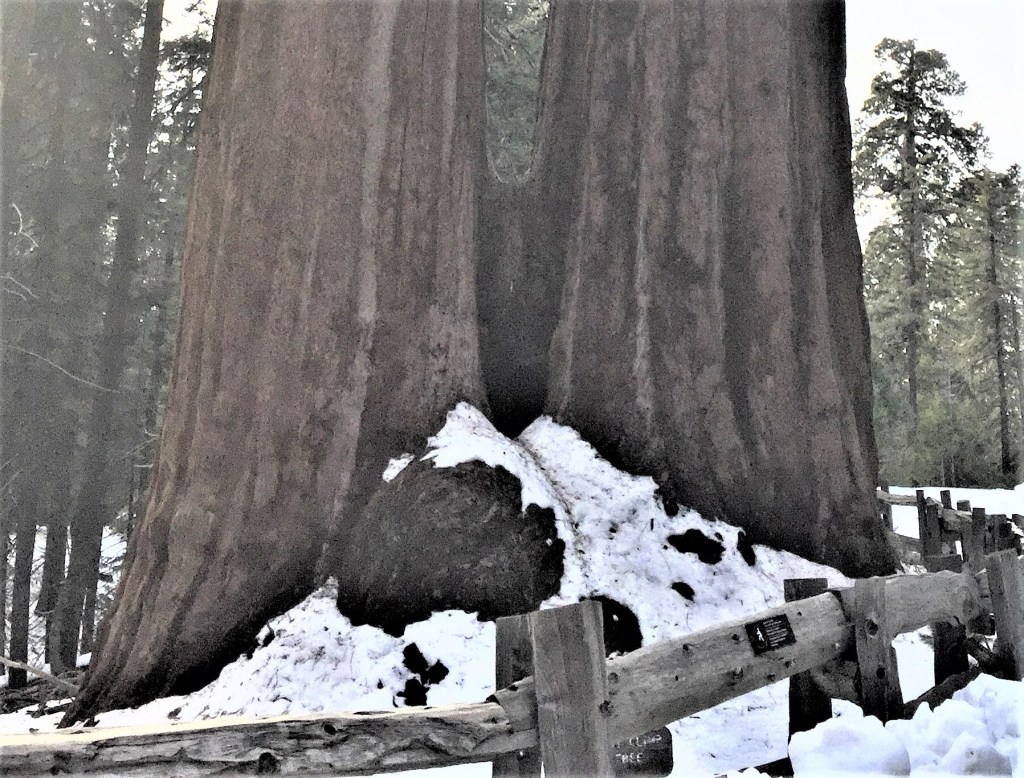
 As Carol and I walked among the trees, we saw a number of them that looked as though two or three had been planted together. Standing very close together with 8-foot diameter trunks, it looked as though someone had poured liquid bark on the trees ten feet off the ground which solidified, connecting the trees. Looking at this photo carefully, you can see where the bark has joined the two trees.

Yes, they had grown up together – the seeds having landed about ten feet apart. As seedlings, ten feet is a long distance. But as they grew and their trunks began touching, a phenomenon called inosculation took place. This funny word means to connect or join; to become one or make continuous; to unite.

As each of them grew in width at about an inch per year, they began touching in 120 years. As the trunks or branches rubbed together and wore off the bark, the live fibrous tissues touched each other and began intertwining. They didn’t get infected, and the trees became one plant, sharing nutrients and water.

Depending on how close trees are, either the bark joins and becomes one covering around both trees, or the tree trunks themselves physically join and become one tree. The trees that fuse together like that are called Hugging Trees. And together, they are stronger than individual trees.

Trees and bushes are not the only organisms that experience inosculation. This interesting phenomenon takes place when a person receives a skin graft. Through inosculation, the blood vessels and skin tissues connect, intertwine, and become one.

As I stood in the Humboldt Redwoods State Park gazing at these two magnificent works of God that had become one, I began thinking about my relationship with Carol.

We were born in different states. Eighteen years later we met in Southern California in college. Both of us lived on campus, and – attracted to each other – we saw each other in classes, during meals in the cafeteria, and in the choir.

Married August 22, 1966, we began growing together – yes, including rubbing each other the wrong way sometimes. But we didn’t allow the irritations, the inconveniences, the frustrations, and occasional anger to infect us as we wore off the rough edges; and over the years we became one in many ways.

We share the same house, the same joys, the same children, the same grandchildren, the same church, the same God. We have the same basic goals in life. We even react in much the same way, and at times spontaneously come up with the same ideas. We’ve grown strong together.

Two trees…two lives. It’s amazing how two individuals can develop a strong marriage if they stay together, weather the storms of life, and learn to truly love each other.

Current Actions Produce Delayed Results

The phone rang. Looking at the caller ID, I answered, “Howdy Paul.”

“Hey Eugene, what are you doing June 21 through June 24?” Paul was an army chaplain, recently retired, and is now a supporting chaplain at the Naval Academy at Annapolis, Maryland.

I responded, “Nothing’s on the calendar for those days – yet. What do you have in mind?”

“You want to fly to Montana with me?”

“Are you driving?”

“No, big brother. We’ll fly commercial.”

“Are you looking for grizzlies, moose, bison, or what?”

“Wrong on all counts. I want to see the shortest river in the world. You coming with me on this ‘brother’s trip’ or not?”

“Count me in!” And that started an adventure that two close brothers will never forget; and will result in a co-authored book.

Flying out of Oklahoma City, we changed planes in Salt Lake City, then made Helena, Montana home for two nights.

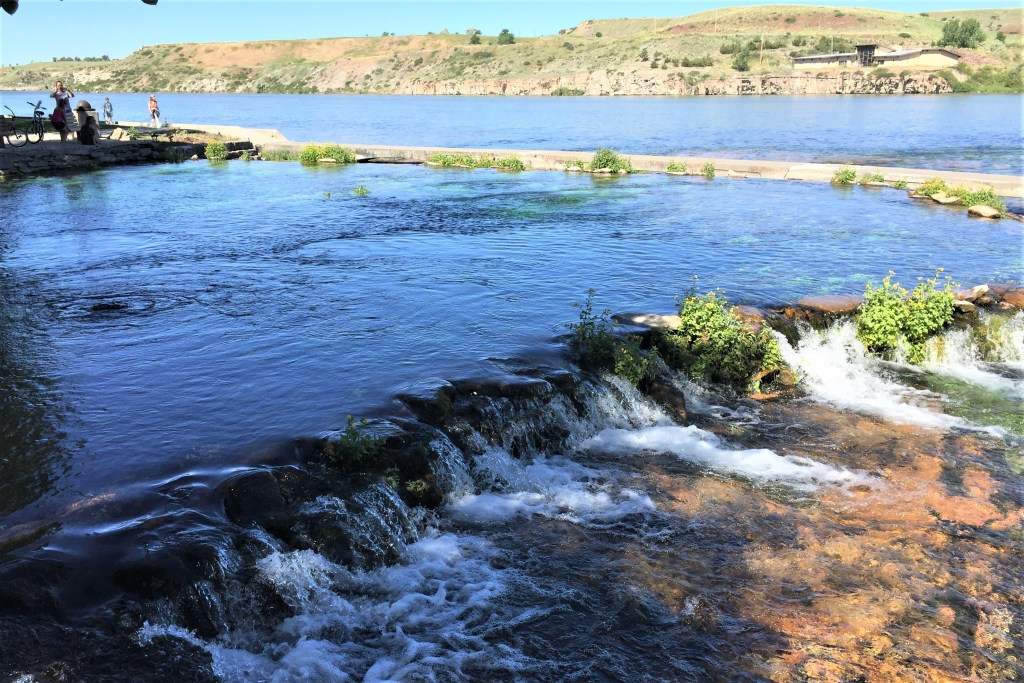
Over dinner, we discussed the purpose of the trip. Up near Great Falls, Montana, there is a natural phenomenon called Giant Springs from which flows what has been dubbed the shortest river in the world. Paul informed me, “Both the Springs and the River are why we are here.” The next day, we drove 75 miles to Giant Springs.

The Little Belt Mountains are sixty miles from Great Falls. As it rains and snows in those hills, water seeps into the Madison Aquifer. Most of that water flows underground into five surrounding states and up into Canada, but a portion travels to Giant Springs. There, approximately 150 million gallons push to the surface every day through openings in the limestone overlaying the Madison Aquifer. Situated on the east bank of the Missouri, some spring water flows directly into the Missouri, while the remainder enters the Missouri by way of the 201-foot-long Roe River. Fish eggs are called roe, and a portion of the short river is diverted into the fish hatchery. Therefore, the name Roe River.

As Paul and I approached the water, I incredulously asked, “That’s a river? That’s shorter than a football field.”

“Sure is. I was on a business trip in 2004, and I always wanted to come back and study it.”

Well, study it, we did – and still are. Various reports say it takes the water twenty-six to fifty-six years to make the sixty-mile trek through the Madison Aquifer, flowing from the Little Belt Mountains to Giant Springs. Yet other reports say some of the water is diverted through different layers of limestone and takes 3,000 years for the journey. Why is there a diversity of opinion about how long it takes? There is an answer, and we will find it.

Another point: the water becomes impure as it seeps into the ground. It can become contaminated by animal droppings, dead animals, mold, and so forth. But as it flows through the limestone, much of the impurities are filtered out.

But what’s the point of it all? I’m glad you asked.

There is a cause and effect working here. The mountain rain and pristine snow (the cause) and the beauty and majesty of the springs (the effect) remind us of the timeline of human life. As it takes many years for the water to seep through sixty miles of limestone to the Springs, things also happen in our lives that often produce a delayed response.

As a child you may have been told, “You’re dumb; you’ll never amount to much!” Or, “You can’t do anything right!” Those are devastating blows that contaminate life; and the clock begins ticking for results to push to the surface. But as the limestone removes the impurities from the water, someone’s intervention can remove those impurities from life. Loving interactions heal wounds.

On the other hand, you might have heard, “You are GOOD at this! You will do well in life.” That, also, sets the clock ticking, and what bubbles to the surface years later can benefit both humanity and God.

The point is: events and personal interactions shape us, but it may take years for the results to show.  So be kind to others and guide them. Help shape lives in a positive manner. Love others as God loves you.

Well, after the working part of the trip, we drove to the town of Stanford, Montana, where Paul treated me to lunch. He said, “I’m taking Stanford (my first name) to Stanford for lunch in honor of your first name.” It was sixty miles out of the way, but who cares? We had a wonderful time up in Big Sky Country.

Happy New Year, Friends

On December 31, 2020, Carol and I spent a quiet New Year’s celebration together. It was relaxing because from 2011 through 2020, we had been home on December 31 only four times. We’d been in California on New Year’s Eve five times and in Florida once. And this past New Year’s Eve we were in New Mexico.

Several friends asked, “Can’t sit still, can ya?” My response is normally, “You find no moss under my wheels.” And we’ve driven over 29,000 miles in 2021.

It’s well-known by our families, friends, and those who read my articles that we enjoy living in Siloam Springs, Arkansas. All cities, towns, and villages have their problems, but we’ve found this town to be one of the more pleasant places we’ve lived. With that in mind, why do we “hit the road” so often?

One quick answer is: our five kids live in five different states, and my siblings are spread out from the West Coast to the East Coast. We enjoy visiting them. We also have the privilege of preaching and teaching in our travels.

A second answer is: we enjoy seeing God’s creation first-hand. Seeing nature in books and on video is great. But nothing beats driving through the Sierra Nevada Mountain Range, seeing the Giant Redwoods in northern California, the amazing Oregon Coast, Puget Sound in the great northwest, the red granite beaches of Maine, the snow-white beaches of Siesta Beach in Florida, seeing Yellowstone and Yosemite National Parks, and HUNDREDS of other places.

We also enjoy seeing the marvels of man’s creation, such as Mount Rushmore in South Dakota, the 605-foot-tall Space Needle in Seattle, and the 630-foot-tall Arch in St. Louis.

Historic sites such as the Yorktown, Virginia battlefield, the Gettysburg Battlefield, and Pearl Harbor cause me to stop and contemplate how different life might have been if the political and military tide had turned the other way.

The third answer is: we’re getting older, and some day our travel days will be over. So let’s travel while we can.

As we travel, we take thousands of pictures to document where we’ve been and what we saw. You see many of them in these blogs. We’re grateful for digital photography, because that’s a lot less expensive than the film we bought in the past. We often get our pictures out (on computer or another device) and through our memory, we enjoy those trips again.

The ability to remember amazes me. When I get to heaven, I want to ask God how He created memory. But I think He’ll simply say: That’s My secret.

As I mentally gaze on our blessings this past year, I’m fully aware that many people have died, others have gotten sick, many have lost homes and businesses due to pandemics, government mistakes, the natural flow of economics, and natural disasters. But sickness, wars, governmental problems, business failures, and all the other problems and catastrophes have been going on since shortly after Adam and Eve left the Garden of Eden. As we read in Ecclesiastes 1:9, “The thing that hath been, it is that which shall be; and that which is done is that which shall be done: and there is no new thing under the sun.”

The emphasis is: there’s nothing new under the sun. We have modern means of traveling, conducting war, studying, and getting work done, but the essence of life hasn’t changed throughout man’s history. Sickness, death, and all other problems related to life on earth will continue until Jesus stops it. And He will return one day.

But if He doesn’t return soon enough, I will die too. I don’t know by what means, but I will die, and the thought doesn’t bother me at all. Why not? Because that’s life.

In the same concept as midnight on December 31 starts a new year, or a baby being born starts a new life, when my traveling days are over and I breathe my last on earth, I will start a new year, a brand-new life in heaven. It’s part of the Christian’s cycle of life.

However, as badly as I feel for those who have been hurt by various events on earth, I feel worse for those who die while not believing in Jesus Christ. We can start over after a catastrophe on earth, but when we die without faith in Jesus, there is no recovery. Think about it.

Protected by a Spider

Okay, I know that title above sounds a little goofy, but I want you to think about something. What does it take to protect us?

Since there are thousands of dangers in the world, let’s get to the spider and branch out from there.

Now, to put it succinctly – or bluntly, if you prefer – a busy spider protected the future King David when he was hiding from the current King Saul. I read a story some time ago in Hebrew literature, and I’ll write it here to the best of my memory.

When King David was a boy, he enjoyed walking through the fields while taking care of his father’s sheep and enjoying nature. He was thrilled to see how each creature gave something to the world. Several examples are, hens lay eggs, bees make honey, goats produce milk, and sheep give us wool. But he couldn’t figure out a good purpose for the lowly spider.  

“What’s the purpose of the spider?” David wondered. He didn’t even find a good use for the web, although he must have forgotten about it catching bugs. As an answer to the question, God seemed to impress on him that everything in creation had its purpose, and that one day he would understand that the spider also had a purpose.

Years went by and David became a hero who saved his people from the enemy by killing giant Goliath. King Saul was envious of him, feared for his throne, and decided to kill David.

David ran for his life and hid in the hills but Saul, with a portion of his army, was hunting for him. One day hearing that Saul was closing in on him, David hid in a nearby cave. Saul’s spies told him that David was in this area and figured they would kill him within an hour or so.

David was now in mortal danger and cried out to God, “Who will help me?”

Unknown to David, as soon as he entered the cave, a spider quickly spun a beautiful, well-developed circular web across the cave’s entrance. Saul’s men reached the cave where they were sure David was hiding and were about to enter it. But when they saw the intricate web, they said, “If David were here, he’d have torn the web to pieces. He must be hiding somewhere else. Let’s go!”

That’s how David realized that the spider, like all other creatures, can be useful, and he immediately thanked God for creating spiders.

What did it take to save David’s life? A spider.

That makes me stop and wonder how many times diversions, incidents, delays, etc., have saved me from danger.

Returning home from Maryland last month, I made a wrong turn somewhere in Pennsylvania which delayed me for about thirty minutes. No big deal. We normally give ourselves extra time because we don’t enjoy being in a hurry. But when we got back to the right highway, there was quite a slow-down. We eventually saw the tow trucks hauling off two mangled cars.

Would we have been in that wreck if we hadn’t taken the wrong turn? I’ll never know, but checking the timing of my wrong turn, that error could have saved our lives.

A spider protected David. A wrong turn might have protected us. What else protects us?

Some years ago, we were attending a local church that we enjoyed. I was a deacon, Carol and I sang in the choir, a couple of our kids were in the orchestra. But one day the idea came to me that we were supposed to leave that church.

I prayed about it, and the Lord impressed me with, “It’s time to go.”

I didn’t understand why, but I had long-since stopped questioning God. So we talked with the pastor and developed a gentle way of stepping out without raising too many eyebrows.

Within a short time, a major problem broke out in the church and reputations were hurt. But because we had already stepped away, we were not affected in any negative way. We were protected by “the still, small voice” we read about in 1 Kings 19:11-13.

Spider. Wrong turn. Still small voice. God protects us in many ways. All that’s required of us is to obey the Lord. John 10:27 says, “My sheep hear my voice, and I know them, and they follow me.”

Don’t allow delays and problems to ruin your day. Those delays might prevent a bigger problems.

What’s Over the Next Hill?

“Daddy, what’s over that hill?”

“What do you think you’ll see?” Dad chuckled. He must have been humored at my numerous questions. He continued, “If you sit still for a minute, we’ll be on that hill, then we’ll both find out.” Dad knew but wanted the view to be a surprise.

From my earliest memories at almost 3-years old, I’ve always wondered: What’s around the corner? What’s in the box? How did the mountain get there? What’s fire made out of? What’s over the next hill? I’ve always had an unquenchable thirst for knowledge. I still do.

That was a special trip for me. I was 5 years old, and seldom had the privilege of spending time with dad and mom by myself. Eventually, I had five sisters and four brothers, and this trip would be the first of three trips where I was the only one dad and mom took with them.

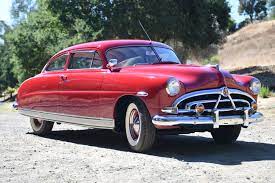
Mom was taking a nap in the front seat of the Hudson Hornet, my four sisters (two older and two younger) were left with elders in the church, and I was leaning over the front seat looking with eyes wide open. I had never seen mountains and valleys like this. Seat belts hadn’t been invented yet, but we never had a problem.

There were no freeways where we lived in 1951, and our highways allowed us to travel at the break-neck speed of 55 miles per hour. However, some of these mountain roads allowed only 35-45 mph. Our destination was about 400 miles away, and we left home long before daylight.

As we approached the crest of the hill, dad asked, “Eugene, do you know where we’re going?”

“Yes, we’re goin’ campin’.”

“That’s right. But do you remember where mother said we’re going?”

While I was trying to remember that hard word, we reached the top of the hill. Dad pulled over to the side of the road.

“Ooooohhhhh Daddy! Someone broke that mountain in half!” I was stunned to see half a mountain standing on the side of the valley.

Dad already had his camera in hand and was opening the door. “Son, that broken mountain is called ‘Half-Dome’ and this is called Yosemite Na… Eugene? Where are you?”

Dad found me hiding inside the car, not wanting to get out. I was scared spitless of heights, and when I saw the valley floor WAY DOWN THERE, I panicked. But peeking out the window, I couldn’t take my eyes off that broken mountain.

“Okay, Eugene. Would you get out of the car if I hold your hand?”

I shook my head, “Hu-uh.”

When mom said, “Daddy will let you look through his binoculars if you get out of the car,” I agreed to hold daddy’s hand and get out.

That was my introduction to Yosemite National Park.

We drove down into the canyon and dad took me on a few short hikes. I enjoyed playing in the heavy mist of Bridal Veil Falls, then helping dad set up camp. I don’t remember how much of a help I was, but it was fun being with daddy and mommy.

My favorite part was watching the fire fall down the face of Glacier Point. The park ranger gave a talk each evening, and an entertainment group sang as others prepared a roaring fire on top of Glacier Point. Then at 9:00 PM, the ranger hollered, “Let the fire fall!”

Several men then pushed the burning material over the edge with bulldozers, and a river of glowing embers fell more than a half mile (some 3,000) feet to the valley floor. Little boys never forget things like that. (The final “fire-fall” was on January 25, 1968.)

The question of “what’s over the next hill” has never left me. I might see an elk, a river, a glowing sunset, the wide expanse of the ocean, or another mountain. I never tire of it. And I am blessed with a wife who shares the same adventurous spirit.

We’ve been in every state of the Union and have driven over many hills. But there is one “hill” I cannot experience yet, and I can only imagine what the other side looks like. I’ll go over that hill after I take my last breath here on earth and enter heaven. I’m not in a hurry to get there, but God, dad, and mom are waiting for me, and I won’t be afraid of that height. Who knows: God might have thousands of hills over there for me to experience.