

Several years ago, Carol and I visited Gettysburg, Pennsylvania. We settled in, and decided to get our laundry washed before the rest of the crowd in the Gettysburg RV Campground figured out where the laundry room was. It was dark and we were getting ready to fold the clean clothes when I got sight of the half-moon out the window.
“Precious, wait a minute. I’ve got to get a picture of the moon.” The moon, planets, sun, and stars have intrigued me all my life. I have hundreds of pictures of the moon, many of the sun, and a few of Mars. But my pictures won’t hold a candle to the collection David Cater has. Mr. Cater writes articles on humankind’s astronomical frontier and star-gazing for numerous newspapers, and I greatly enjoy it.
As I walked outside, I thought of his columns.
Outside the laundry room, my eyes adjusted to the darkness, and I saw two smaller dots: one at the two o’clock position from the moon, and a dimmer dot at the 10:30 position.
Doing a quick check on Google, I discovered what Mr. Cater could have easily told me: the brighter dot was Jupiter, approximately 484 million miles distant at that time, and the dimmer dot was Saturn, approximately 920 million miles from earth at that time. However, the internet isn’t always correct but Mr. Cater would know.
The reports also said that these gas planets wouldn’t reach this position relative to the moon and our visual perspective again for another 20 years.
I went back into the laundry room to keep my promise to my Precious: I helped fold the clothes. But Carol became curious about my excitement, and she stepped outside to peer at the night sky. Several other campers walking by looked up when I was describing these two satellites of the sun and one of the earth, and they became awestruck.

One said, “I never knew we could see other planets without a telescope.”
Another quipped, “How do you know which one is what?” “Look it up on Google.” “Oh, yeah. I should have known that.”
Jupiter is the largest of our 8 (or 9) planets. How big is it? Its diameter is about 87,000 miles, it takes 12 earth-years to orbit the sun, and it might have 79 moons – several of which are larger than our moon. It’s possible that Jupiter has a solid core that is at least 12 times the mass of our earth, but Jupiter as a whole has a mass of about 318 times that of earth. Most of the “atmosphere” is comprised of hydrogen and helium. Since its gravitational pull is powerful, it is a primary protector of the earth by attracting and capturing dangerous comets and asteroids that might imperil the earth.
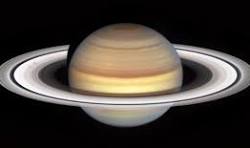
Saturn circles the sun once every 29 earth years, and has a diameter of about 72,400 miles, but the diameter of its spectacular rings is about 170,000 miles. Saturn is the second-largest planet in our solar system. It probably has a solid core, but we’re not sure of its makeup. It could be rock and iron, ice made of water, ammonia, or helium, or possibly fluid metallic hydrogen. It’s atmosphere is primarily of hydrogen and helium. Saturn is about 95 times the earth’s mass, has 82 known moons with probably many more hiding in the rings. Saturn, also, is a protector of earth due to its gravitational pull.
But with all the admiration and attention we bestow on these two giants that we can see without a telescope, let’s not forget two more protectors. Many of the dangerous astronomical bullets (meteors, asteroids, comets) that escape the gas bullies are caught by the moon. The comets (mostly water ice) that enter our atmosphere evaporate and add to our water supply, and most of the meteorites and asteroids that enter our atmosphere are pulverized and turned to dust. Over all, the earth could be gaining over 30,000 tons of water and dust a year due to these astronomical visitors.
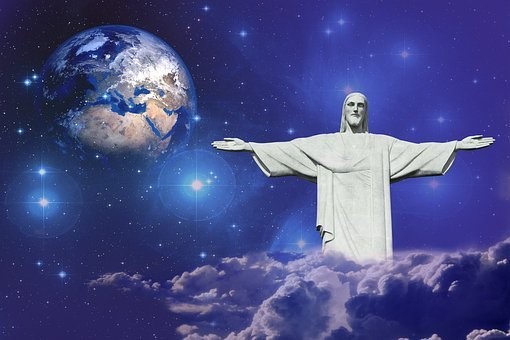
God’s foresight in assembling the solar system amazes me! God created man for fellowship. He redeems fallen man through relationship with Jesus Who died for us but rose from the dead. And He protects humanity so that those who cooperate with Him can fulfill His heavenly plan. God’s foresight, love, and protection reveals what an awesome God we have!


 Gene Linzey