An Important Question (pt. 1)

I enjoyed a question a reader asked because it prompted me to critically and logically think about my faith and my understanding about God.

Question: How do you determine the difference between 1) what God and Jesus actually said and did, versus 2) what the Bible authors merely reported that God and Jesus said and did?

To affirm what God and Jesus said and did would require eyewitnesses. Therefore, I will not start with faith; I’ll start with what many scholars believe to be fact.
Literary scholars of various religious and non-religious persuasions determined that portions of the Old Testament may have been written as early as 3500 BC, and I think they are on the right track. Why do I agree with them?

According to Genesis chapter three, God had personal interaction with Adam. Therefore, Adam learned about the creation events from God, and most likely wrote about it. And since Adam lived well into Methuselah’s lifetime, he passed the knowledge regarding creation and the beginning of human history to Enoch and his son, Methuselah; and they could have started formally documenting the history of mankind. Since Methuselah died about a week before the flood began, he had time to document what Noah was doing.
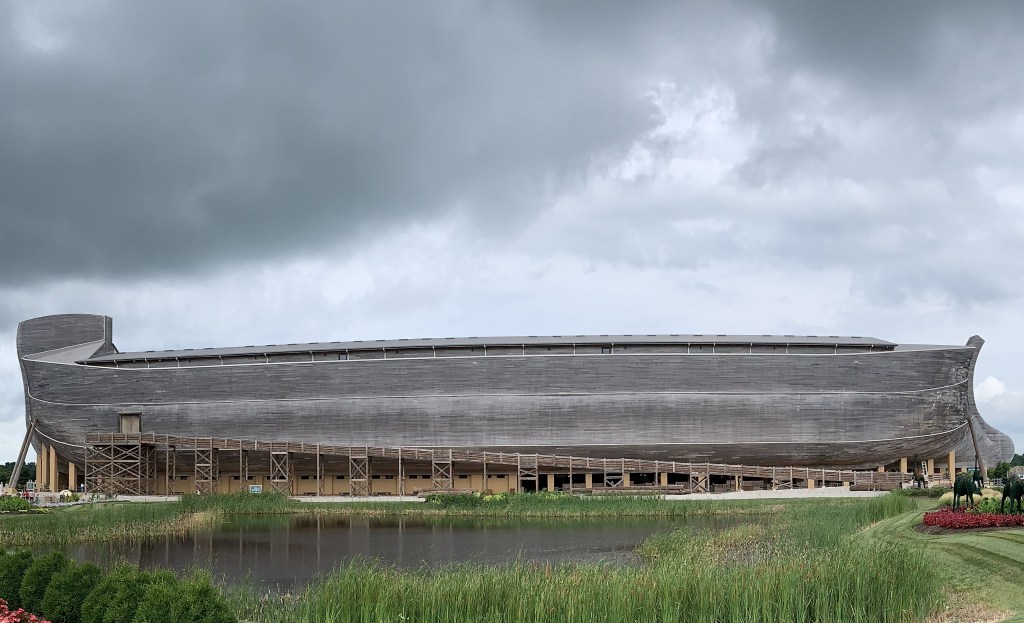
God gave Noah a 120-year warning that the flood was to happen, so Noah wasn’t in a hurry and would have taken all the writings that Methuselah gave him onto the Ark. Noah and Shem may have added more info to the writings.

Those writings (on clay, parchment, paper, or whatever the medium), were passed down to Abraham and eventually reached Moses. All that information was the basis for the first 11 chapters of Genesis.

The information presented in Genesis 12 through 50 was most likely documented by Abraham, Isaac, Jacob, Joseph, and several others while they were in Egypt, and given to Moses. If the writings started around 3500 BC, and we apply the genealogy given us in the Bible, we can see how the actions and words of God – and of Jesus – were documented by eyewitnesses. It takes many guesses out of the equation.

Add to the equation: the Bible is the oldest history book in the world, and much of it has been verified by archeology and other scientific endeavors.

Hundreds of prophecies have been spoken throughout the OT time frame. A few of the prophecies were spoken by seemingly wild-eyed hermits, while many, if not most, were spoken by kings, priests, farmers, shepherds, merchantmen, and other socially accepted people. Most of them have already come true, such as: approximately 356 prophecies in the OT about the coming Messiah have been fulfilled in Jesus.

Quoting from https://www.learnreligions.com/prophecies-of-jesus-fulfilled-700159, Learn Religions – Old Testament Prophecies of Jesus, we read: “In the book Science Speaks, Peter Stoner and Robert Newman discuss the statistical improbability of one man, whether accidentally or deliberately, fulfilling just eight of the prophecies Jesus fulfilled. The chance of this happening, they say, is 1 in 1017 power.”

10 to the 17th power is 10 with 17 zeros after it. Go figure the number.

But there were not 8 prophecies about Jesus that were fulfilled – there were approximately 356. For this, I don’t know how many zeros would be required, the result equals to an impossibility.

But all that deals only with prophecies about Jesus. There were hundreds of other prophecies throughout the 1200 years of writing Genesis through Malachi. They were about people, politics, events, and they were fulfilled, also. If there is no one who knows everything that will ever happen in the course of mankind, this is a staggering impossibility.

Many of those 356 prophecies that were fulfilled in the life, death, and resurrection of Jesus point to the fact that Jesus would be the Messiah, and others pointed to the fact that Jesus would be God in human form.

Now, switch to what is called the New Testament.
What we call the “Church Age” did not begin until the Day of Pentecost. That’s why we say the books of Matthew, Mark, Luke, and John are actually a continuation of the Old Testament. That would change the 1200 years of writing to almost 1600 years. Those four books reveal the life of Jesus and show how Jesus fulfilled many prophecies in the OT.

John, the Gospel writer, was possibly the final Old Testament prophet. Remember, he didn’t die until somewhere around 100 AD – about 60 years after Jesus was crucified. And with everything said about the coming Messiah being fulfilled in Jesus, John informs us in John 1:1 that the Messiah, who had originally been predicted in Genesis 3:15, was and is God.

Let’s continue next week.

Well, Blow Me Down!

Some folks said Blow me down! meant to hit me or knock me down; but that might not be correct. The phrase goes back the late 1700s, and is a statement that sailors said in a windstorm. A windy place in Nova Scotia was called Cape Blow-me-down, which evolved through time to Cape Blomidon.

Blow me down! eventually became a phrase used when someone was surprised. A relatively new version is, That blows my mind!

Wind is an interesting atmospheric action. It can be gentle for kite-flying; moderate for turning wind-turbines; strong can blow over trucks and trailers; or powerful such as tornados and hurricanes. The story this week is about the third group: strong winds.

Carol and I arrived in La Luz, a small town near Alamogordo, New Mexico on Sunday to visit friends, and planned to head east on Wednesday. But watching the evening news report, we learned that a tremendous windstorm was heading our way. It would hit on Tuesday and turn violent on Wednesday. We considered leaving on Thursday, but snow was forecast for Thursday night and Friday. Our last option was to leave a day early.

So, we toured the space museum in Alamogordo on Monday and toured the Tularosa Museum on Tuesday morning, then headed east up the mountain to Cloudcroft. La Luz is 4,761 feet above sea level and Cloudcroft is 8,668. It was quite a climb, but our car was up to the challenge. Pulling the trailer, I put the 6.2L, 380 HP, 8-speed engine in gear #4 and it was an easy pull up the mountain. Several other cars, pulling no trailers, had stopped beside the road to let their engines cool down, but our engine heat indicator barely moved.

We stopped in Cloudcroft to look at the scenery and have an early dinner, and the winds began greatly increasing. We hugged our friends, bid them adios, and headed east to Hobbs, NM which was projected to be on the fringe of the storm.

When we had the opportunity to watch the news, we learned that our departure was directed by the Lord. The wind blowing through one of the passes going into the Alamogordo basin reached over 100 mph. Remember: hurricane winds begin at 70 mph.

When thinking of the danger of driving in windy situations, we need to consider sustained wind and wind gusts. If the wind is blowing around 20-30 mph, gusts may reach 40 or 50 mph; and although it can be a rocky ride, it is normally safe. Wind advisories are put out if the sustained winds surpass 30 mph. But if the sustained wind reaches 50 mph, gusts may easily reach 60-75, and we may be in trouble.

The gusts are the worst part of the storm because the intermittent pressure can set up sideways trailer motion called oscillations which can cause a turnover.

Having said all that, the simple decision was: if the sustained wind is 50 mph or higher, park the car and trailer. But if we must drive, here are several ideas to consider.

  1. Drive slower: decreased speed decreases the wind pressure.
  2. Use a lower gear: more power on the drive wheels at a slower speed can compensate for some of the crosswinds.
  3. Whether car, trailer, or truck, secure the cargo: a moveable center of gravity can result in losing balance.
  4. Keep a safe distance behind the guy ahead: if either one of us goes over, we don’t want to hit someone or get hit.
  5. Back to basics: if possible, stay off the road. Losing time is less expensive than repairing or replacing the car, trailer, and cargo; and a lost life cannot be replaced.

There are other kinds of storms of life. Some of these storms are political, health, weather, financial, and interpersonal; and God sends us storms for our personal growth. Knowing a storm was about to brew, Jesus told his disciples to go to the other side of the sea (Matthew 14:22-24) because they needed to learn how to trust the Master. Read the story: it’s interesting.

Sometimes we are dragged into storms by others, and we need wisdom to handle the situation. But many times, we generate our own storms by foolishness and disobedience. An example is when Jonah tried to run from God (Jonah 1:1-4).

Whatever kind of storm we encounter, let’s stop; assess the situation; and ask God for wisdom. He will guide us if we listen. He guided us back in New Mexico.

Two Trees … Two Lives

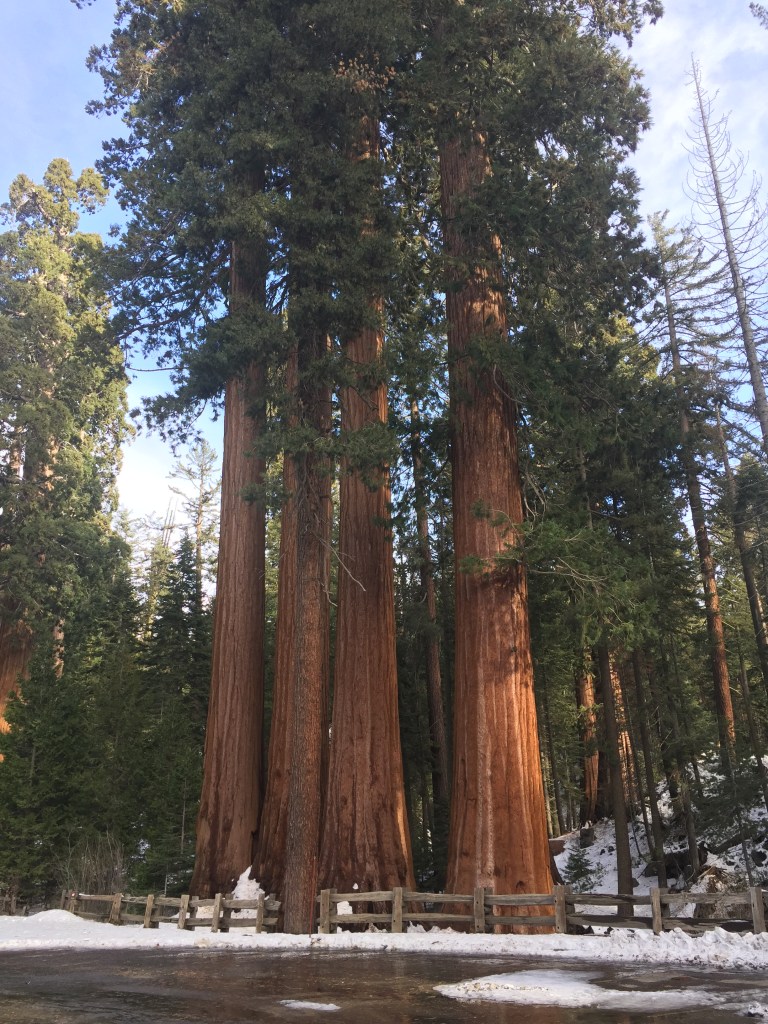
As we walked through the Redwood Forest in Northern California, we were awed by the beauty, the grandeur of these magnificent trees that average 240 feet in height. I grew up in Southern California but rarely did my parents have opportunity to go that far north. Eight hundred miles was a long way in the 1950s, and I saw the Redwoods only one time in my childhood.

But this was 2018, Carol & I were on our year-long jaunt around the US of A, and childhood memories came flooding through the canals of my mind. On November 14 we visited the Humboldt Redwoods State Park, and on December 8, we visited the Calaveras Big Trees State Park – in the snow, of course – with our son, Ron, and his family.

There are basically two divisions of giant Redwoods: Giant Sequoias (sequoiadendron gigantem) are found in the California Sierra Nevada Mountains, and Coastal Redwoods (sequoia sempervirens) grow near the Northern California coast.

Some Giant Sequoias grow 300 feet tall, have a diameter up to 35 feet (that’s almost 110 feet in circumference!), have a root system which can cover several acres, and be more than 3,000 years old. For history buffs: a tree that old sprouted about the time Saul was crowned King of Israel and about 100 years prior to the beginning of the Neo-Assyrian Empire. The Coastal Redwoods can grow 370 feet tall – the tallest trees in the world – with trunks up to about 30 feet in diameter (95 feet in circumference).

Loggers had cut about 90% of these colossal trees for housing, furniture, etc.; but various conservation groups appealed to Congress to preserve the Redwoods, and the state and national park systems succeeded in rescuing the remaining 10%.

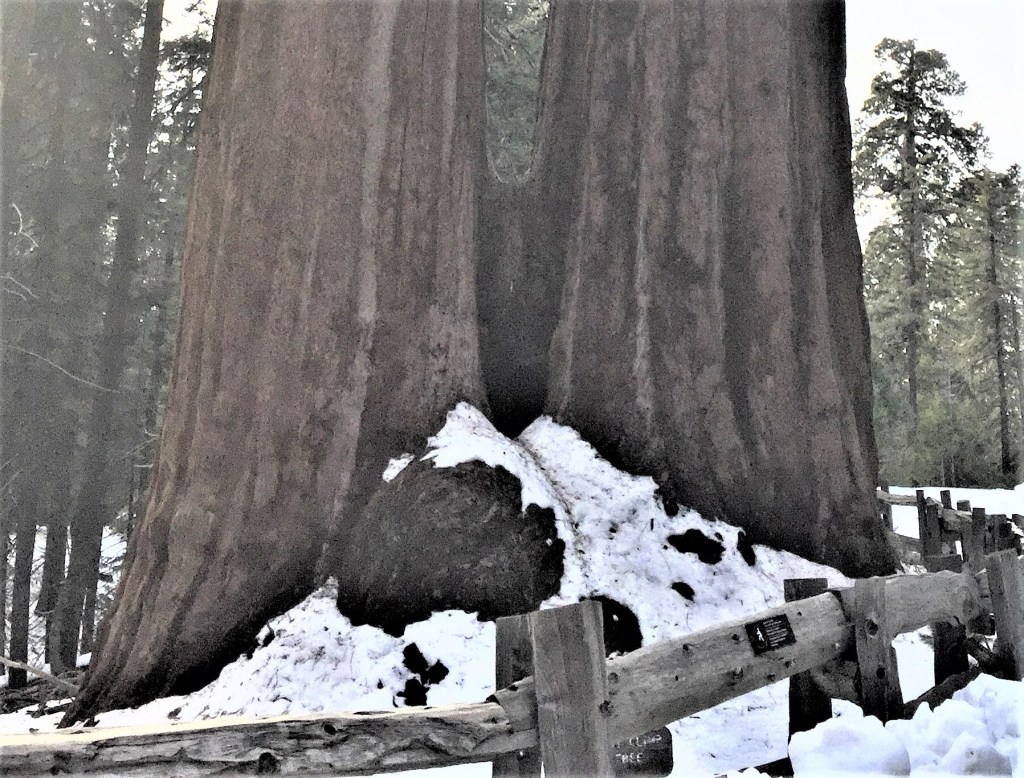
 As Carol and I walked among the trees, we saw a number of them that looked as though two or three had been planted together. Standing very close together with 8-foot diameter trunks, it looked as though someone had poured liquid bark on the trees ten feet off the ground which solidified, connecting the trees. Looking at this photo carefully, you can see where the bark has joined the two trees.

Yes, they had grown up together – the seeds having landed about ten feet apart. As seedlings, ten feet is a long distance. But as they grew and their trunks began touching, a phenomenon called inosculation took place. This funny word means to connect or join; to become one or make continuous; to unite.

As each of them grew in width at about an inch per year, they began touching in 120 years. As the trunks or branches rubbed together and wore off the bark, the live fibrous tissues touched each other and began intertwining. They didn’t get infected, and the trees became one plant, sharing nutrients and water.

Depending on how close trees are, either the bark joins and becomes one covering around both trees, or the tree trunks themselves physically join and become one tree. The trees that fuse together like that are called Hugging Trees. And together, they are stronger than individual trees.

Trees and bushes are not the only organisms that experience inosculation. This interesting phenomenon takes place when a person receives a skin graft. Through inosculation, the blood vessels and skin tissues connect, intertwine, and become one.

As I stood in the Humboldt Redwoods State Park gazing at these two magnificent works of God that had become one, I began thinking about my relationship with Carol.

We were born in different states. Eighteen years later we met in Southern California in college. Both of us lived on campus, and – attracted to each other – we saw each other in classes, during meals in the cafeteria, and in the choir.

Married August 22, 1966, we began growing together – yes, including rubbing each other the wrong way sometimes. But we didn’t allow the irritations, the inconveniences, the frustrations, and occasional anger to infect us as we wore off the rough edges; and over the years we became one in many ways.

We share the same house, the same joys, the same children, the same grandchildren, the same church, the same God. We have the same basic goals in life. We even react in much the same way, and at times spontaneously come up with the same ideas. We’ve grown strong together.

Two trees…two lives. It’s amazing how two individuals can develop a strong marriage if they stay together, weather the storms of life, and learn to truly love each other.

This is Getting Close to the End of the Year.

Sunset on November 27, 2021 in Siloam Springs, Arkansas
We feel like time travelers.

Can you believe it? This year is almost over, and 2022 is about to begin! 2021 has been a busy year for Carol and me. We’ve traveled over 29,000 miles – yes, we drove every one of them – and we feel like we’ve traveled through time. We’ve also seen a lot of beautiful scenery. 

I’ve also formatted dozens of books for folks, and written a few myself. One I’ve worked on for quite a while, and finally put in print this year, is a compilation of my Reflections on Life articles. If you want a book that is easy to read, yet is chalk-full of information on numerous topics, get this book.  It contains about 77 short articles that will let you travel through time from ancient history to now. You’ll read about topics from geology to history to Bible to astronomy, plus a whole lot more!

Now that I think about it, you might want to have your own books published, and we can do that for you for a low fee. So go to plpubandlit.com and check us out. You’ll find our prices are very hard to beat, especially when you see the quality of work we do. When you call us, you don’t get a recording very often because we enjoy talking with our clients, and giving personal service.

P & L Publishing and Literary Services also provides professional editing services. Look us up at P & L Publishing & Literary Services – Expert Formatting & Editing for Self-Publishing Your Book (plpubandlit.com).

If you have a book or books you’ve been thinking of writing and publishing, you’ll enjoy checking out our web site at plpubandlit.com. We’ll be glad to help your literary dreams become a reality.

Christmas is almost here, with New Year’s just around the corner. Please drive carefully, and live in such a manner that you will be safe and help others be safe.

MERRY CHRISTMAS

AND

HAPPY NEW YEAR, FRIENDS.

Death Valley

When we reached California to visit our son and his family, Ron asked, “How was the trip?”

“It was a tough trip. I went through the valley of death just to see you.”

“Really, Dad? So you, a 74-year-old Californian, finally visited Death Valley National Park. Was it worth the time?”

“For a Californian, definitely, YES. But I think for a US Citizen, the answer is still, Yes.”

After Carol and I drove through Bryce and Zion National Parks on May 10 and 11, our next visit was to Death Valley.

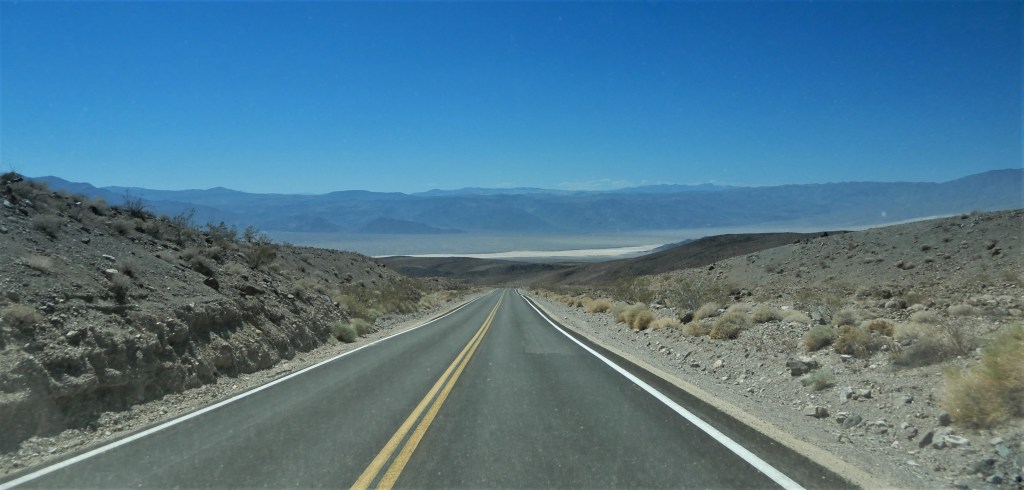
There are three basic routes to visit the Valley: the Fast Route, Scenic Route, and the Explorer Route. Any of the three are worth the time spent, although I think the Scenic Route is the most rewarding.

Situated in the northern Mojave Desert, Death Valley is an intriguing part of our Country. Here’s an interesting travel trivia tid-bit. The highest point in the Continental United States (that excludes Alaska and Hawaii) is Mount Whitney. The lowest point in the US is Bad Water. Are you ready? These two geological points are only 88 miles apart. Mount Whitney reaches 14,494 feet above sea level in the Sierra Nevada Mountain range, and Bad Water is in Death Valley at 282 feet below sea level.

The Valley is also the hottest spot in the Western Hemisphere. When we visited it on May 12, 2021, the temperature was 110 degrees F. A year earlier on August 16, the temp reached 130 F. The highest air temperature ever recorded in the Western Hemisphere was in Death Valley on July 10, 1913. It was 134 degrees F. But there’s more. The hottest surface temperature ever recorded on earth was in Death Valley on July 15, 1972. That was 201 degrees F, and some folks fried eggs on the ground. I hope they didn’t eat them.

The Valley is called a “graben” which is a block of land between two mountain ranges that has dropped, probably due to earthquakes. Over 5,000 years ago, the Valley held a 100-mile-long lake which was about 600 feet deep.

Have you ever heard of climate change? Long before industries developed and before we contaminated the atmosphere, several thousand years before the Pilgrims came to America, climate change was already well-developed, and Death Valley Lake, along with thousands of others, dried up.

The area turned to desert and most of the water evaporated which left an abundance of crystalized material; the primary one was borax. Borax was mined heavily from 1883-1907. Have you ever heard of Boraxo, or 20 Mule-Team Borax? It came from Death Valley, and the Pacific Coast Borax Company sponsored radio and television shows called Death Valley Days. The radio program ran from 1930-1945, and the television show ran from 1952-1975. Ronald Reagan was the narrator of the television show from 1964-1965.

Several geological faults intersect in the Valley, and the Amargosa River runs into it but disappears in the sand. And, if you’re wondering, it snowed once in January of 1922.

The Valley is home to the Native American Timbisha tribe, formerly called Panamint Shoshone. They called the area “tumpisa” which means “rock paint” because red ochre paint is made from the clay found there.

On February 11, 1933, President Herbert Hoover declared the area as Death Valley National Monument, but in 1994 it was renamed Death Valley National Park. Located in California and Nevada, it’s the largest national park in the 48 states, and has almost 1,000 miles of roads in it. Dress with loose-fitting clothing and take plenty of water with you during your visit.

But why is it called Death Valley?

In the 1849 California Gold Rush, about 300,000 adventurers went to find their fame and fortune. A group of 13 were just a few who entered the Valley but didn’t understand the dry heat of the deep desert and didn’t take enough water. They were found dead, and people called it a valley of death.

Do you know that millions of people around the world today are searching through an emotional and spiritual valley of death for fame, self-worth, or mere acceptance, while others are seeking wealth, power, and prestige? That craving will never be satisfied outside a relationship with Jesus Christ. Fulfillment in this life, and joy throughout eternity is found only in Jesus.

Visit Death Valley but live for Christ. The treasure you seek can be discovered by reading the treasure-map, the Bible.

Who Should Be Thankful?

Mr. Linzey,

I read your columns, and I can figure out what you think about Thanksgiving Day. But why does the celebration have to be Christian? Why can’t just anyone celebrate it?   (Gregg)

Thank you for your question. The simple truth is, everyone can enjoy Thanksgiving Day festivities. However, two questions need to be addressed: what is the memorial, and what was involved in the original celebration?

America’s Thanksgiving Day was a harvest festival based on giving thanks to God for His provision and protection. It was, and is, definitely Christian in nature, and everyone can commemorate it. But to properly observe and celebrate Thanksgiving Day, as intended, requires a belief in the almighty, loving, justice-oriented, Judeo-Christian God. Otherwise the observance is relegated to a holiday which honors a different god, an assortment of gods, or not god at all. Merely a holiday weekend.

But there’s something else to consider.

Can I celebrate the Kansas City Chief’s Super-bowl victory last February by conducting a fundraising campaign for the 49ers? No. Can I celebrate Pearl Harbor Day by lamenting the defeat of the Japanese Empire? No. Therefore, can we celebrate our American Thanksgiving Day, in context with its history and inherent meaning, by worshiping other gods and celebrating it differently than intended? No.

Having said that, any non-Christian – of whatever religion – can show gratitude and give thanks for blessings. The question is: to whom would he show gratitude and give thanks?

While a Jew or Christian cannot worship Allah during the fast of Ramadan, adherents of other religions cannot meaningfully celebrate Thanksgiving Day as originated in America while employing a different religious world view.

While anyone can enjoy the day off and be grateful for blessings, only those who worship and honor the Living God can truly celebrate Thanksgiving Day as intended. Am I being biased or prejudiced? Biased, yes. Prejudiced, no. I am merely being true to the concept. (Bias and prejudice have two different meanings.)

The intent of our Thanksgiving Day celebration is to worship and honor our provider, our Father, God.

With that in mind, let’s look at some of the history behind Thanksgiving Day.

For the 50 surviving Plymouth Pilgrims and their 90 Wampanoag neighbors celebrating between September 21 and November 11 in 1621, wild turkey was on the menu along with wheat, “Indian” corn, barley, peas, waterfowl, five deer, bass and cod. Actually, the Native Americans brought a lot of the food, including the five deer.

Since then, we’ve added items such as ham, sweet potatoes, corn on the cob, popcorn, cranberry sauce and pumpkin pie. The Pilgrims probably made pumpkin pudding sweetened with honey, but they didn’t have sugar, crust or whipped topping…and No Pumpkin Pie!! Life was tough back then.

Because the wild turkey was fast and alert with sharp eyesight, Benjamin Franklin wanted to make it the United States national symbol. Also, the turkey reminded Franklin of God’s provision in our early colonial existence. (The turkey lost out to the Roman Emblem: the Eagle.)

For years, Thanksgiving was observed randomly, but the first Thanksgiving Proclamation was made on June 20, 1676. Thanksgiving proclamations were made annually by the US Congress from 1777-1783 and celebrated in December. George Washington declared a national day of Thanksgiving in 1789 and 1795; John Adams in 1798 and 1799; and James Madison twice in 1815.

The next national Thanksgiving Day was declared during the American Civil War in April of 1862 by Abraham Lincoln. In 1863, he declared Thanksgiving for August 6, and for the last Thursday in November. He declared a similar observance in 1864, establishing a precedent that has been followed by every president since then.

After a few deviations of time, the last Thursday in November was finally chosen as the day for our National Day of Prayer and thanksgiving, but remained a non-holiday tradition until President Franklin Roosevelt signed the bill on November 26, 1941. It established the fourth Thursday in November (in perpetuity) as our national Thanksgiving public holiday.

Eleven days later, Japan bombed Pearl Harbor!

Friends, we never know what lies in store for us from one day to the next. Life is so precious, yet circumstances are so unpredictable. We humans tend to be self-centered, but our heavenly Father loves us so much, and is willing to help us in times of trouble. So, let us, all around the world, humbly admit our need for God, and set time aside to honor Him. And with heart-felt gratitude, let’s thank Him for all that He has done for us.

Total Solar Eclipse at Glendo

I enjoy reading articles about solar eclipses from others, but today I’ll tell a portion of our own story.

Carol and I were on our 51st wedding anniversary trip and decided to visit our daughter (Darlene) and her family in Colorado, then visit the Rocky Mountain National Park just outside Estes Park, Colorado. But we timed our visit to coincide with the total solar eclipse.

We had seen partial solar eclipses and several total lunar eclipses; but never a total solar eclipse, so we didn’t know what to expect.

Darlene and her son went with us as we drove three and a half hours north of Denver. Arriving at Glendo, Wyoming around 4:30 on Monday morning, we easily found a place to park in an open grassy area, and took a nap in the car. Darlene and I awoke a couple of hours later and walked to the lake in time to take some great sunrise pictures over the water.
It was a warm day with planes flying overhead and hot-air balloons lazily hovering nearby. The count-down for the total eclipse began around 10:22 a.m., and our anticipation grew.

Thousands of people, including professional photographers, had their telescopes and cameras ready. Many were set up on tripods, but most of us simply held cameras in our hands.

I took several pictures with the camera pointing directly at the full sun with no filter, but shot most of the pictures with the solar-viewing lens covering the camera lens. I took a picture every 10 minutes until the eclipse was near 90%, then changed battery and began taking quite a few.

It was light enough to read with only 10% sunlight, but it got dark quickly after that. Then, as someone said: “BAM! Darkness!” And with the sudden darkness, the temperature suddenly dropped, making the hot-air balloons rise.
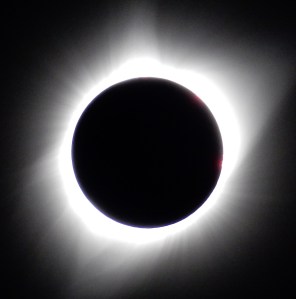
As noon-day brightness turned to night, hundreds of people shouted, cheered, and cried. I didn’t expect the sudden emotion that swept over me. All I could do and say was, “Oooooooooh Wow! God, you are amazing to arrange this kind of phenomena.” I took turns looking at the corona and taking pictures: taking 15 shots of the corona during blackout.

Then, again, “BAM!” The light came back on – but differently.

As the eclipse was increasing, the sunlight was dull-yellow; but the instant the sunlight reappeared, it was a bright, diamond, crystal color! What a surprise! I’ll never forget it. Again, very emotional. Cheering, yelling, crying spontaneously erupted from the crowd.

We didn’t wait for the eclipse to unwind. At about 20%, we packed up and began heading out … but another surprise popped up.

It took only 3.5 hours to drive from Denver and park on the grass at Glendo Park; but it took 4 hours to drive the 3 miles from the grassy spot to I-25. Then it took another 2 hours to drive 26 miles south. That is where we escaped the unending line of red break-lights and headed east for Scotts Bluff, Nebraska. After a snack in Scotts Bluff, we headed south, getting back to Aurora just after midnight; but it was much better than the projected 6:00 a.m. if we stayed on I-25.

As I write this Reflection, I am reviewing the pictures I took. Someone told me that taking a picture directly at the sun without a filter would hurt the camera. I am not bragging, but it didn’t affect my Nikon 9900. My wife also shot the sun directly with her Nikon 9400, and they both continue to work wonderfully.

We are now looking forward to watching the next total solar eclipse in Little Rock in 2024.

God didn’t have to put the moon in such an orbit that we would have lunar and solar eclipses. But He must have thought ahead and said, “I’ll make life interesting for my special creation – man. Not only will I give him animals to make life interesting, I’ll also show my creativity in the heavens for him to enjoy.”

Psalm 19:1-2 says, “The heavens proclaim the glory of God. The skies display his craftsmanship. Day after day they continue to speak; night after night they make him known.”

God is an awesome God. He loves you and desires to have a living relationship with you through Jesus Christ. Read about Him in the Bible. God would like you to spend eternity with Him.

Man Evolved From What?

I always enjoy discussions with my friends who are scientists and/or who believe in one of the various concepts of physical evolution. Here is an over-simplified summary of those beliefs. I may displease folk on both sides of the issue, but please read to the end.

There was nothing in space – there was no space, either. Then a magical thing called a Big Bang occurred over 15 billion years ago: stuff was created out of nothing – out of nowhere. Stuff can be called energy, gas, dust, atoms, electrons, muons, or anything you choose to call it. But it is the stuff from which the entire cosmos congealed. Oh yes, space also appeared simultaneously in which to house all the stuff.

After several billion years of gas and energy swirling around in space, gravity appeared so that the energetic gas and dust could coagulate and form huge rocks. We refer to these rocks as planets. But most of these gas balls didn’t form rocks; instead, they remained gas and dust and continued to attract more gas and dust. Eventually some of them became so large, pressure and friction caused them to ignite and become burning gas balls. We call these huge fire balls stars. And these stars, which were formed from gas and dust, began spewing transformed gas and dust back into space. This transformed material might be referred to as various forms of radiation. A small portion of that radiation is called light.

After 10 billion years, a rock we call “earth” began forming. It was hot. The hot rock began releasing hydrogen and oxygen, and those gases combined to form a liquid. We call it water.

Oh yes: all this was developing without any design, designer, or choreographer.

The water that resulted from the rocks began dissolving those rocks and created a mineral-rich liquid. And after a while, carbon joined the soup.  So now we have a thick viscous liquid made of mineral-rich water – all made from dissolved rock – which congealed from gas and dust – which came from the Big Bang – which produced itself out of absolutely nothing. Very intriguing.

Then, approximately 3.8 billion years ago, the viscous liquid was struck by some form of a life-generating jolt to create a life-form: vegetation. It wasn’t lightning, because that kind of jolt kills life. So there you have it: life evolved from dissolved rocks. Then this mineral-rich water continued to spawn other forms of vegetation.

And even more fascinating, after several billion years, some forms of vegetation decided to think for itself, and became air-breathing, self-locomotive life-forms. But they needed RNA and DNA. They say RNA (ribonucleic acid) was created before DNA (deoxyribonucleic acid) appeared. Fascinating, because RNA needs DNA to exist, while DNA needs RNA to exist. But some people tell us that RNA happened all by itself. Hmmmmmmm.

During the next six million years, animals evolved, and some became a type of human. Even more interesting, some of these semi-human-type animals developed the concept of a god, and began creating things to worship. Some bowed down to rocks, some bowed to trees, and some bowed to the lights in the sky. However – amazingly – some demanded that others bow to them. (How in the world did ego or pride evolve?)

So here it is: gas, dust, and space created itself out of nothing; gravity developed so that the gas and dust could congeal in space; some balls of gas and dust formed rocks; some balls formed stars; stars spewed gas back into space; rocks created water; water dissolved rocks to form a viscous liquid; this liquid formed vegetation; some vegetation turned into animals; some animals became humanoid; and humanoids decided to worship stuff, worship lights in the sky, and worship each other.

Modern man calls that science; some call it evolution; and I call it improbable, humanistic science-fiction, which is actually void of true science.

Why? Because both Biblically and scientifically, it is an impossible, non-scientific belief which is religious in nature. Modern man doesn’t believe in miracles, yet the “evolutionary steps” are impossibilities equivalent to a series of miracles.

I am neither questioning the age of the universe, nor questioning evolution within individual species; but life cannot evolve from rocks no matter how many billions or trillions of years we add to the cosmic calendar. That is speculation originally developed by people who were trying to figure out how everything got here, but could not accept the simple statement: “And God said….”

But to remain scientifically-oriented, we must include God doing the creating because accepting the impossible without a cause is absolutely anti-scientific. However He did it, God created inorganic matter, and He created life – two different concepts.

The Bible says: “In the beginning, God created the heavens and the earth.” Someday we’ll will learn how He did it.

Ability versus Availability

In mid-June several years ago, Carol and I were returning home after visiting Jeremy (our son) and his family in Perkins, Oklahoma. We were on highway 33 about halfway between Perkins and Tulsa when I suddenly stopped the car and turned around. Carol asked, “What are you doing?”

Pulling onto the shoulder on the north side of the road, I said, “Look.”

Carol incredulously exclaimed, “Oh no, a fire!”

I was already calling 9-1-1. When the operator asked about my specific location, I said, “I am on Oklahoma highway 33, east of the intersection of highway 48; but I don’t know how far.”

The operator said, “No problem: we’ve got you pegged. Stay there; a truck will be on the way.”

When Carol asked how they knew where we were, I said, “GPS on my cell phone.” (That’s another story.)

Fires generate their own weather-patterns and can produce fierce winds. That becomes a major factor in the growth of wild fires, and is why they need to be spotted and put out early. In the past several years, fires had ravaged that portion of the state.

It was after 10:00 pm, dark, and we had nothing with which to douse the fire; so we were merely a landmark, waiting for someone who could extinguish the growing blaze. About six minutes later, a fire-truck pulled up in back of us. The driver said, “Thank you for calling it in, and thank you for waiting for us. You are free to go now.” That was a hint to get out of his way.

Carol and I didn’t have the ability to quench the fire, but we were available to contact those who could do the job.

Ability versus availability.

Another time, in the summer in 1976 in the heat of the day, Carol, the kids, and I were heading south on Arizona highway 89. We were almost to the little town of Congress when we saw a small brushfire beside the road. We surmised that the fire was caused by a foolish person throwing a cigarette out the window. It was hot, and a lot of dried vegetation (fuel for the fire) covered the country-side.

Cell phones were not invented until the mid-1980s, and I didn’t have one until the mid-90s. With no way to call for help, 6-year-old Ron, 4-year-old Jeremy, and I used a cardboard box, dirt, and our 5-gallon container of water to extinguish the small-but-growing blaze. In that situation, we were available and had the ability to complete the task.

What is the common denominator in those two events? Availability.

Without our presence and alertness in each of those situations, both fires might have caused great physical damage and possible bodily harm.

No, I’m not bragging; merely explaining the concept of availability. The idea is: no matter what you know or what you think you know, your knowledge cannot benefit anyone unless you are available to apply it.

“Available” means: Present and ready for use; at hand; accessible.

What about you? Are you available to mankind and to God? Although an unlikely candidate, Abraham Lincoln was available. God, Himself, doesn’t need our skills and abilities, but He does give us the privilege of exercising our gifts and abilities—what He gave us or enabled us to learn—to fulfill our portion of His plan: thus, growing His kingdom and helping mankind. You may be a computer technician, auto mechanic, writer, pastor, secretary, lawyer, politician, policeman, or fireman. Whatever your vocation, God calls each of us to work as though He (God) is our supervisor. He then helps us to be alert to situations, such as the fires, and directs us as to our part in putting them out.
Psalm 147:10-11 says, “His pleasure is not in strong horses, nor his delight in brave soldiers; but he takes pleasure in those who honor him, in those who trust in his constant love” (GNT).

The psalmist tells us that God does not rejoice in our strength and ability, but He finds pleasure in our attitude. Are we available to Him and mankind, or are we stuck on our own desires? It is our attitude that determines whether or not we are available.

I am not inferring that you need to accept every offer that comes your way. You need to pray about all that. But we can take a hint from Jesus’ parable of The Good Samaritan. Are you available to help? Are you available to put out various “fires” (physical, emotional, relational, etc.) that you encounter?

Pray about it. It is great to be part of God’s team.

Seeing Things Differently

Dandelions! Disgracing the yard. I want grass to mow, not weeds to grow!

One day when I got home from work back in New Mexico, I found the yard blanketed with yellow flowers that would soon be replaced by round, geodesic white puff balls that easily break apart.

To eradicate the pest from the yard, we need to kill the entire plant. If we don’t kill the taproot, the plant will grow back; so something like Ortho Weed-B-Gone, or Scotts Turf Builder Weed & Feed is needed.

When we were kids in Southern California, we picked dandelions and had a grand time blowing them to pieces and watching them waft away in the breeze. We were cooperating with nature by seeding the countryside, but we didn’t know we were irritating the neighbors by seeding their yards with these vicious weeds.

And now we watch our grandkids do the same thing; but we watch with mixed emotions. It’s great watching the kids having fun, but we also know we are involved in spreading the dandelion scourge.

But wait a minute. What’s so bad about these beautiful yellow-then white geodesic weeds? And are they really weeds? Do they really disgrace the yard? After that day on our half-acre up at 7,834 feet altitude, I gained a different perspective of these beautiful specimens of life.

Some folk believe the dandelion evolved about 30 million years ago in Eurasia. But no one but God, and possibly some angels, existed that far back; so how would they know. God didn’t tell anyone. The angels probably didn’t, either.

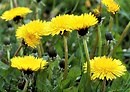
For several days, we saw the sea of yellow flowers open in the morning when sunlight hit them, and close in the shade of the evening—much like the Morning Glory, Gazania Daisy, the California Poppy, and others.

Some theorize that these type flowers close up at night to save their nectar from nighttime plant-eating thieves. Others think that these plants close up to protect themselves from nighttime chill. Who knows? Either way, we enjoyed seeing a yard of green turn to a blazing bright yellow every morning.

Dandelion—a French word—literally means “tooth of lion” or “lion’s tooth”. (I don’t know why it was given that name.) Dandelions are officially known as Taraxacum officinale; and maybe—just maybe—we shouldn’t call them weeds. I won’t itemize all the ailments they have allegedly cured because some of it is hearsay and part is doubtful folklore. But this prolific bit of vegetation does provide benefits.

In addition to preventing soil erosion, they are loaded with vitamins and minerals. Vitamins A, B, C, and D, and iron, potassium, calcium, zinc, and some detoxifiers, are available right in your yard. Yes, they are edible both raw and cooked. It is best to harvest them before they blossom; but be sure to get them before the white geodesic puff-balls make their grand appearance.

Dandelion tea is an inexpensive diuretic. As a diuretic (it also aids in pancreatic operation), the tea can aid diabetics and those with urinary disorders. Containing antioxidants, dandelions could be useful in reducing free radicals in the body, which, in turn, could reduce the risk of cancer. Dandelions, like celery, are beneficial regarding intestinal health.
The greatest benefit comes from eating the dandelion greens raw. If you do cook them, drink the juice to retrieve what you just cooked out.

I suppose I should add a note of caution. Diabetics who are taking blood-sugar modulators might stay away from eating dandelions; it could result in hypoglycemia. Also, many folks might be allergic to the plant. So, do your research related to your own health status.

But this whole concept (eradicating dandelions) reminds me of many who want to stay away from Jesus and His church. They think “church” or the Christian religion will hinder their lifestyle; and they want to eradicate Christ from their life.

They don’t understand that, as the dandelion has healing properties that can benefit their physical health, on a much higher plane Jesus Christ has made available benefits that will aid us both physically and spiritually; both in this human life, and forever.

Photo by Pixabay on Pexels.com

Our lives began at conception; but we will live forever somewhere.

Where will you spend eternity? Jesus is truly God, and He gave His life to save you from an eternity of desolation. Don’t eradicate Him from your life. Study the Bible. Live for Jesus. Enjoy eternity with Christ. His benefits are—quite literally—out of this world.