

In the summer of 2013, Carol and I were in Southern California when I learned that one of my cousin’s sons had died. Attending the graveside funeral, two other cousins and I began talking about family memories. The statement that caught my attention was, “When a person dies, all his or her memories are sealed in the coffin, never to be recovered – unless they were documented.”
Unless they were documented kept ringing through the corridors of my mind.
Documented how? When? In what circumstances?
We all know that nothing happens unless it is planned. Even accidents are planned out of ignorance by those who refuse to take safety precautions.
My cousins and I began talking about generating a family writing project, and the outcome could be a book of family memories. It could generate family cohesiveness. (We needed it!) We especially wanted to get memories from our surviving parents written down prior to their departure from this life. The farther back we can go, the stronger our family foundation will be. Our grandparents were already gone and our fathers (who were brothers) were gone. But our mothers were still here, and perhaps we could get the writing ball rolling. They could fill in memories of their husbands – our fathers.
Well, that didn’t happen. The only memories from our parents that we were able to compile was from their private writings in letters and diaries. And that wasn’t much.
When one of the cousins asked why we need to get memories written and what difference it would make, all I could say was, “For you, it wouldn’t make much difference because you are not interested in your past. And it infers that you aren’t interested in teaching your kids about their past. But enquiring minds want to know.” He openly agreed that it doesn’t matter to him, but that didn’t hurt our relationship. We still enjoy great camaraderie.
But I’ll answer that question for you folks.
Family history is important. Among other things, it helps to establish personal identity, self-esteem, and helps us understand the direction we’ve chosen to travel in life. Several examples follow.


Both of my parents were musicians, they came from a line of musicians, and my nine siblings and I are musicians. Dad was a chaplain, Mom’s side of the family includes a line of ministers of the Gospel, and nine of us siblings have been in or are in Christian ministry.
Dad was not only humorous, but quite pragmatic. What about the ten of us? All of us are pragmatists, and all but one has a well-developed sense of humor. Yes, we laugh a lot sometimes in the wrong place and at the wrong time. Let me add here, no matter how funny the story might be, try NOT to laugh at a funeral. It is the wrong place and the wrong time.
Everyone has quirks, traits, or habits that are peculiar to them. Why do we have them? Where did we get them? Does it matter?
It does matter for several reasons.
If we are being harassed or pestered about a personality trait, we might want to change. Understanding our past can assist us in making the change. But understanding our past can also strengthen our backbone if we don’t want to change. We just might like who we are!
I’ve been told often, “You’re just like your dad!” At first, I didn’t know how to take that hit. But when I stopped to analyze the situation, I was happy. I like my dad! So I was happy to be “just like him.”
One time I introduced Dad to some of my colleagues in New Mexico. After a few minutes of interaction, one of my friends said, “Chaplain Linzey, you’re just like your son.” Dad and I looked at each other, looked back at my friend, and broke out laughing. When the one who made the comment realized what he just said, he broke out into a big laugh, too.
Proverbs 17:22 informs us that a cheerful disposition (“a merry heart”) is good medicine to the body, but discouragement causes our health to deteriorate (“dries up the bones”).
So, what does that have to do with writing family memories?
Thanks for getting me back on track.
I have nine siblings. Two are in heaven, and two don’t have time to write. But six of us decided to get this family memory project going. I’ll tell you more next week.
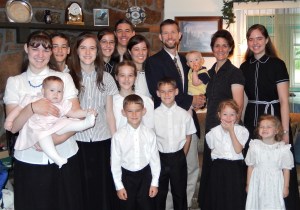 (our son and his wife) and their singing family were ministering. In his presentation, Ron discussed how music is produced. Ron started with, “What song are you singing?” I enjoyed that message.
  piccolos, and across the lips of trumpet players (brass instruments) generates vibrations. The piano produces music by the hammers impacting the strings, which generates vibration. The drums need no explanation. Then, of course, the various instruments transform the vibration or friction into musical notes.
 I just spoke the sentence “All sound is musical in nature” near the piano. I then played the keys to match my words “All sound.” The notes were “D” for “All” and “D flat” dropping to “G” for “sound.” When I spoke, various strings in the piano began vibrating – this deals with harmonics. Again, singing is talking according to note patterns. .
 have Godly content in their words and attitudes – are like a magnificent concert orchestra and choir. Their harmonics are a gift from the Lord.
 problem involves difficulty in breathing. Several causes are asthma, pneumonia, bronchitis, emphysema, and a big title called Chronic Obstructive Pulmonary Disorder, or COPD. You have probably seen the advertisements for numerous medications.
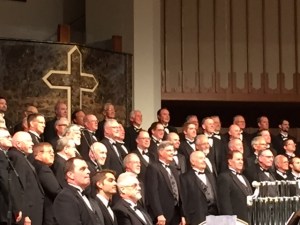 While the participants were drawn to the session by a fondness for music, they also had an ulterior motive for singing: to cope better with lung disease. The weekly group is led by a professional musician and is offered to people with respiratory problems including asthma, emphysema, and Chronic Obstructive Pulmonary Disorder. Doctors at London’s Royal Brompton Hospital started the program after reasoning that the kind of breathing used by singers might also help lung patients.”
  singing is beneficial spiritually and emotionally. Psalm 9:1-2 says, “I will praise you, Lord, with all my heart. I will tell all the miracles You have done. I will be happy because of You; God Most High, I will sing praises to Your name.” and Proverbs 17:22 says, “A happy heart is like good medicine, but a broken spirit drains your strength.”
 Gene Linzey