Peace in the Midst of a Storm

It was December 24, 1914. The battle lines had been drawn up between the English and German forces. As with the Union and Confederate forces in the American Civil War, the English and Germans thought the fight would be over in a few months. But five months after it started, the “hell” of war began to weigh heavily on them.

It had been raining during the day, and freezing at night. The dead between the opposing trenches could not be retrieved, so they froze each night. On December 7, Pope Benedict XV had suggested a cessation of hostilities in honor of Christmas, but neither England nor the German high command would agree. They thought the soldiers wouldn’t see the man across the line as an enemy if they dwelled for a day on Christ and Christmas.

But some men in the frozen, muddy trenches had other ideas. Christians were on both sides of the field, and Christmas Eve on this particular portion of the battle-line was peculiarly quiet.

German soldiers, who had spent time in England prior to the war, began singing Christmas Carols, some in English. Most of the Germans sang in their own language. Their English enemy, 100 yards across no-man’s-land, cautiously looked above the soggy sandbags to see what was going on. Seeing no weapons ready to fire, and no bullets whizzing over their heads, some English soldiers began singing. There, in the middle of the storm of The War to End All Wars, the peace of God was manifesting itself in the hearts of declared enemies.

Then December 25, 1914 – Christmas Day – dawned.

Against the orders of his commander, a German soldier climbed out of the trench, raised his hands in a gesture of peace, and nervously, slowly, walked onto the field of death. Orders of “Don’t shoot!” were issued from the English side. An English soldier, thinking this might be a trick, nevertheless, climbed out of his trench.

Then, he slowly laid his rifle down and raised his hands in peace. As the two men cautiously walked toward each other, men on both sides began emerging from the safety of the trenches and joined them. Those who knew the other’s language conversed, shared stories of home and family. Several reports I read said they played soccer that day, using cans or soggy sandbags for the ball.

The men in the German/Prussian uniforms did not hate those in the English uniforms, and the opposite was true. The unofficial cease-fire on December 25, 1914 verified that fact. They were pitted against each other because of the ideologies of their national governments.

There was another event in the history of the world that took place about 1,880 years earlier that set the stage for the English/German non-official cease-fire. It, also, manifested peace in the midst of a storm.

Not only was the iron hand of Rome harshly ruling the known world, the cruel and insecure Herod was ruling Israel. As the emperor mandated the death of those who would not bow to him or his gods, Herod ordered the death of anyone – including wife and son – who threatened his rule. In the midst of that deathly turmoil, the angel warned Joseph and Mary of the danger. They were granted a place of safety and serenity in a stable for the birth of the One who came to offer salvation and peace to the world – Jesus. Scripture says He would be called Emmanuel, which means, God with us.

He is still with us. The peace He offers was not only for the Jews back in the days of Imperial Rome. It wasn’t only for those who stopped fighting for a day in 1914. Jesus offers peace to us today – in the midst of the storm of covid-19, the turmoil of the presidential election, and social upheaval.

If Democrats, Republicans, Independents, Communists, Socialists, Green Party members, and the rest could stop fighting, study the Bible and allow the truth of Christmas – and the true Christ – to enter their hearts and minds, they could learn God’s purpose for their lives. Jesus also died for the Buddhists, Shintoists, Muslims, atheists, and everyone else who would accept Jesus into their tumultuous lives.

He came as a baby so He could grow up experiencing the pressure and pain we encounter. But His babyhood lasted only a year or so. He became a man Who suffered every kind of pain, trial, and temptation that we suffer. But He never sinned. And He died!
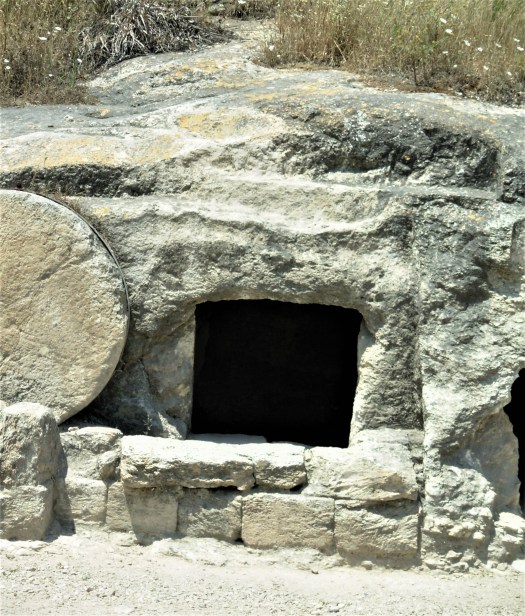
But three days later He came out of that tomb, and we have eyewitnesses to the fact: the guards on duty who were there to make sure no one stole the corpse. And because of His resurrection, He offers us His peace and joy in the midst of our storms. And He offers us eternal life with Him in heaven if we accept Him into our lives. He’s listening right now, so you can talk with Him. He loves you and will help you.

Have a Blessed Christmas.

The Mighty “A”

I’ve visited many forts in the USA. Among them are an underground bunker near Boston, Massachusetts, Fort Sumter in Charleston Harbor in South Carolina, and Fort Worden near Port Townsend on the Washington Peninsula. Forts were strategically placed on our borders for training and for protection in wartime. Some forts were ready for battle during both World Wars in case the Germans or Japanese attacked the mainland.

But land-based forts are for defense, and are useless in battles we fought across the seas. We needed portable offensive forts: forts that could be hauled across the world so we could take the fight to the land of those attacking us. Our first serious effort to build a floating fortress was in 1892 when we built the USS Texas. That was a good start and we learned a lot, but we needed something more substantial.

The US experimented with several ideas from 1894 through 1932, and we finally succeeded in designing and building fully decked-out citadels. However, because of a tactical error, eight of these sea-going fortresses were sitting-ducks in Pearl Harbor on December 7, 1941 and all eight battleships were bombed. The USS Nevada, USS Tennessee, and the USS Maryland were repaired and returned to service the next year. Three others returned to service in 1943-1945, but we needed new and improved fighters.

Interestingly, no US battleship was sunk in any war after December 7, 1941.

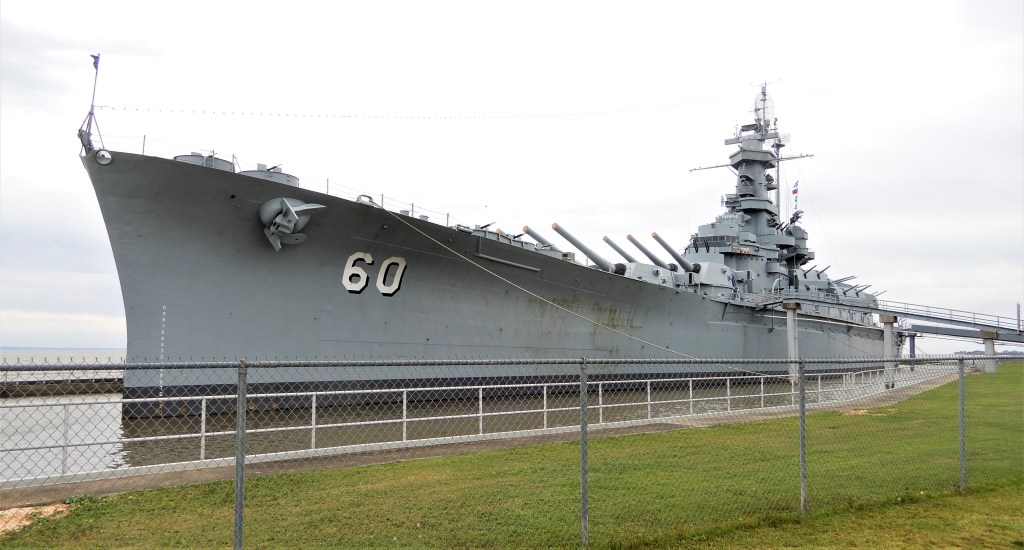
The USS Alabama was one of the new sea-going fortresses coming on line, and was commissioned in February of 1942 prior to the battles of the Coral Sea and Midway. The Alabama, weighing about 45,000 tons and had a crew of 1,793 men, was a fast battleship that could cruise at 27.5 knots (32 mph), and could sail for 14,773 nautical miles (17,000 miles) before refueling.

The ship bristled with firepower. It had 20 five-inch (inside diameter) guns firing 54-pound projectiles, and had 46 anti-aircraft guns. Its massive fire-power came from 9 sixteen-inch (inside diameter) guns which fired projectiles (large, bullet-shaped bombs) weighing an average of 2,400 pounds. These fortresses didn’t need to be near the shore, for they could hit the enemy 24 miles away with these weapons. Amazing!

For weight comparison to the sixteen-inch projectiles: a Chevy Spark (automobile) weighs about 2,269 pounds and a Nissan Versa weighs about 2,400 pounds.

The ship had a belt (steel-plating) at and below the waterline that was over a foot thick to deflect the concussion of near-miss bombs, and deflect or dull the blast of torpedoes.

The USS Alabama has seen battle action around the world: throughout the Atlantic, the Mediterranean, the Philippines, and all through the Pacific Ocean. But its legend continued even after the war. In 1947 it was taken to the Puget Sound Naval Shipyard in Bremerton, Washington to await further orders. The USS New Jersey was the only battle wagon activated for the Viet Nam war, so the Alabama was decommissioned. In 1964 it was towed to Mobile, Alabama and became a floating museum. Yesterday I met several folks who donated money for that effort.

But there’s more to the Mighty “A” to know.

The Alabama is also a movie-star – although, uncredited. It had a major role in the 1975 movie Movin’ On. It was used in the 1988 miniseries War and Remembrance representing the USS Iowa. Nicolas Cage starred in USS Indianapolis: Men of Courage with the Alabama posing as the USS Indianapolis. And it was used in most of the battleship scenes in the 1992 film Under Siege.

I’ve been on aircraft carriers, cruisers, destroyers, frigates, PT-boats, tug-boats, and many others. But I had never been on a Battle-Wagon. Seeing the ship often as I drove by on Interstate 10, I always wanted to visit it, and decided that I would … someday.

That day finally came on April 25, 2019.

As I walked up the gangplank, I said the traditional, “I request permission to come aboard.” The tour guide was a retired Master Chief Petty Officer. Smiling, he responded, “Permission granted. Welcome aboard, Chaplain.” We both laughed and saluted.

I walked every available passageway from stem-to-stern. I slowly walked the main deck and recalled what our US Navy personnel experienced in battle. I honor and admire them for fighting to maintain our freedoms.

With the advent of jet planes, rockets, and missiles, Battleships are now obsolete; but I am in awe of this magnificent ship. I am grateful to the Mobile, Alabama city fathers for preserving this historic memorial – the Mighty “A” – for future generations to experience.

Historical Trivia

I thought I’d follow up last week’s blog of New Years myths with a few tidbits of historical trivia.

Many things are going on in the world today and we tend to get tense, worried, and cynical.  But I think we need to “lighten up” … for at least a week. Also, I think humor is appropriate since Proverbs 17:22 says “A cheerful heart is good medicine, but a broken spirit saps a person’s strength” (NLT). So, here is some light-hearted trivia that I found many years ago. When I first read them, it looked like some had incorrect information so I did a little “lookin’ up” to get as close to the truth as I could. So sit back, relax, and enjoy the next five minutes.

Have you heard the saying “God willing and the creek don’t rise”? Some folk have a picture of an uncrossable stream or creek rising during a torrential downpour – especially with all the flooding happening in parts of the world today. However, there is one small error in that quote. The statement was written by Benjamin Hawkins, a politician and Indian diplomat in the early 1800s. While on the job in the southern USA, Hawkins was requested by President Thomas Jefferson to return to Washington D.C. and give a report about what was happening. His response was, “God willing and the Creek don’t rise.” Because of his job, and the fact that he capitalized the word “Creek,” it is deduced that he was referring to a potential Creek Indian uprising, and not a flooded body of water.

In George Washington’s days, there were no cameras. One’s image was either sculpted or painted. Some paintings of George Washington show him standing behind a desk with one arm behind his back, while others showed both legs and both arms. In fact, many paintings show people with arms or legs out of sight. That’s because prices were based on how big the canvas was, how many objects (things and people) were to be painted, and by how many fingers, hands, arms, legs, and feet were to be painted. Arms and legs are more difficult to paint, therefore painting them raised the price considerably. This is one probable origin of the expression, “It’ll cost you an arm and a leg.” By the way, that’s why many (if not most) cartoons show the characters with only three fingers and a thumb. Omitting the fourth finger reduced the production costs.

In centuries past, personal hygiene was not understood, and people didn’t bathe very often, which aided in the profusion of lice. Therefore, many women and most men in the European higher social strata shaved their heads because of lice and bugs, then wore wigs. This continued in colonial America – which, of course, was primarily an extension of British society. Wealthy and influential people could afford to buy larger wigs – and they did. Today we still use the term “He’s a big wig” because someone appears to be, or is, powerful and wealthy.

You might have heard various stories about the origin of “chairman of the board.” Well, some of the stories are flakey, but this is probably correct. The word “chair” infers sitting in the chair, or seat of authority (at times, perhaps the only chair while others sat on benches), and “board” (as we know it) was first heard of in the 13th century spelled borde, and means “table” – such as “God’s borde” (meaning “the Lord’s table.”) A mother’s call to the family was: “Mi bord is maked. Cumed to borde.” – meaning, “The table is set [for a meal]. Come to the table.” Also, people pay a fee or rent for “room and board” – sleeping quarters and food at the table. So, chairman of the board would be the person in charge at the table where business is conducted: be it church, industry, restaurant, or government.

Here’s one more. Have you heard the phrase, “turn a blind eye” in a situation?

In the naval battle of Copenhagen in 1801, British Admiral Horatio Nelson (who was blind in one eye) lead the attack against a joint Danish/Norwegian flotilla. The British fleet was commanded by Admiral Sir Hyde Parker. Sensing defeat, Parker sent a signal for Nelson to disengage, but Nelson was convinced he could win if he persisted. In Clarke and M’Arthur’s biography, Life of Nelson, published around 1809, they printed what they said was Nelson’s actual words at the time: [Putting the field glass to his blind eye and addressing his assistant] “You know, Foley, I have only one eye – and I have a right to be blind sometimes. I really do not see the signal.” So, turning a blind eye to Admiral Parker’s order, Nelson proceeded to defeat the enemy.

Thank you for reading, and I hope you have a pleasant week.

Fort Sumter

Dad was a chaplain in the US Navy and we moved around somewhat. So in my four years of high school, I attended four different schools: two in Southern California, the third near Boston, and I graduated in Charleston, South Carolina in 1964.
In April of 2016, the USS Yorktown, CV-5 Survivor’s Reunion was held in Charleston, and I was chaplain for the group. One day, Carol and I drove over to James Island to locate the house my parents rented and the high school I attended. This was the first time I had returned to the Charleston area since May of 1964, but I located both house and school without a hitch. They hadn’t moved.

Memories flooded my mind, and I verbally relived many of them while Carol listened. (I met Carol in Southern California in late August of 1964.) When my parents lived in the Charleston area, we didn’t visit Fort Sumter which is situated in Charleston Bay. Perhaps that was because renovations, beginning in 1961, had not been completed. But now I was looking forward to visiting the fort.

Fort Sumter was named after General Thomas Sumter – a hero in the Revolutionary War. Built primarily by slave labor, construction of the fort was started in 1829 but was still incomplete in 1861 when the War Between the States began.

There are several names for that war, and each name reflects the feelings of various groups through history. A well-accepted name is The War Between the States. Many northern folk called it The War of the Rebellion, while many Southerners called it The War of Northern Aggression. Some Europeans called it The War of Secession, but the common name here in modern America is the American Civil War. But as Colonel Butch Quick said, “There was nothing civil about it!” Well over 625,000 Americans died in that hellish conflict.

Many believe that the war was not primarily about slavery. As an example: South Carolina’s General James Longstreet is quoted as saying, “We should have freed the slaves, THEN fired on Fort Sumter.”

Understanding that South Carolina was thinking about seceding from the brand-new Union as early as 1827, Fort Sumter was not built to keep South Carolina in line; the fort was one of a series of fortresses built along our eastern coastline to protect our major ports from potential European aggression.

Our tour boat backed away from the wharf and sailed around the bow of the USS Yorktown, CV-10, that was docked nearby. The Yorktown (built to replace the USS Yorktown, CV-5 that sunk in the Battle of Midway in June of 1942) was commissioned in 1943 and is huge; but with its flight deck looming 50 feet above our heads, it looked enormous.

A twenty-minute cruise toward the Atlantic Ocean, Fort Sumter looked small with walls currently about 15 feet high. However, seventy thousand tons of New England granite had originally been imported to build the 5-sided Fort Sumter on the harbor sandbar; and the walls in 1861 were 5 feet thick and 50 feet high. It was designed to house 650 men with 135 canons.

South Carolina had officially withdrawn from the fledgling United States of America, and Confederate Brigadier General Beauregard ordered Union Major Robert Anderson to surrender Fort Sumter. When Anderson refused, the Confederate forces began firing on April 12, 1861.

The fort was built to withstand a naval assault using small, ship-mounted guns, but it could not long endure the massive bombardment from the shore-based gun batteries. Even though there were no casualties during the 36-hour bombardment, Major Anderson finally realized that the situation was hopeless.

Therefore, to save the lives of his men, Major Anderson raised a white flag. Deciding not to capture the Union forces, General Beauregard provided a boat and personnel to take the Union soldiers to a Union ship waiting off shore. Note: two years later in the heat of the war, on September 8, 1863, Union naval forces, using larger guns, attempted to regain control, but failed. Again, the fort was severely damaged.

Ninety-eight years later, South Carolina and the US Government agreed to restore Fort Sumter and make it a National Monument with a Visitor Education Center. This was being completed as I graduated from high school just across the harbor on James Island.

Fifty-two years later, I returned with Carol and the USS Yorktown CV-5 Survivor’s group, and finally had the privilege of touring the fort. I was impressed with the history and the restoration. If you have the opportunity, I would encourage you to visit Fort Sumter.

Joy in Sorrow

Several years ago, Carol and I were in San Diego, California to officiate at a military funeral for a good friend. Victor was a WWII veteran, and served on the USS Yorktown, CV-5, with my father. The Yorktown was sunk in the Battle of Midway, but most of the crew survived. Vic and my father were members of the USS Yorktown CV-5 Survivor’s Club, and dad was the chaplain. When I attended the CV-5 Reunion in 2006 in Albuquerque, NM, only twenty survivors were in attendance, along with family members and friends.

When Dad died in February of 2010 at the age of 89, I was asked to take his place as chaplain. Nine WWII survivors plus family members and friends attended the 2010 Reunion in Little Rock, AR. Five years later at the funeral, Vic left this life at 94 years of age. It’s always sad to see a loved one depart.

But the end of life on earth is not the end of the story.

Victor and dad were Christians, and we know where they are: in heaven. Death for a Christian is a joyful kind of sorrow. Although we’re glad they no longer suffer, it still hurts to say goodbye. But when a Christian dies – or graduates – the goodbye is not final.

First Thessalonians 4:13-14 is the basis for our joy in sorrow. It says: “And now, brothers and sisters, I want you to know what will happen to the Christians who have died so you will not be full of sorrow like people who have no hope. For since we believe that Jesus died and was raised to life again, we also believe that when Jesus returns, God will bring back with Jesus all the Christians who have died. (NCV)” Therefore, death for the Christian is only a temporary parting.

Does everyone go to heaven? I wish everyone did. I’ve thought long and hard about it over the years, and I shudder to think what many folk are experiencing who died without submitting their lives to Jesus Christ. I fear for those who will yet reject Christ knowing that, after death, they will live throughout eternity in torment. Although God wants all people to be in heaven (John 3:16, 2 Peter 3:9), not all people go there.

But if you’re breathing, it’s not too late. As the man on the cross, adjacent to Jesus at Calvary, asked for forgiveness in his last hour of life and entered paradise, we also can repent and go to heaven.

The only way to heaven is to choose to live for Christ and obey Him while we are yet alive. Jesus died to redeem mankind. Defeating death, He returned to life and lives forever. He wants you to live forever with Him. In heaven you will never have to lock your doors again. You’ll never be afraid or be hurt again. There will be no more death. However, before Jesus returns, we get to heaven by going through the door called death.

What does that feel like to die? Many times our kids fell asleep on the couch or on the floor of the living room but woke up in their bed. In the morning they asked, “How did I get here?” My Precious wife told them, “After you fell asleep, your father picked you up and took you to your room.”
That’s what death is like for the Christian. Whether we leave this life because of sickness, an accident, or old age; we merely fall asleep here in our “living room”, but we wake up in Heaven because our Father takes us to our new home. A Christian should never fear death. For the Christian, there can be joy in sorrow.

Are you living the way God wants you to live? If you died today would you go through the door that I call LIFE and live with Jesus, or go through the other door? Is there anything you need to ask God to forgive you for? Don’t be afraid to talk to God about it. He loves you very much and wants to forgive you. He wants you in Heaven with Him (2 Peter 3:9).

Victor and dad were shipmates and friends in this life, and they are continuing their friendship in heaven. Who knows: they may be visiting together right now. I’ll be in heaven sometime in the future, and I hope to see you there.