Lessons From the Flock – Eggs

“We got six eggs from five chickens? How’d that happen?”

“Maybe it’s because my babies love me and want to stay in my good graces.”

 “Yeah, right!” Carol laughed. “But who gave the extra egg?”

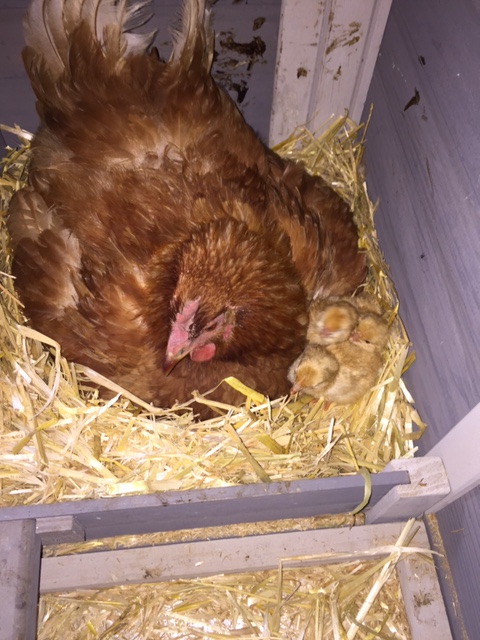
I studied the eggs. Each bird colors her eggs differently although some are very close. “Goldie gives dark brown eggs; Elona’s and Red Head’s are lighter brown; Whitey and Baby give light brown eggs with a pink hue. That’s why, although Goldie was the brooder who sat on the eggs, I think Whitey was the biological mama. But Goldie gave us two eggs today.”

“So Goldie is trying to stay in your good graces? She’s also the one who has been giving us double-yolkers.”

Carol was right. Within the past three weeks Goldie gave us five double-yolkers.

Carol had another question: “Don’t forget that Goldie also gave us several tiny eggs with no yolks; that was strange! How do they make eggs, anyway?”

It was time to study.

As with women, hens enter the world with all the eggs they will ever have. Our birds started laying eggs at six months of age, although some chickens lay at five months. Here, briefly stated, is the process.

Light entering the eyes starts the activity. Light and heat are the stimulants which help chickens produce an egg on the average of every 25 to 26 hours. However, rather than delaying the egg several hours each day, our birds usually lay them between 8:00 and 10:00 every morning and skip a day periodically. Hens normally don’t lay eggs in the dark, so if the egg is ready to be laid at night, she will “hold it” until morning.

The oocytes (eggs in the ovary which become yolks) begin growing. Normally, one a day is released into the oviduct where fertilization can take place, but several may be traveling down the oviduct simultaneously – growing as they move. If a rooster is on the job, the yolk is fertilized early in the journey. The chick will grow on the outside of the yolk, and the yolk and albumin (egg-white) are the food for the developing chick. The birds need plenty of clean water in order to manufacture eggs.

At about the half-way point, the albumin begins to accumulate. The mass is then wrapped in a membrane which holds things together for the calcite shell. Chickens need calcium to create the shells. About four days a week, I crush three or four of their own dried shells and mix it with their feed. (Our chickens don’t prefer oyster shells.)

The membrane, containing the yolk and albumin, sits in a calcium-rich fluid at the end of the oviduct where the calcite settles or is deposited all around the membrane. It takes over twenty hours for the shell to form. One end of the egg is more pointed, and the other is gently rounded; and normally, the rounded end comes out first.

If the egg is brown, the pigment is the last step of the process because the brown coloring is only on the surface; but green eggs are green throughout the shell.

I mentioned that Goldie gave us several yolk-less eggs. Those are called “no-yolkers” or “wind-eggs.” That happened after she gave us several double-yolkers where two yolks traveled close together and were caught in the same shell. The double-yolkers were the size of goose-eggs, but the wind-eggs were the size of half my thumb. (The wind-egg whites are as good to eat as are the whites in normal eggs.)

All five birds lay the eggs in the same nest – one at a time, of course. And it’s fun hearing each one “sing” as she ascends the ramp to deposit her gift.

Remember Carol’s question? She wanted to know how we got six eggs from five birds in one day. I had the answer: Goldie had an egg ready to lay sometime during the night but held it until daylight. By then, the next egg was almost ready. When she laid it a couple of hours later, we had six eggs for the day.

As I was preparing this article, I began laughing. “What’s up?” Carol asked.

“I’m laughing at the concept of Evolution. There is absolutely no way that birds – with their built-in egg-manufacturing process – could have evolved from a non-bird life-form. It is, also, impossible for any life-form to self-generate from dissolved rocks. Life, including vegetation, requires the engineering genius of our Creator: Almighty God.”

“Okay. And I suppose your research also answers another question.”

“Which one?”

“Which came first: the chicken or the egg?”

“You are smart! And we understand from the scientific viewpoint that, indeed, the chicken came first.”

I Try to Protect My Flock

In 2017 we were visited by a small flock of chickens. This blog, and the blogs for the next three weeks are about those memories.

I evicted the raccoon, ground hog, and opossum from the premises. Then I repaired the 8’x10’ barns to prevent predators from hiding close to the coop and put up new fencing to keep predators out of the chicken yard. The chickens and squirrels get along together, and the chickens love to eat little worms, frogs, and every kind of moving bug they can catch. Bugs are happy meals for happy chickens. (Yes! They do eat small frogs.)

Every night I latch the doors to the coop and latch the gate to the chicken yard. I feed the four hens and one rooster well, keeping food and water available 24-hours a day, and I give them scratch, table scraps, and other goodies every day. I try to protect my flock.

Carol and I decided to let the hens hatch a batch of chicks. All four hens took turns laying the eggs in one nest. I suppose the hens drew straws and Goldie was chosen to be the Momma. Twenty-three eggs fit inside the nest, so we began gathering the rest.

In New Mexico, we raised chickens and turkeys from 1973-1978. Buying the chicks at 3-days old, we didn’t hatch our own, therefore, this would be the first time we hatched … uh … let our hen hatch them, and we had a lot to learn.

I forgot that the mama hen turns the eggs several times a day. Thinking that one of the hens laid an egg on top of the 23, I took it and put it in the refrigerator. (We wash all the eggs we collect.) Four days later, Carol and I were negatively surprised when I cracked that egg to cook it, and dropped a fully-developed chicken as big as the first two digits on my baby finger into the pan. It had previously died in the fridge.

One night I got home late and forgot to secure the coop. The next morning, I found chicken feathers all over the yard, but no rooster. Fred (the rooster) apparently had fought the predator to protect his harem, and gave his life for them. But in the fracas, Fred also mortally wounded the opossum, and I found the opossum’s carcass in the corner of the yard. However, something else (coyote?) had jumped the fence and took Fred’s carcass.

Never again will I forget to secure the coop.

After Goldie sat on the nest for three weeks, the eggs began hatching. Eleven hatched, but one died. I called the remaining babies “Our ten chicklets.” I made sure I closed and latched the coop, but there was something else I didn’t know: the other hens would hurt or kill the babies.

Making the fatal mistake of allowing the hens to be in the same coop with the babies, the next morning I found eight dead chicklets. It was my fault, and I felt terrible. Even worse, while Goldie was trying to protect her young’uns, the other three hens attacked her. That broke our hearts, and I resolved to keep the hens away from Goldie and her remaining babies until they were older. Goldie recovered, but a week later, one of the chicklets died.

The remaining chicklet is nearly full-size now, and she has a name: Baby. So, we have Red Head, Whitey, Elona, Goldie, and Baby. Now the hens don’t attack Baby; it’s just the regular “pecking-order” that takes place.

As I’ve been thinking about all this, the Church came to mind. Too often, if someone’s theology differs from ours, they are labeled or branded as in error. Regardless of theology, if they tend to differ in other seemingly important areas, the church often tends to shun them or separate from them. We sometimes “kill” them socially by damaging their reputation. And if we allow our emotions to control us, we can even insult Jesus by splitting His Church. This ought not to be!

People who are made in the image of God should not act like animals. I Peter 4:8 informs us that we should look for ways to love and protect God’s flock.

Neither you nor I are perfect, so learn to accept others as they are. Love and honor God by loving and protecting His flock. Remember: you need their friendship as much as they need yours.

I’ll tell you more about the flock in the next three weeks.

What’s the Basis for Your Faith?

The title of this Reflection is a question I’ve been asked several times. Years ago, I often said: “The Bible is the basis for my faith.” But my answer has changed. Now I joyfully say, “Eyewitnesses, and the empty tomb where Jesus was buried is the basis for my faith.”

What’s the difference? To answer that, I’ll use a Protestant version of the King James Bible.

This version of the KJV Bible (printed around 1885) has 66 books, 1,189 chapters, 31,102 verses, and 788,258 words in the text. It contains stories and narratives that relate information such as numbers of people killed in numerous battles, lists of kings, priests, and prophets, and genealogies of various people.

But that information, and a lot more, is based on various dating and numbering methods. For example: some cultures listed the second year of the king’s reign as the first year simply because some kings were killed before the first year was complete. Sometimes the second year of a baby’s life was counted as its first because 1st-year mortality was rampant. Sometimes, a king and a co-regent reigned simultaneously, yet their individual reigns seem to be listed consecutively.

Various versions of the Bible – even various KJ versions – have different word and verse counts. Other things are documented differently, depending on the original ethnic scribes or subsequent translators.

All of that, plus more, give people opportunities to call the Bible wrong – therefore, impugning the integrity of the Bible – which, consequently, tends to impugn the integrity of those of us who believe the Holy Bible.

Therefore, I no longer say the Bible is the basis for my faith because detractors, skeptics, agnostics, atheists, and adherents of other religions think they have grounds to prove the Bible wrong.

I now rely on eyewitnesses and the empty tomb as the basis for my faith. As surely as the person on the right of this blog witnessed the US Navy Blue Angles flying over Duncanville, Texas, there were eyewitnesses of Jesus’ resurrection and of the empty tomb in which He had been buried. That means Jesus rose from the dead. How can you argue against a person who predicted that he would die, how he would die, by whose promptings he would die, by whose hands he would die, and that he would come back to life in three days – and it all come true? Are you going to call him a liar? Not me; especially since much of it was also predicted centuries earlier by others.

How can a person debate that? Jesus either rose from the dead, or he didn’t. It isn’t “The Bible” I have to believe – it is eyewitnesses I believe. Witnesses such as Matthew, Peter, John, and others who documented their observations. They had no idea that their writings might be saved for people to read centuries later. However, because their observations and stories were found to be authentic, they were incorporated into a group of books that became the Holy Bible.

Merriam-Webster defines the word bible as: a publication that is preeminent especially in authoritativeness or wide readership. Many bibles abound such as the Machinists’ Bible, Deer Hunters’ Bible, Flower Gardener’s Bible, the Holy Bible, and many more.

The topic of Jesus’ rising from the dead has been found by archeologists in ancient Roman documents because it was a political concern for the emperors. Therefore, it is worth our time discussing it, but not arguing over it.

But I don’t blindly accept the Holy Bible. We can believe it or we don’t have to believe it; but there isn’t much sense in arguing over it. The fact is that the Holy Bible is not just a spiritual book; it is one of the oldest and greatest history books in existence. It’s also a matter of faith. But faith goes both ways: you either have faith to believe Jesus rose from the dead, or you have faith that he didn’t rise from the dead. You have faith to believe the Bible, or you have faith not to believe it. You have faith to believe in God or you have faith not to believe. Everyone’s life is based on faith in something or in someone.

The historicity of Jesus living and dying has been proven by non-biblical sources, so that is not the issue. His raising from the dead is the issue. But you’ll also discover that Jesus’ resurrection has been proven by atheists and agnostics. Of course, they became believers in Christ once they verified the deity of Jesus Christ.

Not only does the empty tomb provide me with answers for this life, it also substantiates my faith for eternal life. And I ask you to turn to Jesus Christ and live for Him.

It All is Beauty to Me

Driving over a hill, I wonder what I’ll see.

It may be a rock or a rill, it all is beauty to me.

Magnificent valley below, flowering bush and tall tree,

Swaying as the wind does blow, it all is beauty to me.

Climbing the mountain high with my head up in the cloud,

Breathing deeply, I sigh, and praise the Lord out loud.

Seeing the vista so wide, away from the noisy crowd,

With only birds at my side, I praise the Lord out loud.

Sailing along the coast, the wind and rain I brave,

I thrill with Jesus, my host, and with the freedom he gave.

Sitting on sandy shore, watching the crashing wave,

Thinking of God I adore, and the freedom He gave.

Walking through forest green, quiet meadow and lake,

I thrive in nature serene with each breath that I take.

Turning to go home, I plant my stake,

Planning again to roam with each breath that I take.

Thoughts on Godly Character

It’s interesting how different folk prioritize character traits, or Godly attributes, as having a higher value than others. For example, one person considers honesty as the highest character trait on the list, while someone else views compassion as the most important. Yet another extols humility. So, which one is the most important?

That can’t be answered because it misses the main point, and it reminds me of when a friend asked me some years ago, “Which of your five children do you value the most?” I told him, “That question has no answer because they are all equally valuable.” And it’s the same with the various attributes of God: they are all equally important.

Character is a transliteration of χαρακτήρ, or carakter, which denotes express image. The idea is a brand, an engraving or indelible mark – in this case, an image or imprint on the soul. Therefore, a character trait of God is an attribute which characterizes or closely represents the nature of God.

Having worked with an organization which taught about living with high integrity and good character, I helped teach what I unofficially called the character traits of God. There are quite a few identified in the Bible, but here is my list. Don’t go to sleep now. Read this list slowly and think about God as you read each word (in alphabetical order).

Depending on the circumstances, God is: Alert, Attentive, Available, Bold, Cautious, Compassionate, Content, Creative, Decisive, [shows] Deference, [is] Dependable, Determined, Diligent, Discerning, Discrete, [manifests] Endurance, [is] Enthusiastic, Faithful, Flexible, Forgiving, Generous, Gentle, Grateful, Hospitable, Holy, Humble, [shows] Initiative, [is] Joyful, Just, Loving, Loyal, Meek, [Jesus was] Obedient, [is] Orderly, Omnipotent, Omnipresent, Omniscient, Patient, Persuasive, Punctual, Resourceful, Responsible, [Jesus was] Reverent, [is] Righteous, Secure, Self-Controlled, Sensitive, Sincere, Sovereign, Thorough, Thrifty, Tolerant, Transcendent, Truthful, Virtuous, and Wise.

Still awake? Good. Almighty God is more amazing than you or I could ever imagine! After reading this partial list, can any one of them be considered more important than the others? The answer is a definite No. It takes all of them – plus more – to describe or define Who our God is.

But we can truthfully say: depending on the circumstances, several may be more applicable than others.

For Example: If I am going for a job interview, a Loving or Reverent attitude might not be as relevant as being Attentive and Punctual – depending on the job, of course. And if the house is on fire, we can forget Hospitality; but being Decisive, Determined, and Dependable would really help.

A friend manifested no less than 31 Godly character traits as he repaired the air conditioning unit on my RV. It’s amazing how much we represent God as we help others. Why is that?

When God created mankind, He programmed us to be like Him. In Genesis 1:26 God said, “Let us make man in our image; to be like us.” Therefore, as we endeavor to live a good life, it isn’t just our duty and responsibility to represent God – to be His ambassadors – we can’t help it because it’s part of who we are. And as we help others we are the extension of God’s hands and feet.

But there’s another side to this.

Some folk purposely live in rebellion against God. Some thrive as they steal or defraud others, damage reputations, hurt or commit murder. Some are greedy, ruthless, haters of good. I could continue, but you get the point. These folk are blocking God’s eternal plan for their lives.

However, if they repent and honestly ask to be forgiven, God will Forgive them although they may face the consequences of their poor decisions.

Living with Godly character and integrity produces a wholesome life now, and a wonderful life for eternity.

 What kind of character are you? What are you doing with the time God has given you here on earth?

Identification Generates Change

I’m sure you were asked as a child, “What do you want to be when you grow up?” As I did, you most likely had a ready answer. I wanted to be a Navy Chaplain like my father. Many of my friends gave answers such as: a policeman, fireman, doctor, race car driver, a movie star, and so forth. In the 1970s, two other common answers were: a rock singer or an astronaut.

Why do kids respond like that? The simple is: identification. Identifying with something or someone we admire gives us a sense of belonging, a sense of importance.

As a Californian, I liked the San Francisco 49er football team. When the 49ers won a game, “I” won. When they succeeded, I succeeded. When they lost, I lost. I’ll never forget when WE won OUR 5th Super Bowl Ring! Had I ever met any of them? No, but what difference did that make? I liked Bill Walsh, Joe Montana, and Jerry Rice.

But I truly admired my father, and I strongly identified with him. I always liked dad better than the 9ers, anyway.

I also learned to admire other men who talked and sung about Jesus, and in high school a southern gospel quartet from Mississippi became my focus: The Blackwood Brothers Quartet. Not having met them, I referred to them by their first names, and sung along with the records I bought. I learned all four parts of all their songs and learned to sound like them – somewhat. When I finally met them near Boston, Massachusetts, my spirits soared!

A few others whom I admired and wanted to emulate were the Apostle Paul, Abraham Lincoln, Billy Graham, Paul Harvey, and Dr. J. C. Holsinger (Carol’s and my history professor in the university).

Identification with a person, group, or event generates change. Why? We mentally gravitate toward the object of our focus.

I tend to think like dad. I’m for a unified nation as was Lincoln. I focus on the Bible like Billy Graham. I learned to sing like several of the Blackwoods. Fifty years ago, I could sing tenor similar to Bill Shaw; but as the years passed, I began singing bass similar to J.D. Sumner – but not nearly as low as he did. I learned to study like Dr. Holsinger. I learned to tell stories similar to Paul Harvey. I learned to think theologically and philosophically like Paul.

Since identification generates change, identifying with these men gave me direction in life.

Merriam Webster Online Dictionary defines identification, in part, as: “A largely unconscious process whereby an individual models thoughts, feelings, and actions after those attributed to an object that has been incorporated as a mental image.” The person changes as the thoughts and feelings become a part of his life and his worldview.

An extreme form of emulation is idolatry and leads us away from God. But admiration, properly applied, is beneficial if it leads us toward God, maturity, and wholesome living.

But there is one more person with whom I have identified, and who has changed my life more than any other: Jesus Christ.

My favorite quote from Billy Graham is: “The Bible Says!” So, let’s go there.

John 14:23 says – “If people love me, they will obey my teaching” (NCV).

Romans 6:4 says – “When we were baptized, we were buried with Christ and shared his death. So, just as Christ was raised from the dead by the wonderful power of the Father, we also can live a new life” (NCV).

So, obedience is another way of identifying with the Lord. Obedience includes actions, lifestyle, and manner of speaking. And we find that water baptism is our statement to the world that we have totally identified with Jesus: in his life, death, and resurrection.

Remembering that we mentally gravitate toward the object of our focus, I have learned to focus my life on Jesus Christ. I know who I am, and to whom I belong.

Some who call themselves Christian but who do not live according to Jesus’ teachings, have not identified with Him. If your life – words, actions, lifestyle, attitudes – does not openly verify identification with the Lord, there is a question as to the sincerity of your faith.

Identification with Christ grants strength, security, belonging, power. Not power to rule people, but power to overcome evil and spiritual darkness. Those who identify with Christ receive authority to become adopted children of God. Identification with Jesus will help us throughout eternity.

Who do you admire or look up to? With whom do you identify? As you contemplate your eternal existence, will your role-models help you or hinder you? Think about it. Pray about it. Jesus is ready and willing to help you.

Two Trees … Two Lives

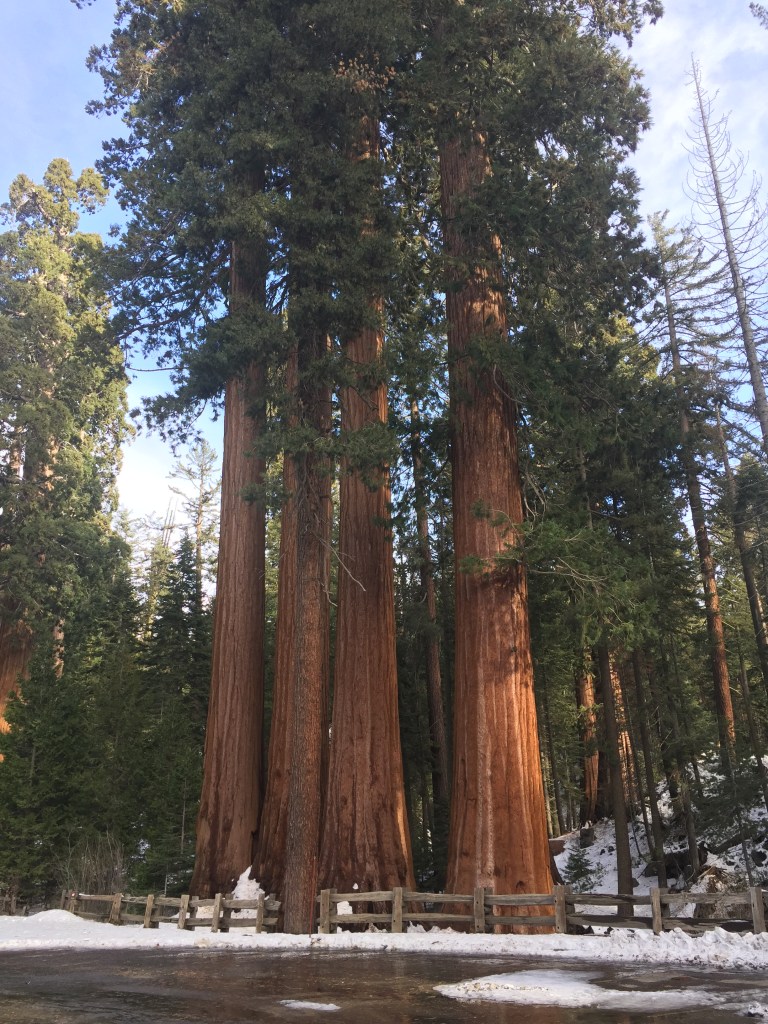
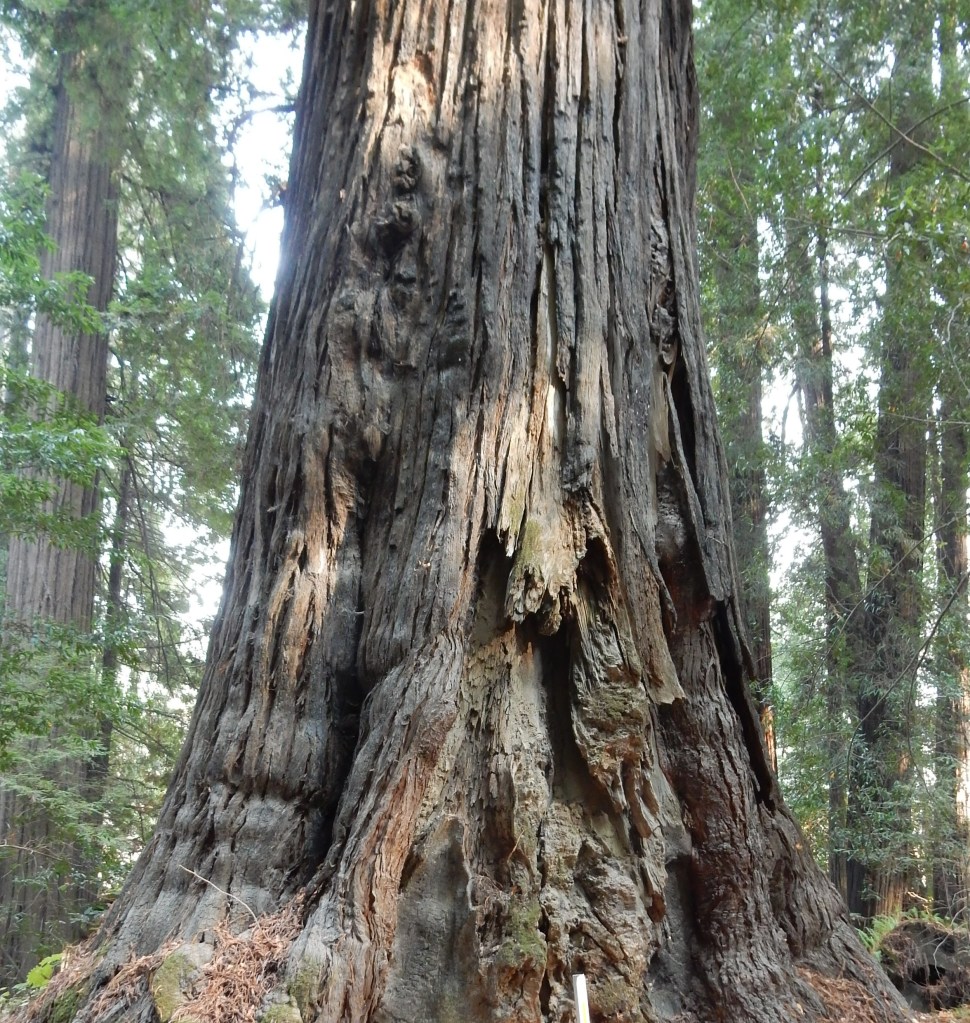
As we walked through the Redwood Forest in Northern California, we were awed by the beauty, the grandeur of these magnificent trees that average 240 feet in height. I grew up in Southern California but rarely did my parents have opportunity to go that far north. Eight hundred miles was a long way in the 1950s, and I saw the Redwoods only one time in my childhood.

But this was 2018, Carol & I were on our year-long jaunt around the US of A, and childhood memories came flooding through the canals of my mind. On November 14 we visited the Humboldt Redwoods State Park, and on December 8, we visited the Calaveras Big Trees State Park – in the snow, of course – with our son, Ron, and his family.

There are basically two divisions of giant Redwoods: Giant Sequoias (sequoiadendron gigantem) are found in the California Sierra Nevada Mountains, and Coastal Redwoods (sequoia sempervirens) grow near the Northern California coast.

Some Giant Sequoias grow 300 feet tall, have a diameter up to 35 feet (that’s almost 110 feet in circumference!), have a root system which can cover several acres, and be more than 3,000 years old. For history buffs: a tree that old sprouted about the time Saul was crowned King of Israel and about 100 years prior to the beginning of the Neo-Assyrian Empire. The Coastal Redwoods can grow 370 feet tall – the tallest trees in the world – with trunks up to about 30 feet in diameter (95 feet in circumference).

Loggers had cut about 90% of these colossal trees for housing, furniture, etc.; but various conservation groups appealed to Congress to preserve the Redwoods, and the state and national park systems succeeded in rescuing the remaining 10%.

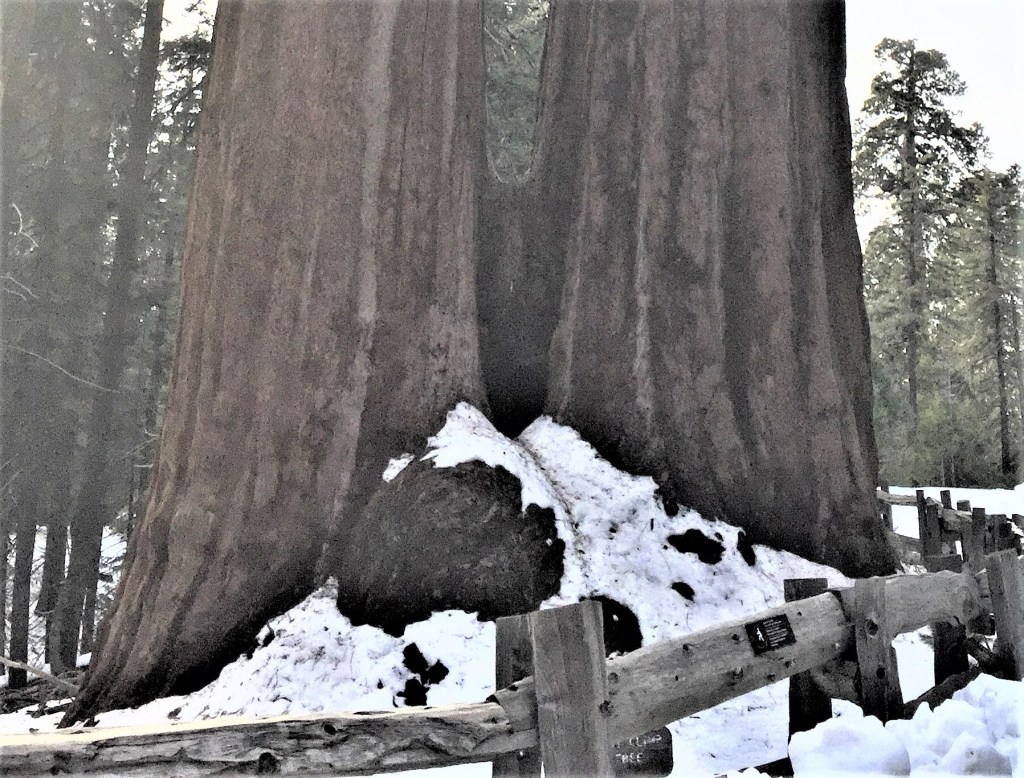
 As Carol and I walked among the trees, we saw a number of them that looked as though two or three had been planted together. Standing very close together with 8-foot diameter trunks, it looked as though someone had poured liquid bark on the trees ten feet off the ground which solidified, connecting the trees. Looking at this photo carefully, you can see where the bark has joined the two trees.

Yes, they had grown up together – the seeds having landed about ten feet apart. As seedlings, ten feet is a long distance. But as they grew and their trunks began touching, a phenomenon called inosculation took place. This funny word means to connect or join; to become one or make continuous; to unite.

As each of them grew in width at about an inch per year, they began touching in 120 years. As the trunks or branches rubbed together and wore off the bark, the live fibrous tissues touched each other and began intertwining. They didn’t get infected, and the trees became one plant, sharing nutrients and water.

Depending on how close trees are, either the bark joins and becomes one covering around both trees, or the tree trunks themselves physically join and become one tree. The trees that fuse together like that are called Hugging Trees. And together, they are stronger than individual trees.

Trees and bushes are not the only organisms that experience inosculation. This interesting phenomenon takes place when a person receives a skin graft. Through inosculation, the blood vessels and skin tissues connect, intertwine, and become one.

As I stood in the Humboldt Redwoods State Park gazing at these two magnificent works of God that had become one, I began thinking about my relationship with Carol.

We were born in different states. Eighteen years later we met in Southern California in college. Both of us lived on campus, and – attracted to each other – we saw each other in classes, during meals in the cafeteria, and in the choir.

Married August 22, 1966, we began growing together – yes, including rubbing each other the wrong way sometimes. But we didn’t allow the irritations, the inconveniences, the frustrations, and occasional anger to infect us as we wore off the rough edges; and over the years we became one in many ways.

We share the same house, the same joys, the same children, the same grandchildren, the same church, the same God. We have the same basic goals in life. We even react in much the same way, and at times spontaneously come up with the same ideas. We’ve grown strong together.

Two trees…two lives. It’s amazing how two individuals can develop a strong marriage if they stay together, weather the storms of life, and learn to truly love each other.

Reaching for Life

I’ve been looking at my pictures of the redwood forest in Northern California. The trees are big! Our pine tree in back yard that is over two and a half feet in diameter looks big; but it is small compared to a relatively small five-foot diameter redwood tree. Amazingly, redwoods that are 10-18 feet in diameter are common, and it staggers the imagination knowing that the diameter of the General Sherman Redwood is over 32 feet!

A typical farmed redwood tree may weigh 50,000 pounds, but some redwoods weigh over 2,000,000 pounds! Interestingly, about half the weight is in the water. The redwood bark may be 2-feet thick, and a huge redwood tree may provide wood to build 30-35 homes.

Water is necessary for life. The redwoods grow to 250-350 feet tall and require over 100 gallons per tree per day. But it rains a lot in these forests, snows in the winter, and fog is prevalent; therefore, they are seldom thirsty. The root systems of redwoods are shallow, and that would mean a heavy wind or flood could topple them easily. But as they reach for life-giving water, a mature tree spreads its roots over 2 to 4 acres; and with 8 to 20 trees per acre, the root systems overlap and intertwine which results in a strong foundation for these top-heavy giants. They effectively support each other in rough times.

Light is also necessary for life. God engineered plants to reach for or aim toward light. This is called phototropism. The same is true of these giant trees. Programmed to be tall anyway, they continue to reach for life – for sunlight. Lone trees out in the open will not be as tall as those in the forest with a thick canopy of foliage; and they are also open to more danger. There is protection among its neighbors.

The mature redwoods are basically fire-resistant. The thick, fibrous bark does not burn easily; and as a protective shell, it insulates the tree which allows it to survive most fires. The thick bark also provides protection of another kind: it has the ability to withstand fungus, disease, and insect attacks. This is why these trees live so long. The oldest known redwoods are about 3,000 years old. Only the bristlecone pines (about 5,000 years old) are known to be older.

Looking at the pictures of these magnificent trees, my mind gravitates toward humanity. I see similarities. No – not about size, but about other features and qualities.

The redwood’s root system covers a wide area which gives it stability in inclement weather. In the same way, our roots in healthy relationships with family, church, and society give us stability during “inclement” situations such as death, job loss, health deterioration, and more. In our many storms of life, we need each other for emotional and physical support. But our strong roots in a healthy relationship with Jesus Christ will help us even more in this life on earth, as well as throughout eternity.

 A straight tree is stronger than a crooked tree, and its wood is useable in more situations. Likewise, a morally and intellectually straight man is stronger, trustworthy, where an immoral or double-minded man is weak, confuses people, and leads people down the path of destruction.

Trees must reach for the light to survive. In the same manner, man must reach for light – truth – to survive. We cannot survive very long, either societally or spiritually, if we live in spiritual and moral darkness. We cannot mature as morally strong individuals if we resist truth.

As the thick bark protects the trees, living in truth will protect us. Knowing the truth about various aspects of life – food, environment, chemicals, health, morals, physiology, and a lot more – can help us live safely. And purposefully living according to the truths found in the Bible will protect us in many ways most people don’t yet understand.

As the trees depend on water from the sky for life, man depends on guidance from the sky – direction from God – for life. Psalm 1:1-2 tell us not to follow the advice of ungodly people, but to meditate on and live according to the words of the Lord. Psalm 33:11 tells us that God’s plans are good, healthy, and beneficial. And Proverbs 14:11-12 warn us that man’s apparently powerful plans will fail in the end, but God’s seemingly weak plans are actually strong and will stand forever. Trust in Jesus: Reach for Life.

The Positive Side of Life

Have you noticed that I like to be joyful, happy? I like to laugh and have a good time. I learned that from my dad who used to say, “We’re only going this way once; we might as well make the most of it!”  Of course, Dad meant that within a totally Christian lifestyle.

Should we be serious? Yes, but we don’t have to somber to be serious. Just after the North lost a major battle in the American Civil War, President Abraham Lincoln told a joke in Congress and was challenged by his Secretary of State.

“Mr. President, don’t you think you ought to be serious in a time like this?”

President Lincoln replied, “If I took everything serious, I would lose my mind.” Lincoln understood that a little humor alleviated a lot of mental turmoil.

We sometimes forget that God’s original intention for all mankind was to be joyful, happy while we fulfill His will for our lives – even if we encountered difficulties.

Do you know that the word joy, its derivatives, and related words are in the Bible over 250 times? God approves of joy and happiness as we serve Him. One of the words is rejoicing which is “celebration of thanksgiving; making happy sounds; laughing, having a good time; being cheerful.”

Proverbs 15:13 tells us that a cheerful heart brings a smile to your face; a sad heart makes it hard to get through the day.

Proverbs 18:14 informs us that the will to live can get you through sickness, but life is difficult with a broken spirit.

Proverbs 15:15 tells it from the opposite viewpoint: “Every day is hard for those who suffer, but a happy heart is like a continual feast.” In other words, even if we’re poor and are struggling, a cheerful heart fills the day with song.

Proverbs 17:22 says, “A happy heart is like good medicine, but a broken spirit drains your strength.” And I have found that a cheerful disposition is good for our health, but gloom and doom leave us bone-tired.

If you find that the cares of life are getting you down, remember the prayer of Francis of Assissi. It goes something like this:

          Lord, grant me the strength to change the things I can change;       

          Grant me the courage to accept the things I cannot change;

          And grant me the wisdom to know the difference.

Keep in mind that facing each situation with a cheerful disposition can make the difference between success or failure.

A truly joyful person is one who can enjoy the scenery even on a detour. Some of Carol’s and my more enjoyable traveling moments have been on routes we didn’t plan on, and it happened again just today. When things seem to go wrong, we try to find the good in it.

Normally, joyful people are healthier, they are more creative, they are more alert, and are more fun to be around. Why? Joyful people enjoy life! And joy is contagious. (So is depression, and that’s a problem!)

Joyful people don’t usually get stopped by negative influences, but more freely release or express the creativity that our Lord placed within them. Joyful people are generally more productive because they are prone to stay focused on what God wants them to do in this life.

It says in Nehemiah 8:10, “Then he said unto them, Go your way, eat the fat, and drink the sweet, and send portions unto them for whom nothing is prepared: for this day is holy unto our Lord: neither be ye sorry; for the joy of the Lord is your strength.”

That last phrase could be translated, “…for the joy that the Lord gives you will make you strong.”

Forget Murphy’s Law that says, anything that can go wrong will go wrong. That’s pessimistic and can slow you down. Instead, think about how you can make things right.

Let’s focus on and dwell on the last part of Romans 8:28, “…And we know that God causes everything to work together for the good of those who love God and are called according to his purpose for them.”  

So let the joy of the Lord saturate your bones, your mind, your spirit. If something seems to go wrong, turn to God and ask Him for understanding and guidance; and then you be the human element that turns things around for the better.

Join me on the positive side of life.

Hardships

The word hardship came from England back in the 1200s, and it described sturdy ships that endured the brutal storms of the North Atlantic.

Today it’s defined as a condition that is difficult to endure. It refers to suffering, deprivation, and oppression: something hard to bear, lack of comfort, constant toil or danger.

As we think about hardship, we need to remember that life is not supposed to be about us. Life, including eternal life, is about Jesus and our relationship with Him. However, although Jesus should be the center of all human existence, most people put Him on the sidelines, or not in their life at all.

Then, generating our own hardships, people get all limp and wishy-washy about life, or get hard and bitter. We have a difficult time doing things God’s way because we don’t spend time getting to know our heavenly Father.

But God has been saying all along: Please give me the reins. I can tame this team of horses, but you need to cooperate.

A young woman who didn’t know how to cooperate with the Lord told her mother about how life was so hard for her. There seemed to be no end to her problems, and she wanted to give up. She couldn’t understand that she was creating most of the hardships for herself.

Her mother sent up a silent prayer, then took her daughter to the kitchen. Filling three pots with water, she placed them on the stove and turned the heat to high. In the first pot she placed carrots; in the second, she placed a couple of eggs; and in the last, she poured a cup of coffee grounds.

Without saying a word, she let them boil for about twenty minutes, then turned off the burners. She fished the carrots and eggs out and placed them in separate bowls. Then she ladled the coffee grounds out and placed them in a bowl.

Turning to her daughter, she said, “Tell me what you see.”

“Carrots, eggs, and coffee grounds.”

Her mother brought her closer and asked her to feel the carrots and peel an egg. The daughter noted that the carrots were soft and the eggs were hard boiled.

“Now, check the coffee grounds and water.”

The daughter smiled. “The coffee grounds look the same but wet. But the water was now … coffee, and I think I’ll have some. Mother, what are you getting at?”

Her mother explained that each of these objects had faced the very same adversity: 212-degree boiling water for twenty minutes. Each reacted differently. The carrots went in strong, hard, and stiff, but after sitting in boiling water, they softened and became weak. Inside the shell, the eggs had been fragile. Their thin outer shell had protected the liquid interior, but after bumping around in the boiling water, the insides became hardened. The ground coffee was unique. The oppressive adversity (boiling water) released color and flavor.

“Which are you?” she asked her daughter. “When hardship knocks on your door, how do you respond? Are you a carrot, an egg … or … coffee?”

The daughter, drinking her coffee, understood the lesson.

So I ask you, dear reader: Are you the carrot that is strong when there are no problems, but with pain and adversity you wilt and lose your strength?

Are you the egg that starts with a malleable attitude, but becomes hardened with the heat? Did you have a fluid spirit, but after a death, a break-up, a financial hardship, or some other trial, you became cynical? Does your shell look the same, but on the inside are you inflexible?

Or are you like the coffee? Do you change the circumstances that bring the pain? When things are at their worst, do you cave in or help change the situation around you?

When the hour is the darkest and trials are their greatest, how do you handle adversity?

Remembering that hot water releases the fragrance and flavor of the coffee grounds, perhaps you can remember to sincerely turn to God for guidance. He is always willing to help us. God tells us in Isaiah 43:2-3, “When you go through deep waters, I will be with you. When you go through rivers of difficulty, you will not drown. When you walk through the fire of oppression, you will not be burned up; the flames will not consume you. For I am the Lord, your God, the Holy One of Israel, your Savior.”

That is true if we cooperate with God. How do you respond to hardships?