Artificial Intelligence?

How many of you have thought about – I mean, deeply thought about – what is called AI, or Artificial Intelligence? Before we talk about it, let’s define and understand it.

At some point in history, the word “artificial” was given the meaning of insincere, fake, or forced. But that’s not what it means.

According to an etymology dictionary, “artificial” comes from the Latin in the 14th century, artificialis, which came from artificium, and that is: a work of art; skill; theory; system. The overall concept is: “made by man; contrived by human skill and labor.” The artificium was not the THING that was made; it was the SKILL, CRAFT, or TRADE that made the item.

Today, when we talk about Artificial Intelligence – or AI – there’s a lot of misunderstanding. AI today, in its broadest sense, is the intelligence or knowledge manifested by machines that are run by computer systems, and you might be surprised at how much of our industry is run by computers.

AI applications are systems such as web search engines (Google, et. al.), YouTube, Amazon, Netflix, Alexa, Siri, electronic chess games, cell phones, and thousands more! But remember, they are all run by computers. However, AI is used in so many systems – such as the computer I’m using at the moment – that they are not thought of as Artificial Intelligence any longer.

There shouldn’t be any mystery associated with AI. Remember, all Artificial Intelligence is man-made. There is nothing spooky, weird, or mysterious about it. Everything the computer or computer-operated machine can do or say has been programmed by man. And humans have been programmed by our Creator God to be very creative.

For example: One time I asked my cell phone, “Hey Siri, where’s my wife?” The machine answered, “If you don’t know, you’re in trouble.” (My wife and I burst out laughing!) That’s an application of AI, and someone programmed that as one of the possible responses.

Please understand this: Computers and computer-operated machines cannot – repeat, CANNOT – create information or responses without the information to generate those responses being programmed into it. They are wired and programmed by humans to scan thousands of computers and hard drives, then copy various bits of information and paste them together to give coherent responses. And the science involved has grown so well that it seems that the computer is thinking as a human. But it is not, and it cannot think as a human.

The most complex device or machine you can think of might seem to have a mind – or spirit – of its own. But remember that many primitive people thought compasses were possessed of spirits, and early native Americans thought photographs captured people’s souls. But, that was only because they didn’t understand the science involved.

So we need to understand that machines are not people, and they cannot think and respond like people. The movie, 2001 – Space Odyssey, was only science fiction; and the computer, HAL, was not real.

AI, in and of itself, is not evil. Here are several comparative examples:

Guns, by themselves, cannot kill or hurt anyone; people do.

Bows & arrows cannot hurt anyone; people do.

Knives cannot hurt anyone; people do.

Bats cannot hit a ball; people hit the ball with the bat.

Cameras, both movie and still, are not evil; but some people use them to glorify immorality, heinous murder, and evil spirits.

In like manner, AI is not bad. Instead, it’s being used in thousands of applications for the benefit – and amusement – of humanity. However, as with guns, bows & arrows, bats, knives, movies, and almost every other good thing, AI can be used wrongly for the detriment of man.

But listen: there definitely is an intelligence that overshadows anything and everything that man can do and ever could do. He is Almighty God.

When we pray, answers can come immediately: not because some AI can process at super speed, but because the Holy Spirit already knew what we were going to ask. The Bible says in I Chronicles 28:9b, “the Lord examines all minds and understands every motive of one’s thoughts.” And Isaiah 65:24a tells us, “Before they call, I [God] will answer.” Now that is fast!
So, if you want to know when Alexander the Great was born, and why some people thought of him as a god, check AI – the internet.

But when you need wisdom and guidance for living, call on the real God we read about in the Bible, and He will answer. God is omniscient – all knowing – and He cares for us.


Actively Listening Can Enhance Your Writing

In my opinion, learning to actively listen can make us a better writer. Let’s look into it.

In her book, Listening: Its Impact at All Levels on Reading and Other Language Arts (1979), Sara Lundsteen said, “Listening is the foundation for speaking, which is the foundation for reading, which is the foundation for writing.” She taught that since listening is a foundation for writing, active listening can further enhance the author’s writing. I want to follow up on that.

Actively listening to others – rather than passively listening, or interrupting – can increase our vocabulary. An increased vocabulary allows us to give people in our stories a wider range of expression.

Actively listening to others can teach us how others think. Learning how others think allows us to create a greater number of characters, with wider intellectual capacity, and more complex personality. That, in turn, can give us the potential for a more complex and a much more interesting story.

But actively listening also helps us personally. I found that when I learned how to actively listen, without interrupting, I began interacting on a more mature level, and people began asking for my thoughts and opinions. By listening, I gained a broader audience and became a better writer.

Listening will help you too, and help you to …

Write Creatively.

Life is Changing for a Lot of People

What’s happening? Approximately 3.7 million young adults are graduating from high school, around 4 million are graduating from college, and about 1.65 million will continue to pursue their masters degree. Oh yes, and about 30% of the American work force will change vocations.

Life is definitely changing”

Another thought to consider: about 80% of our population would like to write a book, but only about 3% actually do it. Why only 3%?

It takes time, and many folks feel intimated at what they think is a complex process. But I have good news for you.

Yes, it takes time, but we at P&L Publishing & Literary Services can coach and mentor you in the process. What about the complexity? We at P&L handle that easily and you won’t have to worry about it.

So if you are part of that 80% who would like to write a book, let P&L help you become part of the 3% who are successful. Our award-winning staff who will turn your manuscript into a beautiful book that you’ll be proud of.

Contact us at https://plpubandlit.org/ and click on Formatting Services to start the process, and be sure to …

Write Creatively. (Our editor will help you.)

Working Together

I was sitting in my office in Lemon Grove, California, looking out the window. I was waiting for the next person I was going to interview, and watching for the next trolley to rush past. I had about 10 minutes and was also wondering what my next article would be about.

About that time, the trolley came barreling past. If they don’t stop for passengers, they are going 45-50 miles per hour here. During the weekend, only 2 cars run in tandem, but during the week, 3 cars run together. I walked outside to take this photo.

I began wondering about which one is either pulling or pushing, but then I observed the power system. Each car was receiving its own power from the electric cables above the cars. I suddenly realized that each car – the 3 of them connected together – was pulling its own load. And I had to write about it!

I tell you, inspiration happens in the most unusual ways and at the most interesting times. Always try to be alert as you go about your day, and capture those fleeting thoughts, those inspirations that rush by like the trolley cars. Even though connected together, each car was pulling its own load.

In like manner, each writer must make his or her own progress, but we at P&L Publishing & Literary Services can connect with you and assist you in your pursuit of publishing your book. We can take the complexity out of the process and make your pursuit of excellence easier.

Feel free to connect with us at https://plpubandlit.org/ and click on Formatting Services for more information.

An Important Question (pt. 2)

Continued from last week, we’re getting pretty close to the requirement of faith.

To acknowledge that 356 prophecies were fulfilled in the person of Jesus is one thing. But to say that a man – a human being – is God? That’s a tough pill to swallow! But let’s continue.

Since 356 prophecies were fulfilled in one person, we now have to ask the question: How did all those people (prophets) know what to write? It’s impossible for several people over a span of 1200 years (not including any New Testament writer) to agree with each other in knowing exactly what will happen to a single individual hundreds of years later. There had to be a mastermind to share the information with them.

And that mastermind had to be alive for the duration of human existence so there would be no mistake in telling these people what to write. But no human in the history of the world – including before the flood in Noah’s time – lived longer than 969 years.

This reveals that the existence of the mastermind started before the beginning of the human race and shared knowledge of the future with various people. Since only God can do that, I have no recourse but to accept what the Bible says about him.

John 1:1 – In the beginning was the Word. The Word was with God, and the Word was God. Verse 14 tells us that the Word became flesh. Therefore, we know that the Word was Jesus; and Jesus was and is God.

So far I’ve related what the Bible said about God and Jesus, and we know that everything said about them came true. Therefore, since it verifies that Jesus is God, I have no problem believing whatever the Bible authors said about Him.

The Bible says Jesus raised people from the dead. Can God do that? Of course, He can. He created life in the first place; He can certainly restore life.

The Bible says Jesus turned water into wine. Can God do that? Yes, of course. He created vegetation and water out of nothing, so he can change water into fermented grape juice.

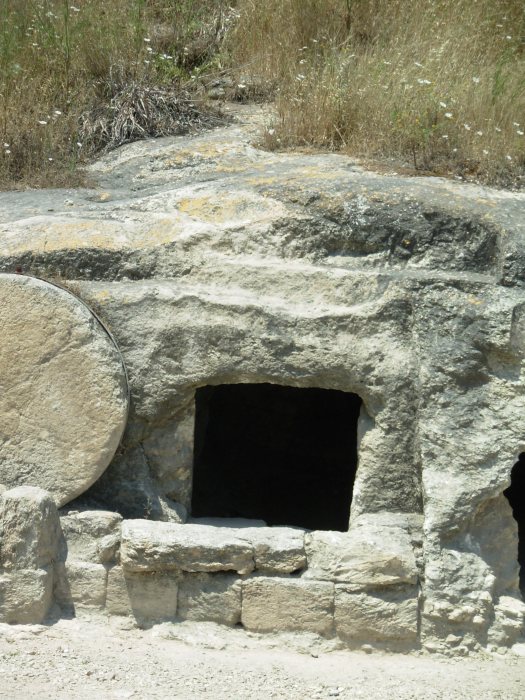
The Bible says Jesus died, was buried, and raised from the dead three days later. Can God do that? Again, yes. God created rocks, planets, stars, galaxies, vegetation, animals, and humans – all out of nothing. Therefore, it is no big deal for God to prevent the body that He lived for 33 or so years from decomposing, and to re-inhabit it. Not only that, the guards at the tomb were eye-witnesses, but were paid to lie about it (Matthew 28:11-15).

Now, where were we? Oh, yes …

If humanistic evolution were true, dissolved inorganic rock material would have to be transformed into organic material. That is a physical impossibility. Therefore, it would still require the miraculous power of a Creator – Almighty God. Only God can do the impossible. Therefore, since the Creator would still be necessary, He wouldn’t need billions of years to create and establish life: He could do it within days if he wanted to.

Did the Bible authors tell us that God or Jesus did something They couldn’t do? Did the Bible authors tell us that God or Jesus did something They didn’t do?

No. In fact, the last verse in the Gospel of John says, “Jesus did many other things as well. If every one of them were written down, I suppose that even the whole world would not have room for the books.”

I asked my dad once how that could be true. Dad responded with, “Do you know all that Jesus, as God, did throughout the history of the universe? How did Jesus make rocks? How did he make flowers? How did he make a star? How many stars did he make? How many galaxies did he make? How did he make people? And the questions continue.”

Obviously, I don’t know how many books it would take to record every single thing Jesus/God did throughout the history of the universe, so I will believe the verse. That is faith. Faith is believing what we cannot prove.

There are many detractors – including theologians, scholars, and scientists – who deny the truth in the Bible. There were even people back in the first century who outright lied about Jesus and about what took place. But remember my comment last week: “…to explicitly affirm what God and Jesus actually said and did would require eyewitnesses.” And there were many eyewitnesses who wrote down what they saw and heard.

We serve an amazingly, almighty God who can do anything He can imagine, and He has a great imagination. Looking through a microscope and a telescope reveals the glory of God and the magnificence of His imagination.

Thinking God’s Thoughts

In August of 2006, our daughter asked me, “Dad, will you write a poem for Timothy’s and my wedding?”

“Yes, but I’ll submit it to you for approval before finalizing it.” The first verse was from Rebecca’s point of view; the second from Timothy’s viewpoint; and so on throughout the poem.

When Rebecca showed it to Timothy, he exclaimed, “That’s amazing! Your dad said it exactly the way I would have said it. How did he do it?”

Rebecca responded, “Dad mentally climbed into your shoes. He knows the sound of your voice, he knows how you think, and imagined what you would say. Then he simply wrote what you probably would have said.”

In another situation, I worked for a man at a scientific laboratory for about eight years. I wrote many of his reports and memos, and conducted other business in his name. Rarely making editorial amendments, one day he asked me, “How do you write my reports in my ‘voice’ so fluidly? It seems as though you read my mind. How do you do it?”

I told him: “I know the sound of your voice, I know your work ethics, and I’ve watched you make decisions. Therefore, I mentally climb into your shoes, imagine what you would say concerning the situation, let those thoughts flow through my mind, and write what I hear.”

My father passed from this life in February of 2010, but I can still tell you what he would think and say in various situations because I know him intimately.

I hope you readers understand that I don’t have any special ability uncommon to the rest of you. You all can do the same thing. How?

You must know how the other person thinks. You must know how he or she sounds. You must know the person’s values and how the person reacts. Very simply: you must KNOW the person.

Jesus provided the best example of this concept. Having originally come from heaven (John 1:1-3), He knew the Father intimately. Jesus diligently sought the Father’s counsel and He always remained alert to the Father’s thoughts. Jesus knew and shared God’s values, ethics, compassion, etc. Because of that, every time Jesus spoke, He told others what God’s desires were.

In reality, we can also know God’s thoughts and apply His solutions to many of our problems in life. And if we employed that same concept with our friends and family members, we could generally avoid or settle most of the interpersonal problems that come our way.

So, how do we mere humans think God’s thoughts? I am glad you asked.

First, you have to know that God is real. Second, you have to know God intimately. And unless God, Himself, appears to you in a vision, the primary way you will know Him is by studying the Bible – God’s revelation of Himself to humankind.

We find insight into this concept in 1 Corinthians 2:13-16. The Apostle Paul was teaching about spiritual matters relating to our relationship to Jesus. He said,

13 When we tell you this, we do not use words of human wisdom. We speak words given to us by the Spirit, using the Spirit’s words to explain spiritual truths. 14 But people who are not Christians cannot understand these truths from God’s Spirit. It all sounds foolish to them because only those who have the Spirit can understand what the Spirit means. 15 We who have the Spirit understand these things, but others can’t understand us at all. 16 How could they? For, “Who can know what the Lord is thinking? Who can give him counsel?” But we can understand these things, for we have the mind of Christ” (NLT).

That last phrase is the key: “We (Christians who obey the Lord) have the mind of Christ.” That is, we can learn to think along the same lines as Jesus thinks because studying the Bible helps us to think more like God. But there is an added benefit: thinking more like God enables us to understand Scripture more accurately. Then, of course, more accurately understanding Scripture helps us to know the Lord more intimately, and to progressively think more like Him.

We can learn to think God’s thoughts. That was God’s plan when He created Adam and Eve. When we think like someone, we can become like that person. And that’s what God wants of us – to become more like Him. (Read Ephesians 4:13.)

One Nation Under God

For some time now, our government has felt obligated to divorce Christ and Almighty God from the public domain. For those of you who either haven’t studied history or don’t believe the historical record, I pray that the following reflections on history will help you to understand the path we have trod that made us a great nation – Under God.

“A patriot without religion in my estimation is as great a paradox as an honest man without the fear of God.” So stated Abigail Adams, wife of John Adams.

On July 2, 1776, the Second Continental Congress adopted Richard Henry Lee’s resolution to be independent from Great Britain. It was a unanimous vote with only New York abstaining. The next day, July 3, John Adams wrote a letter to Abigail in which he wrote:

“The day is past. The second day of July 1776, will be the most memorable Epocha [sic], in the history of America. I am apt to believe that it will be celebrated, by succeeding generations, as the great anniversary festival. It ought to be commemorated, as the Day of Deliverance by solemn acts of devotion to God Almighty.”

It took two days for news to spread throughout the colonies, so July 4 became the Great Day. But the point is the same: true freedom is a gift from God, and God is to be praised for it.

Decades earlier, William Penn – after whom Pennsylvania was named – said, “Men must choose to be governed by God, or condemn themselves to be ruled by tyrants.”

On this topic, the esteemed Benjamin Franklin said, “Freedom is not a gift bestowed upon us by other men, but a right that belongs to us by the laws of God and nature. I never doubted the existence of the Deity, that He made the world, and governed it by His Providence.”

And Thomas Jefferson, the chief writer of our Declaration of Independence, said, “The God who gave us life gave us liberty. And can the liberties of a nation be thought secure when we have removed their only firm basis, a conviction in the minds of the people that these liberties are the gift of God? That they are not to be violated but with His wrath? Indeed, I tremble for my country when I reflect that God is just; that His justice cannot sleep forever.”

Do you remember the firebrand Patrick Henry? He said, “It cannot be emphasized too strongly or too often that this great nation was founded not by religionists but by Christians, not on religion but on the Gospel of Jesus Christ.”

And I cannot ignore the colonists’ premier general and president, George Washington. He said, “It is impossible to account for the creation of the universe, without the agency of a Supreme Being. It is impossible to govern the universe without the aid of a Supreme Being. It is impossible to reason without arriving at a Supreme Being.”

Then, in both the political and summer heat of 1787, when the fledgling nation was floundering as Congress of the newest nation on earth tried to stabilize the country, Old Ben Franklin once again stepped to the forefront on June 28. He said, in part:

“I have lived, sir, a long time; and the longer I live, the more convincing proofs I see of this truth, that God governs in the affairs of men. And if a sparrow cannot fall to the ground without His notice, is it probable that an empire can rise without His aid? We have been assured, sir, in the sacred writings, that ‘except the Lord build the house, they labor in vain that build it.’ I firmly believe this….I therefore beg leave to move that henceforth Prayers, imploring the Assistance of Heaven, and Its Blessing on our deliberations, be held in this Assembly every morning before we proceed to business; and that one or more of the clergy of this City be requested to officiate in that service.”

So, on what are our civil liberties based? Noah Webster (1758-1843) said, “The religion which has introduced civil liberty is the religion of Christ and His apostles….This is genuine Christianity and to this we owe our free constitutions of government.” Therefore, it is clear to me that our national perils, natural and political, are because our nation, our government, has divorced God. Our rescue is dependent upon returning to the faith of our fathers – both spiritual and political.

Notes on Marriage

What does it take to have a joyful, long-lasting Marriage? Not merely long-lasting, but joyfully long-lasting. This topic could possibly fill 75 books, but I’d like to share two simple ideas that will help.

First: Develop a Deep-Seated Desire to Honor the Lord.

I accepted the Lord into my life at age 5 – and I remember it clearly even today – but I didn’t know much about maturing in my Christian walk until after Carol and I were married. Was I a Christian? Yes. Did I turn away from the world? Yes. That’s why I turned down the invitation at age 18 to go to Hollywood.  Did I love the Lord? Yes, as much as I knew how.

God knew how to get my attention, and I listened. At age 15, He let me know that I would get married early. But I didn’t go looking for a girl-friend for a prospective wife: I knew God would bring her to me – or take me to her. And He did.

We married on August 22, 1966: my 20th birthday anniversary. We said our vows from memory and sang a duet for our wedding; the title is Submission [to the will of God].

Throughout our marriage, I had three priorities: 1) Serve the Lord to the best of my ability, 2) Take care of my family, and 3) In everything I do, give it my best effort. I decided to be the perfect husband and the perfect father. Well, I knew there is no such thing as perfect, but I would be next to it.

WRONG! I made many mistakes, and that shouldn’t surprise anyone.

But my strongest desire in the world was to live for the Lord in the best way I knew how. I also knew that Carol was more spiritually mature than I was, and I learned from her.

Second: Develop a Deep-Seated Desire to Honor your Spouse.

I had a flippant outlook on life until Carol and I were married. I was a mediocre student in high school and my first two years in college. But when we were married, my outlook on life changed. I excelled in all my schooling and vocational work. As a bi-vocational pastor, I helped stabilize churches and businesses.

But putting that kind of drive into husband-hood and fatherhood caused strife. Something needed to change. But what? My attitude, for starters. Here are several items I had to work on.

Be kind to others. Accept them for who they are. If a change needs to be made, allow God to do the work.

Be kind to Carol and the kids. Don’t try to force them into my mold. Allow them to grow into their own person. Guide them. Don’t order them, but help them.

Listen to Carol. Spend time with her. Allow her to freely express her thoughts and feelings. It was hard for me to listen without trying to fix everything, but listening without interrupting is sometimes the best thing a person can do.

Don’t try to solve everyone’s problems. I don’t know as much as I think I do, anyway. I need to allow the Holy Spirit to be the Fixer. Don’t try to take His place, but as much as humanly possible, be available to help.

When Carol & I seem to get upset with each other, it isn’t always because of something we did wrong. We might be bothered about another issue, and we’re subconsciously expressing our feelings about it. We learned this from I Samuel 8:1-9. The people were upset with the prophet Samuel; they wanted a king to rule them instead of a prophet. God told Samuel, “They’re not rejecting you, Samuel; they’re rejecting Me.”

That told Carol and me we aren’t normally upset with each other, so don’t interpret disagreements as personal attacks. The fight isn’t ours, and the Lord will help us to eventually settle it. I call it: Don’t catch the verbal hand-grenades. Don’t retaliate or respond to the perceived attack.

Don’t try to resolve every misunderstanding because some problems will not be resolved this side of the grave. Most problems are not life & death issues; they are not violations of our marriage vows; and they won’t make much of a difference anyway. State your opinions, but do not require changes. Allow each other the emotional freedom to be himself or herself.

Be each other’s best friend.

So honor the Lord, and honor your spouse; you will be surprised how much happier you both will be, and how much more joyful you home will be.

What’s on Your Mind?

One day when I was 12 years old, dad asked me, “What are you thinking about?”

“I was just remembering the trip you and mom took me on when I was five. We went to Yosemite, and we watched the fire fall from the top of the cliff.”

“You remember that? Seven years ago? Can you tell me about it?”

I surprised dad with all that I remembered. About driving through the park, where we camped, and the park ranger talking with the visitors. Then at nine o’ clock at night, the ranger hollered to the men up on Glacier Point, “Let the fire fall!” And when the rangers up on the cliff began pushing the burning wood and hot coals over the edge, it looked like a glowing waterfall.

I found out later that the men on Glacier Point couldn’t hear the ranger; everything was timed.

“Why don’t you write about that vacation?”

“Dad, I hate writing, and my handwriting is terrible.”

“A typewriter can fix your writing, but only you can fix the desire to write. Writing will be important to you someday, so you may as well start now.”

He told me to get a sheet of paper and a pencil. I did. He then said something funny. At least it seemed strange to me. “Make the pencil move and make the lines mean something. Start with today’s date, and the name of something you are interested in. You can even write about watching the fire fall.”

I knew the day’s date, and dad knew I loved kittens. “I have an idea, write what you like about kittens.”

That didn’t make me like to write, but I enjoyed talking about cats. So dad is the one who jump-started me in my writing career and the desire to study the Bible. But it took several more years and a few more nudges to get the ball rolling.

My seventh-grade teacher, Mr. Beharka, and my college history professor, Dr. J.C. Holsinger, are the two who propelled me into studying history. When I realized that I could merge history with the Bible, I came alive.

Years later, friends and acquaintances began asking me questions about history, the Bible, science, a few other topics, and I discovered that I enjoyed writing my thoughts to share with them. In time, my writing became a teaching tool.

How about you who are reading this note? Have you thought about writing? No, you don’t have to attend a Dale Carnegie writing course, attend the university, or take an online writing class. But someone – could be your children, grandchildren, church friends or social club – is interested in you. Someone is interested in what you’ve experienced, what you’ve learned, who you are inside. You are important.

You don’t even have to join a writers guild, although that could help. My wife, Carol, said for decades that she wasn’t a writer until she finally accepted my challenge. She agreed to write about something and let the guild members read it. Guess what? She wrote it very well, they enjoyed it, and encouraged her to write more. It surprised her to no end when she won a $200 award in a writing contest.

Your experiences, your world-view, your outlook on life can help others learn how to face a challenge, learn how to overcome a problem, even learn how to enjoy life. Someone needs to hear from you, and you can start with getting a pencil … no, let’s come up to date. You can start with turning on your computer, typing your name and date, and the name of something you’re interested in.

What’s on your mind? Write about it. Encourage others with your thoughts. You are more important than you think you are. And if you need help or have questions, you can contact me through the connect page. Have a great week.

God’s Foresight, Love, and Protection

Several years ago, Carol and I visited Gettysburg, Pennsylvania. We settled in, and decided to get our laundry washed before the rest of the crowd in the Gettysburg RV Campground figured out where the laundry room was. It was dark and we were getting ready to fold the clean clothes when I got sight of the half-moon out the window.

“Precious, wait a minute. I’ve got to get a picture of the moon.” The moon, planets, sun, and stars have intrigued me all my life. I have hundreds of pictures of the moon, many of the sun, and a few of Mars. But my pictures won’t hold a candle to the collection David Cater has. Mr. Cater writes articles on humankind’s astronomical frontier and star-gazing for numerous newspapers, and I greatly enjoy it.

As I walked outside, I thought of his columns.

Outside the laundry room, my eyes adjusted to the darkness, and I saw two smaller dots: one at the two o’clock position from the moon, and a dimmer dot at the 10:30 position.

Doing a quick check on Google, I discovered what Mr. Cater could have easily told me: the brighter dot was Jupiter, approximately 484 million miles distant at that time, and the dimmer dot was Saturn, approximately 920 million miles from earth at that time. However, the internet isn’t always correct but Mr. Cater would know.

The reports also said that these gas planets wouldn’t reach this position relative to the moon and our visual perspective again for another 20 years.

I went back into the laundry room to keep my promise to my Precious: I helped fold the clothes. But Carol became curious about my excitement, and she stepped outside to peer at the night sky. Several other campers walking by looked up when I was describing these two satellites of the sun and one of the earth, and they became awestruck.

One said, “I never knew we could see other planets without a telescope.”

Another quipped, “How do you know which one is what?” “Look it up on Google.” “Oh, yeah. I should have known that.”

Jupiter is the largest of our 8 (or 9) planets. How big is it? Its diameter is about 87,000 miles, it takes 12 earth-years to orbit the sun, and it might have 79 moons – several of which are larger than our moon. It’s possible that Jupiter has a solid core that is at least 12 times the mass of our earth, but Jupiter as a whole has a mass of about 318 times that of earth. Most of the “atmosphere” is comprised of hydrogen and helium. Since its gravitational pull is powerful, it is a primary protector of the earth by attracting and capturing dangerous comets and asteroids that might imperil the earth.

Saturn circles the sun once every 29 earth years, and has a diameter of about 72,400 miles, but the diameter of its spectacular rings is about 170,000 miles. Saturn is the second-largest planet in our solar system. It probably has a solid core, but we’re not sure of its makeup. It could be rock and iron, ice made of water, ammonia, or helium, or possibly fluid metallic hydrogen. It’s atmosphere is primarily of hydrogen and helium. Saturn is about 95 times the earth’s mass, has 82 known moons with probably many more hiding in the rings. Saturn, also, is a protector of earth due to its gravitational pull.

But with all the admiration and attention we bestow on these two giants that we can see without a telescope, let’s not forget two more protectors. Many of the dangerous astronomical bullets (meteors, asteroids, comets) that escape the gas bullies are caught by the moon. The comets (mostly water ice) that enter our atmosphere evaporate and add to our water supply, and most of the meteorites and asteroids that enter our atmosphere are pulverized and turned to dust. Over all, the earth could be gaining over 30,000 tons of water and dust a year due to these astronomical visitors.

God’s foresight in assembling the solar system amazes me! God created man for fellowship. He redeems fallen man through relationship with Jesus Who died for us but rose from the dead. And He protects humanity so that those who cooperate with Him can fulfill His heavenly plan. God’s foresight, love, and protection reveals what an awesome God we have!