
Continued from last week, we’re getting pretty close to the requirement of faith.
To acknowledge that 356 prophecies were fulfilled in the person of Jesus is one thing. But to say that a man – a human being – is God? That’s a tough pill to swallow! But let’s continue.
Since 356 prophecies were fulfilled in one person, we now have to ask the question: How did all those people (prophets) know what to write? It’s impossible for several people over a span of 1200 years (not including any New Testament writer) to agree with each other in knowing exactly what will happen to a single individual hundreds of years later. There had to be a mastermind to share the information with them.
And that mastermind had to be alive for the duration of human existence so there would be no mistake in telling these people what to write. But no human in the history of the world – including before the flood in Noah’s time – lived longer than 969 years.

This reveals that the existence of the mastermind started before the beginning of the human race and shared knowledge of the future with various people. Since only God can do that, I have no recourse but to accept what the Bible says about him.
John 1:1 – In the beginning was the Word. The Word was with God, and the Word was God. Verse 14 tells us that the Word became flesh. Therefore, we know that the Word was Jesus; and Jesus was and is God.
So far I’ve related what the Bible said about God and Jesus, and we know that everything said about them came true. Therefore, since it verifies that Jesus is God, I have no problem believing whatever the Bible authors said about Him.
The Bible says Jesus raised people from the dead. Can God do that? Of course, He can. He created life in the first place; He can certainly restore life.
The Bible says Jesus turned water into wine. Can God do that? Yes, of course. He created vegetation and water out of nothing, so he can change water into fermented grape juice.
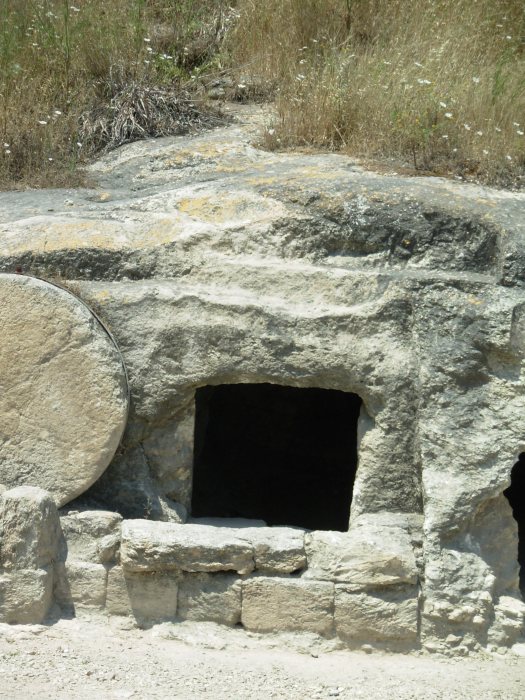
The Bible says Jesus died, was buried, and raised from the dead three days later. Can God do that? Again, yes. God created rocks, planets, stars, galaxies, vegetation, animals, and humans – all out of nothing. Therefore, it is no big deal for God to prevent the body that He lived for 33 or so years from decomposing, and to re-inhabit it. Not only that, the guards at the tomb were eye-witnesses, but were paid to lie about it (Matthew 28:11-15).
Now, where were we? Oh, yes …
If humanistic evolution were true, dissolved inorganic rock material would have to be transformed into organic material. That is a physical impossibility. Therefore, it would still require the miraculous power of a Creator – Almighty God. Only God can do the impossible. Therefore, since the Creator would still be necessary, He wouldn’t need billions of years to create and establish life: He could do it within days if he wanted to.
Did the Bible authors tell us that God or Jesus did something They couldn’t do? Did the Bible authors tell us that God or Jesus did something They didn’t do?
No. In fact, the last verse in the Gospel of John says, “Jesus did many other things as well. If every one of them were written down, I suppose that even the whole world would not have room for the books.”

I asked my dad once how that could be true. Dad responded with, “Do you know all that Jesus, as God, did throughout the history of the universe? How did Jesus make rocks? How did he make flowers? How did he make a star? How many stars did he make? How many galaxies did he make? How did he make people? And the questions continue.”
Obviously, I don’t know how many books it would take to record every single thing Jesus/God did throughout the history of the universe, so I will believe the verse. That is faith. Faith is believing what we cannot prove.
There are many detractors – including theologians, scholars, and scientists – who deny the truth in the Bible. There were even people back in the first century who outright lied about Jesus and about what took place. But remember my comment last week: “…to explicitly affirm what God and Jesus actually said and did would require eyewitnesses.” And there were many eyewitnesses who wrote down what they saw and heard.


We serve an amazingly, almighty God who can do anything He can imagine, and He has a great imagination. Looking through a microscope and a telescope reveals the glory of God and the magnificence of His imagination.


 Gene Linzey