
 Charles sent me an e-mail and said, “I would really like to read your take on Chance (or Luck) vs Divine Providence.”
To answer this will involve condensing five books into 809 words. Thank you, Charles, for the request.
First, let’s understand “chance.” It deals with opportunity, accidents, random occurrences, possibilities – all without design or control by anyone. For example, I flipped a quarter in the air twenty times and let it land on the floor. I started each flip with George Washington’s head facing up. It landed heads up eight times and tails up twelve times. I ran the same experiment again, but this time I started it with the Eagle facing up. It landed heads up nine times and tails up eleven times. That’s interesting, but still, chance.
We would shift to Divine Providence now, except luck was mentioned. This goes into religion – but not Christianity.
Luck is another name for the Greek goddess Tyche; with Fortuna being Tyche’s Roman counterpart. We get the concept of good or bad fortune from the goddess Fortuna. Tyche and Fortuna are primary goddesses to whom the Greeks and Romans prayed for material blessings.
Enter The Moirae, or the Faits. These three goddesses supposedly predetermined the entire life and destiny of everyone who will ever live. That included everything the person thought, said, did, and what happened to him or her. We now call it “fatalism.”
Saint Augustine, who initially rebelled against God and believed in the Faits, eventually created a Christianized version of fatalism. He said nothing could happen without God’s specific command, and that God had predestined our entire life for us. Let’s see about this. If the average heart-rate is 70 beats per minute, God would have to stand there and specifically order each person’s heart to beat 36,817,200 time a year. Multiply that by 7,500,000,000 people in the world!
No. God sets some things in order, and commands them to keep it up.
Augustine then misapplied Romans 8:29 to support him. It says, “For whom he [God] did foreknow, he also did predestinate to be conformed to the image of his son.” But Paul put the emphasis on “foreknow”; not on “predestinate.” Paul wasn’t talking about God choosing whom He will save. Instead, Paul is talking about God’s fore-knowledge of who will choose to live for Christ.
Let’s bring in sovereignty: “supreme power; freedom from external control; autonomous.” Some national governments are sovereign.
Finally, we come to Divine Providence. And that truly is God’s position. The book of Job clarifies that no one tells God what to do. God, by Himself, decides what He will AND will not do.
Providence deals with: preparation, good governance, foresight, guidance, prudent management. General Providence refers to God supporting the natural order of the universe. But Divine Providence refers to God specifically and intentionally interacting in the affairs of mankind. Therefore, we need to read carefully and understand what God said in Scripture.
James 4:2-3 says, “And yet the reason you don’t have what you want is that you don’t ask God for it. And even when you do ask, you don’t get it because your whole motive is wrong—you want only what will give you pleasure. (GNT)” This 2-fold Scripture alone informs us that God requires our interaction: 1) we need to ask of God, and 2) we need to have the right attitude.
Let’s add Psalm 37:23. “The steps of the godly are directed by the Lord. He delights in every detail of their lives.” God takes pleasure in interacting with and caring for His people.
Although God sees the sparrow as it falls to the ground (Matthew 10:29), He does not mandate its death. Two of my sisters had houses that burned down several years ago, but they were not hurt. My dad died of cancer at age 89. My mother died at age 97. Another sister died of cancer at age 50. People get hurt out of carelessness. My lawn mower quit today. And sickness and death are still part of the human experience (Romans 5:14).
 Does God purposely engineer all that? No; all that happens because we are part of the human family. The Bible says that death will be the LAST enemy to be conquered (1 Corinthians 15:26), so we can expect the other maladies and difficulties to continue for a while.
God does decree some of what happens in human history, but does not control or mandate every human decision. Instead, God leaves personal decisions up to us (Romans 6:12-13). Nevertheless, God does respond to prayer and can use all things that happen to us for our good (Romans 8:28).
In all that happens to us, God monitors our reactions. It is our reactions and attitudes that shape us, and prepare us for our interaction with God in heaven.
 four years of high school, I attended four different schools: two in Southern California, the third near Boston, and I graduated in Charleston, South Carolina in 1964.
 Our tour boat backed away from the wharf and sailed around the bow of the USS Yorktown, CV-10, that was docked nearby. The Yorktown (built to replace the USS Yorktown, CV-5 that sunk in the Battle of Midway in June of 1942) was commissioned in 1943 and is huge; but with its flight deck looming 50 feet above our heads, it looked enormous.
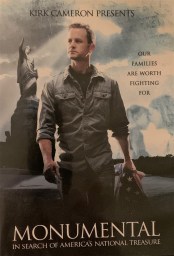 Have you ever watched a movie (or DVD) several times and wanted to see it again? My Precious Carol and I watched a film this past week called, “Monumental: In Search of America’s National Treasure,” staring Kirk Cameron. This was the second time I watched it, and I’ll watch it again. If you haven’t seen it, you should. It’s a 90-minute film about America’s beginning.
 established that the Founding Fathers followed to make the United States of America the most successful example of civil, economic, and religious liberty ever developed in the history of the world.
 The first governmental document in America was the Mayflower Compact. The Pilgrims established this document firmly on the principle that God should be the center of our public life. This guaranteed religious freedom.
 Christianity is the only religion in the world in which God loves His creation, is ultimately concerned with the people, and came down to man’s level of existence in order to personally help him. Every other religion, with the possible exception of Judaism, leaves the adherent in question as to his relationship with his god and his future.
 covers any kind of faith or belief system you can think of. And many religions have various denominations within them. We read that within Christianity we may have as many as 33,000 denominations. That is, of course, debatable; and at least two “denominations” consists of one solitary congregation.
 approximately 300 million. The New Age religion (which actually dates back to antiquity) is quite complex, and claims that every person and animal either is or can become a god. This, of course, contradicts Scripture.
 You think you know the story in Luke 15:11-32 because you’ve heard it a hundred times? Keep reading, because this time you might be surprised. Bear with me as I put the story in a modern setting.
 equal to half his worth, and gave it to rebellious George. Jake, the older son, was ecstatic! Now everything the old man owned was his, and he would do everything he could to increase the value of the business; for he was now heir to it all!
 Fourteen hours and two states later, the bus pulled into town around noon. Wondering how he would get from the station to the ranch, the boy looked out the window – and saw his dad.
  had a barbeque shin-dig ready; and a huge cake had been prepared that was decorated with “Welcome Home, George!”
 Dad responded, “Jake, everything I have will be yours. But George asked to be forgiven, and it is only right that we accept your brother into our home. After all, he is family.”
 Noting his confusion as we talked, I asked, “Do you know what a Christian is?” “Sure” he said. “It’s someone who goes to church; one who does good works. I know: It’s someone who loves his neighbor. Right?”
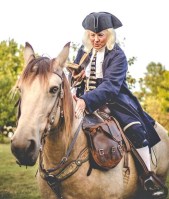 people preach and teach about the Bible out of a sense of duty. Many think of preaching as a vocation or think they are helping God by preaching. That’s how it was with John and Charles Wesley. They preached about Jesus for several years and led prayer meetings. They even started a Believer’s Club and were missionaries before they, themselves, accepted Christ into their lives.”
 “You can become like someone if you know him personally – or have studied him. I know my mom & dad because I spent time with them through the years, and got to know him very well. In the same way, you will get to know Jesus by reading and studying the Bible and praying. Joining a Bible study will help. Read the Gospel of John, chapters 5-10 and ask Jesus to show you how to live and think. You’ll need to ponder or contemplate what Romans 12:2 says: ‘Don’t copy the behavior and customs of this world, but let God transform you into a new person by changing the way you think.’ God won’t change your thinking for you, and you can’t do it without His help. It’s a team effort. And you should keep in mind that your actions are a result of your thinking.
 are you willing to publicly proclaim that you will live for Jesus?”
 know we won’t be far from the Salton Sea?”
 “If you get there by driving on the freeways through Riverside, it is about 182 miles; and if you go through the mountains through Julian, it is about 138 miles. But if you get there by helicopter, it is only about 70 miles.”
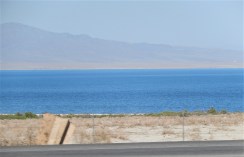 Development Company were trying to increase water flow from the Colorado River into the valley for farming. But the powerful river overcame their barriers, gouged deep channels into the land, and poured into the Salton Sink basin for eighteen months. The engineers were finally able to stop the flow in 1907. Interestingly, the Salton Sea sits squarely on a portion of the San Andreas Fault.
  vacated houses with broken windows. We did see a few sandy residential areas with very small town centers, but the thriving resort and retirement communities I had read about years ago seemed to be non-existent. The lake had been receding in the past several decades but more rapidly during the recent California drought. The badly-receding shoreline was salt-encrusted, and badly deteriorated boats were rotting in the salty sand.
  in the midst of the length of the storm to Brawley, or drive across the storm for twelve miles. Either way, we would drive slowly for we couldn’t see very well more than 75 feet ahead of us. We chose the shorter hazard.
  Martin Luther was quoting the Apostle Paul, so you might be pitting the Apostles Paul and James against each other (and James was Jesus’ half-brother).
 said good works and Godly living will be a result of our faith in Jesus Christ.
 “Think not that I am come to destroy the law or the prophets: I am not come to destroy, but to fulfil. For verily I say unto you, ‘till heaven and earth pass, one jot or one tittle shall in no wise pass from the law, ‘till all be fulfilled.” So, am I a legalist? Perhaps – in the correct meaning of the word. I do believe in the law.
 and I were playing Scrabble last night … before I go any further, do any of you play Scrabble? How about Yahtzee, Monopoly, Life, Pictionary, Dominoes, or Balderdash? Do any of you put puzzles together? Do you eat together as a family, or as a married couple? Or is it “each person is on his own”? Are you obsessed with getting ahead in life, fearful about the direction of the stock market, or worried about what’s going to happen in the Middle-east?
 anything?”
 I write a lot. But life should not consist of merely learning, earning, and accumulating stuff. The most important thing is growing in our relationship with God, then manifesting our faith in Jesus Christ by how we live with and treat others.
 Jesus home … or somewhere else? Think about it.
  safe in the leafy maze. Our granddaughters play all around the yard, including near the vines, but the birds know the girls are not a threat to the eggs and fledglings.
 and the golden retrievers next door when we lived in New Mexico. Although separated by a five-foot chain-link fence, the retrievers wanted to kill Taffy and always “barked their heads off” every time they saw him.
 rejection are storms.
 Gene Linzey