Who’s the Designer?

I’ve been driving cars for over 59 years, but that doesn’t make me an auto mechanic. I’ve been using computers for 33 years, but that doesn’t make me a computer programmer. In like manner, a person who has a Ph.D. and works in a scientific laboratory doesn’t mean he or she knows much about creation, the origination of the cosmos, or of life.

But please listen: just because I’m a dedicated Christian doesn’t mean I know everything about creation or of the origination of life, either. If we are honest, we admit that we all base our lives on faith to some degree.

While I openly admit that my knowledge is limited, others who oppose my views get upset or frustrated if I declare their knowledge to be limited.

Let’s look at a few ideas logically and scientifically.

To start, faith is required to believe in what has not been proven. For example, I had faith that this chair would support me. I sat on it to test my theory. Wonderful! It is now proven that the chair will support me, so faith is no longer required. Let’s continue.

In September of 2000, Alan Dershowitz, an agnostic, debated Alan Keys, a Roman Catholic. In defending his main thesis that “what is right cannot be known,” Dershowitz said, “We know what evil is. We have seen it.” He mentioned events such as the holocaust and the crusades. He then raised his voice and emphatically declared, “I don’t know what’s right. I only know what’s wrong!” (From the book, I Don’t Have Enough Faith to be an Atheist, by Norman Geisler and Frank Turek; page 179.)

But Dershowitz was definitely and defiantly wrong.

We cannot know what is incorrect or wrong unless we have a standard of what is correct to judge it against. To know what’s wrong, we must know what is right. Therefore, since we know it is evil to murder, we instinctively understand the intrinsic value of life. Since we know that lying is wrong, we intuitively understand the moral value of truth. The principle of right and wrong is imbedded in everyone’s conscience. Therefore, we have proof that we can know what is right.

How about the concept of truth? Some people emphatically declare that since everything is relative, there is no absolute truth. But is that statement correct? Think now: Is it absolutely true that there are no absolute truths?

Some people affirm that Biblical Creation is not true, and claim that the mythical and unprovable Big Bang created the well-organized cosmos with logical and scientific precision with no intellect or mind to guide anything. But I don’t care how it’s explained, it is scientifically and physically impossible for matter to self-generate out of nothingness. The Big Bang hypothesis is science fiction. I might add, though, It is an intriguing concept.

I’ve never received an intelligent answer to this question: If evolution were true, how did rock particles turn into living organisms?

By the way, have you ever looked through a microscope at a one-celled amoeba? I have. Those critters are very complex. And if you ever stop and think about it, there’s no intelligent rationale as to how amoebas evolved into other life-forms. In reality, evolution is not scientific. It’s a hypothesis, it’s called a theory, and taught as fact. But that’s not science. At best, it is an unprovable concept that is based on faith.

We in the scientific arena understand that nothing (neither material nor energetic substance) can be created out of nothing. Matter can be neither created nor destroyed. Yet matter – stars, planets, gas – does exist.

To believe billions of galaxies came into existence due to an explosion of absolutely nothing takes more faith than to believe our Creator – God – spoke the cosmos into being.
In order for people (agnostics, atheists, higher critics, skeptics, non-believers) to persuade me that God did not create all of nature, they should give me a viable alternative. But they can’t. Their arguments break down due to physical impossibilities, built-in inconsistencies of logic, ignorance of obvious truth, and lack of substantiation. That’s why many who believed in (had faith in) evolution have gravitated toward the Intelligent Design concept.

But they still have a problem: if there’s no God, who is the intelligent designer?

Understanding that ALL concepts of creation are intrinsically religious, the only logical approach is Genesis 1:1, “In the beginning, God….”

God is the designer of it all.

You Have Faith? In What?

In 1979 when I worked for a car dealership, a man walked up to me one day and requested an automobile. He listed the specifications: make & model, color, engine type and size, what he would pay for it, and all the rest. And he wanted it within two weeks. I chuckled and said, “You won’t get it at that price.”

Waxing eloquently about his faith, he said, “I told God what I wanted and I’m holding God to His word. The Bible says God will give us the desires of our hearts, and this is my desire. Therefore, I know I’ll get what I ask. And I want you to receive a blessing by getting it for me.”

I was flabbergasted to think a puny human could be so brash as to “hold God to His word.” God isn’t on trial. We humans are the flaky ones, and God is holding US accountable. We don’t have a right to demand anything of God.

When I asked, “Is your faith based on what you want, or on what God wants for you?” he retorted, “What’s that supposed to mean?”

I told him although he was sincere in his belief, sincerity doesn’t make something true; rather, truth substantiates faith, or exposes ignorance. Truth either validates or invalidates a person’s sincerity. So I asked him again about the object of his faith.

He laughed at my apparent ignorance, and said, “Scripture says ‘you have not because you ask not.’ I WILL get that car, everything I want on it, and at my stated price; but someone other than you will be blessed for getting it for me.” With that, he walked away.

I have many friends who tell God what they want. They say if they truly believe it, they will get it. They also tell me that not receiving what they want reveals a lack of faith.

I agree with Scripture but I disagree with their application of Scripture.

Although many of these folk have a true love for Jesus, they are taking those verses out of context. So what is the Biblical teaching?

I think some of you just tuned me out. But for those who are still reading, the interesting part comes next.

James 1:6 says to ask without wavering, and James 4:3 says we don’t get what we ask because we ask for the wrong things. So, let’s go to Jesus’ words.

Jesus said in Mark 11:24 – “Listen to me! You can pray for anything, and if you believe, you will have it.” His immediate audience knew what He meant; it is we new-comers who missed it.

Jesus stated it more fully to another audience in John 14:12-13. “The truth is, anyone who believes in me will do the same works I have done, and even greater works, because I am going to be with the Father. You can ask for anything in my name, and I will do it, because the work of the Son brings glory to the Father.”

Two phrases stand out: “in My name” and “brings glory to the Father.” And this is where the rubber meets the road.

“In My name” means to ask for what Jesus would ask; and that includes 1) asking in the manner and attitude in which Jesus would ask, 2) asking specifically for what Jesus would ask, and 3) accepting the timing of God’s response. Jesus’ continuous attitude was, “Not My will, but Thine be done.” As we grow in our relationship with the Lord, we will have Jesus’ attitude.

“Bringing glory to the Father” means that the answer to the request is to glorify God – not to primarily benefit us. Jesus never asked for a new donkey, a faster horse, or a better place to sleep. Those are not bad things, but that wasn’t what Jesus needed. God promised to meet our needs – not necessarily our wants. Psalm 37:4 instructs us that if we are in tune with God, He will give us the proper desires – the desires of our hearts.

Faith in God is not self-centered, but God-centered. True faithfulness is purposely living according to God’s word, and is revealed by a life dedicated to the Lord – not necessarily by things we have.

That man returned a month later to show me his new car. But when I pointed that many of the features he demanded were missing and that he paid about $2,000 more than he told God he would pay, he shrugged and said, “Well, I guess you can’t have it all.”

Perhaps he woke up to the truth of “asking in Jesus’ name” and maybe he didn’t. But dear reader, I hope your faith is in Jesus Christ, not in what you want. I hope your desire is to bring glory and honor to God, not merely to make yourself happy.

May God bless you as you learn what it means to truly honor our Lord.

Set Beneficial, Wise Goals

An acquaintance was driving on a cross-country trip and spotted something vaguely familiar beside a barn. He stopped at the farm house to enquire about it. The farmer hadn’t thought about selling it, but gave George permission to check it out.

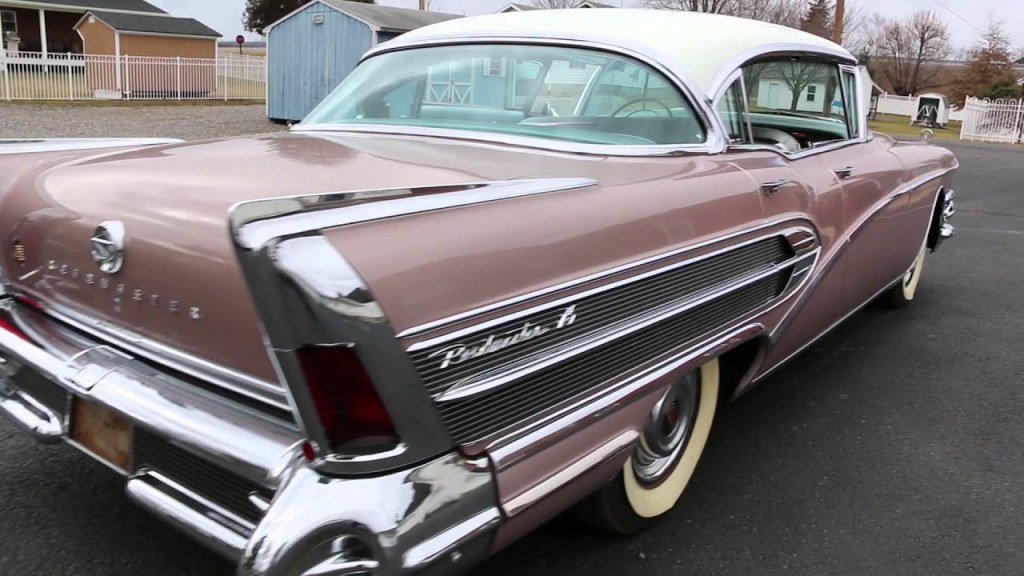
As George approached the car, his eyes saw a rusty, dilapidated, 1958 Buick Roadmaster. The leather seats were shredded with springs protruding, covered with animal fur and chicken feathers – in much the same condition as pictured here.. Two windows were broken with the other two down. The chrome was peeling, and all four tires were cracked like a dried up lake bed, and flat. As he managed to open the hood, the scared cat hissed and jumped off the engine, and George saw what used to be radiator hoses and electrical wiring dangling uselessly: they had long-ago deteriorated.

But in George’s mind, he saw something else.

He saw a bright, shiny, light-burgundy, 1958 Buick Roadmaster with a circled V on the front grill, and a gleaming white roof. In his mind he saw the shiny chrome all around the car with sunlight glinting off it, the electric windows working, and new soft and pliable leather seating inviting him. Ultimately, he saw himself slowly cruising through town, smiling as the men oohed and aahed over it. In George’s mind, it looked just like the one his dad owned when George was in elementary school. THIS is what he longed for.

George’s new years resolution was to make this dream come true.

George had a garage where he would do most of the work himself. He would buy the books for body, engine, and electrical work; he knew a painter in a nearby town who would paint it that beautiful light-burgundy color; and knew a man who could replace the windows.

He made the farmer an offer, and after a little negotiating the deal was done. In two days, the cat had to find a different hiding place as a truck hauled the soon-to-be-renovated-beauty to George’s garage. He was ecstatic!

That was four years ago.

How many times had his wife said, “George, when are you going to stop procrastinating.” It wasn’t a question – it was a demand. “Why did you bring it here in the first place! Will you please do something with that rusty hulk?” That last one was a plea.

What happened? Very simply, George found himself not wanting to do the work. With all the right intentions and a dream to be fulfilled, George set unrealistic goals for himself. In the vernacular, he bit off more than he could chew.

He envisioned the finished product, but he didn’t know how to go about it. He also found out that he didn’t have the desire to get out the sander and throw sparks all around the garage and smelling ozone while sanding every square inch of the rusty hulk (the title given to it by George’s wife). Every time he looked at the ghost-of-the-past, he mentally sunk lower.

Why did I ever bring it home? He wondered.

When he finally prayed about it, asking the Lord if he should start the project, or perhaps if there was something else he should do with it, an interesting idea came to him. Perhaps it was from the Lord. He made an appointment with the pastor and shared the idea with him.

“Great idea!” boomed the clergyman, and he called in the youth director.

“This could be the answer to one of my prayers.” the youth pastor said. “I’ve been looking for a project for the high school boys.”

George gave Rusty Hulk to the church as a gift, and George’s wife got her garage back. Borrowing tools from their parents, the teen-age boys had a ball removing old seats, stripping the rusty shell of everything that was possibly removable, and throwing sparks as shiny metal emerged.  

To make the story short, George wasn’t procrastinating. Desiring to fulfill a childhood dream, George attempted to do something that was not his calling. When he finally realized it, he was able to let it go.

When the church youth group was through, it wasn’t the Light-Burgundy Blazing Beauty that George imagined, but it was nice. The church sold the Roadmaster, and the substantial profit was used to set up a workshop where the youth group could do other projects. George’s gift kept on giving.

Do you find yourself procrastinating when it comes to finishing a project or reaching a goal? The solution might be to create a workable New Year’s Resolution. Pray about each project, and see if that’s what the Lord wants you to do. See if it’s something you really want to spend your time doing … or even have the skills to do. Setting goals too high might not be compatible with your God-given creativity. So, don’t do that.

May the Lord bless you as you wisely set goals this year.

Happy New Year!