Well, Blow Me Down!

Some folks said Blow me down! meant to hit me or knock me down; but that might not be correct. The phrase goes back the late 1700s, and is a statement that sailors said in a windstorm. A windy place in Nova Scotia was called Cape Blow-me-down, which evolved through time to Cape Blomidon.

Blow me down! eventually became a phrase used when someone was surprised. A relatively new version is, That blows my mind!

Wind is an interesting atmospheric action. It can be gentle for kite-flying; moderate for turning wind-turbines; strong can blow over trucks and trailers; or powerful such as tornados and hurricanes. The story this week is about the third group: strong winds.

Carol and I arrived in La Luz, a small town near Alamogordo, New Mexico on Sunday to visit friends, and planned to head east on Wednesday. But watching the evening news report, we learned that a tremendous windstorm was heading our way. It would hit on Tuesday and turn violent on Wednesday. We considered leaving on Thursday, but snow was forecast for Thursday night and Friday. Our last option was to leave a day early.

So, we toured the space museum in Alamogordo on Monday and toured the Tularosa Museum on Tuesday morning, then headed east up the mountain to Cloudcroft. La Luz is 4,761 feet above sea level and Cloudcroft is 8,668. It was quite a climb, but our car was up to the challenge. Pulling the trailer, I put the 6.2L, 380 HP, 8-speed engine in gear #4 and it was an easy pull up the mountain. Several other cars, pulling no trailers, had stopped beside the road to let their engines cool down, but our engine heat indicator barely moved.

We stopped in Cloudcroft to look at the scenery and have an early dinner, and the winds began greatly increasing. We hugged our friends, bid them adios, and headed east to Hobbs, NM which was projected to be on the fringe of the storm.

When we had the opportunity to watch the news, we learned that our departure was directed by the Lord. The wind blowing through one of the passes going into the Alamogordo basin reached over 100 mph. Remember: hurricane winds begin at 70 mph.

When thinking of the danger of driving in windy situations, we need to consider sustained wind and wind gusts. If the wind is blowing around 20-30 mph, gusts may reach 40 or 50 mph; and although it can be a rocky ride, it is normally safe. Wind advisories are put out if the sustained winds surpass 30 mph. But if the sustained wind reaches 50 mph, gusts may easily reach 60-75, and we may be in trouble.

The gusts are the worst part of the storm because the intermittent pressure can set up sideways trailer motion called oscillations which can cause a turnover.

Having said all that, the simple decision was: if the sustained wind is 50 mph or higher, park the car and trailer. But if we must drive, here are several ideas to consider.

  1. Drive slower: decreased speed decreases the wind pressure.
  2. Use a lower gear: more power on the drive wheels at a slower speed can compensate for some of the crosswinds.
  3. Whether car, trailer, or truck, secure the cargo: a moveable center of gravity can result in losing balance.
  4. Keep a safe distance behind the guy ahead: if either one of us goes over, we don’t want to hit someone or get hit.
  5. Back to basics: if possible, stay off the road. Losing time is less expensive than repairing or replacing the car, trailer, and cargo; and a lost life cannot be replaced.

There are other kinds of storms of life. Some of these storms are political, health, weather, financial, and interpersonal; and God sends us storms for our personal growth. Knowing a storm was about to brew, Jesus told his disciples to go to the other side of the sea (Matthew 14:22-24) because they needed to learn how to trust the Master. Read the story: it’s interesting.

Sometimes we are dragged into storms by others, and we need wisdom to handle the situation. But many times, we generate our own storms by foolishness and disobedience. An example is when Jonah tried to run from God (Jonah 1:1-4).

Whatever kind of storm we encounter, let’s stop; assess the situation; and ask God for wisdom. He will guide us if we listen. He guided us back in New Mexico.

Tornado!

Carol and I were visiting our son, Jeremy, and his family in Oklahoma when my cell phone interrupted us. It was a tornado warning for Siloam Springs. We’ve received tornado warnings in the past and were thankful the storms passed over or around our town. But this time, it was different.

After midnight on October 21, 2019, an EF-2 tornado, accompanied by straight-line winds, hit Siloam Springs and a few other places in northwest Arkansas. An EF-2 can cause major damage.

The next day, our daughter-in-law, Angela, checked the news and found that up to nine tornados hit the Dallas-Fort Worth area. The worst of them was an EF-3. Soon, the topic of windstorms, especially tornados, prompted a discussion among the grandkids.

When one of the granddaughters learned that these circular winds can pick up cars, rip roofs off buildings, topple trucks, and pick up and splinter houses, she asked, “Grandpa, how does a tornado pick up huge things like cars and houses?”

Aha! A teachable moment, and five or six grandkids were close by.

“Gloria, what’s the name of the machine that cleans your carpets?”

“A vacuum.”

“Right. And what does it do?”

“It picks up dirt.”

“Right, again. The roller with brushes on it is sometimes called a beater. The roller turns almost 6,500 times a minute. That’s about 108 turns a second. But the machine also has a fan that sucks in air. So, when the roller and brushes vibrate the carpet and shake the dirt loose, the machine pulls loose dirt in with the air. If the vacuum hits a piece of mud, the mud usually breaks apart and the vacuum sucks up the pieces. Small rocks can’t break apart, so the vacuum just swallows them.”

“That gets loud. But how does a tornado pick up cars or houses?”

“I’m getting there. Does your mama have a blender?”

“Yep.”

“When you turn it on, what happens?”

“It chops up food, spins it, and makes it into a liquid.”

“What does it look like as it’s spinning?”

“It pulls the food down in the center and pushes it up on the sides.”

“Right. A tornado does that but upside down. A tornado is like a huge blender but without the blades. The powerful force of the wind and change of air pressure – vacuum – are what tear things apart. Now, let’s put this all together.

Tornados are like a combination of upside-down blenders and right-side-up vacuums. Vacuum heads are only 8-16 inches wide and can pick up dirt, sand, pennies, little rocks, socks, things like that. But a tornado can be as small as 500 feet wide or as large as several miles wide. They create winds as slow as 80-miles-per-hour, or over 300-miles-per-hour. And they can pick up things that weigh several tons.

 “When a tornado hits a car, the car is like a rock and doesn’t break apart. So, the wind moves the car and the vacuum sucks it up. It’ll get banged up, thrown around, and most of the time it’s destroyed. When a tornado hits a house or building, the wind normally tears it apart like a vacuum cleaner breaks up a piece of mud. The tornado sucks up the pieces of buildings and sends them several yards and sometimes miles away. But once in a while, a gentle part of the tornado – that sounds funny – picks up an entire house without shattering it. The house moves sideways for several feet or is turned around without breaking up.”

“But the plumbing and electrical system has to be repaired.”

“You got it. The power of the wind breaks the house loose from the footing, and the upside-down blender suction picks it up and turns it. However, even though the house might look mostly fine, it might have to be rebuilt anyway because of internal damage.”

That brief, over-simplified explanation satisfied the grandkids’ curiosity.

But tornados of other kinds, such as death in the family, loss of job, poor health, breakup of a marriage, can tear up our lives. We might appear to be fine, but we are broken up on the inside, and simple explanations don’t help. A counselor might help us cope, and friends can help us recover; but only God can help us heal.

Don’t be afraid to ask the Lord for help. John 15:13 says, “Greater love has no one than this, than to lay down one’s life for his friends” (NLT). Jesus gave his life for you. Turn to Him and trust Him in the turbulence of your life.

Friend or Foe?

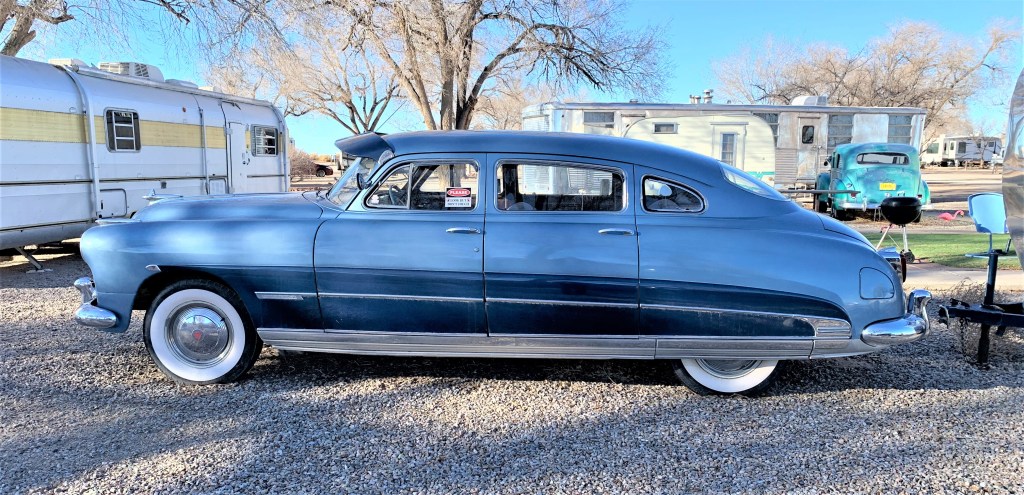
Wind always fascinated me. My 7-year-old hand became an airplane as I stuck it out the window while Dad drove the 1952 Hudson Hornet at the break-neck speed of 60 miles per hour. I enjoyed watching the wind blow water across the neighborhood as water shot high into the air from our garden hose. Wind was my friend. (The Hornet in this picture is not the car Dad drove. I saw it recently at the Enchanted Trails RV Park in Albuquerque, NM.)

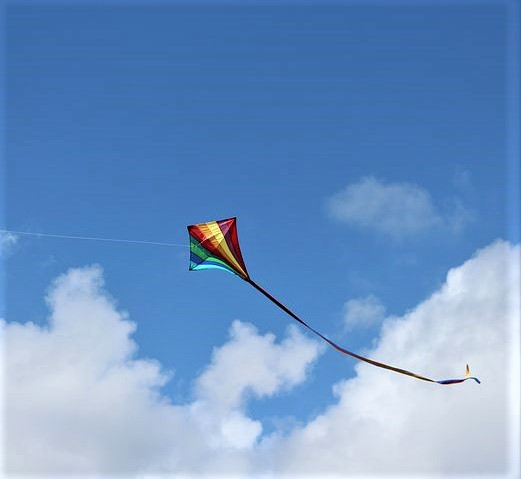
Earlier in life, I enjoyed being outdoors. I was 12 years old. It was Saturday morning with a good breeze blowing across our back yard in El Cajon, California. After breakfast, I assembled my kite, tore up an old pillowcase and made the tail, and gave the kite a test flight. I could have bought a 425-foot-long roll of Megalon string, but dad allowed only 300-foot rolls; so I bought 3 rolls. I named my kite Bird. It took off fast – but nose-dived! Ouch!

I made one adjustment to the tail and tried it again. Beautiful!

I waited for a good gust of wind and launched my Bird. Within a half hour, I had used up one roll of string. Tying the string to a stick, I wondered, why not add another roll of string?

I tied the string securely to the beginning of a new roll. Working the Bird very carefully, I released the second roll of string. I had never put a kite up that far. I was happy, but my natural curiosity began working overtime.

Would I be able to take it up another 300 feet? Let’s try it!

I attached the third roll of string and slowly let it out. At this point, allowing for the angle of the kite’s ascent, the kite was probably 750 feet above the ground and in the main air flow that blew above El Cajon Valley. The Bird was tugging firmly on the stick that the string was tied to.

“Eugene, Mom said it’s time to come in for lunch.”

I don’t remember who the messenger was, but what should I do with the Bird? There was no way I could bring it down in time for lunch. Could I tie it to the fence by the telephone pole and see if it’s still flying in an hour? Why not? What happens if the wind stops blowing? I don’t know, but Mom’s calling, so I’ll find out later.

After lunch, I hurried back outside to check on the experiment. I could hardly believe it! The wind had picked up, and the high-flying Bird was not about to come down. And now I began pondering….

I’ve never had a kite that well-balanced. Probably never will again. I’ve never put a kite up that high. Probably never will again. I’ll never be challenged to fly a kite again. I’ve done it!

After I stood there for about 10 minutes looking at the sight, I cut her loose. It was amazing to watch the Bird fly higher and across the valley until it disappeared out of sight. Did it come down in town somewhere? Maybe. But probably on one of the hills surrounding the valley.

The wind is normally a friend to kite-flyers. Years later I taught my boys to fly kites, but they never matched my experiment with the Bird. Wind also turns the giant turbines on wind farms across the plains which generate electricity.

However, most people also understand that the wind can be an enemy. Trucks and trailers are blown over and their contents get scattered all over the highways. Tornados and hurricanes destroy hundreds, if not thousands, of homes and businesses every year. The wind kicks up tremendous haboobs – dust and sandstorms up to 100 feet high – which cover towns and cities with thick layers of dust and sand.

But wind isn’t the only thing that blows across our lives that either help or hurt us. Our words and attitudes can benefit or destroy people. We can either make their day or ruin it. We can either bless others and help them improve their lives or curse them and send them into a spiral of despair. Look at three verses in Proverbs 15.

Verse 13, “Happiness makes a person smile, but sadness can break a person’s spirit”

Verse 18, “People with quick tempers cause trouble, but those who control their tempers stop a quarrel.”

Verse 28, “Good people think before they speak, but foolish people pour out foolishness.”

Don’t speak words that kick up storms or create devastation; use your words to help people. Be a friend, not a foe. Be a blessing to your community, and God may bless you.