The Dog Next Door

“He’s not here. Precious, do you know where Pup is? Have you seen him lately?”

“You’re the one who loves on him and named him Pup. He responds to your voice. Call him.”

“I have. But I haven’t seen him for three days.”

The topic at hand was the dog that lives, or lived, next door to us. I remember the first time he greeted me. Oh, it definitely was not a friendly greeting!

I went out to work in the back yard when a deep-throated mouth erupted just the other side of the fence. I suppose the full-grown dog was napping, and I startled it. I called him “Pup” because I couldn’t remember the name the little kids in the yard called it. But Pup jumped up, fur on its neck in a full bristle, anger – or fear? – on its face, with noises being emitted from its mouth at full throttle.

I approached the fence to talk with it, but that didn’t work. Pup feigned an attack, but when I didn’t back up, it ran to the house with its sound-system on a high setting. And for the next two or three months, every time Pup saw me in the yard, it stopped whatever it was doing and picked up the barking where it left off. It absolutely would not allow me any opportunity to show my friendliness to it.

Then something happened.

The neighbors brought a pot-belly pig into their family. We watched it grow from piglet to hoglet. It isn’t an Arkansas Razorback, but it is big! They named it Pickles but my name for the critter remained Piglet.

One day Piglet was resting against the fence near to where I was working. I began speaking gently to it and reached out to touch it. Piglet’s fur is not fur. It is coarse hair, almost like a bristle brush.

Perhaps Pup thought I was going to hurt Piglet, and it zoomed up, placed itself between Piglet and me, and proceeded to sound off. Before Pup realized what was happening, I seized the moment and began petting him on his head and massaging his ears.

Pup, with a puzzled look on its face, was dutifully barking at me, wanting to bite me, but enjoying the kind attention. After five or ten very long seconds, Pup stopped barking and backed up.

He just stood there and cocked its head to one side. As I began gently speaking to it, he slowly backed away. Two days later, I saw Pup through my office window and took a break from writing to see if we could connect.

I slowly walked up and hung my arms over the fence. “Hey, Pup. I like you. You want to be friends? Come on, I won’t bite, bark, or even spit.” What else would I say to a critter that probably couldn’t understand what I was saying? I was just trying to be friendly.

Believe-it-or-not, Pup came up, sniffed my hand, and let loose with two or three obligatory woofs as he backed up. But then he came back. We had connected! From then on, every time I went to the yard, either front or back, Pup came up and wanted me to pet him.

Then something else happened.

When I went to greet Pup, he stood up, put his paws on the fence railing, and as I pet him, he closed his eyes as he placed his head against my arm. He was actually loving me! Or he was enjoying me loving him. Yes, I loved him, too.

Then something else changed.

As I would be loving on Pup, if Piglet or the other dog even came near, Pup would break off and very sternly, with sound system and teeth, warn the other critters to stay away. But then, something else changed: within a week, Pup was gone.

When I enquired of the neighbors about Pup, I had a story for Carol.

“Precious, I found out what happened to Pup.”

“Oh, where is he?”

“The neighbors said Pup was jealous of the other animals, and needed a yard of his own, so they gave him away. I miss him.”

“Well, look at you: a cat person who fell in love with a dog.”

“Okay, but don’t rub it in.”

We don’t have any pets because of our periodic travels, but I do enjoy the neighbors’ critters. However, we do have visitors: racoons, possums, deer, road runners, a fox, turtles, and others. The current residents are feral cats. They have adopted our son, but they won’t let me near them. I like it that way because that means I don’t have to feed them.

But as Carol said, I am a cat lover, so, keep feeding the kitties, Michael.

To find what I do in addition to writing blogs, click on to the web site of our formatting and publishing company at: https://plpubandlit.org/.

Part 3: What was the Star of Bethlehem?

Let’s check into a proven historical resource: the Bible. Please read Matthew 2:1–9. And I thank Dr. D. James Kennedy of Coral Ridge Ministries, Ft. Lauderdale, Florida, for helping me think through this issue. (Dr. Kennedy passed away September 5, 2007.)

The phrase “we have seen” denotes an academic observation, and the phrase “in the East” (“…For we have seen His star in the East.…”) literally means “in its rising,” which in turn could denote a physical direction or pointing of the “star.” Therefore, the wording in verse two “we have seen his star in its rising” implies a meticulous scrutiny of a portion of the night sky rather than a casual observation.

The zodiac is divided into twelve constellations, and at that time in history each constellation was assigned to a specific world empire. The common thought back then was whenever a king or prince was born, a “sign” (comet? super-nova? conjunction of several planets?) would be found in that empire’s constellation.

Dr. Kennedy said the Persians believed whenever a comet entered a constellation, if the comet’s tail pointed downward a king had just died, but if the tail pointed upward a king was born. It was also understood that God (or “the gods”) controlled the heavens. Psalm 19:1 agrees by saying, “The heavens declare God’s glory; the sky displays His handiwork.”

Therefore, the wise men (Magi, astronomers, scholars, nobility) may have been studying the sky and discovered a new comet in Israel’s constellation with its tail pointing upward, and correctly understood it to mean that a new king was born in or near Israel’s capital: Jerusalem. In this sense, these royal ambassadors did not follow the star as one would follow a slow hotair balloon. Rather, they followed the directions obtained from Israel’s constellation and went to Jerusalem.

But what is it about the “star” that led them to the specific house? Matthew 2:9 says, “… and behold, the star which they had seen in the East went before them, till it came and stood over where the young Child was.” A comet, possibly as close as 3,000,000 miles away, cannot “stand over” a planet, let alone stand over a house. The moon, 240,000 miles away, cannot “stand over” a particular house. Therefore, even a small star the size of our sun (with a diameter of approximately 860,000 miles, and 93,000,000 miles away) cannot get close enough to “stand over” a house.

So we need to consider another act of God – that of possibly assigning a messenger – to further direct the royal ambassadors. Here is a brief explanation of my theory.

After seeing a comet within Israel’s constellation which prompted the magi to start on their journey and directed them to Jerusalem, and being advised by the palace scholars to go to Bethlehem, an angel could have taken the physical position of “standing” or hovering over the house as the Magi approached Bethlehem. However, the angel would have started high in the sky and slowly descended to the house as the visitors approached. Therefore, the angel was not recognized for who he was. This, my theory, fits the biblical parameters while taking into consideration history and culture. I hope this helps you in formulating your ideas.

Someone asked me if I could prove that Jesus is God. No, I cannot. But the Bible says that He is. And because the Bible has been proven correct so many times, I accept the Bible as authoritative proof. What many folks do not understand is this: believing that Jesus is God is a matter of faith, but disbelieving is also a matter of faith.

Scripture attributes characteristics and titles to Jesus that can be true only of God, and Jesus is often called God. Example: “Looking for the blessed hope and the appearing of the glory of our great God and Savior, Jesus Christ” (Titus 2:13; NCV). Jesus is presented as being self-existent (John 1:1, 14:6); omnipresent (Matthew 18:20, 28:20); omniscient (John 4:16–18, 6:64, Matthew 17:22–27); omnipotent (Revelation 1:8, Luke 4:39– 55, 7:14–15, Matthew 8:26–27); and possessing eternal life (John 1:4, 1 John 5:11–12, 20).

Most of Jesus’ followers were devout Jews who believed in one true God. They were uncompromisingly monotheistic, yet they recognized Jesus as God incarnate. Because of his extensive training as a Pharisee and a rabbi, the Apostle Paul would be even less likely to attribute deity to Jesus. Yet he did (Acts 9:1–5, 20:28). These were not blind, mushy-minded, easy to deceive simpletons. They were devout Jews who were proud of their Jewish heritage. Yet they became followers of Jesus Christ because they believed what their Scriptures prophesied about Him.

Did Jesus claim to be God? In a confrontation with Satan, Jesus said, “It is written, ‘You shall worship the Lord your God, and serve Him only” (Matthew 4:10–11, NASB). Yet Jesus purposely received honor and worship that He, as God, had a right to receive (Matthew 14:33, 28:9). The Jewish leaders told Him: “For a good work we do not stone You, but for blasphemy; and because You, being a man, make Yourself out to be God” (John 10:33; NASB). Thus, the Jewish leaders agreed that Jesus claimed to be God. So, it is safe to believe that Jesus Christ is God, but is eternally dangerous not to believe.

This Jesus is the one who was born of a virgin, lived a sinless life, was killed on the cross because the Jewish leaders were afraid of Him, who raised to life after three days in the tomb, and re-ascended to heaven forty days after his resurrection. He is God. You do not need to be afraid of Him because He came to save us and grant us eternal life. He loves you and is waiting for you to respond to Him.

Reaching for Life

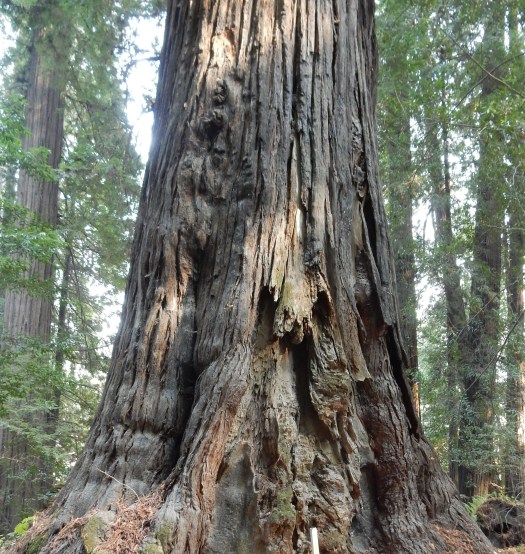
I’ve been looking at my pictures of the redwood forest in Northern California. The trees are big! Our pine tree in the back yard that is over two and a half feet in diameter looks big, but it is small compared to a relatively small five-foot diameter redwood tree. Amazingly, redwoods that are 10-15 feet in diameter are common; and it staggers the imagination knowing that the diameter of the General Sherman Redwood is over 32 feet!

A typical farmed redwood tree may weigh 50,000 pounds, but some redwood trees weigh over 2,000,000 pounds! Interestingly, about half the weight is in the water. The redwood bark may be over 18 inches thick, and a huge redwood tree may provide wood to build 30-35 homes.

Water is necessary for life. The redwoods grow to 250-350 feet tall and require over 100 gallons per tree per day. But it rains a lot in these forests, snows in the winter, and fog is prevalent; therefore, they are seldom thirsty. The root systems of redwoods are shallow, and that would mean a heavy wind or flood could topple them easily. But as they reach for life-giving water, a mature tree spreads its roots over 2 to 4 acres; and with an average of over 30 trees per acre, the root systems overlap and intertwine which results in a strong foundation for these top-heavy giants. They effectively support each other in rough times.

Light is also necessary for life. God engineered plants to reach for or aim toward light. This is called phototropism. The same is true of these giant trees. Programmed to be tall anyway, they continue to reach for life – for sunlight. Lone trees out in the open will not be as tall as those in the forest with a thick canopy of foliage, therefore, they are open to more danger. There is protection among neighbors.

The mature redwoods are basically fire-resistant. The thick, fibrous bark does not burn easily, and as a protective shell, it insulates the tree which allows it to survive most fires. The thick bark also provides protection of another kind: it has the ability to withstand fungus, disease, and insect attacks. This is why these trees live so long. The oldest known redwoods are about 3,000 years old. Only the bristlecone pines (about 5,000 years old) are known to be older.

Looking at the pictures of these magnificent trees, my mind gravitates toward humanity. I see similarities. No – not about size, but about other features and qualities.

The redwood’s root system covers a wide area which gives it stability in inclement weather. In the same way, our roots in healthy relationships with family, church, and society give us stability during “inclement” situations such as death, job loss, health deterioration, and more. In our many storms of life, we need each other for emotional and physical support.

But strong roots in a healthy relationship with Jesus Christ will help us even more in this life on earth, as well as throughout eternity.

 A straight tree is stronger than a crooked tree, and its wood is useable in more situations. Likewise, a morally and intellectually straight man is stronger and more trustworthy, where an immoral or double-minded man is weak, confuses people, and leads people down the path of destruction.

Trees must reach for the light to survive. In the same manner, man must reach for light – truth – to survive. We cannot survive very long, either societally or spiritually, if we live in spiritual and moral darkness. We cannot mature as morally strong individuals if we resist truth.

As the thick bark protects the trees, living in truth will protect us. Knowing the truth about various aspects of life – food, environment, chemicals, health, morals, physiology, and a lot more – can help us live safely. And purposefully living according to the truths found in the Bible will protect us in many ways most people don’t yet understand.

As the trees depend on water from the sky for life, man depends on guidance from the sky – from God – for life. Psalm 1:1-2 tells us not to follow the advice of ungodly people, but to meditate on and live according to the words of the Lord. Psalm 33:11 tells us that God’s plans are good, healthy, and beneficial. And Proverbs 14:11-12 warns us that man’s apparently powerful plans will fail in the end, but God’s seemingly weak plans are actually strong and will stand forever.

Trust in Jesus: Reach for Life. And live forever.

The Undulating Seascape

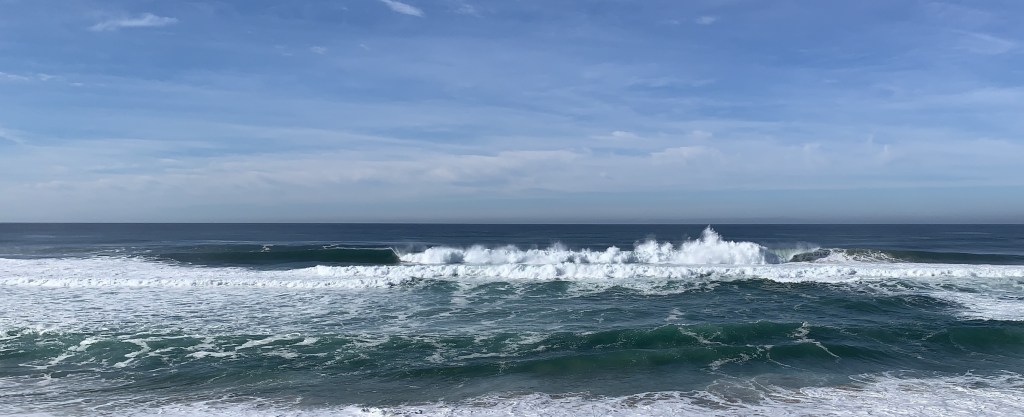
I’m from San Diego, California, and Carol’s from Seattle, Washington. We both are ocean-loving kids. Carol’s family visited the northern Pacific coast often; and my parents took us to the Southern California beaches often during my childhood, and to the Atlantic seaboard in my later high school years. Carol and I can sit on the beach or on a pier jutting into the water and watch the undulating seascape for hours on end and never tire of it.

Friends and acquaintances don’t understand, and ask, “How can you just sit there and look at the same thing for hours? Isn’t that totally boring?”

The answer is a resounding NO. The sea is never the same.

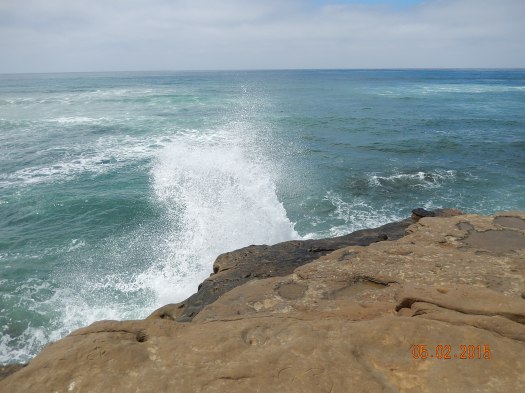
The swells that eventually morph into waves are always changing; and believe-it-or-not, the waves never crash the same. Sometimes the waves merely topple over, other times they mount up and trap enormous amounts of air as they prepare to pound the sand. That’s when the compressed air sends water exploding every which way. Other waves relax and melt into the surrounding water. Often several swells, which are moving at different speeds, will combine and create a much larger, more dynamic wave. And we get thrilled when a several hundred-foot-wide wave curls and breaks in one unified action.

The winds offshore create whitecaps out at sea, and the color of the water – based on the color of the sky and how the sunlight reflects off the water – changes continuously.

Sea animals often come into view. In Puget Sound in Washington State, Orcas (killer whales) are often present; but on our last trip up there we saw and filmed a humpback whale. That humpback must have gotten lost because they normally don’t enter the Sound.

Up and down the coast, we often see dolphins, sea lions, sea otters, gray whales, elephant seals, humpback whales, harbor seals, and other sea critters. In fact, on our last visit to the Oregon coast, we saw hundreds of sea lions floating off the coast, barking their greetings and, quite often, their disapprovals to each other.

We watch seagulls fight for food floating or near the surface of the water. And pelicans have an interesting way of circling to spot their underwater prey, then dive like spears to get their fresh fish feast. Periodically, we see jellyfish – and portions thereof – washed up on the beach. If you see any of these, please don’t touch them because the poison on the tentacles can still hurt you.

We like to go fishing on the coast. An interesting rule is: if we stand on shore or even in the surf, we need a license. But if we stand on the pier, no license is required. I caught a lot of fish from the pier.

One interesting non-sea-life viewpoint was Face-Rock at the State Park in Bandon, Oregon. The huge rock just off-shore resembles the head of a person looking up to the sky, and carries the legend of Indian Princess Ewauna who was lured out into the water by Seatka, the evil spirit of the sea.

At Monterey, California, we nearly lost track of time. After visiting the fascinating Monterey Aquarium, we went to the shore several miles away. The tide was coming in, the waves were crashing in spectacular form with dynamic results! We watched for several hours without realizing it was getting dark. Although both of us had taken over 150 pictures, we kept taking them because every time we looked, the scene was different.

By the way, it was the Monterey Aquarium staff who discovered that octopi (plural of octopus) kill sharks. Look it up on the internet for the whole story.

But just as the undulating seascape is ever-changing, life is ever-changing. Every time we wake up, turn around, go the to store, or meet someone, things change. Our health changes, businesses close, people lose jobs, someone dies. We sometimes emotionally feel like corks tossed about on turbulent water. We need an anchor. What can we do?

As a ship in a storm needs a safe harbor, we can find peace and safety in Jesus. The song declares: “I’ve anchored my soul in the Haven of rest.”

The Bible informs us that Jesus understands everything we experience, has endured every kind of temptation, pain, and hardship we face, and is willing to help us – if we let Him.

Who’s the Designer?

I’ve been driving cars for over 59 years, but that doesn’t make me an auto mechanic. I’ve been using computers for 33 years, but that doesn’t make me a computer programmer. In like manner, a person who has a Ph.D. and works in a scientific laboratory doesn’t mean he or she knows much about creation, the origination of the cosmos, or of life.

But please listen: just because I’m a dedicated Christian doesn’t mean I know everything about creation or of the origination of life, either. If we are honest, we admit that we all base our lives on faith to some degree.

While I openly admit that my knowledge is limited, others who oppose my views get upset or frustrated if I declare their knowledge to be limited.

Let’s look at a few ideas logically and scientifically.

To start, faith is required to believe in what has not been proven. For example, I had faith that this chair would support me. I sat on it to test my theory. Wonderful! It is now proven that the chair will support me, so faith is no longer required. Let’s continue.

In September of 2000, Alan Dershowitz, an agnostic, debated Alan Keys, a Roman Catholic. In defending his main thesis that “what is right cannot be known,” Dershowitz said, “We know what evil is. We have seen it.” He mentioned events such as the holocaust and the crusades. He then raised his voice and emphatically declared, “I don’t know what’s right. I only know what’s wrong!” (From the book, I Don’t Have Enough Faith to be an Atheist, by Norman Geisler and Frank Turek; page 179.)

But Dershowitz was definitely and defiantly wrong.

We cannot know what is incorrect or wrong unless we have a standard of what is correct to judge it against. To know what’s wrong, we must know what is right. Therefore, since we know it is evil to murder, we instinctively understand the intrinsic value of life. Since we know that lying is wrong, we intuitively understand the moral value of truth. The principle of right and wrong is imbedded in everyone’s conscience. Therefore, we have proof that we can know what is right.

How about the concept of truth? Some people emphatically declare that since everything is relative, there is no absolute truth. But is that statement correct? Think now: Is it absolutely true that there are no absolute truths?

Some people affirm that Biblical Creation is not true, and claim that the mythical and unprovable Big Bang created the well-organized cosmos with logical and scientific precision with no intellect or mind to guide anything. But I don’t care how it’s explained, it is scientifically and physically impossible for matter to self-generate out of nothingness. The Big Bang hypothesis is science fiction. I might add, though, It is an intriguing concept.

I’ve never received an intelligent answer to this question: If evolution were true, how did rock particles turn into living organisms?

By the way, have you ever looked through a microscope at a one-celled amoeba? I have. Those critters are very complex. And if you ever stop and think about it, there’s no intelligent rationale as to how amoebas evolved into other life-forms. In reality, evolution is not scientific. It’s a hypothesis, it’s called a theory, and taught as fact. But that’s not science. At best, it is an unprovable concept that is based on faith.

We in the scientific arena understand that nothing (neither material nor energetic substance) can be created out of nothing. Matter can be neither created nor destroyed. Yet matter – stars, planets, gas – does exist.

To believe billions of galaxies came into existence due to an explosion of absolutely nothing takes more faith than to believe our Creator – God – spoke the cosmos into being.

In order for people (agnostics, atheists, higher critics, skeptics, non-believers) to persuade me that God did not create all of nature, they should give me a viable alternative. But they can’t. Their arguments break down due to physical impossibilities, built-in inconsistencies of logic, ignorance of obvious truth, and lack of substantiation. That’s why many who believed in (had faith in) evolution have gravitated toward the Intelligent Design concept.

But they still have a problem: if there’s no God, who is the intelligent designer?

Understanding that ALL concepts of creation are intrinsically religious, the only logical approach is Genesis 1:1, “In the beginning, God….”

God is the designer of it all.

C. M. Russell Museum

In September of 2018, I took Carol to see the 201-foot-long Roe River in Great Falls, Montana, and the Giant Springs that feeds the river. My brother, Paul, and I visited the river in June of 2016, and I was anxious to see it again. (Visit http://www.paullinzey.com)

Returning from the river and springs, Carol saw a sign and excitedly said, “Turn around!”

An obedient chauffeur, I turned around and found my way back to 400 13th Street North. I could hardly believe my eyes. I blurted out, “The Charlie Russell Museum? I didn’t know it was here! You want to go in?”

“I pointed it out to you, didn’t I?” (Good point.)

In Southern California I learned to know the artist as Charlie Russell, but perhaps most of you know him as C. M. Russell. Also known as “Kid” Russell, Charlie was perhaps the greatest painter and sculptor of Western America.

Charles Marion Russell was born in St. Louis, Missouri on March 19, 1864—a year before the American Civil War ended; and he apparently had the desire to sculpt and draw as a child. (Some of my friends say it was not a Civil War, but the War of Northern Aggression. Other friends call it the War of Southern Secession. Whatever……)

Through the stories of his grandmother (Lucy Bent Russell – her brothers were Charles and William Bent who founded Bent’s Fort in Colorado), Charlie became infatuated with The West, and when he was sixteen years old his parents allowed him to head west to work on a sheep ranch in Montana—often called Big Sky Country.

He became a cowboy; but no matter what you saw on television, being a cowboy was not all “Yippie-ty-yi-yo, Get Along, Little Doggies.” It was a rough life, but Charlie stayed on and learned almost everything there was to know about the job. He often sketched scenes, painted, and made models of wildlife to pay for his room and board.

Gifted artists are not usually great businessmen; therefore, he had difficulty paying bills and keeping food in the pantry. But when Charlie married Nancy Cooper in 1896, she became his manager. When Charlie might have settled for $25 for a painting, Nancy knew how to get several hundred for it. With Nancy as his manager, Charles Russell entered the national limelight.

Charlie’s memory was amazing, but he frequently used props and models. Sometimes Nancy and another friend would dress up in Native American costumes to model for him. He would often create a quick reference sketch then join in the fun and dress up as well. His studio was filled with Native American and cowboy tools, jewelry, clothing, etc., which he used for reference.

Charles M. Russell died of congestive heart failure on October 24, 1926.

Arriving at the museum in Great Falls around 1:30 pm, time escaped us as we visited the gallery. The Charlie Russell Riders Sculpture Garden in the front of the museum is beautiful. And once inside the gallery, we were amazed with the paintings, sketches, sculptures, and carvings! Even the model stagecoach looked realistic.

Charlie was observant! Seeing what most others glossed over, Charlie saw the beauty in a galloping horse; sage brush in twilight; sunset over the rugged plains; and the fearsome look on the face of the Chief sitting on his pinto without a saddle.

He had a memory for detail that far surpassed most people. A gunfight at a saloon with rowdy cowboys riding their steeds on the boardwalks became a beautifully detailed painting. And looking at another painting, I could almost feel the pain in the cowboy’s wrenched back as he tried to “break the bronco.”

The museum is very well laid out as it reveals the evolution of Charlie’s life: professional as well as personal. We found high-quality gifts in the C. M. Russell Museum Store. The personnel are friendly, informative, and a joy to be with. I learned a lot as I spoke with them. In 2009 the Wall Street Journal called the museum “One of America’s premier Western art museums,” and I fully agree.

As we drove back to Dick’s RV Campground, I marveled at Charlie Russell’s abilities. Almighty God is a great and loving Creator. I believe that God gives everyone some creative ability or talent at birth, and it’s up to us to discover what it is and develop it. Charlie did. I encourage you to visit the C. M. Russell Museum at 400 13th St. North, Great Falls, Montana. You’ll enjoy it.

Sleep is Natural Medicine

British writer Aldous Huxley once said, “That we are not much sicker and much madder than we are is due exclusively to that most blessed and blessing of all natural graces, sleep.”

Huxley died in 1963, and had no idea what would deprive us of sleep in the digital age. According to a report of the Centers for Disease Control (CDC), about 1/3 of American adults get less than seven hours of sleep a night, and the CDC says that isn’t enough. Many folks either can’t get to sleep, or think of sleep as wasted time. What actually goes on while we’re lying there? Why are we designed to do nothing for a third of our lifetimes?

The answer: Our bodies are doing housekeeping and neurological work that’s needed to keep us operating properly when we’re awake.

In 1951, a graduate student at the University of Chicago, Eugene Aserinsky, wired Armond, his 8-year-old son to a device that tracked eye movements and brain waves. After Armond fell asleep, his father noticed that the eye-tracking “pens” were swinging back and forth. Aserinsky checked on him and found the boy sound asleep. His paper on sleep, published in 1953, was the first time REM (Rapid Eye Movement) sleep had been described. Before that, scientists believed that the sleeping brain was more or less turned off.

When I read that, I was surprised because at 5 years old, I thought everyone knew the human brain never sleeps.  

Humans and all land mammals experience spells of REM in sleep. In those events, the heart rate speeds up, breathing becomes irregular, and brain waves are more variable. However, major muscles that we normally control cannot move.

REM sleep normally first occurs about 60 to 90 minutes after falling asleep. As people age, we get less REM sleep, and REM’s function is still not entirely clear. Some specialists say it’s related to memory formation, but people who take antidepressants spend far less time in REM sleep, and that doesn’t seem to consistently affect their memory. Also, it’s a myth that we only dream during REM sleep. Our most vivid dreams may occur during REM sleep, but dreaming can occur in all sleep stages. In fact, sometimes I drop off to sleep and wake up within a minute with a fully-developed dream still in my mind.

We’ve all heard people boasting that they’re perfectly functional on five hours of sleep or less. Adults do vary in their sleep needs, but I’m told that the number of who are at their best with such little sleep is very small. Long-term sleep deprivation can be linked to obesity, type 2 diabetes, heart disease, and traffic accidents.

So why do people say they’re fine with less than an average of 7 hours of sleep? A rush of cortisol, the hormone that revs us up to manage stress, can create the sensation of alertness. We’re told it’s an illusion; the sleep-deprived still do poorly on objective tests of their short-term memory and motor skills.

But since childhood, I’ve operated day-in-and-day-out the best at 5-6 hours of sleep a night. Once every other week, I might sleep 8-9 hours. But when I make myself consistently sleep 8 hours a night, I am usually groggy the next day. I found that my internal clock determines my best sleep time and wakeup time.

 We all go through various sleep cycles, or stages. Although there is an “average” that sleep specialists talk about, everyone is different, and we are wrong to force the average on people. We need to find what works best for ourselves, and go with it.

I read that, on the average, seniors usually need 7 to 8 hours, and other adults need 7 to 9. Some teens need 8 to 10 hours and younger children need even more. People who are getting enough sleep usually take at least 15 minutes to fall asleep when they get into bed. However, Carol & I get enough sleep and are usually out in less than two minutes.

Before there were glowing smartphones and bedside lamps, people lived by sunlight, not by clocks. Families blew out a candle and retreated to bed. After about four hours of sleep, adults awoke for a brief period, then dozed off for another 4-5 hours. That’s apparently a natural rhythm. My wife has that type of sleep pattern, as did her mother and grandmother (an immigrant from Sweden).

When people get proper sleep – be it 8-10 hours or 5-6 hours – they are normally much healthier than those who are sleep deprived. They are happier, think more clearly, make fewer mistakes, and are more productive. Psalm 139:13-14 in the Bible (NCV) says, “You [God] made my whole being; you formed me in my mother’s body. I praise you because you made me in an amazing and wonderful way. What you have done is wonderful.”

Trouble Breathing

Carol and I enjoyed the drive from Arkansas through Oklahoma, Texas, and New Mexico. After visiting friends and family, we enjoyed the trip through Colorado and Wyoming. We’ve done it many times and we never tire of looking at God’s handiwork in nature. But things began to change in Wyoming.

We received some rain east of Cheyenne as we drove toward Rawlins, but it wasn’t rain that was discoloring the sky. After the rain let up, the sky began turning hazy. Going north to spend the night in Lander, WY, we were wondering what was going on. The haze was too light to be dust in the air, and the wind wasn’t blowing very hard, anyway. But going north from Lander, we began to figure it out.

Smoke in the atmosphere! Forest fires are out of control!

Prior to leaving on this trip, Carol and I saw reports of the fires on the television news reports, so we were aware of what was happening. But we didn’t know the extent of the fires, and we didn’t know how far the smoke had spread.

By the time we reached Coulter Bay north of Jackson, Wyoming, we could smell the burning wood although the forest fires were hundreds of miles away; and the Grand Teton Mountains were difficult to see.

The folks from the medical fields were telling people with health issues to stay indoors, and to wear proper masks or respirators if they had to go outside. However, many folks had only simple dust-masks over their nose and mouth. I’m not sure how effective they were others in blocking the smoke from the lungs, but they did not help me.

We travelled up into Yellowstone National Park and were happy to see that the atmosphere over the Fishing Bridge Campground where we were staying was relatively clear. But smoke had blown in around Old Faithful Geyser Basin.

A week later, we were heading up to Eureka, Montana, and the farther north we went, the worse the smoke was. When we reached my cousin’s home, we could not see the mountains which were only three miles away.

I had trouble breathing, sneezing spells hit me quite often, and my allergy pills were not helping me.

I thought of our fire-fighters and the life-threatening conditions they face every day. I pray for them often. I thought about people trapped in burning buildings and how hellish that must be. Many of them die in those infernos. And the thought of people caught in these diabolical forest fires is almost beyond my comprehension.

Thinking of people who smoke both tobacco and electronic cigarettes I wondered about their sanity. Why do people purposely inhale smoke and gas that can eventually kill them? It doesn’t make sense.

We had a good rain on Sunday night, and the wind had shifted. Both those events cleared the air over Eureka, and we rejoiced Monday as we breathed clearly and deeply. The air almost tasted wonderful!

Then I thought of the contrast between the eastern states and the western states. The east was being devastated with rain, and the west devastated with fire. Whether enshrouded in smoke and fire or caught in a flood, it can be difficult to breath and death can be quick.

And that turned me to thinking about people who are caught in the warped world of sin and who cannot seem to break free of it. They might want to live a better life, but they can’t see past the “clouds of smoke” or the “swirling waters” of their ungodly lifestyle. But unless they change their way of thinking and living, they will eventually die in the tangled mess they have created. Read Romans 12:2.

People may be involved in alcohol, tobacco, gambling, drugs, sex, identity confusion, theft, or any other of the hundreds of lifestyles that causes the person, with every breath they take, to sink deeper into the enshrouding smoke or swirling waters of that devastating activity. That can cause them to lose their joy of living both here on earth and for eternity.

I would like to shout to them, “If you could understand the direction you’re going, if you would turn away from the warped lifestyle, if you would stop diving head-long into your black hole of oblivion and learn to trust in Jesus, you could hold your head higher, breathe easier, and live freely! If you turn to Him, Jesus can give you wisdom to live – really live!

If you do, your life both on earth and for eternity will be a lot better.

Read John 3:16, Luke 19:10, 1 John 1:9.

And Proverbs 3:5-8 says, Trust in the Lord with all your heart and mind; do not depend on your own understanding. Seek his will in all you do, and he (God) will show you which path to take. Don’t be impressed with your own wisdom. Instead, fear – respect and honor – the Lord and turn away from evil. Then you will have healing for your body and strength for your bones.

You’ll be able to “breathe easier” both now, and forever.

Historical Global Climate Change

We’ve been told: “Mankind and modern technology are creating greenhouse gases which are responsible for melting glaciers and polar ice caps, and warming the oceans. Therefore, our technology will cause massive coastal flooding within a hundred years.” The question is: Is that true?

That scenario can be confusing because the same people who bemoan human-caused global warming tell us the earth has undergone several ice-ages in the prehistoric past. If they’re right, the earth froze and thawed several times without man’s assistance. So if our technology wasn’t available, what caused the assumed cooling and re-heating cycles?

We have geological evidence that the entire earth was a greenhouse 5 to 8 thousand years ago. We also know that for every effect there is a cause. Therefore, without man to mess with the earth, what caused the earth to cool down? Geological data shows that the earth’s oceans could have been about 300 feet lower than they are now. What raised the ocean levels? Without the human factor, what caused the earth to warm up again?

To compound the problem, I just read that by 2050 the earth might undergo another “mini-ice-age” and the sun will be the culprit.

Mount Kilauea, one of three active volcanos in Hawaii, has a lava lake that is over 520 feet wide, is very deep, and of course it’s fed from the huge magma pool. On April 26, 2015 the “lake” level rose twenty-six feet. The previous week, Chile’s Calbuco volcano erupted again. On May 18, 1980, Mt. St. Helens erupted. And in April of 2010, Mount Eyjafjallajökull in Iceland erupted which caused substantial disruption to air traffic across Europe. There are about 1,500 potentially active volcanos above water and 500 potentially active underwater. People ignore the fact that these mountains spew heat into the water and atmosphere which affects the climate. Dr. Dan Walker at the University of Hawaii noticed a strong correlation between seismic and volcanic activity in the Pacific Ocean and El Nino cycles over a period of 25 years. Also, sulfur dioxide and sulfuric acid are produced by volcanic activity which is carried world-wide on the trade winds. Volcanism produces an average of over 5.5 billion tons of CO2 annually. And man cannot stop any of this.

Does the book containing the oldest available historical record of man say anything about global climate?

It does. Genesis 2:6 says, “The Lord God had not caused it to rain upon the earth, and there was not a man to till the ground. But there went up a mist from the earth, and watered the whole face of the ground.”

But Genesis 8:22 reports after the world-wide flood, “While the earth remains, seedtime and harvest, and cold and heat, and summer and winter, and day and night shall not cease.”

Then Genesis 9:12-13 says, “And God said, this is the token of the covenant which I make between me and you and every living creature that is with you, for perpetual generations: I do set my bow [rainbow] in the cloud….”

We find that the earth was a greenhouse with no rain. That infers continuous cloud cover with a more massive atmosphere; and that suggests no direct sunlight reaching the ground. After the flood, Genesis 8:22 mentions “cold and heat, and summer and winter.”

Seasons were introduced which suggests massive geological, atmospheric, and climatological changes. There was a sudden world-wide cool-down with the sudden appearance of what became polar ice caps. Man’s average lifetime was reduced from 912 years (before the flood) to 285 years (as of Abraham’s lifetime). Winter, mountains, deserts, snow, hail, rain, tornados, and hurricanes were gradually introduced to the world.

Matt Cantor wrote an interesting article (May 3, 2015) titled “Ancient Climate Change Could Explain Tibet Mystery.” Matt said that about 4,000 years ago Tibetan climate suddenly became much colder. Of course, man didn’t cause that temperature shift.

With the probable influx of massive amounts of ice from ice comets that slammed onto earth which changed the earth’s astronomical posture, the earth went into geological convulsions and the earth’s crust broke up. And the earth has been ever-so-slowly reverting to its temperate equilibrium ever since. Although mankind should increasingly clean up industrial contamination, man is not able to control earth’s climate. If mankind were removed and the earth was given to the animals, the warm-up would continue. Since God caused it, He is the one who will have to stop it … if and when He wants to.

Tales From the Road: An Easy Pull

I am happily surprised at how easily our 8-gear GMC Yukon pulled the trailer over the mountain passes.

I faced my first major concern of the trip as we drove over Wolf Creek Pass, just north of Pagosa Springs, Colorado. I had gone over the pass many times, but not while pulling a trailer. However, my concerns were unfounded. We easily climbed the mountain as we passed other over-heated cars on the side of the road that were not pulling a trailer. Our 5400-pound Yukon pulled the 5,000-pound trailer over the steep 8-mile incline to almost 11,000 feet altitude with no problem. Normally driving in either the 6th or 7th gear while pulling the trailer, we dropped only to 4th and 5th gears during the climb, and the engine temperature raised only about 25 degrees. I was a happy camper! (I didn’t need to stop and help the stalled drivers, for their help had already arrived. We were not callously ignoring them.)

We encountered several minor climbs and passes on our way to Buena Vista, Colorado, and several stiff climbs from there to Denver; but we were not in a hurry and the engine worked wonderfully.

We didn’t encounter any harsh winds, and thanks to the sway bars, the trailer has swayed very little. We check the weather report every day to see what kind of weather we might encounter, but if we are caught off-guard and if the trailer begins to sway, all I have to do is to push two levers near the steering wheel and power will be applied to the trailer’s brakes which will stop the motion. This car was built from the bottom up to handle the load.

The Yukon has … let me interrupt myself. I am not paid to advertise the GMC Yukon. I am merely relating my experiences, feelings, and thoughts.

Now, where was I? Oh yes …

The Yukon has many features that make it an ideal vehicle to pull a trailer. Although it is built to pull up to 8,000 pounds, the trailer is only 5,000 pounds with all of our stuff in it. Therefore, as long as I treat the car properly, change oil regularly, keep air in both trailer and car tires to the proper pressure, etc., the car should last quite a while.

Yes, I understand that unforeseen events happen. Mechanical things sometimes break down and many kinds of problems can occur. But with our 8-year GMC warranty and our AAA insurance coverage, I should have no major problems.

Towing the trailer is an easy pull for the Yukon.

But all this reminds me of our human life.

Do you know that God made humans to normally last a long time? The Bible infers that God originally made us to live forever. However, since Adam introduced sin into the human race, the Bible says in Psalm 90:10, “Seventy years are given to us. Some live to eighty. But even the best years are filled with pain and trouble; soon they disappear, and we fly away.”

My mother and grandparents lived into their 90s, and my father lived to 89, but some folks overheat and stall out along the side of life much earlier. Longevity of life often depends on genetics – I understand that. But many people seem to just give up on life.

I’ve read that some soldiers in World War II with seemingly mortal wounds survived because they were determined to survive; while some others with no wounds pulled the cover over their heads and died. They just gave up, and that is disgusting.

As long as we are alive, most of us have the abilities to accomplish amazing feats. Like the Yukon, God made us to be resilient.

Life can present a temporary stall out, a long-term burnout, or a fatal crash – it often depends on our outlook on life. And we must remember that until Jesus returns, this physical life will come to an end. But when we look at life on the positive side of the picture, life can be a relatively easy pull up the mountain.

Of course, we need to take care of ourselves. Eat properly, rest adequately, exercise, keep worry to a minimum – or don’t worry at all – and keep a joyful attitude during tough times. The Bible says a joyful attitude is good medicine. So, cooperate with God and take care of yourselves.

Happy Trails To You, ‘Til We Meet Again – next week.