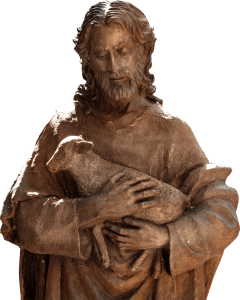
Look Into the Face of Jesus

Who is this baby we call the Messiah? John 1:1-3 starts at the dawn of human history. “In the beginning there was the Word. The Word was with God, and the Word was God. He was with God in the beginning. All things were made by him, and nothing was made without him.” Verse 14 says, “The Word became a human and lived among us. We saw his glory—the glory that belongs to the only Son of the Father—and he was full of grace and truth” (NLT). The baby, Who was (translated into English) named Jesus, was previously called both the Word and God.

Luke 1:26-35 tells Mary’s side of the story. The angel appeared to Mary, informed her that God favored her and chose her to be the mother of the Messiah. The angel told her to name the baby Jesus.

Can you imagine Mary’s shocked response? “I’m engaged, but I’m not married yet, and am still a virgin! How am I going to have a baby?”

The angel replied essentially, “Mary, this is an act of God. If you’re willing, God will supernaturally plant the seed within you, and you’ll remain a virgin until after the baby is born.”

With trepidation, Mary agreed with the angel. But Joseph, Mary’s fiancé, had a different reaction.

Matthew 1:18-25 gives us Joseph’s viewpoint. Joseph wanted nothing to do with an unmarried, pregnant woman! He intended to dump Mary for being pregnant out of wed-lock, but the angel finally convinced him of God’s plan, and that Mary was honest, undefiled, and still a virgin. The angel told Joseph in a dream that God wanted him to marry Mary, the baby was to be named Jesus and would [eventually] save people from their sins. Understanding the shame and derision they would endure, Joseph accepted Mary as his wife and adopted Jesus as his own son.

The Imperial decree ordered all men to return to their town of birth for the Roman census, so Joseph took Mary and went to Bethlehem. On the night of Jesus’ birth, the first yard to light up the community on the first Christmas was the field just out of town.
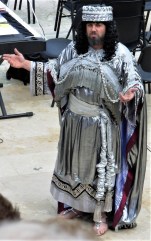
That’s where we read that after the angel scared the daylights out of the shepherds, the angels gave the world-changing announcement that God had entered humanity in the form of a baby. When the shepherds calmed down and believed the angelic message, they were the first visitors to look into the face of our Savior, Jesus Christ, and to welcome God, in the form of a baby, into the world. I also believe they were the first to offer a gift on Christmas night. They gave a lamb to the new-born King.

The wise men, Persian scientists, received the message of the new King as they studied the sky. Psalm 19:1-2 says, “The heavens proclaim the glory of God. The skies display his craftsmanship. Day after day they continue to speak; night after night they make him known” (NLT).

About a year later, these scientists were the first visitors of their kind to welcome God into the world. Looking into the face of our Savior, in the form of a toddler sitting in His mother’s lap, they gave Him gifts fit for a king: gold, frankincense, and myrrh.

Remember that I said Joseph adopted Jesus – the Son of God – as his own son? Now the situation is reversed. If we accept Jesus as our Savior and live to honor Him, God will perform a miracle and adopt us – humans – into His heavenly family. And that introduces another miracle: Jesus, Who is God, is the best Friend a person can ever have!

Christmas is not limited to a starry-eyed baby lying in a manger. It wasn’t intended to be depicted by trees, lights, glitz, hoopla, parties, noise, and a lot more associated with the secular holiday event.

Christmas is about God entering humanity to rescue us from our uncontrolled descent into debauchery and death. God entered humanity as a baby, died on the cross as a man, but broke the curse of sin and death by rising from the dead as Almighty God on the third day and returning to heaven. That’s what Christmas is really all about.

Give gifts. Enjoy the season. Love your family. But look into the face of Jesus. Honor Him in everything you do.

Merry Christmas, friends.

How Do You Celebrate Christmas?

Do you know that the first hint in the Bible of what we call Christmas is in Genesis 3:15? A lot happened between Genesis 3:15 and Matthew 1:18, but we won’t go into all that today.

My questions are: How do you celebrate Christmas? Do you go over the river and through the woods to visit grandma? Do you read the Scriptures that talk about Jesus’ birth? Do you take a trip? Invite people to your house? Do you watch movies or football games? What’s your favorite Christmas meal?

I looked up historic Christmas celebrations. For about 300 years after Jesus’ resurrection, there were no observances of His birth – therefore, no festivities. The first one recorded was in Rome, on December 25, 336 A.D., but didn’t become a primary Christian observance until the 800s. Decorating trees started in Germany, but had nothing to do with Christmas.

In the fourth century, church officials decided to observe Jesus’ birth as a holiday; and for non-biblical reasons, Pope Julius chose December 25. First called the Feast of the Nativity, the custom spread to Egypt by 432 A.D., and to England by the end of the sixth century. By holding Christmas at the same time as traditional winter solstice festivals, church leaders thought that Christmas would be popularly embraced, but in doing so, they gave up the ability to dictate how it was celebrated. Therefore, on Christmas, many people attended church, then celebrated raucously in a drunken, carnival-like atmosphere.

Hmmmm … It seems like that still happens today.

Noting societal debauchery, prevalent poverty, and abusive child labor in Victorian England in the 1840s, Charles Dickens vowed to do something about it, and writing was what he did best. So, in 1843, he published his novel, A Christmas Carol. Although the book is more a work of sentiment than of Christianity, it captures something of the Christmas spirit.

Dickens wanted to insert joy and gladness into a life filled with drudgery, dreariness and death. While acknowledging the seriousness of life, he portrayed the Spirit of Christmas filled with miracles and laughter. He also reminded society of the importance of blessing others by caring for those around them. Dickens encouraged joy and human-kindness, and inspired a positive change in society.
How do Carol and I celebrate Christmas?

We read about the birth of Jesus in chapters 1-2 in Matthew and Luke. That sets the tone for the celebration. We often visit one of our kids, but this year we’ll visit our daughter’s in-laws, Robert and Phyllis Crawford, near Oklahoma City. And instead of buying gifts for our families who live far away, then pay more for mailing them, we’ll mail the allotted money and let them choose the gifts.

Have you heard of the song, Over the River, and Through the Woods, To Grandmother’s House, We Go? I grew up singing it at Christmas, but it was written as a Thanksgiving Poem by Lydia Maria Child in 1844, and referred to Grandfather’s house. I find it interesting that where Carol and I live, all five of our children and their families have to travel over rivers and through forests to reach us.

My favorite Christmas meal is not turkey. (Shhh…don’t tell Carol.) My favorite is ham, mashed potatoes and gravy, yams with marshmallows, and fruit salad with whipped cream. Two to three hours later, I want pumpkin or apple pie with vanilla ice cream! Oh, yes – and coffee.

I like to watch football. On this coming Christmas day, the Minnesota Vikings will play against the New Orleans Saints. But I won’t watch it. Not on Christmas Day. This is a time to spend with family, which includes church family, and helping others.

We usually watch It’s A Wonderful Life the week before Christmas. It helps us to realize – again – the intrinsic value of each and every life. I hope that every one of you reading this reflection understands that every person is important. If you are hurting emotionally or are happy, if you are sick or healthy, if you feel rejected or accepted, if you are poor or wealthy, please believe me: you are important! Whatever may be your status or position in life, reach out and help others. THAT, my friend, is one way of manifesting the spirit of Christmas…the Spirit of Christ.

I understand that the covid-19 pandemic is putting a crunch on worship services, family gatherings, and celebrations this year, but you can still give to others. Be creative and find a way.

But stop and think about what this celebration is really all about – Jesus Christ. He came as a human baby, but never relinquished His true identity – God.

That is spelled out in John 1:1-4. “In the beginning there was the Word. The Word was with God, and the Word was God. He was with God in the beginning. All things were made by him, and nothing was made without him. In him there was life, and that life was the light of all people.”  

Then verse 14 says, “The Word became a human and lived among us. We saw his glory—the glory that belongs to the only Son of the Father—and he was full of grace and truth.”

May the Lord bless you this Christmas season.

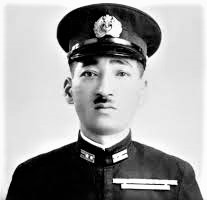
Commander Fuchida Led the Attack

“Sweetheart, my sister just called. She wants to take us four sisters on a sisters-trip. She wants us to go next month. What do you think?”

 “That’s wonderful, Precious! Where are you going?”

“HAWAII!”

“You have to visit the USS Arizona Memorial in Pearl Harbor. That’s a must!”

“We have a month to plan our trip,” Carol responded, “but the USS Arizona will definitely be included.”

That was in June of 2003, and they had a marvelous time!

Years ago in New Mexico, three people who were protesting the bombing of Hiroshima and Nagasaki challenged me about my emphasis on remembering Pearl Harbor. They said, “Pearl Harbor was nothing compared to what the US did to Japan!”

I responded, “You have it backwards. The reason it’s important to remember December 7, 1941 this: If the Japanese hadn’t attacked Pearl Harbor, the US would not have dropped the bombs on them. Knowing history helps us to keep things in perspective.”

Believing their gods declared that Japan would control the world, Japan was eager to expand its empire. However, the United States stood in its way, so Japan decided to knock us out. Their initial targets were our three aircraft carriers they thought were anchored in the harbor. But Admiral Nimitz sent them out to sea, and the catastrophe Japan accomplished in Hawaii did not destroy our fleet – and didn’t knock us out! (I don’t have time in this article to discuss Japans’ previous brutal and bloody campaigns in China and elsewhere.)

Although the attempt might have been made, the Japanese did not inform us about their declaration of war prior to the attack, and an unprovoked attack on American soil is not something we solve by verbal negotiation! That’s why President Bush and the US Congress (both Democrats and Republicans) responded as they did after September 11, 2001.

Japan had a long tradition of opening hostilities by surprise attack. The problem in America was that, as US-Japanese relations worsened, we ignored Japanese tradition and her history. (We keep making the same type of mistakes in the Middle-east today.)

Commander Mitsuo Fuchida was selected to train the pilots and lead the air attack on Pearl Harbor. A great tactician with a brilliant mind, Fuchida did his job well and shouted into his microphone, “Torá! Torá! Torá!” (Torá means Tiger; but is also an acronym for “totsugeki raigek.” That means “lightning attack” which denoted a complete surprise attack.)

However, as mentioned, the aircraft carriers were not there. Even as Japan celebrated the great victory, Admiral Yamamoto became deeply concerned. Although it has never been verified that he said, “I fear all we have done is to awaken a sleeping giant and fill him with a terrible resolve,” (as stated in the movie Torá! Torá! Torá!), Admiral Yamamoto knew Japan would not be able to conduct a Pacific naval war with America for much longer than six months.

But Commander Fuchida was exhilarated! As Gordon W. Prange said on page 37 of GOD’S SAMURAI – Lead Pilot at Pearl Harbor, “Years would pass before Fuchida understood that he had left behind more than smashed ships and aircraft and dead and wounded men. He also left behind a nation welded together by the fires he and his men had set—a United States that would not rest until the Japanese had paid in full for their mornings work.”

And the United States certainly did respond!

That devious and reprehensible act on December 7, 1941 forced the US populace to suddenly move from an isolation mentality to a war mentality, and that move sealed the doom for the Japanese aspirations for empire-expansion.

The focal point today for many of us regarding Pearl Harbor is the USS Arizona which was sunk intact with up to 1,117 sailors on board.

But I have another point to make.

On April 14, 1950, Captain (promoted from Commander) Mitsuo Fuchida met his Maker.

No, Fuchida didn’t die then – he met Jesus Christ and became a Christian. (He died May 30, 1976.)

Fuchida, the fearless, outspoken warrior read a pamphlet by former prisoner-of-war SSgt. Jake DeShazer – one of Doolittle’s Raiders who bombed Japan on April 18, 1942. DeShazer was captured and treated cruelly by the Japanese for forty months. Fuchida also read about Peggy Covell’s missionary parents who were murdered by the Japanese. But DeShazer and Peggy had totally forgiven their former enemies.

Not understanding the difference between war and personal cruelty, these stories intrigued Fuchida. He then read the New Testament to see what changed DeShazer’s life from bitterness to forgiveness, and what helped Peggy to let go of her deep sorrow and forgive her enemy. As Fuchida read the Bible, he began to understand life more accurately. And that improved understanding included realizing his world view was totally wrong.

Asking Jesus to forgive him, Mitsuo Fuchida’s life was also changed, and he became life-long friends with his former enemy: Jake DeShazer. Dedicating the remainder of his life to Jesus Christ, he became an evangelist and introduced many others to our Lord.

It is Jesus Christ Who can turn bitterness to forgiveness, despair to hope, sorrow to joy, and hatred to love. God did it for the man who led the attack on Pearl Harbor, and He can do it for you.

The Master Dreamer

As I was preparing this Reflection, I realized that “Dreamer” has an intense political connotation. But this is not about immigration – legal or illegal – or about anyone’s location of birth. It relates to a discussion several years ago between my son, Ron, and myself.

“Dad, are you a dreamer?”

“I dream quite a bit, more than most people. The sleep test I endured proved it. Why?”

I had no idea what Ron was talking about. I know that sleep dreaming is a function of thinking. When we go to sleep, our bodily functions slow down, but our mind – not to be confused with our brain – plods right along. Dreaming is subconsciously thinking while we are sleeping. This will be another Reflection for another time.

“I’m not talking about dreaming while you’re asleep, dad. I mean, do you dream about what you want? For example; if you were to buy a pickup truck, what features would you want on it?”

I began enumerating the many things I would want.

“So, getting a new pickup truck is one of your dreams?”

“No, I already have a pickup. It’s old, but it’s good. I merely answered your question. I don’t spend much time brooding over or pondering about something that is out of my financial reach, or that I really don’t need. For me, it’s a waste of time. But I DO ponder or meditate on things – even almost impossible things – if I think the Lord wants me to accomplish them. I am pragmatic, and my ‘dreaming’ is figuring out how to accomplish a task that is set before me.

“I also dream about how God accomplished His activities. I ponder on how the Red Sea parted, how the Jordan River stopped flowing, how God flooded the earth in Noah’s time, how God created the polar ice caps, and so on.”

“Do you come up with answers?”

“Oh, yes!”

We then talked about dreamers throughout history, and their vital importance for the forward progress of civilization. Inventors are dreamers. Two examples are the Wright Brothers who succeeded in giving America the airplane. (Some dreamers died in their attempts.)

Ron is a dreamer. My wife, Carol, is a dreamer. Thomas Edison was a dreamer. These people make life more enjoyable for the rest of us.

“Ron, I can’t be a dreamer. God didn’t make me that way. But I sure need people like you.”

“But you’re a writer. Isn’t writing a function of dreaming?”

Hmmmmm…. I had to stop and think about that one.

“Well, yes and no. Everyone who writes fiction has to dream the whole thing up. But since everything I have been writing so far relates to history, I merely need to remember or research the event, and tell it in a truthful and interesting way.”

“What about your next book?”

“You got me there, Ron. This book is about ancient history. The facts are difficult to find, and harder to piece together; and I’ve been intermittently gathering information since you were a kid. But since we don’t fully understand how they lived 4,500 years ago, part of the story line needs to be created, and that takes some dreaming. That’s why it’s taking me so long to write it. I am more of a reporter than a dreamer.”

That gives you an idea of Ron’s and my 2-hour discussion. But let me tell you about the master dreamer of all time. He needs no introduction, for you all have heard of Him. We call Him God.

The greatest history book of all time tells us about it. Genesis starts out with, “In the beginning, God created the heavens and the earth.” Since God never had a beginning, I wonder how long He thought – dreamed – about it before He did something. Think about it: God had no “time-limit”, no deadline in which to finish, and He had an eternity of creativity to express.

The corollary thought is in the New Testament, John 1:1-3; “In the beginning was the Word, and the Word was with God, and the Word was God. All things were made by Him.” Verse 14 tells us the Word is Jesus Himself. Jesus is the Creator.

God made everything from the infinitesimal one-celled amoeba to the giant dinosaur; from the invisible quarks to the super-clusters of galaxies. But God had something else in mind: He made man to fulfill His master plan, and He incorporates anyone who wants to be included into His plan.

For this, you don’t have to dream; all you need to do is believe in and live for Jesus the best way you can. What’s your decision?

Is the Majority Always Right?

That’s a serious question and needs to be answered. But it’s also a dangerous question, because a conniving leader could undermine our social order. Remember, our society consists not only of various levels of government. It includes families, social clubs, churches, and businesses; and to a large extent, our society is based on the “majority rule” principle. That’s what local and national elections are all about.

Before we proceed, please understand I am not advocating a rejection of elections, majority-rule in Congress, congregational government in local churches, and so forth. In any scenario, the first result could be the rise of a dictator, and that is abhorrent. But also understand this: even with majority rule in place, we can still have a dictator, anarchy, or chaos when we elect people who have no fear or reverence for God into office. (Think that one through.)

How can that be? I’m glad you asked. Let’s look at a couple of stories in the Bible. We’ll start with Exodus 32:1-6. Moses was on the mountain getting the rules for living (Ten Commandments) from God. But the majority of the people wanted a god they could see, so they chose a common god of the middle east: a young bull (“golden calf”) to worship. Even Aaron the high priest – Moses’ brother – cooperated with them. But the majority was wrong. In this case, majority-rule was disastrous.

Look at Numbers 13. The Israelites had left Egypt, spent two years hearing from God and getting their society established. They were at the border of the Promised Land, and “home” was in sight. God – who created the world and all that is in it, so He has the right to do what He wants – told Moses to send twelve men across the river to get information.

All 12 gave a good report about the weather, the fertility of the soil (they even brought back figs, pomegranates, and a huge cluster of grapes), the availability of forests for lumber, etc. But 10 of them (83.4 percent) said they should not go into the land, while Joshua and Caleb (16.6 percent) gave the correct report.

The masses agreed with the majority, and God issued judgment: all those over the age of twenty at that time would never enter the Promised Land. All except for Joshua and Caleb, because they agreed with God. The ungodly majority ruled, and they reaped disaster.

However, Proverbs 11:14 says, “Without wise leadership, a nation falls; there is safety in having many advisers.” So what should we do?

We must have wise leadership; but we – the people – must be knowledgeable enough to 1) know who is wise, 2) be courageous enough to elect them, and 3) be wise enough to follow them. How do we gain that wisdom?

Proverbs 9:10 says “The fear and reverence of the Lord is the foundation of all wisdom. Knowledge of the Holy One results in good judgment.” That is beautifully self-explanatory.

Proverbs 11:10a says, “When the righteous [Godly people] do well, the city [society] rejoices [prospers].” Proverbs 29:2 says, “When the righteous [Godly people] are in authority, the people [society] rejoice; but when the wicked [ungodly people] are in power, the people groan [suffer].”

We have seen a lot of that in our nation’s history.

Therefore, since the “majority-rule” concept often gets us into trouble, we should be looking in a different direction. Where should we be looking? Some of you readers may get bothered with me, but the answer is found in the Bible. We should be looking for wise people to lead us.

One man exclaimed, “I am not looking for a Christian to lead me; I want a good politician!” His friend standing nearby mockingly said, “Isn’t ‘good politician’ an oxymoron?” I laughed and said, “I know some good politicians. They are people of high integrity and who cannot be swayed by money, sex, fame, or power. Most of them are Godly folk who pray about their own life, and about pending decisions. But I also know some non-Christian politicians of high integrity.”

We need to understand that the majority is not always right. Therefore, like Joshua and Caleb, we should not be swayed by the opinion of the masses; rather we should study Scripture, pray about decisions, and base our lives on what is right in God’s sight – even if we must stand alone.

But remember: God will be standing with us.

Keep this with you, and read it several times before you vote.

Total Solar Eclipse at Glendo

I enjoy reading articles about solar eclipses from others, but today I’ll tell a portion of our own story.

Carol and I were on our 51st wedding anniversary trip and decided to visit our daughter (Darlene) and her family in Colorado, then visit the Rocky Mountain National Park just outside Estes Park, Colorado. But we timed our visit to coincide with the total solar eclipse.

We had seen partial solar eclipses and several total lunar eclipses; but never a total solar eclipse, so we didn’t know what to expect.

Darlene and her son went with us as we drove three and a half hours north of Denver. Arriving at Glendo, Wyoming around 4:30 on Monday morning, we easily found a place to park in an open grassy area, and took a nap in the car. Darlene and I awoke a couple of hours later and walked to the lake in time to take some great sunrise pictures over the water.

It was a warm day with planes flying overhead and hot-air balloons lazily hovering nearby. The count-down for the total eclipse began around 10:22 a.m., and our anticipation grew.

Thousands of people, including professional photographers, had their telescopes and cameras ready. Many were set up on tripods, but most of us simply held cameras in our hands.

I took several pictures with the camera pointing directly at the full sun with no filter, but shot most of the pictures with the solar-viewing lens covering the camera lens. I took a picture every 10 minutes until the eclipse was near 90%, then changed battery and began taking quite a few.

It was light enough to read with only 10% sunlight, but it got dark quickly after that. Then, as someone said: “BAM! Darkness!” And with the sudden darkness, the temperature suddenly dropped, making the hot-air balloons rise.

As noon-day brightness turned to night, hundreds of people shouted, cheered, and cried. I didn’t expect the sudden emotion that swept over me. All I could do and say was, “Oooooooooh Wow! God, you are amazing to arrange this kind of phenomena.” I took turns looking at the corona and taking pictures: taking 15 shots of the corona during blackout.

Then, again, “BAM!” The light came back on – but differently.

As the eclipse was increasing, the sunlight was dull-yellow; but the instant the sunlight reappeared, it was a bright, diamond, crystal color! What a surprise! I’ll never forget it. Again, very emotional. Cheering, yelling, crying spontaneously erupted from the crowd.

We didn’t wait for the eclipse to unwind. At about 20%, we packed up and began heading out … but another surprise popped up.

It took only 3.5 hours to drive from Denver and park on the grass at Glendo Park; but it took 4 hours to drive the 3 miles from the grassy spot to I-25. Then it took another 2 hours to drive 26 miles south. That is where we escaped the unending line of red break-lights and headed east for Scotts Bluff, Nebraska. After a snack in Scotts Bluff, we headed south, getting back to Aurora just after midnight; but it was much better than the projected 6:00 a.m. if we stayed on I-25.

As I write this Reflection, I am reviewing the pictures I took. Someone told me that taking a picture directly at the sun without a filter would hurt the camera. I am not bragging, but it didn’t affect my Nikon 9900. My wife also shot the sun directly with her Nikon 9400, and they both continue to work wonderfully.

We are now looking forward to watching the next total solar eclipse in Little Rock in 2024.

God didn’t have to put the moon in such an orbit that we would have lunar and solar eclipses. But He must have thought ahead and said, “I’ll make life interesting for my special creation – man. Not only will I give him animals to make life interesting, I’ll also show my creativity in the heavens for him to enjoy.”

Psalm 19:1-2 says, “The heavens proclaim the glory of God. The skies display his craftsmanship. Day after day they continue to speak; night after night they make him known.”

God is an awesome God. He loves you and desires to have a living relationship with you through Jesus Christ. Read about Him in the Bible. God would like you to spend eternity with Him.

The Cracked Windshield

As we were driving near the Salton Sea in Southern California, a blinding sandstorm lightly sandblasted our windshield. Afterward, when the sunlight hit the windshield at the right angle, or if a car came toward us at a critical angle at night, it created a visual difficulty. But we could still see well enough to drive safely so we didn’t replace it.

But this is a different story.

In October of 2016, a truck about 300 feet ahead of us lofted a rock that landed on our windshield – right in front of Carol. In addition to startling Carol and eliciting a yelp from her, it created a crater in the windshield with five or six cracks radiating outward.

What could I do? There is no need to stop. No sense in getting aggravated, worried, or upset; and the truck driver didn’t do it intentionally. Change lanes if possible, continue on course and take care of it later. But be assured: if not repaired soon, the cracks will grow and the windshield will become what I call “spider-webbed”.

Here’s some background information.

The dashboard was created to prevent mud and horse excrement from “dashing” the legs of the driver and passengers. Dashboards on buggies were originally vertical or at an angle, but lower on the carriage.

Windscreens (early name for windshields) may also have had their beginnings on horse-drawn carriages or buggies. They were made of glass, were mounted on top of the dashboards, and provided protection for the upper body and face.

Since many early cars were manufactured without tops, the windscreen provided some protection from the wind as well as from stuff being splattered by horses and other vehicles. In the US, the windscreen became a shield from the wind as the vehicles began going faster; so it took on the name of windshield.

In a car, the “shelf” between the driver and the windshield kept the title of dashboard, and the windshield could be laid down on the dashboard on dry and non-windy days. But the glass broke easily, so improvements in glass quality and safety were needed.

A process called “tempering” was utilized to make a safer glass, but it was soon replaced by “safety-glass.” Safety-glass is a laminated glass that is made like a sandwich: two layers of tempered glass with a layer of plastic in between.

Today, the major components of windshields or windscreens are silica, soda ash, dolomite, limestone, and cullet. Often potassium oxide and aluminum oxide are added; but silica (sand) comprises well over 60% of the material.

Also, modern windshields can have more than two layers of tempered glass with layers of plastic (usually polyvinyl butyral or ethylene-vinyl acetate) in between. This allows the windshield to be considerably more flexible and more resilient to blows from rocks or other objects.

Because of the flexibility and lamination, when an object hits the windshield, potential damage is usually confined to the outer glass layer. It may still need to be repaired or replaced, but the lamination prevents the glass from shattering.

Back to the cracked windshield.

I called Safelite AutoGlass Company. They said if the break was smaller than a credit card and has three or fewer radiating cracks, the insurance companies will not provide a replacement. Well, the break with cracks was smaller than a card, but it had five or six radiating cracks that I call spider-legs – and they were growing. So we set up an appointment for the next day; and while we shopped at Sears, the car received a new windshield.

Wow! What a joy it is to see super-clearly as we drive throughout the California country-side – and on interstate highways.

Do you know that our spiritual vision can be damaged by bumps in life? Someone can purposely or inadvertently hurl a spiritual stone at us and crack our mental or spiritual “shield”. Then, without the badly-needed protection, we become vulnerable to other dangers. Our damaged vision robs us of wisdom, and our poor reactions make things worse.

What should we do? Safelite AutoGlass cannot help us here; but Almighty God can. Ephesians 6:16 says, “Above all, take the shield of faith which will protect you from all the fiery darts of the wicked.”

Place your faith in Jesus: in Almighty God. He will give you clear vision and help you make correct decisions in life.

So, enjoy life – both the rough and smooth parts – and stay clear of those who would throw things that could hurt you. But if you do get a crack in your shield, turn to God immediately for help. Jesus promised never to leave us or forsake us.

Trip to Palomar Mountain

I asked young Fred if he knew what a telescope was. He responded, “It’s something you look through to see things wiggling in a drop of water.”

When I said that was a microscope, he asked “Aren’t they the same thing?”

After I described the difference, he gave a good summary: “Okay. One helps you see tiny things that are up close; and the other one helps you see big things that look tiny because they are far away.” I laughed, and said, “You got it.”

Mount Palomar, August 2016

Mankind has used both microscopes and telescopes to help us understand more about life, and that leads us to today’s Reflection on Life.

“When we go see mom today, is there anything else you would like to do?”

When Carol asked that question four years ago, I responded, “I’ve wanted to visit the observatory at Palomar for years. It’s about forty miles from Mom, so let’s go early to Palomar Mountain, then visit mom afterwards.” And so we did.

The Spanish name “Palomar” means “place of the pigeons” or “pigeon roost”; for in the early 1800s, Spaniards found multiplied thousands of band-tailed pigeons on the mountain.

The nearest town to the observatory is Rincon, California. Its altitude is 1,030 feet above sea level. But make sure your car is in good condition because you will drive up a steep, narrow, winding road to an altitude of 5,616 feet. It is sixteen miles by road, but almost one mile straight up.

The Palomar Observatory

There, gracing the mountaintop is a glistening, white dome: the Palomar Observatory operated by the California Institute of Technology, known as Caltech.

George Ellery Hale conceived of the idea and wrote about it in 1928. The Rockefeller Foundation gave $6,000,000 toward the project, and the Corning Glassworks company created the 200-inch object that would become the primary mirror. Originally weighing twenty tons, Corning had a railway flatbed modified to transport it; and it took sixteen days to safely ship it from New York to Pasadena, California.

Receiving it on Palomar Mountain in April of 1936, Caltech personnel spent thirteen years cutting, grinding, and polishing the mirror. Finally weighing about fourteen tons, the concave mirror was installed and the telescope was put into operation in January of 1949. American astronomer Edwin Powell Hubble (after whom the Hubble telescope was named) was given the honor of being the first person to use the Palomar Telescope.

The observatory operates several telescopes: the 18-inch Schmidt scope, the 48-inch Samuel Oschin scope, a 60-inch scope, and the 200-inch Hale telescope which was the largest in the world for 45 years. The Gran Telescopio Canarias (Great Canary Telescope on the Spanish Canary Islands) is largest now, with a 409-inche mirror, which is 34 feet in diameter.

Using the Hale telescope on Palomar Mountain, we’ve discovered many things, among which are millions of distant galaxies and quasars, and we’ve studied the structure and chemistry of intergalactic clouds.

Jean Mueller, the first woman hired as a telescope operator at Palomar Mountain in 1985 (also the first woman to operate the Hooker telescope at the Mount Wilson Observatory near Los Angeles), discovered over 100 supernovae by studying Palomar data. A supernova is the explosion of a giant star with the resultant brightness of about ten billion suns.

Several recent projects – among many – include studying near-Earth asteroids, Kuiper Belt Objects, star formation, planets in other solar systems, and black holes.

The Observatory up close

Because of light pollution, the observatory has reduced its major operations, shifting more work to the Hubble Space telescope. Prior to the covid-19 pandemic, the observatory was open every clear night of the year except December 24 and 25. Sections of the Palomar Observatory were open to the public during the day where visitors could take self-guided tours daily from 9 a.m. to 3 p.m. Guided tours of the dome and portions of the observing area were available Saturdays and Sundays from April through October. I strongly recommend a visit to the site, and you will be amazed at what you learn. Information is available at the Observatory’s web site: http://www.astro.caltech.edu/palomar/homepage.html and http://www.astro.caltech.edu/palomar/visitor/.

I find it interesting that Job 9:9 and 38:32, written over 3,500 years ago, names Arcturus, Orion, Pleiades, and refers to nearby astronomical bodies. Psalm 8:3-4a tells us that Almighty God created the vastness of the seemingly infinite cosmos, but also reveals that God is concerned about mortal humanity. Scripture says, “When I consider thy heavens, the work of thy fingers, the moon and the stars, which thou hast ordained; What is man, that thou art mindful of him?”

Think of it: the ultimate Supreme, Sovereign God is concerned about finite, mortal man; and you don’t need a telescope to find Him, for He’s only a prayer away.

Chance vs Divine Providence

Charles sent me an e-mail and said, “I would really like to read your take on Chance (or Luck) vs Divine Providence.”

To answer this will involve condensing five books into 809 words. Thank you, Charles, for the request.

First, let’s understand “chance.” It deals with opportunity, accidents, random occurrences, possibilities – all without design or control by anyone. For example, I flipped a quarter in the air twenty times and let it land on the floor. I started each flip with George Washington’s head facing up. It landed heads up eight times and tails up twelve times. I ran the same experiment again, but this time I started it with the Eagle facing up. It landed heads up nine times and tails up eleven times. That’s interesting, but still, chance.

We would shift to Divine Providence now, except luck was mentioned. This goes into religion – but not Christianity.

Luck is another name for the Greek goddess Tyche; with Fortuna being Tyche’s Roman counterpart. We get the concept of good or bad fortune from the goddess Fortuna. Tyche and Fortuna are primary goddesses to whom the Greeks and Romans prayed for material blessings.

Enter The Moirae, or the Faits. These three goddesses supposedly predetermined the entire life and destiny of everyone who will ever live. That included everything the person thought, said, did, and what happened to him or her. We now call it “fatalism.”

Saint Augustine, who initially rebelled against God and believed in the Faits, eventually created a Christianized version of fatalism. He said nothing could happen without God’s specific command, and that God had predestined our entire life for us. Let’s see about this. If the average heart-rate is 70 beats per minute, God would have to stand there and specifically order each person’s heart to beat 36,817,200 time a year. Multiply that by 7,500,000,000 people in the world!

No. God sets some things in order, and commands them to keep it up.

Augustine then misapplied Romans 8:29 to support him. It says, “For whom he [God] did foreknow, he also did predestinate to be conformed to the image of his son.” But Paul put the emphasis on “foreknow”; not on “predestinate.” Paul wasn’t talking about God choosing whom He will save. Instead, Paul is talking about God’s fore-knowledge of who will choose to live for Christ.

Let’s bring in sovereignty: “supreme power; freedom from external control; autonomous.” Some national governments are sovereign.

Finally, we come to Divine Providence. And that truly is God’s position. The book of Job clarifies that no one tells God what to do. God, by Himself, decides what He will AND will not do.

Providence deals with: preparation, good governance, foresight, guidance, prudent management. General Providence refers to God supporting the natural order of the universe. But Divine Providence refers to God specifically and intentionally interacting in the affairs of mankind. Therefore, we need to read carefully and understand what God said in Scripture.

James 4:2-3 says, “And yet the reason you don’t have what you want is that you don’t ask God for it. And even when you do ask, you don’t get it because your whole motive is wrong—you want only what will give you pleasure. (GNT)” This 2-fold Scripture alone informs us that God requires our interaction: 1) we need to ask of God, and 2) we need to have the right attitude.

Let’s add Psalm 37:23. “The steps of the godly are directed by the Lord. He delights in every detail of their lives.” God takes pleasure in interacting with and caring for His people.

Although God sees the sparrow as it falls to the ground (Matthew 10:29), He does not mandate its death. Two of my sisters had houses that burned down several years ago, but they were not hurt. My dad died of cancer at age 89. My mother died at age 97. Another sister died of cancer at age 50. People get hurt out of carelessness. My lawn mower quit today. And sickness and death are still part of the human experience (Romans 5:14).

Does God purposely engineer all that? No; all that happens because we are part of the human family. The Bible says that death will be the LAST enemy to be conquered (1 Corinthians 15:26), so we can expect the other maladies and difficulties to continue for a while.
God does decree some of what happens in human history, but does not control or mandate every human decision. Instead, God leaves personal decisions up to us (Romans 6:12-13). Nevertheless, God does respond to prayer and can use all things that happen to us for our good (Romans 8:28).

In all that happens to us, God monitors our reactions. It is our reactions and attitudes that shape us, and prepare us for our interaction with God in heaven.

Peace at all Costs?

I heard it again: “I want peace at all costs!” That’s an interesting cry because people who say that don’t realize it is one of the most ignorant statements a peace-loving, freedom-loving person could utter.

This is what it means: “No matter what it costs, I want peace.” They don’t know that true peace has already been established. I’ll come back to that in three minutes.

But this is what the ignorant statement entails: “No matter the financial cost, the emotional cost, the loss of personal or national security, the loss of personal or national freedoms, the loss of religious freedoms, and no matter how many people are mocked, jailed or killed, I WANT PEACE!” The clincher is: the person who makes that cry has no idea of what peace is.

So we find out: What is “peace”? Peace is actually described as: a state of tranquility, harmony, or concord, and is a by-product of truth reigning in society. It is freedom from civil disturbance; state of security or order; freedom from disquieting oppressive thoughts or emotions; harmony in personal relations; and a state of mutual concord between governments.”

After reading that definition, we must ask: What is the foundation of peace? Before you answer, let me say: It isn’t waving a white flag or holding your hands up in surrender.

In the Middle-East the Israelis and their neighbors have been “talking peace” since 1948. The surrounding nations attack Israel. Israel wins and the defeated nations want peace. Then they say they will keep the peace if Israel gives land back. The US urges Israel to keep the peace at all costs. Israel does, and gives back land. The neighbors continue fighting and say they will continue to keep the peace if Israel gives back more land. Do you see what’s going on? They are lying: the neighbors don’t want peace with Israel!

In American politics, we have libertarians, conservatives, independents, liberals, and a host of other view-points. Every person will tell you they want peace; but many of them have no idea what it is, and wouldn’t know how to achieve it if they did. Why not? Many of them don’t understand the foundation upon which peace is built, and continue trying to bend politics their way.

But we must remember: peace and freedom go hand-in-hand. Peace is not the absence of conflict, nor achieved by avoiding conflict. We do not achieve peace by hiding our head in the sand. Peace is achieved by boldly but wisely facing evil, fighting it if we must, and assuring that Godliness prevails. “Peace at all costs” cannot produce peace; it produces slavery, bondage, and war. Therefore, the phrase is absurd.

So, what is the basis for peace?

Here is the shocker: TRUTH – not politics – is the foundation for peace. Abortion, sodomy, euthanasia, immorality, nudity on television, theater, DVD – the list goes on – are all based on lies and deception perpetrated by Lucifer. The abortionist wants peace, if he is allowed to kill the unborn. The homosexual wants peace, if he is allowed to press his lifestyle on others. Hollywood wants peace if it is allowed the freedom of corrupting society with gross immorality and violence. Many people demand “tolerance & diversity” but then make laws to refuse tolerance & diversity for those who disagree with them. They are deceiving themselves, and are living a lie by oppressing others.

That isn’t a manifestation of peace!

Some churches teach that peace and love are the highest ideals, but that, also, is not correct. Truth is the highest ideal, and must be taught in church, at home, in society, and in government. Do not allow the pursuit of peace, self-fulfillment, or political persuasion to deter you from living a life with truth as your foundation.

“Peace at all costs” leads to intolerance, treachery, and death. Instead, we must adopt Martin Luther’s plea: “Peace if possible; Truth at all costs!” Peace is the by-product of right intention, right thinking, and right action. Jesus said in John 14:27a [NASB]: “Peace I leave with you; My peace I give to you; not as the world gives do I give to you. Do not let your heart be troubled.” That last phrase could mean “Don’t let the world’s troubles disturb you.”

We can have peace in our own heart and mind in the midst of a troubled world, but worldwide peace is not possible until Jesus returns. Romans 12:18 says, “If possible, so far as it depends on you, be at peace with all men.” Therefore, with our focus on Jesus Christ, let’s establish Truth as our foundation; then pursue peace wherever possible.

You want peace at all costs? Jesus paid the high price on the cross with His life. So accept Jesus into your life, and you can have peace.