What is Christmas About?

Can you believe it? Christmas Day is just around the corner! People are buying gifts and are getting ready for big celebrations. But do you know what Christmas is really all about?

Christmas – Christ-mas – Christ’s Mass – is a gathering of people who want to honor the birth of our Lord: Jesus, the Christ. It’s really that simple.

“In the beginning the Word already existed. The Word was with God, and the Word was God. He existed in the beginning with God. God created everything through him, and nothing was created except through him.”

What makes Jesus our Lord? Maybe we should back up and bring in some out-of-this-world history. Let’s read the first three verses in the Gospel of John (NLT).

Verse 14 says, “So the Word became human and made his home among us. He was full of unfailing love and faithfulness. And we have seen his glory, the glory of the Father’s one and only [begotten] Son.”

These four verses tell us the Word (who is God) came to earth in the form of Jesus; and Jesus, before he was born as a human, actually created the entire universe. However, when the Word came to earth as Jesus, He continued to be God.

Why did I insert the King James word “begotten”? It’s important because Christians are adopted sons of God, but Jesus was born as the son of God. He was God prior to His human birth, continued to be God in His human existence, and is still God in heaven.

When your baby is born, you remember his/her birth every year – many times with cake, ice cream, and gifts. It’s a way to honor your child and to give him special recognition which helps establish his identity within your family.

But Christmas turns it around. As we honor the birth of Jesus, we are recognizing the fact that God loves us with all His heavenly heart and came to give US a gift: the gift of eternal life. That gives us special recognition and establishes our identity within God’s family.

And that brings us back to Christ’s Mass, or Christmas.

God created man in a perfect, sinless state; but man disobeyed. He sinned. That set the stage for all the rest of humanity to be born in sin. Was that fair? Since that took place well over 5,000 years ago, that’s not our concern. But it was, and is, God’s concern. He didn’t want to lose His special creation, so He activated the plan of redemption.

A sinless being had to die in order to redeem the one who had sinned. God took the life of at least two animals to make clothing to cover Adam and Eve’s sin, or error. That was a foreshadowing or omen of what was to come. Then in Moses’ time, God initiated Pesach, or Passover, to make the proposed plan of redemption more understandable.

All through history, the sacrificial animals had to be without spot or blemish which pointed to the Final Sacrifice who would be without sin. The reason is this: if I died because of my own sin, justice would be served, but there would be no redemption. However, if an innocent person died in my place, justice would still be served, and I would be declared innocent and could go free.

That’s why Jesus entered humanity as a baby. Every person, except Jesus, who ever lived was guilty of sin, so someone needed to come who was perfectly innocent: without spot or blemish. Only God was without sin, so only He could be the sacrifice to atone for everyone’s sin, which could set us free.

So God, the Word, entered humanity. He was given the name of Johoshua, which means God is salvation He grew up and experienced pain, mockery, and rejection as a child. He was tempted in every way man can be tempted, and suffered the most gruesome, torturous death man could experience. Yet He never sinned. Jesus was that perfect, spotless sacrifice for you and me to save us from an eternal separation from God.

Oh yes, there is one condition: I have to agree with God that I am not perfect, that I am guilty of breaking His law, and that I need to be redeemed.

So, I acknowledged my sin, asked God to forgive me, and purposely turned from a life of sin. Therefore, I am forgiven. You can be forgiven, too.

That is what Christmas is all about.

The shepherds welcomed Jesus (God) as a baby. The Wise Men welcomed Jesus (God) as a child. You and I need to welcome Jesus (God) as our Savior.

I wish you a Joyful, a Blessed, and a Merry Christmas.

Pearl Harbor: December 7, 1941

On December 7, 1941, at 7:55 a.m. Hawaii time, a dive bomber from the Japanese Imperial Navy flew unchallenged over the mountains on the island of Oahu. Then 360 Japanese warplanes, following closely behind, thundered over the mountains, descended on and attacked the U.S. naval base and the Army air base at Pearl Harbor. That catapulted the United States into World War II.

President Franklin D. Roosevelt then galvanized the US Congress and the nation into action with his memorable speech which started with: “Yesterday, December 7, 1941 – a date which will live in infamy – the United States of America was suddenly and deliberately attacked by naval and air forces of the Empire of Japan.”

Part of our Pacific fleet was crippled. Included in the destruction were: four battleships, three cruisers, three destroyers, several other ships and subs, and almost 200 planes. Over 2,300 Americans were killed and 1,200 wounded in that disaster. That debacle could not and would not be ignored.

Interestingly, the attack was engineered to prevent the United States from entering the war which would have enabled Japan to advance her imperialistic goals.

Dad’s 1999 book was updated and in December of 2021 was released under a new title: Dead in the Water. I put in new Introduction and numerous pictures, and my brother, Paul, put in a new Afterword. You can find the book on Amazon, and you’ll be glad you bought the book.

Japan’s surprise attack – prior to declaring war – propelled this mighty nation into action. The US aircraft carriers which Japan intended to sink at Pearl Harbor were not at Pearl. Admiral Chester Nimitz, also a Texan, had sent them elsewhere, and the aircraft from those ships destroyed the core of the Japanese Imperial Navy six months later in the Battle of Midway. My father was on the USS Yorktown in that battle.

Recently we seem to have forgotten about the attack on Pearl Harbor. No, we don’t hate the Japanese, but if we forget history, we’ll forget who we are and why our nation exists.

When I worked at the Los Alamos National Laboratory – where our first atomic bombs were constructed – every year well-meaning people protested on August 6 and 9. Those were the dates the US dropped the bombs on Hiroshima and Nagasaki. They thought we should never have bombed Japan.

The fact is, we didn’t want to bomb Japan; we didn’t even want to get into the war. But when we are attacked, we do respond.

Tales From the Road: Life Without Internet

Several years ago, my precious Carol and I stayed at an RV Campground for six weeks in southern Washington. It was a beautiful area, but the campground had one thing missing. It did not provide wi-fi service for us. They did provide it for people staying for two weeks or less, but those of us who stay long-term have to pay for our own internet service, wi-fi, and electricity. All you veteran RVers probably know what I’m talking about, but this was new to us.

I laughingly and facetiously asked Carol, “Is there life without internet?”

She reminded me of when our three older kids were in elementary school. The school officials were going to conduct an experiment that was titled: Is there life after TV? The Public Schools were cooperating in a research endeavor regarding the effects of television on family life.

This was not mandatory for everyone, but on Monday morning all kids in the school were encouraged to refrain from watching television for the next 7 days. The kids took notes home to their parents asking them to participate with the project.

The kids were asked to bring in daily reports of what they did each day and how life changed, but in our house, we watched very little TV anyway, so our quality of life did not change. Darlene, Ron, and Jeremy practiced their musical instruments a little more and we got into more family discussions. But I was surprised when Carol told me how much better we all got along with each other.

Guess what? Shortly after this educational experiment, we sold the TV and used the money for music lessons. Our kids were in on the family pow-wow, and that decision was unanimous.

For all the other students in the school, was there life after television? After just two days, there was weeping, wailing, and gnashing of teeth in many of the homes – and much of that came from the parents!

It was surprising how many families had wrapped and warped their lives around the screen that usurped so much of their time. Unplugging the television was like a divorce, and life was shattered. Many families couldn’t take it and turned the TV back on! Relief flooded their homes as each family member resumed going his or her separate way.

That was in 1979. We still do not immerse ourselves in television, theater, entertainment, etc. Our daughters and Carol & I own televisions, but the TVs are tools we use at our discretion. On the other hand, our two married boys, Ron and Jeremy, don’t own television sets. We all understand what life is about.

Now, where was I? Oh yes … is there life without the internet?

The first question Carol and I asked ourselves is: What is the purpose of this extended trip?

The purpose is two-fold. We realized that if nothing in our lives changed in these, our later years, we would not be making any new memories. So 1) I resigned from my responsibilities to reduce stress, and be with Carol. And 2) I need time to write two or three books.

And guess what? It was great! Even without internet.

But let me be open with you: I do need wi-fi and internet periodically, but not 24/7. I have to have internet capability – as when I need to email, submit blogs, send my Reflection articles to the newspaper, and do research – and the park officials allow me to intermittently use their service. But leaving the RV to do that means I plan my time judiciously because I enjoy spending time with Carol.

So, are there benefits of not having internet and TV? Yes, that’s why I am not paying for it at RV campsites. But we are paying for electricity. That comes in handy if we want to have lights, heat, and use of the computer – wi-fi or not.

One man asked me, “Don’t you want continuous use of your e-mail service?”

I told him that I can live without most of the e-mail I receive. E-mail that friends and family send can be answered when I have time. I reminded him of the benefit of e-mail: others can send e-mail at THEIR convenience, and I can respond at MY convenience. I am not hog-tied to the internet or e-mail; the telephone is for immediate interaction – usually.

 Well, since you’re reading this, I suppose the internet is working. Have a great day.

Thanksgiving Day

I lean back in my La-z-Boy chair, prop up my feet, turn on the 10 motors in the chair to massage my tired back, and relax. I like football, but I don’t feel like watching a game right now. Carol brings me a cup of coffee with the right amount of milk and sugar. I take a sip, ahhhhhhh, close my eyes, and thank God for the wonderful life He has ….

“Sweetheart. Gene, where are you?”

“Huh … wh … what’d you say?”

“You must have fallen asleep.”

“Yeah … I guess I … was … dreaming.”

Thanksgiving Day is almost here, and I’m in front of the computer where my hand fell on the keyboard. I looked at the screen and saw a page of Js. I deleted them. I looked over to where my La-z-Boy chair is beckoning me in real life.

“The reason I called you – oh, sorry that I had to wake you up – but we got a call from family in California. The fires are raging, and many houses, barns, and businesses have gone up in flames. Are you sure we should go out west?”

I thought back on the dream I was enjoying.

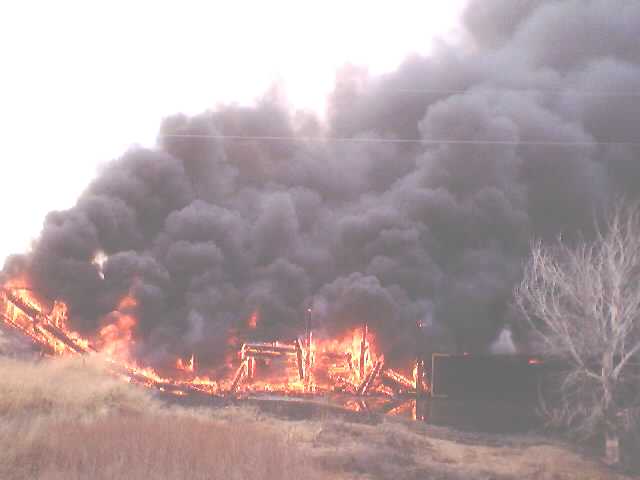
Not many bad things have happened to us, and I’m thankful. But what about my friends and family members? We are mourning for the family whose father and daughter recently drowned. Fires have ravaged multi-thousands of acres and several towns, and tornados have created havoc in many places. How will those whose lives have been turned upside down celebrate? Or can they truthfully celebrate Thanksgiving with the turmoil they’re experiencing?

I thought about the smoke would encounter if we went west. That shouldn’t be too bad, and we probably would not meet up with any flames. At least, I hope not. The smoke is devastating for some folks with bronchial problems, but my allergy pills should help me.

“Precious, I think we should go to our daughter and family south instead of our son and family out west.”

Years ago, two of my sisters lost houses in fires, and some friends are currently without electricity. Friends whose houses were damaged by the twisters are waiting for the repairs or reconstruction to take place. With that in mind, a question hung heavily in my mind, so I asked the Lord. “Father, how can people be thankful in the face of disaster? How can they actually be grateful when so much has been taken from them?”

Then I remembered asking my sister, Jan, how she felt when her house was destroyed. She responded, “Eugene, it’s only stuff. Whatever we want to replace, we can. But it’s only stuff. We’re still alive. That’s what counts.” That was an excellent, mature response.

I asked our friends how they’re doing after the tornado damaged their house. One of them responded, “We’re doing fine. It was hard to sleep afterwards, but it’s only a house. God has taken care of us.” The other said, “We’re doing fine. It’ll get repaired, and we are thankful to the Lord.”

I’ve never heard God speak out loud, but He answered my prayer with the following thoughts.

I give many kinds of blessings, many of them are material. Most people, even those who don’t know Me, are generally happy about what they have. But those who know Me are grateful for our relationship, and they don’t wait for this day of the year to show it. Their gratefulness, their thankfulness, is not based on what they have, but what they are. They are thankful for life. And when their human life is over, they will thank Me face-to-face.

Some time ago, a missionary couple at church told us about a poor family overseas. With barely enough money to buy food, they received a gift of $70. They were excited, but they knew another family who had no food at all. Following God’s leadership, they joyfully gave that $70 to the other family. Their generosity revealed not only a grateful spirit, but a deep, mature relationship with God.

“Precious, I called to see if the repairs on the trailer were complete. It’s almost ready.”

“What if the weather gets stormy?”

“We’ll go without the trailer.”

It isn’t what we have or don’t have that produces joy, and it isn’t whether or not we’ve experienced hardship in life that prompts us to be thankful. What engenders gratefulness is knowing Jesus Who offers us eternal life.

James 1:17 tells us that every good gift comes from God. Let’s express our gratitude to God every day. Let’s be generous to others. And let’s be compassionate and help those who are experiencing hardship and tragedy. Allow God to bless others through you.

Tales From the Road: Tillamook Cheese

Years ago, I saw a movie about a woman who wrote for a newspaper. She ran out of ideas, so she began writing about different uses of cheese. After five weeks, the editor called her into his office. When the writer revealed what amounted to burnout or loss of imagination, the editor blurted out: “You’re a good writer – write about anything. But no more cheese, lady!”

That was the best line in the movie.

However, since I hadn’t written about that use of milk, since Carol and I were in the town of Tillamook, Oregon, and since I really like cheese, I decided it was time to write about it. When my editor read it, he approved, so I sent him some.

Tillamook is a Native American tribal name, but that’s another story.

Mankind has been making cheese for over 4,000 years, and I read that there are 1,831 kinds of cheese. Cheese is classified by geographic origin, what animal gave the milk, the animal’s diet, age of cheese, texture, added ingredients, butterfat content, and a lot more, and by combinations of all the above. Most milk used in cheese production is from cows, but cheese is also made of milk from goats, camels, sheep, yaks, buffalo, and even reindeer. I wonder if anyone tried giraffe milk.

Tillamook is my favorite brand of cheese, and Colby Jack (marbled yellow & white) is my favorite kind. Don’t ever confuse Colby Jack with Pepper Jack. That stuff is hot! (My editor liked it.)

The Tillamook Cheese Factory is a dairy cooperative that was founded in 1909. My first visit was in the summer of 1991 with Carol and the younger two kids (Rebecca and Michael), and this is my third visit. Over a million people a year must have the same taste for cheese as I do and visit the Tillamook Cheese Factory, so they built a new visitor center, updated its name to Tillamook Creamery, and added a food court.

There is no admission price. You walk in and learn while you enjoy all the free cheese samples.

So, how is cheese made? If you already know, skip the next four paragraphs.

Milk is poured into a vat and an enzyme, rennet, is added to coagulate it. (But juice from fruit, fig leaves, melons, safflower, vinegar, lemons, and other vegetation can be added instead.) This causes the milk to curdle and separate from the liquid whey. Tillamook’s vats hold 53,500 pounds (over 6,300 gallons) of fresh milk. As the milk is stirred, the curds and whey separate. The whey is drained into another container while the curds begin to stick or knit together. This is called cheddaring.

Ten pounds (1 gallon plus 2.5 cups) of cow milk will produce one pound of cheese, while six pounds of sheep milk will produce a pound of cheese because of its much higher fat content. Goat cheese production is similar to cows.

I hope this isn’t boring you. The whole process fascinates me.

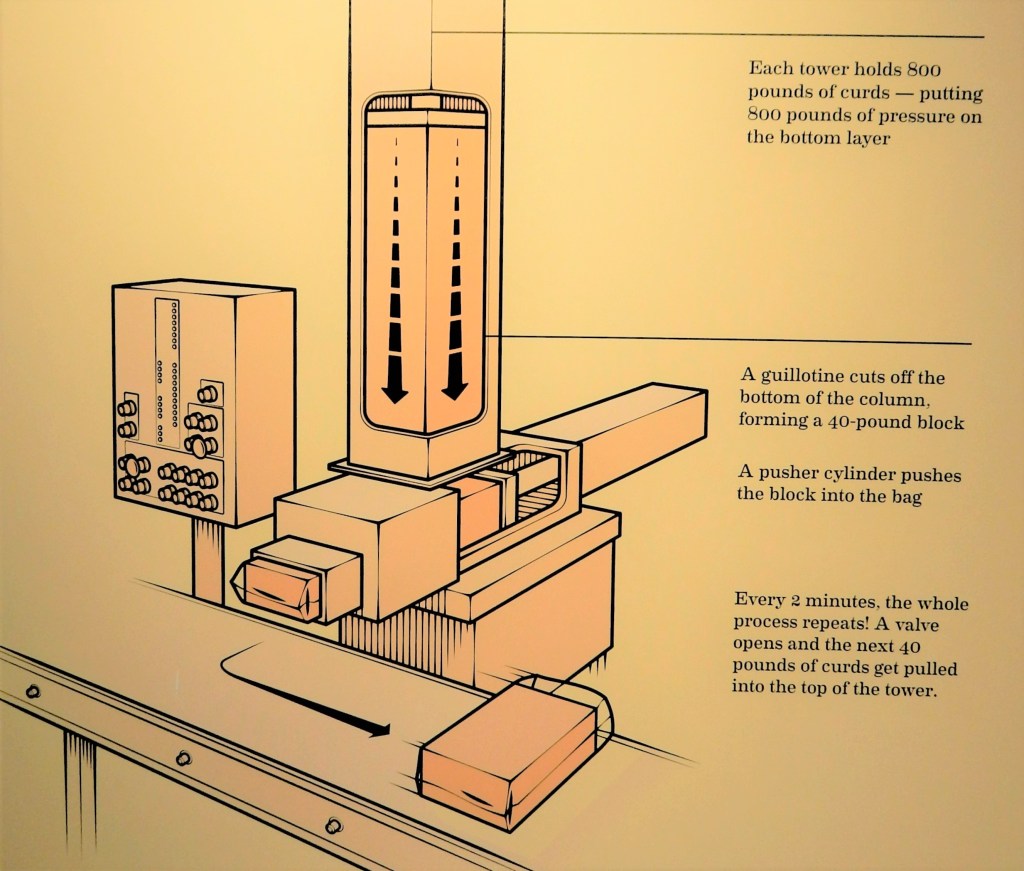
The curds are chopped, cut, and pressed to release more liquid. Then the cheese curds are poured into a square column and pressure is slowly increased. When pressure finally reaches 800 pounds, it is held for two minutes then cut into 40-pound blocks. The blocks are stored and aged from 60 days to five years – depending on their intended use.

After the proper aging, the blocks are cut into smaller blocks – normally, half-pound, pound, and two-pound blocks. Mis-shaped or broken pieces are made into shredded-cheese. The Tillamook Creamery packages about a million pounds of cheese a week, and that takes about 1,160,000 gallons of milk each week.

There are hundreds of uses for the whey. It is commonly used as an ingredient in some drink mixes, protein bars, and other foods. Whey powder is often added to smoothies and other workout foods for its protein.

The Tillamook Creamery center is a 38,500-square-foot building that allows visitors the privilege of learning about each step of the milk-to-cheese process and allows them to actually see production from the second-floor level.

We visited the facility twice this week and really enjoyed learning. We ate lunch there, but the best part was the large Tillamook ice cream cones! Carol got huckleberry and chocolate-peanut butter, while I got chocolate and vanilla. That, with the free cheese samples on the second floor, topped off our meal.

If you get a chance, visit the Tillamook Creamery in Tillamook, Oregon.

Tales From the Road: An Easy Pull

I am happily surprised at how easily our 8-gear GMC Yukon pulled the trailer over the mountain passes.

I faced my first major concern of the trip as we drove over Wolf Creek Pass, just north of Pagosa Springs, Colorado. I had gone over the pass many times, but not while pulling a trailer. However, my concerns were unfounded. We easily climbed the mountain as we passed other over-heated cars on the side of the road that were not pulling a trailer. Our 5400-pound Yukon pulled the 5,000-pound trailer over the steep 8-mile incline to almost 11,000 feet altitude with no problem. Normally driving in either the 6th or 7th gear while pulling the trailer, we dropped only to 4th and 5th gears during the climb, and the engine temperature raised only about 25 degrees. I was a happy camper! (I didn’t need to stop and help the stalled drivers, for their help had already arrived. We were not callously ignoring them.)

We encountered several minor climbs and passes on our way to Buena Vista, Colorado, and several stiff climbs from there to Denver; but we were not in a hurry and the engine worked wonderfully.

We didn’t encounter any harsh winds, and thanks to the sway bars, the trailer has swayed very little. We check the weather report every day to see what kind of weather we might encounter, but if we are caught off-guard and if the trailer begins to sway, all I have to do is to push two levers near the steering wheel and power will be applied to the trailer’s brakes which will stop the motion. This car was built from the bottom up to handle the load.

The Yukon has … let me interrupt myself. I am not paid to advertise the GMC Yukon. I am merely relating my experiences, feelings, and thoughts.

Now, where was I? Oh yes …

The Yukon has many features that make it an ideal vehicle to pull a trailer. Although it is built to pull up to 8,000 pounds, the trailer is only 5,000 pounds with all of our stuff in it. Therefore, as long as I treat the car properly, change oil regularly, keep air in both trailer and car tires to the proper pressure, etc., the car should last quite a while.

Yes, I understand that unforeseen events happen. Mechanical things sometimes break down and many kinds of problems can occur. But with our 8-year GMC warranty and our AAA insurance coverage, I should have no major problems.

Towing the trailer is an easy pull for the Yukon.

But all this reminds me of our human life.

Do you know that God made humans to normally last a long time? The Bible infers that God originally made us to live forever. However, since Adam introduced sin into the human race, the Bible says in Psalm 90:10, “Seventy years are given to us. Some live to eighty. But even the best years are filled with pain and trouble; soon they disappear, and we fly away.”

My mother and grandparents lived into their 90s, and my father lived to 89, but some folks overheat and stall out along the side of life much earlier. Longevity of life often depends on genetics – I understand that. But many people seem to just give up on life.

I’ve read that some soldiers in World War II with seemingly mortal wounds survived because they were determined to survive; while some others with no wounds pulled the cover over their heads and died. They just gave up, and that is disgusting.

As long as we are alive, most of us have the abilities to accomplish amazing feats. Like the Yukon, God made us to be resilient.

Life can present a temporary stall out, a long-term burnout, or a fatal crash – it often depends on our outlook on life. And we must remember that until Jesus returns, this physical life will come to an end. But when we look at life on the positive side of the picture, life can be a relatively easy pull up the mountain.

Of course, we need to take care of ourselves. Eat properly, rest adequately, exercise, keep worry to a minimum – or don’t worry at all – and keep a joyful attitude during tough times. The Bible says a joyful attitude is good medicine. So, cooperate with God and take care of yourselves.

Happy Trails To You, ‘Til We Meet Again – next week.

Anniversary of the Christian Reformation

Every year about this time most of America thinks about costumes, candy, goblins, graveyards, and a host of other weird things. Although the idea of ghosts or dead people haunting the living has existed for millennia, the spooky part of Halloween might have originated with the ancient Celtic festival of Samhain, when people would light bonfires and wear costumes to ward off these ghosts, or temporarily resurrected, somewhat deteriorated beings. And in the eighth century, Pope Gregory III designated November 1st as a day to honor all saints and martyrs. This evolved into the holiday known as All Saints’ Day. The previous evening (October 31st) was known as All Hallows’ Evening, but eventually evolved into Halloween, candy, goblins, etc., and incorporated some of the traditions of Samhain.

But enough of fantasy and phantoms; let’s get back to reality.

October 31st is the anniversary of Martin Luther’s indomitable stand for Truth. Luther, named after St. Martin of Tours, was dedicated to learning truth and wanted to learn from the sages such as Aristotle, Plato, and Gabriel Biel. But two men who became his tutors (Bartholomaus Arnoldi von Usingen and Jodocus Trutvetter) taught Luther to be wary of even the great thinkers of the ages. Therefore, human philosophy and human reason became a headache for Luther because they could not give him the satisfaction in life he desired. Luther wanted to know about God, and human-kind’s greatest thinkers could tell him only of man.

This, in itself, was a headache for Luther because he had an insatiable drive to think everything through; to reason everything out. Every aspect of his faith had to be rational and understandable.

Becoming an Augustinian Monk, Luther dedicated himself to God in the best way he understood fasting, long hours of prayer, pilgrimages, confessions…Oh, so many confessions! But he remained empty within. His superior, noting Luther’s personal dissatisfaction, suggested that he become a professor of law, and in 1507 Luther was ordained into the priesthood and assigned to the University of Wittenberg to teach theology. 

Things didn’t get much better for this unfulfilled monk/priest/professor/ theologian/lawyer, and he continued to question whatever seemed to be a man-made doctrine or rule. No church doctrine was safe from Luther’s critical eye if he thought it was not supported by the Bible. Therefore, he rejected the Church’s position that good works, charity, and church traditions must supplement faith in Christ in order for us to receive eternal salvation. 

Already questioning the concept of “indulgences” (buying forgiveness for certain types of sin from the Church), Luther became angry when the Dominican monk, Johann Tetzel, began selling indulgences for the dead (supposedly releasing them from purgatory) to raise money to build St. Peter’s Basilica in Rome. These indulgences might have been the catalyst that prompted Luther, in 1517, to write and publish his “Ninety-five Theses” for the world to read. His eighty sixth thesis was the most direct: “Why does not the Pope, whose wealth is today greater than the riches of the richest, build just this one church of St. Peter with his own money, rather than with the money of poor believers?” This caused great anxiety on the part of the Pope and the College of Cardinals.

However, not desiring to break from the Catholic Church, rather wanting to reform it from within, Luther’s desire was to know God, and to spend his life helping others know Him. Reformed theologian Charles Spurgeon said it this way: “I cannot know Jesus through another person’s acquaintance with Him. I must know Him myself; I must know Him on my own account. It will be an intelligent knowledge. I must know Him, not as the visionary dreams of Him, but as the Word [Bible] reveals Him. I must know His nature: divine and human. I must know His offices, His attributes, His works, His shame – His glory.”

Martin Luther’s battle cry was “Sola Scriptura!” (Only Scripture!), for only the Scriptures point us to Jesus Christ and reveal all we need to know for eternal life.

John 3:16 – “For God so loved the world [people] that He gave His only begotten son [Jesus]; so that whoever believes in Him [Jesus] will not perish [suffer or endure eternal punishment] but have everlasting life [live forever in the glorious and loving approval of almighty God].”

Ephesians 2:8-9 “For by grace are ye saved through faith; and that not of yourselves: it is the gift of God: Not of works, lest any man should boast.” This verse negates the idea that human endeavors and traditions are needed to supplement faith for salvation. The New Living Translation says it this way: “God saved you by his grace when you believed. And you can’t take credit for this; it is a gift from God. Salvation is not a reward for the good things we have done, so none of us can boast about it.”

That was what Martin Luther wanted his parishioners to hear, learn, and understand. To the end, Luther directed people to the Bible as the foundation for faith, life, and our relationship with Jesus Christ.

Many books have been written about Martin Luther and the Reformation, and this brief article does not do justice to the historic event; but I hope it inspires or challenges you to study and learn more about the faith that Martin Luther fought so diligently to clarify and uphold.

Tales From the Road: Road Hazards

Carol and I enjoy traveling. We drive the speed limit, observe traffic rules and cautions, and watch out for hazards. Watching out for hazards is sometimes nerve-wracking because there are many kinds of them.

Potholes and broken sections of pavement which can destroy tires account for most of our hazards. I’ve seen one accident that was caused by a driver who swerved to miss a big hole but hit another car.

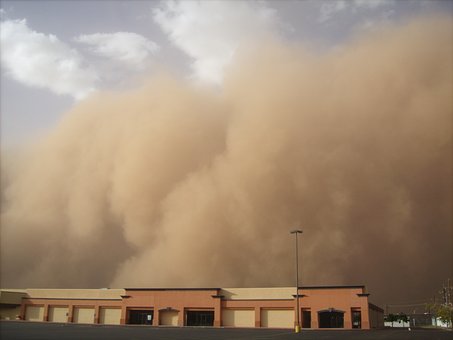
Another hazard that drivers sometimes face in the deserts of Southern California, Nevada, and Arizona, are sandstorms. We didn’t encounter those storms on this trip, but four years ago we got caught. The sand was blowing at 40 mph and was so thick that I couldn’t see more than 20 feet in front of me. When that storm was over, the windshield needed to be replaced.

Yet other hazards crop up: animals on the roadway. Rabbits, racoons, squirrels, and other small game just get squashed, and it’s over. Dogs, deer, coyotes, and the like can present more of a challenge, but elk, cattle, and horses can prove to be fatal – for man and beast.

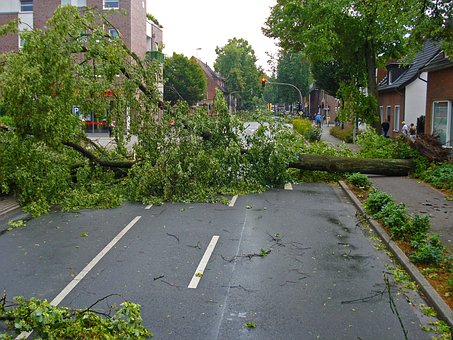
Another hazard we’ve seen – but haven’t been affected by – are downed trees across the roads. Nature has been acting up lately and high winds have been howling through the forests. About a mile from where we are staying, a large tree fell across the road after midnight. It was still dark, and by the time a tired driver saw the tree, he didn’t have time to hit the brake. It took over two hours for the ambulance crew to remove the body, and the highway department to remove the wreck and the tree.

But of all the hazards we face on the highways, one stands out like a sore thumb. It is a high-speed hazard called a Motorcycle!

 All over the United States we see signs reminding us about them. “Be courteous: share the road.” “Watch out for motorcycles.” “Save a life.” “Start Seeing Motorcycles.” And others.

But the more ominous problem is that many of the motorcyclists are not watching out for themselves! I hear the complaints from many RVers across the country. At medium to high speeds, motorcyclists disobey traffic rules. At high speeds, they weave in-n-out of traffic and zip past us between the lanes. The interstate freeway speed limit may be 70mph, and we may be going 65mph while most cars buzz past us doing 70-80. But many cyclists shoot past us doing 80-90 or higher!

When I want to change lanes, I turn on my signal, check my side mirrors, rear-view mirror (if I’m not pulling a trailer), and ask Carol if the way is clear. When I hear and see that all is clear, I pull over. But several times as I was about to change lanes, a motorcycle zoomed out of the distance at over 100 mph ignoring my turn signal. I would’ve been hit if I completed the lane-change, and the cyclist probably would have been dead. Complicating the problem is: if we collided, the default verdict would normally be against the driver of the car.

On one of our trips, we were driving 45 mph east on I-8 up Mission Valley in San Diego. The traffic was heavy. A motorcycle passed me at high speed on the inside shoulder between the concrete highway dividers and my car. I told Carol, “I hope he doesn’t kill himself.”

This photo is that of a different fatality.

About ten minutes later, traffic came to a crawl as the two left lanes began merging into the two right lanes. We eventually passed a damaged car, the mangled bike, and the rider’s broken body. The ambulance had not yet arrived.

There are many hazards on the highways and byways that we watch out for. But we must make sure that we don’t become the hazard.

Do you know that living according to Biblical principles can make our life safer? In Romans 13:1-5, Paul teaches us about obeying those in authority over us. That would include obeying speed limits, wouldn’t it? It includes being courteous drivers and giving others room to enter our lane without crowding them. And according to the principle in Matthew 25:40, if we show kindness to other drivers, we are showing kindness to Jesus.

We also should pray before we get out on the road. God can warn us of danger, remind us to be safe, and can protect us from unsafe drivers.

Tales From the Road: Danger Warnings

How many of you have a trailer, 5th wheel, or motor home? Perhaps I should also ask, how many of you formerly had one? You folks know there are many things to consider while living in an RV and things can go wrong.

While setting up in a campground or park, we need a level spot, or we need to use various items to level the rig. We need to connect to the proper power – 20, 30, or 50-amp service – and include a heavy-duty surge-protector in the circuit. We never know when rain and a thunderstorm will descend on us, or if other catastrophic electrical surges will hit. And as we connect to the water supply, we need to have a pressure-limiter to protect the plumbing. Believe-it-or-not, many campgrounds have high water pressure which can rupture plastic pipes.

When setting up the drain for the gray and black tanks, we need to assure that the tube cannot come loose during the draining operation. That would be a mess, especially with the black tank, and could cause a political or environmental mess. Oh yes: the gray water is from the shower, bath, and sinks. The black water is from the toilet. And when draining both tanks, we drain the black water first and let the gray water flush everything else down the drain. Of course, you want to have an attachment to rinse the tube with fresh water after you drain both tanks.

Until we bought our RV, we didn’t realize how much water evaporates in the trailer. Cooking, boiling water, making coffee, washing dishes, and cleaning ourselves all puts water in the air. But even when we don’t do any cooking, washing, etc., in the trailer, we still found heavy condensation on the windows on cold mornings. We learned that on the average, each person perspires and breathes out between three to five and a half cups of water a day. So, in humid areas, it’s beneficial to have dehumidifiers in the RV.

Hopefully your RV has an outside hose to rinse off sand and mud, so you don’t track it inside. You can use another garden hose if you have multiple faucets or use a splitter on a single faucet.

Most RVs I’ve seen use propane for cooking. When propane burns, it produces heat, water, and carbon dioxide (CO2). CO2 is not poisonous but can kill by displacing oxygen – it suffocates us. But when propane doesn’t burn properly, it produces heat, water, CO2, and carbon monoxide (CO). CO is absorbed into the body much more easily than oxygen and is poisonous. So, check your burners periodically, and make sure that you open windows and use the exhaust fan while cooking.

One time while toasting bread in the microwave oven, we over did it. When we opened the door, the smoke alarm exercised its sound system. In a regular house, the beeping is highly irritating. But in a trailer, it is LOUD and hurts the ears! That’s when we learned the smoke detector works.

That reminds me: once while we were washing dishes after breakfast (Carol washes and I dry), the propane sensor began screaming. That’s loud enough to wake up someone in the trailer next door! But it has to be loud in order to save lives. We discovered that while we were cleaning the stove, we lightly bumped the burner knob and turned on the propane. It wasn’t enough to cause a hiss as the propane escaped, and we don’t have an electronic ignition; but enough gas was escaping to set off the danger warning. That’s when we found out the propane sniffer works.

As I said earlier, there are many things to think about while living in an RV, and our enjoyment and satisfaction depends on our attention to detail. I’m happy to report that after our year-long trip in the RV, we arrived home safely.

But did you realize there are many things to think about while living on this huge RV called Planet Earth? Although we must learn to live safely, we’ll all die sometime, and we need to think about where we’ll go.

God has supplied us with numerous warnings to let us know when we’re in spiritual danger. We receive advice from our parents, spouse, friends, and authorities; but most of our best cautions, counsels, and admonitions are easy-to-read in the Bible. The Psalms and Proverbs are primary sources of wisdom, and our safety depends on our attention to detail. If we read the Bible daily and learn to live for and honor Jesus, He will guide us, and we’ll get to our ultimate “Home” – heaven – safely.

Bible Versions

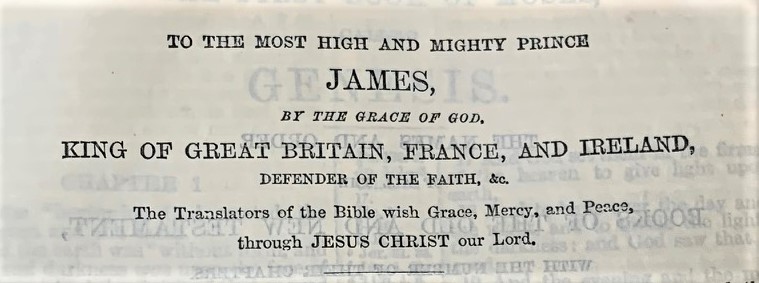
The first time I was asked about my preferred version of the Bible, I said I preferred the KJV – the King James Version. I was in high school and had only recently been introduced to the Amplified and the New American Standard versions.

But in the past 56 years (my entire married life) I have studied out of numerous versions. When someone recently asked me the question of my preferred version, I told him, “I prefer the NCV – New Century Version. However, the KJV is the one I take with me wherever I go simply because I grew up with it and my Bible memorization came from the KJV.”

Some time ago a man told me that I was wrong for not sticking with the KJ because, he claimed, it was the only accurate Bible in the world. I tried to discuss the topic with him, but he wouldn’t consider my point of view. I finally said, “In that case, you have just presented one of the greatest miracles in the history of the world.”

Asking what it was, I responded, “If the King James Bible, published in 1611 AD (or CE), is the only real Bible, the Christian church existed for almost 1,600 years without a Bible and the Jewish Church existed for about 3,500 years without a Bible. Isn’t that amazing?”

He hadn’t thought about that. Many others haven’t thought about it, either. But neither had he thought about the fact that the KJV is only English. If the KJV were the only real Bible, no other language group in the world would have a true Bible.

With that said, people should not spend so much time creating more English versions. Instead, they should invest money to translate Bibles for the ethnic groups who have no Bible in their language.

I remember being in Bible studies when the leader asked, “How do you interpret this Scripture?” Since those studies didn’t involve linguistic experts, the question didn’t make any sense to me. The leader should have asked, “How do you apply this verse?” or “What does this verse convey to you?” or “What is the Lord saying to you through this verse?”

Two major problems most people have of interpreting Scriptures are: 1) many people, if not most, do not understand the history and culture of the Biblical era, and 2) most people do not understand many of the idioms and idiomatic phrases the original authors used. 

There are books to help us with culture and history, but idioms and idiomatic phrases trip us up. (That’s an idiomatic phrase and might be difficult for someone to understand and translate properly 500 years from now.)

A current example of translating idiomatic phrases is the following. Mark 14:38, “The spirit is willing, but the flesh is weak” was translated into Russian by an American, then retranslated into English by a Russian. The result was “The Vodka is strong, but the meat is rotting.” Both non-Christian translators tried to be literally correct, but they missed the intent.

Some of the problems generated today are by many church leaders and Bible scholars who normally filter the Bible text through their own cultural background. But the only proper way of understanding Scripture is through the context of the original writers who wrote the Bible.

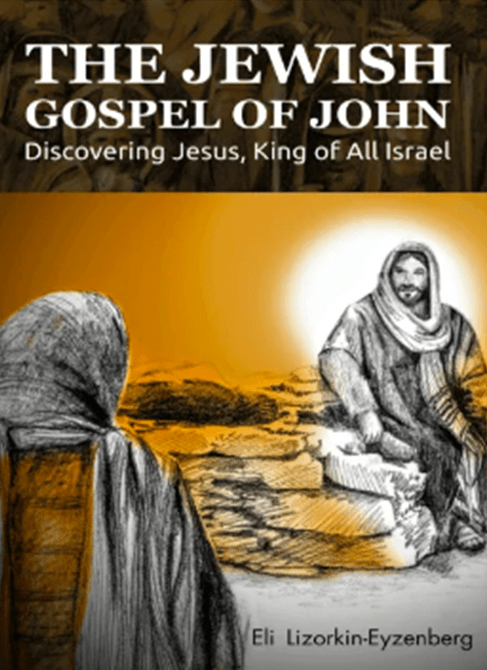
Dr. Eli Lizorkin-Eyzenberg (professor of Jewish Studies for Christians in Tel Aviv, Israel) said in his book, The Jewish Gospel of John: Discovering Jesus, King of All Israel, “The proper context for interpreting the Bible is the context of the biblical writers – the context that produced the Bible. Every other context is alien to the biblical writers and, therefore, to the Bible. Yet there is a pervasive tendency in the believing Church to filter the Bible through creeds, confessions, and denominational preferences.”

That’s why we need Bible scholars, pastors, and teachers who have studied the culture and language of the Bible times to help us.

No matter how we cut it (idiomatically speaking), it is dynamically important that we read the Bible. Study it. Apply the truths and morals to your life. Honor the Lord Jesus Christ by the way you live. Studying the Bible will help you do that.