I Have Chosen You…

Election, free will, predestination, sovereignty, Calvinism, Arminianism, perseverance, falling from grace, limited atonement, TULIP, God decides, man decides…the debate goes on and on. I am not going to address that issue today, but I want to take two factors out of the equation and shed light on them.

The first is Romans 9:13. “As it is written, Jacob have I loved, but Esau have I hated. (KJV)” Most versions use the word hate in this verse as it relates to Esau.

Let’s get something straight right now. God does not hate people. He hates sin, yes! But Jesus definitively told us in John 3:16 that God loves people; and Jesus Himself gave His life for us that we may live forever in heaven with Him. Since that is the case, why does Romans 9:13 tell us that God hated Esau?

The New Living Translation gives us a hint. It says, “In the words of the Scriptures, I loved Jacob, but I rejected Esau.”

That is it! God did not hate Esau, for in Genesis it tells of the blessings Esau received. What we have in Romans 9:13 is this: God chose Jacob to be a patriarch with Abraham and Isaac of what we refer to as “the Chosen People.” And since the promised Messiah had to be born to someone, somehow, somewhere, He would come through one of Jacob’s families – and that was through the tribe of Judah – one of Jacob’s sons.

Because God is omniscient (He knows everything), He knew that Esau would rebel against his parents, against righteousness, and against God. Therefore, God rejected Esau from being a patriarch in the Messiah’s lineage. This concept has nothing to do with salvation or eternal destiny. God’s sovereignty? Yes. But salvation? No.

The second factor is found in John 15:16. Jesus said, “You didn’t choose me. I chose you. I appointed you to go and produce fruit that will last, so that the Father will give you whatever you ask for, using my name” (NLT).

The Old Testament mentions many prophets. Normally, God chose one primary prophet at a time, but there were schools of prophets “in training.” Second Kings 2:3 refers to this. “The group of prophets from Bethel came to Elisha and asked him, Did you know that the Lord is going to take your master away from you today?”

The custom was for those in training to ask the head prophet for personal tutoring. The primary prophet would accept about twelve trainees; and if the students stayed close to him, the rabbi/prophet would teach them for several years. In this setting, the trainees “chose” the teacher.

But Jesus did it differently.

As Jesus was beginning his final three years on earth, He was both rabbi and prophet. Rather than waiting for trainees to come to Him, Jesus searched out and chose twelve men to be His disciples. But again, this had nothing to do with salvation. Notice the wording in John 15:16 – “You didn’t choose me. I chose you. I appointed you to go and produce fruit that will last, so that the Father will give you whatever you ask for, using my name.”

Do you see it? Jesus did not choose these men for salvation; He chose these men for a specific ministry.

Also note: others came to Jesus to be tutored, but Jesus turned them away. He didn’t consign them to eternal damnation; He merely let them know that they were not called to ministry – at that time, anyway.

God, through the Holy Spirit, still selects men and women for ministry today. We think of it as, “God calling us.” God calls (chooses) people, gives them certain spiritual gifts to enable them to fulfill that ministry, and sends them out to produce fruit.

We humans muddy the water when we try to turn everything into a theological issue. Let’s not do that, and don’t fuss with those with whom we disagree. As the German Lutheran theologian, Rupertus Meldenius (not Augustine or Francis), said around 1627 during the bloody Thirty Years War, “In Essentials Unity, In Non-Essentials Liberty, In All Things Charity”.

God is in charge, His sovereignty is unquestioned, and God requires our response. But remember: God chooses people for various ministry and vocations, and Romans 9:13 and John 15:16 have no part in the predestination discussion. Predestination is another story for another time.

The Impossible Dream

On November 6, 2015, our church seniors group attended Wasserman, Darion, and Leigh’s classic musical “Man of La Mancha” in the Berry Performing Arts Center at John Brown University.  JBU’s Music and Theatre departments did an outstanding job producing and presenting it.

When I watch a play or movie, I normally remain objective because I want to see what is going on. (Yes, I am the perennial critic.) That means I usually do not get emotionally involved with the story line first time around.  And because I normally remain objective, I will see a movie or play twice or more if I like it. The second or third time is when I actually enjoy the story.

The original story (Man of La Mancha) was written in two volumes in 1605 and 1617 by Miguel de Cervantes Saavedra; and was titled El Ingenioso Hidalgo don Quijote de la Mancha (in English: The Ingenious Gentleman Don Quixote of La Mancha). La Mancha means “the stain”; but the origin possibly comes from the Moors’ influence and was probably “al-mansha” – which is: dry land, or wilderness. Therefore, the title should be: The Ingenious Gentleman Don Quixote from the Wilderness.

The story is about the adventures of Alonso Quixano (pronounced Kihano). He read so many romantic stories that “he loses his sanity and decides to set out to revive chivalry, undo wrongs, and bring justice to the world.” He talked a farmer, Sancho Panza, into going with him as his squire. In the first part of the book, Don Quixote doesn’t see the world for what it is, and imagines that he is a knight in shining armor. And there are no songs in the book.

But the musical was written in 1972, and, of course, included songs. I read the book decades ago, but watched the musical seven years ago. When the orchestra began playing the theme song, I leaned over to Carol and asked, “Andy Williams?”

Carol said, “Yes.”

That was a surprise. I heard Andy sing “The Impossible Dream” for years, yet I never knew the origin of the song. When I went home and studied the words, it began to make sense. Here are the words from the brochure, written by Joe Darion in1972:

To dream the impossible dream
To fight the unbeatable foe
To bear with unbearable sorrow
To run where the brave dare not go

To right the unrightable wrong
To love pure and chaste from afar
To try when your arms are too weary
To reach the unreachable star

This is my quest, to follow that star,
No matter how hopeless, no matter how far
To fight for the right without question or cause
To be willing to march into hell for a heavenly cause

And I know if I’ll only be true to this glorious quest
That my heart will lie peaceful and calm when I’m laid to my rest

And the world will be better for this
That one man scorned and covered with scars
Still strove with his last ounce of courage
To fight the unbeatable foe, to reach the unreachable star

The words haunted me for some reason. Reading them over and again, I began to softly sing them. But as I sang, the reason for the mystical feeling began to slowly sink into my mind. In awe of the message, I stopped singing and sat down. I don’t know if Joe Darion was a Christian, but in my mind, those words speak of one man, and one man only. That song is a sermon about our Lord – Jesus Christ.

Jesus fought and conquered the unbeatable foe. He bore the unbearable sorrow. He righted the unrightable wrong. He created the unreachable stars. He gave His life for the right without questioning. He marched into hell for His heavenly cause. Jesus was scorned and was covered with scars. And the world is, indeed, better because of all that Jesus did, and all that He is. No man, and no group of men, could ever do for us what Jesus did.

Jesus is called the Man from Nazareth. The Man from Galilee. The Man of Sorrows. And the Son of Man. He came from heaven to this wilderness called earth. He is God almighty – the Creator of the heavens and the earth. Our Redeemer. Our Savior. He is the Coming King.

He’ll ultimately share His heavenly dream with you, if you live for Him now.

God’s plan is not an impossible dream.

Historical Global Climate Change

We’ve been told: “Mankind and modern technology are creating greenhouse gases which are responsible for melting glaciers and polar ice caps, and warming the oceans. Therefore, our technology will cause massive coastal flooding within a hundred years.” The question is: Is that true?

That scenario can be confusing because the same people who bemoan human-caused global warming tell us the earth has undergone several ice-ages in the prehistoric past. If they’re right, the earth froze and thawed several times without man’s assistance. So if our technology wasn’t available, what caused the assumed cooling and re-heating cycles?

We have geological evidence that the entire earth was a greenhouse 5 to 8 thousand years ago. We also know that for every effect there is a cause. Therefore, without man to mess with the earth, what caused the earth to cool down? Geological data shows that the earth’s oceans could have been about 300 feet lower than they are now. What raised the ocean levels? Without the human factor, what caused the earth to warm up again?

To compound the problem, I just read that by 2050 the earth might undergo another “mini-ice-age” and the sun will be the culprit.

Mount Kilauea, one of three active volcanos in Hawaii, has a lava lake that is over 520 feet wide, is very deep, and of course it’s fed from the huge magma pool. On April 26, 2015 the “lake” level rose twenty-six feet. The previous week, Chile’s Calbuco volcano erupted again. On May 18, 1980, Mt. St. Helens erupted. And in April of 2010, Mount Eyjafjallajökull in Iceland erupted which caused substantial disruption to air traffic across Europe. There are about 1,500 potentially active volcanos above water and 500 potentially active underwater. People ignore the fact that these mountains spew heat into the water and atmosphere which affects the climate. Dr. Dan Walker at the University of Hawaii noticed a strong correlation between seismic and volcanic activity in the Pacific Ocean and El Nino cycles over a period of 25 years. Also, sulfur dioxide and sulfuric acid are produced by volcanic activity which is carried world-wide on the trade winds. Volcanism produces an average of over 5.5 billion tons of CO2 annually. And man cannot stop any of this.

Does the book containing the oldest available historical record of man say anything about global climate?

It does. Genesis 2:6 says, “The Lord God had not caused it to rain upon the earth, and there was not a man to till the ground. But there went up a mist from the earth, and watered the whole face of the ground.”

But Genesis 8:22 reports after the world-wide flood, “While the earth remains, seedtime and harvest, and cold and heat, and summer and winter, and day and night shall not cease.”

Then Genesis 9:12-13 says, “And God said, this is the token of the covenant which I make between me and you and every living creature that is with you, for perpetual generations: I do set my bow [rainbow] in the cloud….”

We find that the earth was a greenhouse with no rain. That infers continuous cloud cover with a more massive atmosphere; and that suggests no direct sunlight reaching the ground. After the flood, Genesis 8:22 mentions “cold and heat, and summer and winter.”

Seasons were introduced which suggests massive geological, atmospheric, and climatological changes. There was a sudden world-wide cool-down with the sudden appearance of what became polar ice caps. Man’s average lifetime was reduced from 912 years (before the flood) to 285 years (as of Abraham’s lifetime). Winter, mountains, deserts, snow, hail, rain, tornados, and hurricanes were gradually introduced to the world.

Matt Cantor wrote an interesting article (May 3, 2015) titled “Ancient Climate Change Could Explain Tibet Mystery.” Matt said that about 4,000 years ago Tibetan climate suddenly became much colder. Of course, man didn’t cause that temperature shift.

With the probable influx of massive amounts of ice from ice comets that slammed onto earth which changed the earth’s astronomical posture, the earth went into geological convulsions and the earth’s crust broke up. And the earth has been ever-so-slowly reverting to its temperate equilibrium ever since. Although mankind should increasingly clean up industrial contamination, man is not able to control earth’s climate. If mankind were removed and the earth was given to the animals, the warm-up would continue. Since God caused it, He is the one who will have to stop it … if and when He wants to.

Historical Trivia

I thought I’d follow up last week’s blog of New Years myths with a few tidbits of historical trivia.

Many things are going on in the world today and we tend to get tense, worried, and cynical.  But I think we need to “lighten up” … for at least a week. Also, I think humor is appropriate since Proverbs 17:22 says “A cheerful heart is good medicine, but a broken spirit saps a person’s strength” (NLT). So, here is some light-hearted trivia that I found many years ago. When I first read them, it looked like some had incorrect information so I did a little “lookin’ up” to get as close to the truth as I could. So sit back, relax, and enjoy the next five minutes.

Have you heard the saying “God willing and the creek don’t rise”? Some folk have a picture of an uncrossable stream or creek rising during a torrential downpour – especially with all the flooding happening in parts of the world today. However, there is one small error in that quote. The statement was written by Benjamin Hawkins, a politician and Indian diplomat in the early 1800s. While on the job in the southern USA, Hawkins was requested by President Thomas Jefferson to return to Washington D.C. and give a report about what was happening. His response was, “God willing and the Creek don’t rise.” Because of his job, and the fact that he capitalized the word “Creek,” it is deduced that he was referring to a potential Creek Indian uprising, and not a flooded body of water.

In George Washington’s days, there were no cameras. One’s image was either sculpted or painted. Some paintings of George Washington show him standing behind a desk with one arm behind his back, while others showed both legs and both arms. In fact, many paintings show people with arms or legs out of sight. That’s because prices were based on how big the canvas was, how many objects (things and people) were to be painted, and by how many fingers, hands, arms, legs, and feet were to be painted. Arms and legs are more difficult to paint, therefore painting them raised the price considerably. This is one probable origin of the expression, “It’ll cost you an arm and a leg.” By the way, that’s why many (if not most) cartoons show the characters with only three fingers and a thumb. Omitting the fourth finger reduced the production costs.

In centuries past, personal hygiene was not understood, and people didn’t bathe very often, which aided in the profusion of lice. Therefore, many women and most men in the European higher social strata shaved their heads because of lice and bugs, then wore wigs. This continued in colonial America – which, of course, was primarily an extension of British society. Wealthy and influential people could afford to buy larger wigs – and they did. Today we still use the term “He’s a big wig” because someone appears to be, or is, powerful and wealthy.

You might have heard various stories about the origin of “chairman of the board.” Well, some of the stories are flakey, but this is probably correct. The word “chair” infers sitting in the chair, or seat of authority (at times, perhaps the only chair while others sat on benches), and “board” (as we know it) was first heard of in the 13th century spelled borde, and means “table” – such as “God’s borde” (meaning “the Lord’s table.”) A mother’s call to the family was: “Mi bord is maked. Cumed to borde.” – meaning, “The table is set [for a meal]. Come to the table.” Also, people pay a fee or rent for “room and board” – sleeping quarters and food at the table. So, chairman of the board would be the person in charge at the table where business is conducted: be it church, industry, restaurant, or government.

Here’s one more. Have you heard the phrase, “turn a blind eye” in a situation?

In the naval battle of Copenhagen in 1801, British Admiral Horatio Nelson (who was blind in one eye) lead the attack against a joint Danish/Norwegian flotilla. The British fleet was commanded by Admiral Sir Hyde Parker. Sensing defeat, Parker sent a signal for Nelson to disengage, but Nelson was convinced he could win if he persisted. In Clarke and M’Arthur’s biography, Life of Nelson, published around 1809, they printed what they said was Nelson’s actual words at the time: [Putting the field glass to his blind eye and addressing his assistant] “You know, Foley, I have only one eye – and I have a right to be blind sometimes. I really do not see the signal.” So, turning a blind eye to Admiral Parker’s order, Nelson proceeded to defeat the enemy.

Thank you for reading, and I hope you have a pleasant week.

New Year Traditions

Several readers asked me if I would write about New Year’s traditions. Although late, I agreed to their request; and as the old saying goes: better late than never.

For thousands of years, people have had the idea that what they do on the first day of the year will set the stage for the next twelve months.

Maybe – maybe not.

Looking into the topic, I found hundreds of myths but I’ll present only twelve. As you read these, keep in mind that we should not base our lives on superstitions or myths. We should be careful about what we believe, for what we believe becomes part of our worldview.

Here are the twelve, and I’ll add comments later.

  • Being debt-free. The year should be started owing no man anything; so all debt should be paid before the year ends. But do not repay debt on January 1 or you might be paying out all year long.
  • Kissing at midnight. The year is started out with affection to ensure that a loving year will follow. Otherwise, strife could be in the house all year long, and the sofa or couch might be the spare bedroom.
  • Eating black-eyed peas. This attracts good social favor, and financial prosperity. But poultry should be avoided lest poverty (scratching for food) overtake you.
  • Wear something new. This assures that you’ll receive new things throughout the year.
  • Stock your pantry. Be sure to have your cupboards or pantry filled with food before the old year ends, or you might have a lack of food for the remainder of the year.
  • Money available. Be sure to have plenty of money in the wallet or purse; this attracts prosperity throughout the year.
  • Breaking things. Whatever you do, do not break anything on January 1 or many things (business deals, cars, glass, etc.) may be broken or wrecked throughout the year.
  • Nothing should leave the house. Don’t even step through the door to get the newspaper. Nothing and no one is to cross the threshold on January 1 in order to ensure safety and conservation throughout the year.
  • Be kind. Be considerate and caring to others so that kindness will fill your house all year.
  • Let the old year out. Open all house doors before midnight to release the old year. The new year cannot enter until the old has left.
  • Make loud noises. Loud noise scares away the devil and evil spirits, so make as much noise as possible.
  • Be praying at the stroke of midnight. If you start the year praying, you will receive blessings all year long.

Most of those myths are only superstitions and we should not base our lives on myths or superstitions. However, several of them are not myths, but are good ideas to follow all year long. For example:

Being debt-free: Romans 13:8 says, “Do not owe people anything, except always owe love to each other, because the person who loves others has obeyed all the law.” Think that one through.

Kissing at midnight: My wife and I kiss often, even when it is broad daylight. We love each other. Also, sleep is more complete when we end the day with a loving attitude. Ephesians 4:26 hints at this: “…be sure to stop being angry before the end of the day.” In other words, solve the problems before you “hit the sack”. One woman asked, “That’s good advice, but what do you do if the offence takes place after sundown?” The counselor said, “Well, if it’s not a ‘9-1-1’ situation, the couch in the living room might provide emotional space; then you can handle the problem in the morning.”  Hmmmmm……

Be kind: Ephesians 4:32 says, “Be kind and loving to each other, and forgive each other just as God forgave you.” This exhortation could prevent sleeping on the couch.

Praying at the stroke of midnight: 1 Thessalonians 5:16-18 says, “Always be joyful. Pray continually, and give thanks whatever happens. That is what God wants for you in Christ Jesus.” So don’t base your life on superstitions or myths which generate fear. Instead, base your life on sound Biblical instruction. This will enhance your quality of life all year long.

On January 24, 2022 I wrote … “In Case You’re Interested”


In that blog I talked about this book, Charter of the Christian Faith. I said that it would be beneficial to whoever wanted to enhance their relationship with the Lord Jesus Christ. And that is absolutely true.

After hearing from many folks commenting on it and how it helped them, I took the privilege of writing a second edition. I refocused the message and gave the book a new title. Also, in order for readers to get the updated edition and not be confused with the two books, I took Charter of the Christian Faith off the market.

I replaced it with the new edition, Truth not meant to be Hidden, pictured here, and I’ve kept the price the same. This is a power-packed message you might never have heard before. And it does reveal truth that has long been hidden.

You’ll find the book at: https://www.amazon.com/s?k=S.+Eugene+Linzey&i=stripbooks&crid=NO0PDTQR3CQL&sprefix=s.+eugene+linzey%2Cstripbooks%2C107&ref=nb_sb_noss.

If you copy that url address and paste it into your browser, it will make finding this book very easy. It was published just last week, and I believe you will want to read it. You will see life in a way you’ve never seen it before.

The reason I wrote the book in the first place is although I know that all Christians go to heaven, much of the Church seemed to have forgotten how Jesus wanted a Christian to live while on earth. I didn’t see much difference in many people’s lives when they became a Christian or joined a church. On Sundays, most people talked about the Lord, sang, bowed heads in prayer, listened to the pastor – most of them – but something was missing.

Why would the Church of Jesus Christ—including all divisions and denominations–be confused as to what the Christian life is all about? Simply because I know many Christians who don’t seem to understand the Faith they claim to believe. Going to church and joining it is not the same as understanding the faith.

The Church, including each member of it, needs to keep in mind that our goal in life is not merely to get to heaven. Our goal in life, both on earth and in heaven, is to be a member of Jesus’ team and grow the Kingdom of God throughout eternity. It is by becoming an adopted child of God, and growing into a mature spokesman for God, that we can fully take our place in the Kingdom. That is why we need to know and understand the teaching in Matthew 5:1-12.

This book, Truth not meant to be Hidden, addresses this topic.

Are You Facing the Wrong Way?

Have you ever done something backwards or sideways? You did everything according to directions, but it just didn’t work out the right way?

Many years ago, dad and mom visited us in New Mexico. The first thing that came out of dad’s mouth was, “Eugene, get me a compass, and mount it on the dash board!”

“What’s up, dad?”

“Dad turned the….” Mom started to tell me the traveling woe, but dad cut in.

I laughed about it, but dad forgave me. He knew I wasn’t mocking him. Then I reminded him of what he taught me: laughing at our mistakes is less painful than getting upset.

“I’ll tell my own goofy story, Verna.” And in an aggravated mood, dad told me how in Arizona, he followed the map exactly as planned. But he didn’t know that, at one point while mom was napping, he had the map sideways and drove north for an hour when he should have gone east. “I don’t like going the wrong direction, and I lost two hours. Let’s go get that compass – now, before I forget.”

Another time, I was overseeing a building renovation project. One of our electricians was new in the electrical field, and was perplexed. “I don’t get this.” he exclaimed. “It just doesn’t look right.”

I reviewed his drawing, then looked at the wall he was wiring. “Joe, you’re looking the wrong way. Turn around, and check it out.”

Joe turned, looked at the wall, looked at the print, looked back to the wall, uttered a few unrepeatable words, then said, “Sorry man.”

“You’re okay, Joe. I’m glad you stopped to get help. It’s always easier to ask for help than to correct an error.”

I’ve made directional mistakes, too. In January of 2015, Carol and I visited my brother and his wife in Lakeland, Florida. One afternoon we went sight-seeing in another town. On the way back to Lakeland late at night, I made a wrong turn. Getting off at the next exit, I made what I thought was the correct turn. But it put me back on the same highway – going the same direction. I tried three times, and got the same results. I didn’t know the freeway layout, and just couldn’t seem to get it right.

I started to get aggravated and ask Carol if I would ever get off this road. But dad’s words came back to me: it’s less painful to laugh than to get upset. So, seeing the humor in it, I began to laugh. Then the words of a song by the Kingston Trio in 1959 came to mind, and I began singing the chorus. It was about a man who didn’t have money to get off the subway in the Boston mass transit system.

Did he ever return? No, he never returned, and his fate is still unlearned.

He may ride forever ‘neath the streets of Boston as the man who never returned.”

Carol began laughing with me, and we eventually found our way back to Lakeland.

Well, I found out that I still make directional mistakes. Our television developed a problem, so we bought another one – an inexpensive 32-inch flat screen. I programmed it and made sure everything worked properly. But it wouldn’t change channels when I pressed the channel button.

I contacted the company, and they gave me some information. Situation solved … or so I thought. It still wouldn’t change channels.

Carol, my wonderful helper, said, “You did something wrong.”

It may not surprise you to know that husbands don’t like to hear those words. They may be true, but we still don’t like to hear them.

After talking with an expert in the field, I realized that the remote controller couldn’t talk with the television because I had the receiver box pointing the wrong way. My precious was right: I did something wrong. With a pink face accompanying a bit of embarrassment, I turned the box around and the system worked perfectly.

Sometimes we humans face problems in life because we are emotionally turned the wrong way. We might be stubborn, arrogant, or ignorant, and won’t listen to wise counsel. Instead of correcting the situations, we compound the situation and make things worse.

But if we relax, let go of our pride, and seek counsel, God will help us figure things out. Gaining wisdom as we study the Psalms in the Bible can enable us to adjust our attitude, then the Lord can guide us. The Psalms and Proverbs are loaded with wisdom. Start there.

And if you ever find yourself facing the wrong way, turn around at the earliest opportunity, but don’t get upset. Laugh about it. Laughing is less stressful – for everyone.

You Have Faith? In What?

In 1979 when I worked for a car dealership, a man walked up to me one day and requested an automobile. He listed the specifications: make & model, color, engine type and size, what he would pay for it, and all the rest. And he wanted it within two weeks. I chuckled and said, “You won’t get it at that price.”

Waxing eloquently about his faith, he said, “I told God what I wanted and I’m holding God to His word. The Bible says God will give us the desires of our hearts, and this is my desire. Therefore, I know I’ll get what I ask. And I want you to receive a blessing by getting it for me.”

I was flabbergasted to think a puny human could be so brash as to “hold God to His word.” God isn’t on trial. We humans are the flaky ones, and God is holding US accountable. We don’t have a right to demand anything of God.

When I asked, “Is your faith based on what you want, or on what God wants for you?” he retorted, “What’s that supposed to mean?”

I told him although he was sincere in his belief, sincerity doesn’t make something true; rather, truth substantiates faith, or exposes ignorance. Truth either validates or invalidates a person’s sincerity. So I asked him again about the object of his faith.

He laughed at my apparent ignorance, and said, “Scripture says ‘you have not because you ask not.’ I WILL get that car, everything I want on it, and at my stated price; but someone other than you will be blessed for getting it for me.” With that, he walked away.

I have many friends who tell God what they want. They say if they truly believe it, they will get it. They also tell me that not receiving what they want reveals a lack of faith.

I agree with Scripture but I disagree with their application of Scripture.

Although many of these folk have a true love for Jesus, they are taking those verses out of context. So what is the Biblical teaching?

I think some of you just tuned me out. But for those who are still reading, the interesting part comes next.

James 1:6 says to ask without wavering, and James 4:3 says we don’t get what we ask because we ask for the wrong things. So, let’s go to Jesus’ words.

Jesus said in Mark 11:24 – “Listen to me! You can pray for anything, and if you believe, you will have it.” His immediate audience knew what He meant; it is we new-comers who missed it.

Jesus stated it more fully to another audience in John 14:12-13. “The truth is, anyone who believes in me will do the same works I have done, and even greater works, because I am going to be with the Father. You can ask for anything in my name, and I will do it, because the work of the Son brings glory to the Father.”

Two phrases stand out: “in My name” and “brings glory to the Father.” And this is where the rubber meets the road.

“In My name” means to ask for what Jesus would ask; and that includes 1) asking in the manner and attitude in which Jesus would ask, 2) asking specifically for what Jesus would ask, and 3) accepting the timing of God’s response. Jesus’ continuous attitude was, “Not My will, but Thine be done.” As we grow in our relationship with the Lord, we will have Jesus’ attitude.

“Bringing glory to the Father” means that the answer to the request is to glorify God – not to primarily benefit us. Jesus never asked for a new donkey, a faster horse, or a better place to sleep. Those are not bad things, but that wasn’t what Jesus needed. God promised to meet our needs – not necessarily our wants. Psalm 37:4 instructs us that if we are in tune with God, He will give us the proper desires – the desires of our hearts.

Faith in God is not self-centered, but God-centered. True faithfulness is purposely living according to God’s word, and is revealed by a life dedicated to the Lord – not necessarily by things we have.

That man returned a month later to show me his new car. But when I pointed that many of the features he demanded were missing and that he paid about $2,000 more than he told God he would pay, he shrugged and said, “Well, I guess you can’t have it all.”

Perhaps he woke up to the truth of “asking in Jesus’ name” and maybe he didn’t. But dear reader, I hope your faith is in Jesus Christ, not in what you want. I hope your desire is to bring glory and honor to God, not merely to make yourself happy.

May God bless you as you learn what it means to truly honor our Lord.

Set Beneficial, Wise Goals

An acquaintance was driving on a cross-country trip and spotted something vaguely familiar beside a barn. He stopped at the farm house to enquire about it. The farmer hadn’t thought about selling it, but gave George permission to check it out.

As George approached the car, his eyes saw a rusty, dilapidated, 1958 Buick Roadmaster. The leather seats were shredded with springs protruding, covered with animal fur and chicken feathers – in much the same condition as pictured here.. Two windows were broken with the other two down. The chrome was peeling, and all four tires were cracked like a dried up lake bed, and flat. As he managed to open the hood, the scared cat hissed and jumped off the engine, and George saw what used to be radiator hoses and electrical wiring dangling uselessly: they had long-ago deteriorated.

But in George’s mind, he saw something else.

He saw a bright, shiny, light-burgundy, 1958 Buick Roadmaster with a circled V on the front grill, and a gleaming white roof. In his mind he saw the shiny chrome all around the car with sunlight glinting off it, the electric windows working, and new soft and pliable leather seating inviting him. Ultimately, he saw himself slowly cruising through town, smiling as the men oohed and aahed over it. In George’s mind, it looked just like the one his dad owned when George was in elementary school. THIS is what he longed for.

George’s new years resolution was to make this dream come true.

George had a garage where he would do most of the work himself. He would buy the books for body, engine, and electrical work; he knew a painter in a nearby town who would paint it that beautiful light-burgundy color; and knew a man who could replace the windows.

He made the farmer an offer, and after a little negotiating the deal was done. In two days, the cat had to find a different hiding place as a truck hauled the soon-to-be-renovated-beauty to George’s garage. He was ecstatic!

That was four years ago.

How many times had his wife said, “George, when are you going to stop procrastinating.” It wasn’t a question – it was a demand. “Why did you bring it here in the first place! Will you please do something with that rusty hulk?” That last one was a plea.

What happened? Very simply, George found himself not wanting to do the work. With all the right intentions and a dream to be fulfilled, George set unrealistic goals for himself. In the vernacular, he bit off more than he could chew.

He envisioned the finished product, but he didn’t know how to go about it. He also found out that he didn’t have the desire to get out the sander and throw sparks all around the garage and smelling ozone while sanding every square inch of the rusty hulk (the title given to it by George’s wife). Every time he looked at the ghost-of-the-past, he mentally sunk lower.

Why did I ever bring it home? He wondered.

When he finally prayed about it, asking the Lord if he should start the project, or perhaps if there was something else he should do with it, an interesting idea came to him. Perhaps it was from the Lord. He made an appointment with the pastor and shared the idea with him.

“Great idea!” boomed the clergyman, and he called in the youth director.

“This could be the answer to one of my prayers.” the youth pastor said. “I’ve been looking for a project for the high school boys.”

George gave Rusty Hulk to the church as a gift, and George’s wife got her garage back. Borrowing tools from their parents, the teen-age boys had a ball removing old seats, stripping the rusty shell of everything that was possibly removable, and throwing sparks as shiny metal emerged.  

To make the story short, George wasn’t procrastinating. Desiring to fulfill a childhood dream, George attempted to do something that was not his calling. When he finally realized it, he was able to let it go.

When the church youth group was through, it wasn’t the Light-Burgundy Blazing Beauty that George imagined, but it was nice. The church sold the Roadmaster, and the substantial profit was used to set up a workshop where the youth group could do other projects. George’s gift kept on giving.

Do you find yourself procrastinating when it comes to finishing a project or reaching a goal? The solution might be to create a workable New Year’s Resolution. Pray about each project, and see if that’s what the Lord wants you to do. See if it’s something you really want to spend your time doing … or even have the skills to do. Setting goals too high might not be compatible with your God-given creativity. So, don’t do that.

May the Lord bless you as you wisely set goals this year.

Happy New Year!

Christ Changes Lives

Caleb was puzzled. He had been training four other shepherds for a year now, and a new trainee, Micha, had been assigned to him last week. Caleb was accustomed to his helpers cooperating with him, and he was a little uneasy because they were late bringing in the sheep.

Being a shepherd wasn’t an easy task. Learning to know each animal by name was time-consuming, but that wasn’t the hardest part. Although shepherds need to know about the growing seasons, where the best fields are for grazing, what foliage is unhealthy for the critters, what predators are lurking nearby, how to fight them off, and how to tend the newborn and the wounded, a good shepherd also needs to know how to negotiate with other shepherds who may have trespassed into “their” territory. Caleb was wondering if a problem had erupted, so taking Micha with him, he decided to go out and find out what was happening.

It hadn’t rained for two weeks, so they walked more than an hour over several rather sparse hills to where Caleb had sent the men and flocks.

Tuvia saw Caleb first and joyfully shouted, “God is Good!”

“Not so loud, Tuvia. Yes, God is good. But you must be careful not to startle the sheep.”

“Oh Nahum, you’re always trying to comfort the sheep. But allow me some fun out here in the vast wilderness. I need to let off some energy, and the animals will survive.”

Caleb walked up to them, smiling. “I truly enjoy your enthusiasm, Tuvia. Please never let it leave you. But Nahum does have a point. Where is Levi?”

Ariel responded, “Levi is over the hill tending a ewe giving birth.” Micha immediately ran to watch.

“Over the hill, is he?” mused Caleb. “Well, I suppose we’ll be spending the night out here. It will be a warm and remarkably clear night for the middle of Tishrei (early October), and the sheep seem to be settling down. Yes. tell Levi and Micha to take their time; and Ariel, will you please prepare a meal for us?”

“Yes, Caleb, I’ll have it ready soon.”

After the meal a half-moon was glowing, the stars were shining brightly, a gentle breeze was wafting across the land. And Levi reported that the new birth was a healthy ram lamb.

But Micha sat apart from the rest. His parents taught him the prophecies that the Messiah should be coming soon. He was also taught to always look for deeper meanings to life’s experiences.

Suddenly, he sat up and looked around. He sensed something in the air. The others were relaxing and telling stories, but Micha jumped to his feet and cried out, “Look! Do you see what I see?”

Startled, the others quickly looked – then covering their faces in fear, they fell to the ground. A shining angel appeared and made an announcement! We read the angel’s announcement in Luke 2:10-12

Do not be afraid. I am bringing you good news that will be a great joy to all people. Today your Savior was born in the town of David. He is Christ, the Lord. This is how you will know him: You will find a new-born baby wrapped in white cloth, lying in a manger.

Then, many other glowing angels appeared which lit up the night sky; and they were shouting, “Glory to God in the highest! Peace to all men on earth!”

Or were they singing? It was hard to tell for their voices sounded musical.

The lead angel again told the shepherds not to be afraid and urged them to go.

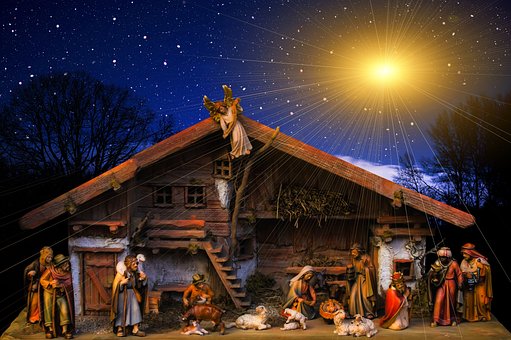
Finally overcoming their fear, Caleb left Ariel with the sheep. The others followed the heavenly directions, taking a one-month-old lamb with them, and quickly went to Bethlehem. It was just as the angel announced: they found the stable where Joseph and Mary were. When they saw the new-born baby, who was declared by the angels to be God, Micha slowly knelt and softly but incredulously asked, “Look, do you see what I see?”

Caleb and the others, presenting the lamb as a gift, knelt beside Micha and looked at baby Jesus with profound awe.

Joseph announced, “His name is Yohoshua (Jesus) – God is salvation. He will save us from our sin-laden existence.”

Mary gently added, “The prophecy proclaimed he will also be called Immanuel, for he is ‘God with us’.”  The shepherds joyfully returned to their flocks. But they told everyone they encountered about the newborn Christ, for their lives were changed forever!