
I asked young Fred if he knew what a telescope was. He responded, “It’s something you look through to see things wiggling in a drop of water.”
When I said that was a microscope, he asked “Aren’t they the same thing?”
After I described the difference, he gave a good summary: “Okay. One helps you see tiny things that are up close; and the other one helps you see big things that look tiny because they are far away.” I laughed, and said, “You got it.”

Mankind has used both microscopes and telescopes to help us understand more about life, and that leads us to today’s Reflection on Life.
“When we go see mom today, is there anything else you would like to do?”
When Carol asked that question four years ago, I responded, “I’ve wanted to visit the observatory at Palomar for years. It’s about forty miles from Mom, so let’s go early to Palomar Mountain, then visit mom afterwards.” And so we did.
The Spanish name “Palomar” means “place of the pigeons” or “pigeon roost”; for in the early 1800s, Spaniards found multiplied thousands of band-tailed pigeons on the mountain.
The nearest town to the observatory is Rincon, California. Its altitude is 1,030 feet above sea level. But make sure your car is in good condition because you will drive up a steep, narrow, winding road to an altitude of 5,616 feet. It is sixteen miles by road, but almost one mile straight up.

There, gracing the mountaintop is a glistening, white dome: the Palomar Observatory operated by the California Institute of Technology, known as Caltech.
George Ellery Hale conceived of the idea and wrote about it in 1928. The Rockefeller Foundation gave $6,000,000 toward the project, and the Corning Glassworks company created the 200-inch object that would become the primary mirror. Originally weighing twenty tons, Corning had a railway flatbed modified to transport it; and it took sixteen days to safely ship it from New York to Pasadena, California.
Receiving it on Palomar Mountain in April of 1936, Caltech personnel spent thirteen years cutting, grinding, and polishing the mirror. Finally weighing about fourteen tons, the concave mirror was installed and the telescope was put into operation in January of 1949. American astronomer Edwin Powell Hubble (after whom the Hubble telescope was named) was given the honor of being the first person to use the Palomar Telescope.
The observatory operates several telescopes: the 18-inch Schmidt scope, the 48-inch Samuel Oschin scope, a 60-inch scope, and the 200-inch Hale telescope which was the largest in the world for 45 years. The Gran Telescopio Canarias (Great Canary Telescope on the Spanish Canary Islands) is largest now, with a 409-inche mirror, which is 34 feet in diameter.
Using the Hale telescope on Palomar Mountain, we’ve discovered many things, among which are millions of distant galaxies and quasars, and we’ve studied the structure and chemistry of intergalactic clouds.
Jean Mueller, the first woman hired as a telescope operator at Palomar Mountain in 1985 (also the first woman to operate the Hooker telescope at the Mount Wilson Observatory near Los Angeles), discovered over 100 supernovae by studying Palomar data. A supernova is the explosion of a giant star with the resultant brightness of about ten billion suns.
Several recent projects – among many – include studying near-Earth asteroids, Kuiper Belt Objects, star formation, planets in other solar systems, and black holes.

Because of light pollution, the observatory has reduced its major operations, shifting more work to the Hubble Space telescope. Prior to the covid-19 pandemic, the observatory was open every clear night of the year except December 24 and 25. Sections of the Palomar Observatory were open to the public during the day where visitors could take self-guided tours daily from 9 a.m. to 3 p.m. Guided tours of the dome and portions of the observing area were available Saturdays and Sundays from April through October. I strongly recommend a visit to the site, and you will be amazed at what you learn. Information is available at the Observatory’s web site: http://www.astro.caltech.edu/palomar/homepage.html and http://www.astro.caltech.edu/palomar/visitor/.
I find it interesting that Job 9:9 and 38:32, written over 3,500 years ago, names Arcturus, Orion, Pleiades, and refers to nearby astronomical bodies. Psalm 8:3-4a tells us that Almighty God created the vastness of the seemingly infinite cosmos, but also reveals that God is concerned about mortal humanity. Scripture says, “When I consider thy heavens, the work of thy fingers, the moon and the stars, which thou hast ordained; What is man, that thou art mindful of him?”
Think of it: the ultimate Supreme, Sovereign God is concerned about finite, mortal man; and you don’t need a telescope to find Him, for He’s only a prayer away.
 My 97-year-old mother was in and out of hospitals, and getting ready to meet the Lord face-to-face. The family was getting ready for another big change; and as is often the case, the family wasn’t able to address every detail. We needed assistance. (The picture of mother and me was taken when she was 95.)
 Wm. G. Justice titled “Training Guide for Visiting the Sick.” Mr. Justice, referring to all the elderly, whether sick or not, said, “The purpose is to oversee the care of those who are hospitalized, sick, shut in, or are in some way in need of care; and to assure they have their needs met to the best of our ability.”
 1 Thessalonians 4:14 says, “For since we believe that Jesus died and was raised to life again, we also believe that when Jesus comes, God will bring back with Jesus all the Christians who have died” (NLT).
 “Okay – we’ve taken Sharon and Jim to the airport. What would you like to do next?” (The year was 2016.)
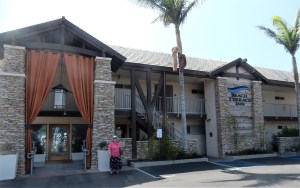 spotted a place called Beach Terrace Inn. “I wonder how much they charge for a night’s stay.” Translated into a man’s language, it actually means, “Find out how much it costs to stay here.” Yes, Ma’am.
 flashy.” Carol and I found that to be true.
 Charles sent me an e-mail and said, “I would really like to read your take on Chance (or Luck) vs Divine Providence.”
 entire life for us. Let’s see about this. If the average heart-rate is 70 beats per minute, God would have to stand there and specifically order each person’s heart to beat 36,817,200 time a year. Multiply that by 7,500,000,000 people in the world!
 Does God purposely engineer all that? No; all that happens because we are part of the human family. The Bible says that death will be the LAST enemy to be conquered (1 Corinthians 15:26), so we can expect the other maladies and difficulties to continue for a while.
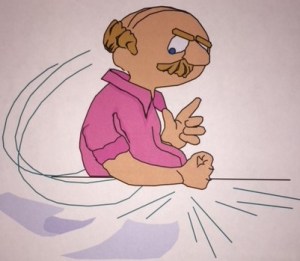 I heard it again: “I want peace at all costs!” That’s an interesting cry because people who say that don’t realize it is one of the most ignorant statements a peace-loving, freedom-loving person could utter.
 since 1948. The surrounding nations attack Israel. Israel wins and the defeated nations want peace. Then they say they will keep the peace if Israel gives land back. The US urges Israel to keep the peace at all costs. Israel does, and gives back land. The neighbors continue fighting and say they will continue to keep the peace if Israel gives back more land. Do you see what’s going on? They are lying: the neighbors don’t want peace with Israel!
 I were heading south on Arizona highway 89. We were almost to the little town of Congress when we saw a small brushfire beside the road. We surmised that the fire was caused by a foolish person throwing a cigarette out the window. It was hot, and a lot of dried vegetation (fuel for the fire) covered the country-side.
 Himself, doesn’t need our skills and abilities, but He does give us the privilege of exercising our gifts and abilities—what He gave us or enabled us to learn—to fulfill our portion of His plan: thus, growing His kingdom and helping mankind. You may be a computer technician, auto mechanic, writer, pastor, secretary, lawyer, politician, policeman, or fireman. Whatever your vocation, God calls each of us to work as though He (God) is our supervisor. He then helps us to be alert to situations, such as the fires, and directs us as to our part in putting them out.
 One day when I got home from work back in New Mexico, I found the yard blanketed with yellow flowers that would soon be replaced by round, geodesic white puff balls that easily break apart.
 geodesic weeds? And are they really weeds? Do they really disgrace the yard? After that day on our half-acre up at 7,834 feet altitude, I gained a different perspective of these beautiful specimens of life.
 operation), the tea can aid diabetics and those with urinary disorders. Containing antioxidants, dandelions could be useful in reducing free radicals in the body, which, in turn, could reduce the risk of cancer. Dandelions, like celery, are beneficial regarding intestinal health.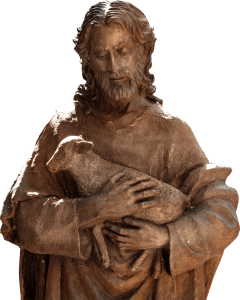
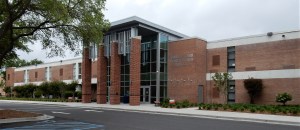 four years of high school, I attended four different schools: two in Southern California, the third near Boston, and I graduated in Charleston, South Carolina in 1964.
 Our tour boat backed away from the wharf and sailed around the bow of the USS Yorktown, CV-10, that was docked nearby. The Yorktown (built to replace the USS Yorktown, CV-5 that sunk in the Battle of Midway in June of 1942) was commissioned in 1943 and is huge; but with its flight deck looming 50 feet above our heads, it looked enormous.
 Have you ever watched a movie (or DVD) several times and wanted to see it again? My Precious Carol and I watched a film this past week called, “Monumental: In Search of America’s National Treasure,” staring Kirk Cameron. This was the second time I watched it, and I’ll watch it again. If you haven’t seen it, you should. It’s a 90-minute film about America’s beginning.
 established that the Founding Fathers followed to make the United States of America the most successful example of civil, economic, and religious liberty ever developed in the history of the world.
 The first governmental document in America was the Mayflower Compact. The Pilgrims established this document firmly on the principle that God should be the center of our public life. This guaranteed religious freedom.
 Gene Linzey