What Have You Been Up To?

“Hey, Gene, I haven’t seen much of you lately. What have you been up to?”

You may have a different name than I do, but has anyone ever asked you that kind of question? Most likely.

I suppose I have been out of sight from many of my friends recently. Yes, the covid pandemic took its toll on socializing this past year – and still is to some degree. But I’ve been busy for other reasons.

As a former pastor, I receive calls to fill in for ministers when they are on vacation or attending church conferences. Sometimes they call me to preach or teach on a special topic. If you read my blogs, you know that I am a devoted follower of the Lord Jesus Christ.
But last year I added another role: I format books. What is it that? One man said, “I write em, you format em, P&L publishes em.” And that is true. It is laborious and time-consuming but rewarding. I enjoy hearing people say, “I never believed I would actually get that book written, let alone published.”

A question many people ask is, “Who do you work for?” My answer is, “I work for you, the author.” And that is the truthful answer. However, the company I represent is P&L Publishing and Literary Services. You can read about them on their web site at plpubandlit.com.

So, what does a formatter do? The process is not fast, but it is simple to understand.

  1. Someone writes a story. This can take anywhere from a week to several years. The manuscript could be a novel, a historical account, a devotional, a how-to teaching, a cookbook, how to catch fish, or about anything you can think of. But then the writer wants it published.
  2. This step often involves an editor. Not always, but often. The editor is a professional who improves the writing and makes the book a better product. You can find more about our editing services on plpubandlit.com. The next step is where I come in.
  3. The formatter gets the necessary information from the author, puts the manuscript in the proper format and uploads the manuscript. Many of my authors do not go through an editor, but just want to publish the book. As the man said, “I write em, you format em, P&L publishes em.”

I have obviously oversimplified the process, but it gives you an idea of the publishing procedure and what I do.

If you are interested in writing a book but don’t know how to start or go about it, P&L also offers mentoring and project development services. But my part is formatting. If you’ve been writing and you now want to get it published, contact P&L Publishing and Literary Services at plpubandlit.com. Tell them you heard about them on my blog. Or, you can contact me directly at masters.servant@cox.net.

And now you know what I’ve been up to lately: I preach, teach, write, and format. I hope to hear from you.

Have a great day.

Memories of Dad

I was five years old, we lived in El Cajon, California, and the church building dad and the deacons built was completed. I was allowed to run in and around the building during certain phases of construction; but after completion, running in church was not allowed.

But I didn’t always obey my parents.

Reddy was my best friend, and when daddy wasn’t watching, we liked to run up the long flight of stairs on one side of the sanctuary, race in the upstairs hallway, and run down the stairs on the other side.

Dad warned me with, “I’ll tan your hide if you don’t obey me.” But for some reason, I did it anyway. I also went into his church office whenever I wanted to. After all, I was the pastor’s kid.

One Sunday morning dad had a personnel issue to handle, and told me to stay out of his office. I could obey that order. Until …

I told Reddy that Daddy was busy so we could run. “Goody!” Reddy almost shouted.

Up one side we ran, down the hall we raced, and ran down the steps on the other side. But getting ready to run down the steps on the second round, I tripped on the top step.

I tumbled head-over-heels all the way down. Miraculously, not a bone was broken and I wasn’t even bleeding anywhere. But my breathing mechanism had totally shut down!

In that situation, there was only one thing to do – Go See Daddy!

Not breathing, I burst into his office. Dad turned and was about to order me back out but saw that my face was turning blue and my mouth was wide open.

“Oh, my Lord!” I remember hearing dad say.

He quickly placed me over his knee, gave me a hard whack on the back which restarted my breathing, and said, “That’ll take care of you ‘til we get home!”

Now I had a different problem.

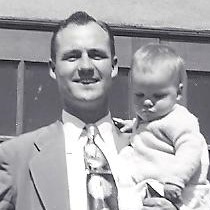
Back home after the church meeting, dad asked me what had happened. Fearfully, I admitted that I disobeyed him and tumbled down the stairs as I was running. (The picture is dad holding my sister, Sharon.)

I was amazed – and relieved – when dad pronounced, “Tumbling down the stairs was your punishment – this time.” Then pulling me to himself and wrapping his arms around me, he gently said, “Eugene, that fall was a hard lesson. Do you think you can remember not to run in church?”

There was only one answer: “Yes, daddy. I won’t run in church again.”

And I never did.

Three years later, we lived in Baldwin Park, California, and dad was in his final year of preparation to re-enter the US Navy as a chaplain. His schedule of seminary classes, being a pastor-husband-father, and sneaking in a few hours of sleep whenever possible, was quite full.

One Friday when I was sitting at the kitchen table with dad as he was finalizing his sermon for the coming Sunday, mom told me it was time for bed.

“Can I stay up with Daddy for a while?”

“No; it’s time for bed. Come on.”

“Can I PLEASE stay up for a little while? I don’t get to see Daddy very much.”

Dad looked up and said, “Eugene, if you want to stay up with me, you need to be very quiet. Don’t make a sound.”

“I’ll be quiet.” I never said something that fast before in my life.

Mom gave me a pencil (no pens back then), and dad gave me some paper. I was in heaven for another hour with my daddy. I have no idea what I wrote, scribbled, or doodled that night, but I remember the extreme joy of being with my daddy. And the well-worn Bible that dad was using that night is now in my office.

Dad is in heaven and our communication is over until I get there. But I do have the extreme joy of spending time with God – my eternal Father in heaven. He enjoys my visits.

God has an open-door policy, and continually invites us into His presence. Have you visited Him lately?

I Was Laid Off

Last week I talked about trust. This blog shows how trust and faith in God helps us.

In September of 1980, Rockwell, International in Tulsa hired me as an aerospace journeyman tool & die maker. I had previously worked for Boeing Aircraft Company as a toolmaker, so I knew the job. Boeing’s new plane was the 757, and Rockwell was building major portions of the fuselage.

But in the fall of 1983, we were finishing our portion and layoffs were announced. As four toolmakers were being laid off each week, my friends worried about me because we had young children to feed. I began worrying, too; but I finally prayed about it.

My prayer was simple, “Lord, what am I going to do?”; and I heard in my mind or spirit, “You’ll be here for at least three more years.”

I’ve never heard God speak audibly, and I don’t expect to in this life. But that was a direct answer to prayer. Jesus said in John 10:27, “My sheep hear my voice, and I know them, and they follow me.”

The next day my friends began helping me worry again, but I told them, “Don’t be concerned about me. I’ll be here at least three more years.” That set their hives a-buzzing! But I didn’t tell them how I knew.

Two weeks later, the supervisor announced that eight of us would be laid off the following Friday – and I was included.

That’s when the Lord prompted me to tell them how I knew; and I was surprised at the mockery I received that entire week. Even my Christian friends thought I was nuts. In front of the workers, the supervisor told me, “Gene, you will be laid off. Don’t make things up.” Giving me my pink slip, he was, however, intrigued at my calm demeanor and my confidence.

On Thursday, the day before my layoff, we were told to clean out our toolboxes, and Friday would be a “free day” – show up but do no work. I told him I wanted to continue working through Friday evening and clean my box out on Monday. Shaking his head, the supervisor agreed.

Friday morning, the supervisor called us to a group meeting. When he publicly asked me if I was ready to be laid off, I told him I wasn’t leaving. He asked me if was sure about it, and I said “Yes.” One of the workers asked if I thought I really heard from God, and I said, “Yes.” Many of them snickered or made derogatory comments.

The boss said, “You with pink slips, step forward and hold them up.” We did. He then looked directly at me and said, “Ten minutes ago, I received a notice from the main office. Tear those slips up. Your layoffs are cancelled, and we are bringing eight others back.”

THAT set their hives a-buzzing!

They gathered around me and wanted to know more. I had a great opportunity to tell them about Jesus and how He leads us … if we listen. For some reason, they all held me in much higher esteem.

What they didn’t know was, this was God’s story, not mine.

The next year I was promoted into management, and had my own crew building portions of the B1-B bomber. But several years later, our contract was winding down and I was given the option of either being laid off within the month or becoming a toolmaker again – then being laid off. That’s a “no-brainer”: be a toolmaker – it’s a paycheck.

 Four months later, when word came that layoffs for the toolmakers were on the horizon, my friends asked me if I was going to be laid off. I said I would pray about it.

Three days later I told them, “I have heard nothing from the Lord. Therefore, I can only assume that I will be laid off.”

That sent shudders down their spines, because that meant they would be laid off, too. A month later, I cleaned out my toolbox. But, believe-it-or-not, I was hired within two weeks by McDonnel-Douglas in Saint Louis, MO.

From the time I heard “You’ll be here for at least three more years” to my eventual layoff, almost four years had passed.

Not only did that episode teach my friends about praying and listening to the Lord, it increased my own faith in Jesus Christ. And that’s what the Lord wants from all of us: learn to pray and listen. If we do, our history will become His Story.

I can only encourage you to pray and ask the Lord for guidance. He can help you through any and every problem.

Do You Trust God?

What in the world is “trust”? Can “trust” be qualified? What I am getting at is… oh, let’s start over.

Let’s define the word. Trust is a firm belief in the reliability, truth, ability, or strength of someone or something. It is conviction · credence · reliance

Can a person live without ever trusting someone or something? No.

You think I’m wrong? Let’s check it out.

Are you sitting on a chair or standing up? Either way, you are trusting something. You either trust the chair to hold you – as I am doing right now – or you trust the floor to hold you; and the floor is holding the chair. I don’t care if you weigh 75 pounds or 575 pounds: you trust the floor, chairs, the bed, even a motor vehicle to hold you; which proves you trust their manufacturers. So we just proved that everyone on earth trusts someone or something. It’s just a matter of in what or in whom we will place that trust.

Next: can “trust” be qualified? That is, can you partially trust someone? Or is it an all-or-nothing concept?

When I was five years old, we lived in El Cajon, California. My dad put me on the top bunkbed, and said, “When I say ‘jump’, you jump to me. (Yes, the lights were on.) But I was afraid of falling, so I told dad I didn’t want to jump. Dad promised me that there was absolutely no way I could fall; because even if I jumped awkwardly or inadvertently fell off the bed, he would still catch me.

I don’t know if you understand the fear of falling, but I was almost scared to death! I was emotionally paralyzed. But dad said very gently, “Eugene, if you can’t trust me, how will you ever learn to trust God?” You see, the proof or result of trust is obedience.

 Well that made sense – even to a 5-year-old.

So I suddenly leapt off the bed and hit dad in the chest with my 40 pounds and nearly knocked him over. Dad caught his balance and asked, “Why didn’t you warn me you were going to jump?” I responded, “You said you would catch me.” Dad chuckled, hugged me, and said, “Good job.”

Dad taught me about trust. Dad taught me a lot about life.

Did I fully trust dad, or did I partially trust him? If we consider my fear, we might say I partially trusted him. But if we consider my obedience, we say I absolutely trusted him. Obedience verifies trust.

What was it dad said? “Eugene, if you can’t trust me, how will you ever learn to trust God?”

As I grew older, I learned to trust God with my entire life.

How would my faith in God have been affected if dad dropped me? That’s hard to say because dad caught me. However, Dad most likely would have picked me up, apologized profusely to mom (who was watching), and tenderly talked to me about what went wrong. And because of that, I think I would still have learned to trust God.

I’ve experienced many situations since I left my parents’ home where I could have forfeited my faith and lost trust in God. But I am reminded of John 6:65-68. Many of Jesus’ disciples left Him, and Jesus asked if the twelve would also leave. “Peter responded, Lord, to whom shall we go? You have the words of eternal life.”

Job was one of the richest men in the world, and he lost everything. He lost his children, livestock, respect and admiration of friends and business associates, and was accused of being a terrible sinner.

But in spite of all of that, Job never lost his faith in God. He wanted to talk to God face-to-face and defend himself, but he never lost his faith. Job 13:15a says, “Though he [God] slay me, yet will I trust in him.” In chapter 19 verse 25, Job proclaims, “I know that my Redeemer lives, and he will eventually come to the earth.” And God, in the form of Jesus of Nazareth, did come to earth to redeem us.

Human mistakes and misfortunes should not deter us from trusting God. Jesus said if we love him, we will obey him. And Obedience is a manifestation of trust.

So, do you trust God?

Are You Color-Blind?

Years ago, I suspected that one of my friends might have a vision difficulty, so I asked him: “Are you color-blind?” He surprised me by asking if I referred to ethnic identification. We laughed, and he told me he was partially color-blind. But he had a point to which I will return later.

So, optically-speaking, what does it mean to be color-blind? Normally, color-blindness is an inherited genetic vision problem; but aging, disease, sickness, or an injury can also trigger it. Sometimes color-blindness can be a side-effect of medicine.

A color-blind person has difficulty seeing primary colors, or a mix of these colors from which every other conceivable color comes. Three theories potentially define primary colors. One basic concept identifies red, blue, and green; and another theory classifies red, blue, and yellow as primary. A third theory includes red, blue, green, and yellow.

A popular belief is that color-blind people cannot see any color at all, but that isn’t always correct. Therefore, the term is actually misleading, but we’ll use it for ease of understanding in this Reflection. And let me add here: very seldom will people even with excellent vision see colors exactly the same as others do.

As various mixes of primary colors produce the different colors and hues, the light-receiving cones in the retinas of our eyes sense variations of the light spectrum which the brain interprets as the hundreds of possible colors. The highest concentration of these color-receiving cones is in the macula – the central part of the retina. Color-blindness occurs when the cones don’t function properly.

One common method of diagnosing color-blindness is by looking at patterns of variously colored dots and trying to decipher numbers, letters, or other patterns embedded therein. The patterns the person can or cannot recognize reveal the area of difficulty.

Inherited color-blindness cannot be treated at present, but sometimes an acquired deficiency can be treated. And I found it interesting that men (about 8%) are more likely to have the color-recognition problem than women (half a percent); but more women are carriers of the deficiency.

Color-blindness may make people ineligible for some vocations, such as flying planes. But during World War II, the Army Air Corp (predecessor to the United States Air Force) hired color-blind people to be “spotters” in planes because they would not be fooled by the camouflaging that was used to hide trucks, cannons, supplies, and soldiers.

What I found to be even more interesting is that some “color-blind” people are not really color-blind. Their eyes function properly and the retinas receive all available colors; but the individuals do not recognize color. The problem here is perception, not vision.

Many folks take the handicap in stride and get on with life. Some artists such as Australia’s Clifton Pugh overcame his handicap by focusing on shades of light and dark rather than on overt color; and France’s Charles Méryon overcame color-deficiency by focusing on etching rather than on painting.

Let me get back to ethnic identification.

My eyes have been tested for color reception, and they came out very good. Also, with my eye-glasses, I have near 20-10 (near perfect) vision. But I am somewhat “color-blind” regarding ethnicity. Many of my friends are not Caucasian or White, yet we call each other brother or sister. Ethnicity is not an issue and the love of Christ flows between us. As I interact with people from around the world, I see people made in the image of God. Even if the person isn’t a Christian, I still see someone whom Jesus loves and for whom Jesus died.

But there is another type of “color-blindness”. As our spotters in the Army Air Corp in World War II were not fooled by enemy camouflage, God’s “color-blind” people are not fooled by Satan’s deception in education, politics, and in the church.

True Vision

They are not fooled by anti-Biblical teaching that is camouflaged by religious, philosophical, political, or educational rhetoric. They are not fooled by so-called political-correctness that squelches Christianity while uplifting other religions, philosophies, and lifestyles.

These folks are blessed by the Lord, but they often come under attack. The world rejects or hates them and misguided Christians misunderstand them. But these color-blind people, like the Apostle Paul and Billy Graham, are the ones who keep the faith in Almighty God alive, and spread it around the world. If you have that kind of vision, as I do, don’t back down. People need to hear us.

The Disappearing Light Beam

I’m sure many of you have seen a cat chase things. Butterflies, moths, mice, strings, almost anything that is small that moves. Kittens and cats do that, and I call that one of the many “cat antics.”

Our daughter had my laser pointer and was playing with her cat – Tiggy. Tig was in her 4-wheel-drive mode with all claws extended to get traction so she could make split-second turns on the carpet. Rebecca finally allowed Tig to “catch” the light beam. But you should have seen the perplexed look on the cat’s face when she lifted her paw only to find that the “bug” had escaped. After looking around for a minute, she walked away.

But our dog, Tyke, had been watching. He knew better than to interrupt the cat because Tig was older and had seniority in the family. Rebecca gave me the laser pointer because I had a different plan.

I put Tyke through the same maneuvers as Rebecca put Tiggy, but with Tyke’s size and slower reactions, I went slower. The dog tired out quicker than the cat and Tyke finally just laid down on the carpet. That’s when I employed my second thought.

I moved the light beam slowly just out of Tyke’s reach as the critter watched. I gave jerky movements with the light and Tyke’s head jerked each time. Then I did it. I ran the beam up and touched his paw.

You should have seen it! Tyke yelped and jumped off that carpet as though a big rock dropped on his foot. Then he looked at me, back at the light beam, slowly went up to sniff it, but I turned it off before he got to it. He looked back at me, then, using his natural sniffer, tried to find it. He never did.

Tiggy’s and Tyke’s perceptions were that the light beam was a solid object, and they reacted according to their perception of reality. Do you know that people do the same thing?

Years ago, I read of a professional basketball player who playfully pointed his gun at a friend. Sincerely believing the gun was not loaded, he acted on his perception of reality and pulled the trigger. When the resounding explosion subsided and the smoke cleared, his friend was dead.

Perceptions can be beneficial, a diversion, or a devastating error, and we must always get a reality check before we make a decision. I understand it’s quite difficult to give Tiggy and Tyke a reality check, but we can help people. Let’s look at two concepts.

Financial security. There’s nothing wrong with gaining financial stability. We are wise to plan for the future, including for retirement. But throughout history, money has disappeared like that light under my pine tree. Stock markets around the world have crashed. Expenses due to sickness have soaked up saving accounts. Casinos have gladly emptied people’s bank accounts. You can think up many other scenarios.

Millions of entrepreneurs have created companies that have given financial blessings to countless millions of people around the world. A great many business owners became prosperous and retired with an abundance of wealth. But many businesses fail. The average failure rate is 20% within the first year, and up to 50% within five years. Like the light the critters chased, businesses disappear.

Tree branches. I cut several branches off the trees in our back yard. When the grand kids saw them two weeks later, the younger one exclaimed, “Grandpa, the branches are still alive. We could plant them and make some new trees.” I explained that the needles on pine tree branches will stay green for almost a month after it was cut off the tree. The branches look alive, but they’re really dead. Appearances are deceiving.

Financial security and business ownership are wonderful, and grants freedom from worry.

But when our blessings disappear, when our securities vanish, when our health turns sour, when our lives become unstable, when a lot of what we perceive to be real dissipates, what should we do?

For those of us who have a dynamic relationship with God and have been trusting Him for our REAL security, the disappearing lights are disappointments but are not personally destructive. Our faith is not in temporal things that can vanish, but in Jesus Christ. In Hebrews 13:5, Jesus is quoted as saying, “I will never leave you nor forsake you.”

And He won’t. Therefore, get to know Jesus and put your trust and your faith in Him. He is no disappearing light beam. He is Alive!

You Can Rule With God

The following is an excerpt from the chapter on Humility in my book, Charter of the Christian Faith.

Years ago, Tom Whittlesey, a life-long friend and author in Tulsa, Oklahoma, wrote and gave me a proverb that helps me stay on track:

“God is not impressed with our ability; God is not disappointed with our inability; God is only gratified with our availability.”

With that in mind, think about the following people who were available to God.

  1. Noah wasn’t a ship builder, but he obeyed God and saved mankind from total annihilation.
  2. Abraham was trained to be an idol-maker but became the father of the Faith.
  3. Sarah was Abraham’s pampered half-sister, but she became the mother of the Jewish nation.
  4. Moses grew up in the Egyptian palace, became a general in the Egyptian army, and committed murder. Nevertheless, he prompted Pharaoh to set the people free.
  5. Rahab was an innkeeper, and perhaps a prostitute; but she assisted the Israelites as they crossed the Jordan River. Then marrying an Israelite, she became one of the ancestresses of Jesus.
  6. King David committed adultery and ordered a murder, but he wrote many of the Psalms while making Israel a mighty nation.
  7. Deborah, the judge, was not a soldier, but she gave Barak the battle plan.
  8. Peter was an uncouth, impulsive fisherman, but he is the one who declared Jesus to be the Christ, the Son of the Living God! and became a leader in the early Church.
  9. Saul arrested Christians to be tortured or killed, but he became the Apostle Paul, ministered to the gentile nations, and wrote at least thirteen of the New Testament books.
  10. Martin Luther was a depressed monk, but he rediscovered, “By faith you are saved; not by works lest any man should boast.”
  11. Corrie ten Boom was a watchmaker’s daughter; but surviving the holocaust during World War II, she shared her testimony of love and forgiveness around the world.
  12. Billy Graham was raised on a dairy farm, but he took the Bible and the Gospel of Jesus Christ to the world.

Did you notice how each of the people on that list helped build the kingdom of God? They were not trained to do what made them famous, and all of them would have remained in the shadows of history had they not obeyed God. However, because they responded to the Lord, their influence is still being felt in the world, and that is one way by which they are rulers in God’s Kingdom.

Because of God’s promises, their rulership has been increased in heaven. The principle is in Luke 19:17 where Jesus was telling a story. “The king said to the servant, ‘You are a good servant. Since I can trust you with small things, I will let you rule over ten of my cities” (NCV). When we humbly avail ourselves to the Lord, and obey Him, God is not hesitant to expand our reputation in order to build His Kingdom. Let me repeat: God is not impressed with our ability; God is not disappointed with our inability; God is only gratified with our availability.

God created us to rule with Him. His response to our humble availability is likely to be, I am indeed pleased. After a maturing process, you shall become a ruler in My Kingdom, beginning in this earthly life.

Read more in Charter of the Christian Faith – available at Amazon.com.

Rocky Mountain National Park

Have you ever seen the Rocky Mountains? No, I don’t mean in a picture, on television, in the theater, or on IMAX. Have you ever driven through the Great Rocky Mountains? Perhaps many of you have driven through a portion of them, but did you observe the grandeur of these magnificent granite formations?

Carol and I visited the Rocky Mountain National Park, just after viewing the total solar eclipse in Glendo, Wyoming, as we celebrated our 51st wedding anniversary. It was a spectacular trip. The word “spectacular” is the keynote for this trip.

The Rocky Mountains, commonly called the Rockies, start in northern British Columbia, Canada, and extend about 3,000 miles south to New Mexico, USA. Several facts about the spectacular Rocky Mountain features are: 1) the Sangre de Christo Mountains run from New Mexico through Colorado; 2) the Rio Grande has its headwaters near Wolf Creek in Southern Colorado; 3) Pikes Peak is near Colorado Springs and Manitou Springs; 4) the Grand Tetons and Big Horn Mountains are located in Wyoming; 5) Branff National Park is in Alberta, Canada; and there are many more! This mountain range should not be confused with the Pacific Coast Ranges, the Cascade Range, or the Sierra Nevadas.

Some geologists say the Rockies are well over 55 million years old on a 4.54 billion-year-old earth; some say they were created about 6,000 years ago when the earth was created; and others say the Rockies were created just after the great flood about 4,500 years ago. But whatever age is ascribed to them (only God knows their true age), my Precious and I had a great trip.

The original Native American Cree name was probably “as-sin-wati”; loosely translated as “seen across plains, look like rocky mass.” But their present name was given by Frenchman Jacque Legardeur de Saint-Pierre in 1752 when he called them “les Montagnes de Roches” (pronounced: lay Montanye de Rosh) – or, the mountains of rocks. And that evolved into the Rocky Mountains. Seventy-four peaks in the Rocky Mountain National Park (RMNP) are over 12,000 feet; twenty-three more top out over 13,000 feet; and two peaks are over 14,000 feet (called 14ers). That’s a total of 99 spectacular peaks in only 415 square miles.

This continental ridge is 70 miles wide at its narrowest, and 300 at its greatest span. I read that the lowest elevation of the Rockies is 3,400 feet above sea level where the Arkansas River flows from Colorado into Kansas; but I didn’t know the base of the Rockies reached that far. And the highest point is magnificent Mount Elbert in Colorado at 14,400 feet.

Driving through Boulder, CO, we started our tour through the RMNP in the town of Estes Park, CO. situated at 7,522 feet. The east entrance to the park is on highway 36, only 3.5 miles from town. If you are driving from the south or west, you can take exit 232 on I-70, west of Denver, and drive north on highway 40. Follow the signs.

Hiking is a common activity. Starting at the parking lot near Bear Lake at 9,475 feet altitude, seven lakes are within 4.7 miles walking distance. That is: 4.7 miles – ONE WAY. Save your energy because you probably want to come back. We walked around Bear Lake – only 256 feet away – and back to the car.

We drove down Devil’s Gulch but couldn’t figure why the name because it’s a spectacular drive. The next day, we left Estes Park, drove to I-70, took exit 232, and entered the Park from the other side. Did I say the scenery was spectacular? Well, it WAS!

Going through Idaho Springs, Granby, and Grand Lake, the west entrance was 145 miles from Estes Park and the views were breath-taking. We visited the Alpine Visitor Center and the Trail Ridge Store above the tree line at 11,796 feet and took pictures of a coyote pouncing on an unseen rodent – probably a mountain vole, yellow-bellied marmot, or some other high-altitude critter. Words and pictures cannot adequately describe our emotions and experiences as we saw God’s handiwork in the high Rockies.

This trip caused me to focus more intently on my relationship with Almighty God: the Creator of every natural thing we saw. The song by Stuart Hamblen sums it up: “How big is God, how big and wide his vast domain, to try to tell these lips can only start. He’s big enough to rule the mighty universe, yet small enough to live within my heart.”

If you get the opportunity, I encourage you to visit the Rocky Mountain National Park. And you can call them les Montagnes de Roches if you prefer.

Happy Traveling.

The Beatitudes are Progressive

This is a follow-up to last week’s blog. It gives a little more insight into the book, Charter of the Christian Faith.

I began seriously studying the Beatitudes while attending the Oklahoma Baptist University in 1985. At the end of the semester, I had to choose one of five topics for my thesis, and I chose Matthew 5:1-12. As I began the research, I experienced almost as much confusion as I did when I read the Beatitudes as a child. But the more I dug into the topic, the more interesting it became, and the greater impact it had on my life.

A major concept I discovered is that the Beatitudes are progressive; they are sequential steps to godliness. It wasn’t obvious when I compared Blessed are the poor in spirit, for theirs is the kingdom of God with Blessed are they that mourn, for they shall be comforted. The words didn’t adequately convey the intent of the Beatitudes; that’s why it’s difficult to comprehend the depth of the message. But when I realized that poor in spirit is sincere humility and mourning is deep sorrow because I have offended God, it became clear that there is an order to these concepts.

This example will clarify my point. When we want to learn math, we don’t begin by studying lambda calculus or advanced trigonometry. We start with adding and subtracting, and progress from there. In like manner, we’ll find out that everything we need to know, or even want to know, about enhancing our relationship with Jesus, starts with humility: the first Beatitude.

As we study the Bible, we find that the Beatitudes, and how God uses them to change and mature us, flow in magnificent sequence—in perfect order.

As we often climb stairs one step at a time to enter a house, mankind has known for thousands of years that we learn one step at a time. Jesus knew it and was a master teacher. That’s why these are not random thoughts to mull over; they are sequential. Following a logical order, each Beatitude is the step to reach the next one.

The goal that God the Father set before all of us is for us to become like Christ, but He knows it will be a life-long endeavor. Therefore, He provided the eight-step process the Church calls the Beatitudes to make the spiritual journey more understandable. In fact, the Sermon on the Mount, prefaced by the Beatitudes “is considered to be the most important sermon Jesus ever preached and starts with what is considered to be the most important attitudes that we need to have, The Beatitudes.”11

Preceding each chapter, is a pictorial illustration of the journey. The man represents humanity, the donkey represents the human mind without Christ, and the lion represents the Lion of Judah, and that is Jesus who is available to help us.

How did Jesus begin this teaching?

And seeing the multitudes, He went up into a mountain; and when He was set, His disciples came unto Him. And He opened His mouth, and taught them, saying….

Whoa! Stop there. Let’s think about this.

There were 5,000 men, plus possibly another 5,000 women and children. How could a multitude that large hear, let alone understand, someone sitting down? Something doesn’t seem right about this picture.

That’s why we study. Let’s read further and analyze the scene.

Although Jesus spoke to large crowds at other times, Matthew 5:2 reveals that Jesus may not have been speaking loudly to thousands, or even hundreds of men, women, and children in this setting. Others may have heard, but the entire Sermon on the Mount—three chapters—was spoken primarily to these twelve men. Why do I say that?

The phrase He opened His mouth is a solemn pronunciation. This is in contrast with verses such as Mark 15:1 which says, And they cried out again, Crucify him! To cry out is to shout! But the phrase He opened His mouth is an important, quiet activity. Jesus was teaching His followers personally, quietly, and without the interference of a noisy crowd.

According to the end of chapter seven, there were many people on the hillside, and some listened in and learned from the Master. (Jesus also taught these same truths to others in different places.) But in this setting, although others may have heard, Jesus purposely addressed a small group of twelve men.

Learn more about Jesus’ primary teaching in the New Testament, and how you can become an effective representative of Almighty God by reading Charter of the Christian Faith.

Note: The book Charter of the Christian Faith has been rewritten under the title Truth not meant to be Hidden. You may find the book on Amazon.

THE BE-WHATITUDES?

For many years I’ve taught about the Bible and from the Bible. One of the series I’ve been asked to teach on quite often is found in the 5th chapter of Matthew. Because of the profound nature of that section of Scripture, I call this teaching, Charter of the Christian Faith. Today’s blog is a portion of the preface of my book by the same name, and will give you a feel for what’s in the following pages. The foreword is written by Rev. David Ravenhill.

I remember as a child in Sunday School, one of my teachers wanted us to memorize the be-something-or-others; but for the life of me, I couldn’t figure out why. I hated memorizing, and these things didn’t make any sense to me. Not only did I not understand them, but the teacher also couldn’t adequately explain them, either so I never got a gold star for learning those be-whatitudes.

But I did mentally retain other verses that made sense to me. Luke 19:10, “For the Son of man is come to seek and to save that which was lost.” And John 3:16, “For God so loved the world that He gave His only begotten Son that whosoever believeth in Him should not perish but have everlasting life.” I understood those verses, even in the King James Version. In fact, most of what I committed to memory was from the KJV.

Also, Acts 1:11 clearly told me that while the people stood watching the incredulous sight of Jesus ascending into the sky, angels told them how Jesus will return. Men of Galilee, they said, why are you standing here staring into heaven? Jesus has been taken from you into heaven, but someday He will return from heaven in the same way you saw Him go! (NLT). That gave me confidence that Jesus would come back, and it told me how He would return. No questions, no guesses. No less than 67 famous people, and more than five hundred others, have claimed to be the returned messiah; but people should have understood they were fake messiahs because not one of them came the way the Bible says Jesus would return.

Nevertheless, I had a hard time with the Beatitudes, but I wasn’t alone. Author Philip Yancey said in his book, The Jesus I Never Knew, “I learned the Beatitudes [as a teenager] yet I never faced the fact that none of us—I above all—could make sense of those mysterious sayings, let alone live by them.” He later said, “If I fail to understand this teaching, I fail to understand Him [Jesus].” That is a powerful statement.

Teacher and song-writer Bill Gaither said, “What we call the Beatitudes still challenge our value systems every day.” Many people—including many in the Church—view the Beatitudes merely as lofty ideals: holy-sounding platitudes which are beyond our grasp. Some people think of them as verses or sayings to comfort the spirit in time of trouble. But is this the primary intent of the first major teaching that Jesus gave us in the New Testament? I don’t think so.

I believe Matthew 5:3-12 is the Charter of the Christian Faith, and this Charter is developed in the full Sermon on the Mount in chapters five through seven.

Again, quoting E. Stanley Jones, “Years ago when I asked Mahatma Gandhi what we could do to naturalize Christianity in India so that it would cease to be a foreign thing, among other concepts he replied: ‘Practice your religion without adulterating it or toning it down’—and he had in mind the Sermon on the Mount.… This fresh discovery, by a Hindu, of a truth long buried beneath the armaments of the fighting West, has been one of the most important spiritual discoveries of modern times.”

In order to properly understand the Beatitudes, we must realize they were not originally intended for our consolation, and they’re not statements to make us sound spiritual. Rather, they comprise one of the most important sets of instructions we could ever receive.

I’ll share more highlights in weeks to come, but you can order your copy on Amazon today. Also, check out my website at genelinzey.com.