Notes on Marriage

What does it take to have a joyful, long-lasting Marriage? Not merely long-lasting, but joyfully long-lasting. This topic could possibly fill 75 books, but I’d like to share two simple ideas that will help.

First: Develop a Deep-Seated Desire to Honor the Lord.

I accepted the Lord into my life at age 5 – and I remember it clearly even today – but I didn’t know much about maturing in my Christian walk until after Carol and I were married. Was I a Christian? Yes. Did I turn away from the world? Yes. That’s why I turned down the invitation at age 18 to go to Hollywood.  Did I love the Lord? Yes, as much as I knew how.

God knew how to get my attention, and I listened. At age 15, He let me know that I would get married early. But I didn’t go looking for a girl-friend for a prospective wife: I knew God would bring her to me – or take me to her. And He did.

We married on August 22, 1966: my 20th birthday anniversary. We said our vows from memory and sang a duet for our wedding; the title is Submission [to the will of God].

Throughout our marriage, I had three priorities: 1) Serve the Lord to the best of my ability, 2) Take care of my family, and 3) In everything I do, give it my best effort. I decided to be the perfect husband and the perfect father. Well, I knew there is no such thing as perfect, but I would be next to it.

WRONG! I made many mistakes, and that shouldn’t surprise anyone.

But my strongest desire in the world was to live for the Lord in the best way I knew how. I also knew that Carol was more spiritually mature than I was, and I learned from her.

Second: Develop a Deep-Seated Desire to Honor your Spouse.

I had a flippant outlook on life until Carol and I were married. I was a mediocre student in high school and my first two years in college. But when we were married, my outlook on life changed. I excelled in all my schooling and vocational work. As a bi-vocational pastor, I helped stabilize churches and businesses.

But putting that kind of drive into husband-hood and fatherhood caused strife. Something needed to change. But what? My attitude, for starters. Here are several items I had to work on.

Be kind to others. Accept them for who they are. If a change needs to be made, allow God to do the work.

Be kind to Carol and the kids. Don’t try to force them into my mold. Allow them to grow into their own person. Guide them. Don’t order them, but help them.

Listen to Carol. Spend time with her. Allow her to freely express her thoughts and feelings. It was hard for me to listen without trying to fix everything, but listening without interrupting is sometimes the best thing a person can do.

Don’t try to solve everyone’s problems. I don’t know as much as I think I do, anyway. I need to allow the Holy Spirit to be the Fixer. Don’t try to take His place, but as much as humanly possible, be available to help.

When Carol & I seem to get upset with each other, it isn’t always because of something we did wrong. We might be bothered about another issue, and we’re subconsciously expressing our feelings about it. We learned this from I Samuel 8:1-9. The people were upset with the prophet Samuel; they wanted a king to rule them instead of a prophet. God told Samuel, “They’re not rejecting you, Samuel; they’re rejecting Me.”

That told Carol and me we aren’t normally upset with each other, so don’t interpret disagreements as personal attacks. The fight isn’t ours, and the Lord will help us to eventually settle it. I call it: Don’t catch the verbal hand-grenades. Don’t retaliate or respond to the perceived attack.

Don’t try to resolve every misunderstanding because some problems will not be resolved this side of the grave. Most problems are not life & death issues; they are not violations of our marriage vows; and they won’t make much of a difference anyway. State your opinions, but do not require changes. Allow each other the emotional freedom to be himself or herself.

Be each other’s best friend.

So honor the Lord, and honor your spouse; you will be surprised how much happier you both will be, and how much more joyful you home will be.

What’s on Your Mind?

One day when I was 12 years old, dad asked me, “What are you thinking about?”

“I was just remembering the trip you and mom took me on when I was five. We went to Yosemite, and we watched the fire fall from the top of the cliff.”

“You remember that? Seven years ago? Can you tell me about it?”

I surprised dad with all that I remembered. About driving through the park, where we camped, and the park ranger talking with the visitors. Then at nine o’ clock at night, the ranger hollered to the men up on Glacier Point, “Let the fire fall!” And when the rangers up on the cliff began pushing the burning wood and hot coals over the edge, it looked like a glowing waterfall.

I found out later that the men on Glacier Point couldn’t hear the ranger; everything was timed.

“Why don’t you write about that vacation?”

“Dad, I hate writing, and my handwriting is terrible.”

“A typewriter can fix your writing, but only you can fix the desire to write. Writing will be important to you someday, so you may as well start now.”

He told me to get a sheet of paper and a pencil. I did. He then said something funny. At least it seemed strange to me. “Make the pencil move and make the lines mean something. Start with today’s date, and the name of something you are interested in. You can even write about watching the fire fall.”

I knew the day’s date, and dad knew I loved kittens. “I have an idea, write what you like about kittens.”

That didn’t make me like to write, but I enjoyed talking about cats. So dad is the one who jump-started me in my writing career and the desire to study the Bible. But it took several more years and a few more nudges to get the ball rolling.

My seventh-grade teacher, Mr. Beharka, and my college history professor, Dr. J.C. Holsinger, are the two who propelled me into studying history. When I realized that I could merge history with the Bible, I came alive.

Years later, friends and acquaintances began asking me questions about history, the Bible, science, a few other topics, and I discovered that I enjoyed writing my thoughts to share with them. In time, my writing became a teaching tool.

How about you who are reading this note? Have you thought about writing? No, you don’t have to attend a Dale Carnegie writing course, attend the university, or take an online writing class. But someone – could be your children, grandchildren, church friends or social club – is interested in you. Someone is interested in what you’ve experienced, what you’ve learned, who you are inside. You are important.

You don’t even have to join a writers guild, although that could help. My wife, Carol, said for decades that she wasn’t a writer until she finally accepted my challenge. She agreed to write about something and let the guild members read it. Guess what? She wrote it very well, they enjoyed it, and encouraged her to write more. It surprised her to no end when she won a $200 award in a writing contest.

Your experiences, your world-view, your outlook on life can help others learn how to face a challenge, learn how to overcome a problem, even learn how to enjoy life. Someone needs to hear from you, and you can start with getting a pencil … no, let’s come up to date. You can start with turning on your computer, typing your name and date, and the name of something you’re interested in.

What’s on your mind? Write about it. Encourage others with your thoughts. You are more important than you think you are. And if you need help or have questions, you can contact me through the connect page. Have a great week.

God’s Foresight, Love, and Protection

Several years ago, Carol and I visited Gettysburg, Pennsylvania. We settled in, and decided to get our laundry washed before the rest of the crowd in the Gettysburg RV Campground figured out where the laundry room was. It was dark and we were getting ready to fold the clean clothes when I got sight of the half-moon out the window.

“Precious, wait a minute. I’ve got to get a picture of the moon.” The moon, planets, sun, and stars have intrigued me all my life. I have hundreds of pictures of the moon, many of the sun, and a few of Mars. But my pictures won’t hold a candle to the collection David Cater has. Mr. Cater writes articles on humankind’s astronomical frontier and star-gazing for numerous newspapers, and I greatly enjoy it.

As I walked outside, I thought of his columns.

Outside the laundry room, my eyes adjusted to the darkness, and I saw two smaller dots: one at the two o’clock position from the moon, and a dimmer dot at the 10:30 position.

Doing a quick check on Google, I discovered what Mr. Cater could have easily told me: the brighter dot was Jupiter, approximately 484 million miles distant at that time, and the dimmer dot was Saturn, approximately 920 million miles from earth at that time. However, the internet isn’t always correct but Mr. Cater would know.

The reports also said that these gas planets wouldn’t reach this position relative to the moon and our visual perspective again for another 20 years.

I went back into the laundry room to keep my promise to my Precious: I helped fold the clothes. But Carol became curious about my excitement, and she stepped outside to peer at the night sky. Several other campers walking by looked up when I was describing these two satellites of the sun and one of the earth, and they became awestruck.

One said, “I never knew we could see other planets without a telescope.”

Another quipped, “How do you know which one is what?” “Look it up on Google.” “Oh, yeah. I should have known that.”

Jupiter is the largest of our 8 (or 9) planets. How big is it? Its diameter is about 87,000 miles, it takes 12 earth-years to orbit the sun, and it might have 79 moons – several of which are larger than our moon. It’s possible that Jupiter has a solid core that is at least 12 times the mass of our earth, but Jupiter as a whole has a mass of about 318 times that of earth. Most of the “atmosphere” is comprised of hydrogen and helium. Since its gravitational pull is powerful, it is a primary protector of the earth by attracting and capturing dangerous comets and asteroids that might imperil the earth.

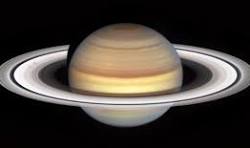
Saturn circles the sun once every 29 earth years, and has a diameter of about 72,400 miles, but the diameter of its spectacular rings is about 170,000 miles. Saturn is the second-largest planet in our solar system. It probably has a solid core, but we’re not sure of its makeup. It could be rock and iron, ice made of water, ammonia, or helium, or possibly fluid metallic hydrogen. It’s atmosphere is primarily of hydrogen and helium. Saturn is about 95 times the earth’s mass, has 82 known moons with probably many more hiding in the rings. Saturn, also, is a protector of earth due to its gravitational pull.

But with all the admiration and attention we bestow on these two giants that we can see without a telescope, let’s not forget two more protectors. Many of the dangerous astronomical bullets (meteors, asteroids, comets) that escape the gas bullies are caught by the moon. The comets (mostly water ice) that enter our atmosphere evaporate and add to our water supply, and most of the meteorites and asteroids that enter our atmosphere are pulverized and turned to dust. Over all, the earth could be gaining over 30,000 tons of water and dust a year due to these astronomical visitors.

God’s foresight in assembling the solar system amazes me! God created man for fellowship. He redeems fallen man through relationship with Jesus Who died for us but rose from the dead. And He protects humanity so that those who cooperate with Him can fulfill His heavenly plan. God’s foresight, love, and protection reveals what an awesome God we have!

Remember The Goal

Have you ever reached your destination, but found out it was the wrong date?  Dad did. On October 13, 2002, Dad and Mom drove seven hours to speak at a Minister’s Retreat. He checked into the motel and called the pastor to let him know he had arrived. Guess what? It was the right place, but the wrong time. Dad was one week early. What could he do? He turned around and drove the seven hours back home. That was a needless 14-hour round trip on his birthday. (He went back the next week; see the photo.)

Have you ever arrived on time, but found out it was the wrong place?  I did. I was working for Metropolitan Insurance Company in 1979. My appointment was two hours from Tulsa on a Saturday morning. I followed the directions – except for one thing: I was supposed to drive two hours SOUTH, but I drove two hours NORTH. I turned around and went back home. That was only a 4-hour round trip and I missed a $100 sale. Dad was at the right place at the wrong time. I was at the right time at the wrong place.

But have you ever started a project and forgot why you were doing it? That’s a tough one! Let me tell you about Christopher Columbus.

Columbus has been described as: One of the greatest sailors in history, a genius, a man of faith, a hero, an administrative failure, and a ruthless, greedy imperialist. It depends on who you talk to. Columbus’s desire to find a westward route to India grew out of the practical experience of a long maritime career, as well as out of his knowledge in geography and cartography (map-making).

His journey to sail and chart the route to foreign lands took place just after a long war had been fought between Muslims and Christians in Spain and Portugal. (This kind of war is not new.) In ancient times sailors knew that the Earth was round, Columbus had studied cartography with his brother, and scientists of the day had even estimated the earth’s size and its volume. (Their incorrect estimate of the earth’s diameter was about 3,000 miles, but of course, today we know the diameter is about 7,920 miles.)

Further examination of Columbus’ writings, and related sources, reveal that Columbus had a very important reason for sailing to India. Christoferens (Christ-bearer) was another version of his name. He believed that he was divinely ordained to carry Christianity across the westward ocean to the people of the Orient. Columbus’ desire was that “the Indian nations might become dwellers in the triumphant Church of Heaven.” That was his goal. That was his calling in life.

What happened to the potential Missionary? He got side-tracked. He got Gold Fever and missed God’s will for his life. He was also deprived of the conditional promises the king had made: riches, his own naval fleet, a title of nobility, and the prestige of having the new lands named after him. (The photo of the boat here resembles Columbus’ boat, the Santa Maria.)

His first trip was in 1492; his 4th trip was in 1504; he died in 1506. To his dying day, he tried to rebuild his fortune, his reputation, and his status in life; but he died a broken man. Columbus put gold and fame above God. He forgot that Scripture said, “You shall have no other gods before Me.” He took his eyes off the goal that God gave him, and focused on another god: gold.

Hebrews 12:1-2 says, “Noting that we are surrounded with such a great a cloud of witnesses, let us put aside everything that might take our eyes off the goal, and the sin which so easily distracts us, and let us persevere as we run the race that God has set before us. Lock your sights onto Jesus the author and completer of our faith; who, because of the joy He would receive, endured the cross, ignored the shame, and now is seated at the right hand of the throne of God.”

Find out what God’s goals are for you. Do what it takes to fulfill them, and your life will take on a richer and deeper meaning.