
In mid-June several years ago, Carol and I were returning home after visiting Jeremy (our son) and his family in Perkins, Oklahoma. We were on highway 33 about halfway between Perkins and Tulsa when I suddenly stopped the car and turned around. Carol asked, “What are you doing?”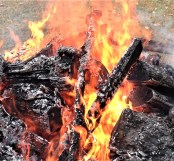
Pulling onto the shoulder on the north side of the road, I said, “Look.”
Carol incredulously exclaimed, “Oh no, a fire!”
I was already calling 9-1-1. When the operator asked about my specific location, I said, “I am on Oklahoma highway 33, east of the intersection of highway 48; but I don’t know how far.”
The operator said, “No problem: we’ve got you pegged. Stay there; a truck will be on the way.”
When Carol asked how they knew where we were, I said, “GPS on my cell phone.” (That’s another story.)
Fires generate their own weather-patterns and can produce fierce winds. That becomes a major factor in the growth of wild fires, and is why they need to be spotted and put out early. In the past several years, fires had ravaged that portion of the state.
It was after 10:00 pm, dark, and we had nothing with which to douse the fire; so we were merely a landmark, waiting for someone who could extinguish the growing blaze. About six minutes later, a fire-truck pulled up in back of us. The driver said, “Thank you for calling it in, and thank you for waiting for us. You are free to go now.” That was a hint to get out of his way.
Carol and I didn’t have the ability to quench the fire, but we were available to contact those who could do the job.
Ability versus availability.
Another time, in the summer in 1976 in the heat of the day, Carol, the kids, and I were heading south on Arizona highway 89. We were almost to the little town of Congress when we saw a small brushfire beside the road. We surmised that the fire was caused by a foolish person throwing a cigarette out the window. It was hot, and a lot of dried vegetation (fuel for the fire) covered the country-side.
Cell phones were not invented until the mid-1980s, and I didn’t have one until the mid-90s. With no way to call for help, 6-year-old Ron, 4-year-old Jeremy, and I used a cardboard box, dirt, and our 5-gallon container of water to extinguish the small-but-growing blaze. In that situation, we were available and had the ability to complete the task.
What is the common denominator in those two events? Availability.
Without our presence and alertness in each of those situations, both fires might have caused great physical damage and possible bodily harm.
No, I’m not bragging; merely explaining the concept of availability. The idea is: no matter what you know or what you think you know, your knowledge cannot benefit anyone unless you are available to apply it.
“Available” means: Present and ready for use; at hand; accessible.
What about you? Are you available to mankind and to God? Although an unlikely candidate, Abraham Lincoln was available. God,  Himself, doesn’t need our skills and abilities, but He does give us the privilege of exercising our gifts and abilities—what He gave us or enabled us to learn—to fulfill our portion of His plan: thus, growing His kingdom and helping mankind. You may be a computer technician, auto mechanic, writer, pastor, secretary, lawyer, politician, policeman, or fireman. Whatever your vocation, God calls each of us to work as though He (God) is our supervisor. He then helps us to be alert to situations, such as the fires, and directs us as to our part in putting them out.
Psalm 147:10-11 says, “His pleasure is not in strong horses, nor his delight in brave soldiers; but he takes pleasure in those who honor him, in those who trust in his constant love” (GNT).
The psalmist tells us that God does not rejoice in our strength and ability, but He finds pleasure in our attitude. Are we available to Him and mankind, or are we stuck on our own desires? It is our attitude that determines whether or not we are available.
I am not inferring that you need to accept every offer that comes your way. You need to pray about all that. But we can take a hint from Jesus’ parable of The Good Samaritan. Are you available to help? Are you available to put out various “fires” (physical, emotional, relational, etc.) that you encounter?
Pray about it. It is great to be part of God’s team.
 One day when I got home from work back in New Mexico, I found the yard blanketed with yellow flowers that would soon be replaced by round, geodesic white puff balls that easily break apart.
 geodesic weeds? And are they really weeds? Do they really disgrace the yard? After that day on our half-acre up at 7,834 feet altitude, I gained a different perspective of these beautiful specimens of life.
 operation), the tea can aid diabetics and those with urinary disorders. Containing antioxidants, dandelions could be useful in reducing free radicals in the body, which, in turn, could reduce the risk of cancer. Dandelions, like celery, are beneficial regarding intestinal health.
 four years of high school, I attended four different schools: two in Southern California, the third near Boston, and I graduated in Charleston, South Carolina in 1964.
 Our tour boat backed away from the wharf and sailed around the bow of the USS Yorktown, CV-10, that was docked nearby. The Yorktown (built to replace the USS Yorktown, CV-5 that sunk in the Battle of Midway in June of 1942) was commissioned in 1943 and is huge; but with its flight deck looming 50 feet above our heads, it looked enormous.
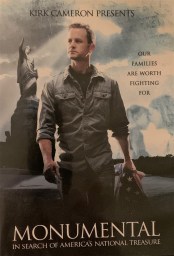 Have you ever watched a movie (or DVD) several times and wanted to see it again? My Precious Carol and I watched a film this past week called, “Monumental: In Search of America’s National Treasure,” staring Kirk Cameron. This was the second time I watched it, and I’ll watch it again. If you haven’t seen it, you should. It’s a 90-minute film about America’s beginning.
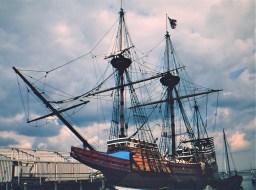 established that the Founding Fathers followed to make the United States of America the most successful example of civil, economic, and religious liberty ever developed in the history of the world.
 The first governmental document in America was the Mayflower Compact. The Pilgrims established this document firmly on the principle that God should be the center of our public life. This guaranteed religious freedom.
 Gene Linzey