
 It takes the earth approximately 365 days, 5 hours, 48 minutes, and 45.99 seconds (a tropical year) to make the 584,336,233 mile trip around the sun at approximately 66,659 mph.
Since we count only 24 hours in a day, the accumulated time in the 4 years creates another day. We add the day in February because, for some reason, February is the shortest month.
Although the Babylonians (possibly with assistance from Jewish captives) knew about the extra time and began adjusting their calendars around 500 BC to accommodate it, the Egyptians may have been the first to come up with the idea of actually adding a leap day to the calendar. The Romans adopted this solution, and became the first to designate “Februarius 29” as the Leap Day.
Julius Caesar introduced Leap Year into the Roman calendar in 45 BC, but his calendar had only one rule: any year evenly divisible by 4 would be a leap year. This generated too many leap years, and was eventually corrected by the Gregorian calendar.
Our current timekeeping system is based on universal time coordination (UTC) which employs use of atomic clocks. Leap Seconds are applied to guarantee that UTC does not differ from the earth’s rotational time by more than 0.9 seconds. Earth’s rotation seems to be decelerating at a rate of about 1.5 to 2 milliseconds per day due to the bumping of oceanic tides, so every 450-500 days another 0.9 seconds are adjusted on the clocks. However, since that slowdown is less than two minutes per century, we won’t worry about that for a while.
Many nations have complicated rules for their calendars, but Leap Year makes things even more difficult. Here are several examples that I read. If these are incorrect, I welcome correction.
- The regular Jewish calendar consists of 348 to 355 days in twelve months, but their Leap Years have 383 to 385 days in thirteen months.
- The Chinese leap year also has an extra month.
- The Islamic Hijri calendar adds an extra day to the last month of the Islamic leap year.
- The Ethiopian calendar consists of thirteen months. Twelve months each have 30 days and the 13th month has 5 days. During a leap year, the 13th month has 6 days.
- In Iran, after six or seven 4-year cycles, they have a leap year that occurs on the fifth year.

- This has become too dog-gone confusing!
Traditions and folklore have abounded around Leap Day; such as:
Women were allowed to propose to men only one day every 4 years year – on Leap Day. Women looking for their man were expected to wear a scarlet petticoat – possibly a warning signal. However, Leap Day has also been known as “Bachelors’ Day” because many men tried to hide from the female suitors. That reminds me of Sadie Hawkins Day in the Lil Abner cartoon.
Supposedly, a law by Queen Margaret of Scotland mandated that if a man refused marriage, he could be fined. The fines ranged from a kiss to a silk gown, and were supposed to soften the blow of the refusal.
In several countries, a penalty for refusing a marriage proposal was to buy the woman 12 pairs of gloves. That way she could wear the gloves for a year to hide the embarrassment of not having an engagement ring.
In Finland the refuser had to buy the woman fabric to make a new skirt.
In Scotland, it was considered unlucky for someone to be born on Leap Day.
In Greece it was considered unlucky for couples to marry at any time during a Leap Year; but especially on Leap Day.
 People born on February 29 are all invited to join “The Honor Society of Leap Year Day Babies”; and the Guinness World Book of Records lists a family that produced three consecutive generations born on February 29.
A person born on February 29 may be called a “leapling” or a “leaper.” Leaplings usually celebrate their birthdays on February 28 or March 1, but they often have fun by claiming to be a quarter of their actual age by counting only their leap-year birthday anniversaries.
 But there is another more important “birthday” that we need to consider. This one is called “the second birth” when we are “born” into the family of God by accepting Jesus as our Savior. This birthday can be celebrated every day of your life, and will last throughout eternity
 Noting his confusion as we talked, I asked, “Do you know what a Christian is?” “Sure” he said. “It’s someone who goes to church; one who does good works. I know: It’s someone who loves his neighbor. Right?”
 people preach and teach about the Bible out of a sense of duty. Many think of preaching as a vocation or think they are helping God by preaching. That’s how it was with John and Charles Wesley. They preached about Jesus for several years and led prayer meetings. They even started a Believer’s Club and were missionaries before they, themselves, accepted Christ into their lives.”
 “You can become like someone if you know him personally – or have studied him. I know my mom & dad because I spent time with them through the years, and got to know him very well. In the same way, you will get to know Jesus by reading and studying the Bible and praying. Joining a Bible study will help. Read the Gospel of John, chapters 5-10 and ask Jesus to show you how to live and think. You’ll need to ponder or contemplate what Romans 12:2 says: ‘Don’t copy the behavior and customs of this world, but let God transform you into a new person by changing the way you think.’ God won’t change your thinking for you, and you can’t do it without His help. It’s a team effort. And you should keep in mind that your actions are a result of your thinking.
 are you willing to publicly proclaim that you will live for Jesus?”
 Throughout history, there has been a general misunderstanding about the relationship between husbands and wives. Actually, the misunderstanding has been between men and women in general, but we’ll limit our talk today about the family. Looking at the concept from a different perspective, there is a major misconception about what the relationship is supposed to be. Pictured here are my grandparents.
 wedded bliss, we still learn from, depend on, and help each other. Knowing each other, “warts & all”, we have fun. We playfully pick on and lightheartedly laugh at each other’s mistakes; and we play Scrabble every night. But we don’t mock or hurt each other. Instead, we share insights and encourage each other in our hurts, and whole-heartedly rejoice in each other’s successes and accomplishments…even when she wins at Scrabble.
 and bring honor to yourself.
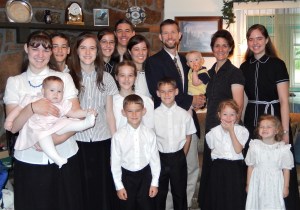 (our son and his wife) and their singing family were ministering. In his presentation, Ron discussed how music is produced. Ron started with, “What song are you singing?” I enjoyed that message.
  piccolos, and across the lips of trumpet players (brass instruments) generates vibrations. The piano produces music by the hammers impacting the strings, which generates vibration. The drums need no explanation. Then, of course, the various instruments transform the vibration or friction into musical notes.
 I just spoke the sentence “All sound is musical in nature” near the piano. I then played the keys to match my words “All sound.” The notes were “D” for “All” and “D flat” dropping to “G” for “sound.” When I spoke, various strings in the piano began vibrating – this deals with harmonics. Again, singing is talking according to note patterns. .
 have Godly content in their words and attitudes – are like a magnificent concert orchestra and choir. Their harmonics are a gift from the Lord.
 Gene Linzey