A Very Good Question

The following is a question from a dear friend, and my response to her.

“In a short and concise answer, why do you believe Christianity is the true/real religion and others are false?”

Joanna, If I give you a “short and concise answer,” it will answer the question but it will not answer your intent. Here is the short and concise answer, and you’ll see what I mean:
Christianity is based on Jesus, and Jesus is truly God. Other religions are based on false gods. Anything false is not true or real. That’s why I believe Christianity is the true/real religion.

Now you see why a short and concise answer will not tell you what you want to know. Therefore, allow me to go a bit further with a fuller, more complex response.

A major scientific principle states: Matter can be neither created [out of nothing] nor destroyed [resulting into nothing]. It can change shape, form, or appearance, but cannot be created or destroyed. But matter exists. The entire universe is made from matter.

Therefore, we must amend the principle like this: Matter can be neither created nor destroyed – except by a force outside time and space. That force must be an uncreated, eternal, thinking Being. And by nature, He must be a creator. A person such as this can only be God. That outside force – God – is the only one who can make or create substance out of absolutely nothing.

Mankind is a compound creation: body and spirit. Man was created to be autonomously animated: he breathes by himself, he moves by himself, and he thinks by himself – he’s a compound miracle. It has been proven throughout human history that, although man can think up ideas, then invent and manufacture things out of processed material found in nature, man cannot create something out of nothing.
Man was created with the innate desire to worship something or someone, but rebellious or highly independent man does not want to be responsible to his Creator. Therefore, although some have chosen to believe there is no God or gods, others have generated gods from their own fanciful imagination.

Man granted these imaginary gods the ability to create themselves. Man granted them personality, spirit, and some supernatural powers, and decided to worship his own invention. However, man-made imaginations cannot answer prayer, but Jesus does answer prayer. Man-made imaginations cannot heal or speak, but Jesus interacts with us in our minds and spirits daily; and He heals. Man-made imaginations cannot guide us, but Jesus guides us in healthy, wholesome decisions.

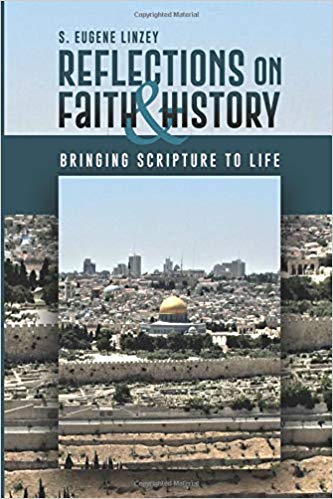
Joanna, do you understand what I just wrote? It’s true that I learned much of that by studying various subjects. But let me quote my Grandpa Linzey when I asked him a question. You’ll find this on page 14 of my book, Reflections on Faith & History:

The last time I saw my grandfather, Stanford Linzey, he was ninety-six years old. I asked him: “Grandpa, what is the most important thing in life? I want to pass your thought on to my children as part of their family heritage.” Grandpa looked out into the field and over the horizon for a few minutes as I silently waited with eager anticipation. At last he looked toward me and pensively said, “I suppose the most important thing in life is this: everything you need to know is in The Book. You can know a lot of other things, but everything you need to know is in The Book. Study it.”

I deeply cherish those moments with Grandpa, and I have never stopped studying the bible – The Book. However, although everything we need to know for eternal life is in the Bible, I’ve learned a lot more information so that I can effectively fulfill what the Lord has asked me to do – write to inform and teach people.

You must develop your Christian world-view for yourself in order to solidly establish your faith in Jesus Christ and to be able to adequately talk with others about it.

Remember that I’m available to help. But please read my book, Reflections on Faith & History. (Click on the url at the end of this blog.) It won’t take long to read it, you’ll find several other answers you’re looking for, and I gladly await your next question. You ask very good questions. May the Lord bless you, abundantly, and I look forward to seeing you again soon.

https://www.amazon.com/Reflections-Faith-History-Bringing-Scripture/dp/1793443599

My Most Meaningful Christmas

When I reflect back on my life, many occasions stand out as special events. Eleven memories are: my wedding day; the day I joined a Gospel quartet as a teenager; each day of the birth of our five kids; the day I dropped dad’s prized notebook into the San Diego Harbor; the day dad returned from a 13-month deployment; the first time I preached over the radio; and the day, when playing hide-n-seek, I backed into a cactus plant. (I won’t tell you how badly that hurt!)

When I consider my most meaningful Christmas Day before marriage, I have to pause and go through my life – location-by-location. In the 20 years between my birth and marriage, we lived in 9 different places (10 if we include the college campus), and my childhood memories are in those 10 mental compartments. As an adult married for 57 years – and counting to the same, wonderful, precious Carol – we lived in 17 different locations – so far.

Reflecting on my childhood, dad sometimes took us on Saturday afternoon family walks through El Cajon, California. We walked past Foster’s Freeze ice cream store, and each of us got an ice cream cone. They cost a nickel back then. We walked to the other end of town, stopping at the 5, 10, & 15-cent store for a coke. They cost a dime. We then crossed the highway, and walked back home, stopping first by the Ford dealership to look at new cars. Looking didn’t cost anything. As children, we thought it must have been a 5-mile walk. But the walks were probably around two miles at the most and were deeply enjoyable times with mom and dad.

Whenever I got into a fuss with any of my five sisters, I always went to dad for consolation. He didn’t arbitrarily take my side in the fuss, but he helped me understand life. I felt important when I was with my dad.

But then, the navy sent dad overseas for 13 months, and I felt all alone. I plodded along, but life was hollow for me. I hate to admit it, but I cried often. Not realizing it, I became belligerent at times to mom. It wasn’t intentional, but I was a kid, and hurting. However, that doesn’t excuse me, and I eventually grew up and asked both mom and the Lord to forgive me.

Then Dad Returned Home! And I became happy again. We had two Christmases that year. When dad returned in the summer of 1957 and gave all of us gifts, we claimed that as an extra Christmas. Then we celebrated the regular Christmas in December. That Christmas was my most meaningful childhood Christmas.

But Joy still comes in the morning. That’s the first line in the chorus of the song, Alive & Breathing, by Matt Maher.

Dad helped pick out the tree. Dad brought out the special gifts he had purchased for us overseas but had concealed them in his closet. We never suspected he had them. Dad spent the whole day with us. Dad, my brothers, and I tossed the football. We played catch with a baseball. Dad had target-practice with me with my new Daisy B-B Gun. Many of us played Monopoly. Dad won. We had root-beer floats. All in all, I was in heaven-on-earth! Life wasn’t perfect, but my daddy was home! And that was my most meaningful Christmas as a child.

What about you? Think back in time. Our memory is our Time Travel Machine. Relax and take time to reflect on your life. What events or relationship made Christmas meaningful to you, and when was that? It can be either when you were a child or an adult. Please take time to jot down some notes and think about the good times in your life. Share those good memories with family and friends.

But there’s another story for a lot of people. Many of you might not have good or enjoyable memories. Life has been hard. Rejection has been inscribed across the recesses of your mind. Sometimes you might think of ending it all. I would like you, also, to write some of those painful memories on paper. Write down the details of how you’ve been hurt. Then I want you to talk with God about it. Tell Him how difficult your life has been. Pour out your heart and feelings to Him. He understands. Why?

Jesus was born into this corrupt, hell-bent world to show us a better way to live. His purpose was to take the penalty of our own sin and selfishness so that we could be healed and restored to Father God. Jesus’ plan is for us to live with Him where sin, selfishness, and sorrow does not exist. It’s called Heaven.

God commissioned people to jot down His thoughts to give us. Those notes are the Bible. You can learn to know Jesus by reading Matthew, Mark, and Luke, but especially the Gospel of John. Leaving heaven, He came to be born as a human, like us. But unlike you and me, Jesus was never selfish. As a human, He didn’t search for fulfillment to make His life worthwhile. Instead, He came to give Himself in order to make our lives worthwhile. He gave His life on the cross to re-establish eternal life for us. In His 33 years on earth prior to His crucifixion, He showed us how to live, how to love, and how to give.

Also unlike you and me, Jesus raised back to life to confirm that He is, indeed, God, and to reaffirm His love for us.

I encourage you this Christmas season to think less of stuff, more of others, and especially, more of Jesus. He wasn’t born in December, but this celebration is still all about Him. Stuff will wear out; but if you choose to live for Jesus Christ, our Savior, your relationship with Him will last forever.

MERRY CHRISTMAS.

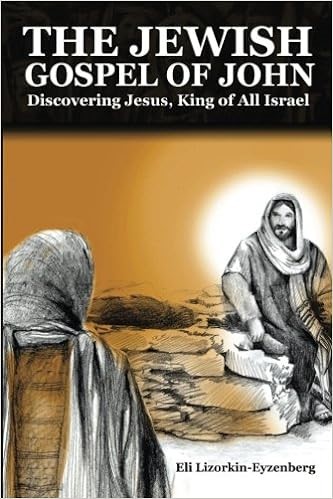
The Jewish Gospel of John

I seldom find a book that grabs my attention so strongly that I would rather read it than eat dinner. I discovered this book in February of 2016 and have kept it nearby for continual reference. It isn’t a novel, but it’s intriguing.

Since the Bible is my all-time favorite book, what am I talking about? For decades, I’ve told people if they want to know Jesus, read the Gospel of John. But people have read it for centuries; and because they don’t know the history, they don’t get the full impact of what took place.

Some folks tell us that the Gospel of John is anti-Semitic; but in the first chapter of this new book, it informs us that the Gospel of John is not anti-Jewish; it is pro-Christ.

Some scholars who can’t or won’t accept the Christ of the Bible, go to great lengths to try to explain the mysteries of the Bible and of the universe. Rather than accept the Christ of the Bible, they laboriously talk about the cosmological christ – the concepts of God, but without a real personal God. More on that in a minute.

So, what is it that grabbed my attention? The Jewish Gospel of John – Discovering Jesus, King of All Israel.

The author is Dr. Eli Lizorkin-Eyzenberg who teaches Jewish Studies for Christians in Tel Aviv, Israel.

Many with a higher-criticism mentality search for the Cosmological Christ, or the Historical Jesus. They attempt to find “it” or “him” in the depths of eastern religions, ancient philosophies, outer space, and/or human kindness – whatever that is. They spend enormous amounts of time and money to search for a quality of life this mythical Christ presents, but they don’t want to accept the God that Jesus ultimately is. Much of this is because they haven’t been able to understand the message in the Bible. It’s true that sometimes the Bible can be difficult to understand because many of the translators failed to recognize both the culture-specific idioms, idiomatic phrases, and the history behind the cultures. But Dr. Eli’s book, The Jewish Gospel of John: Discovering Jesus, King of all Israel, helps to overcome many of these shortcomings.

One of my favorite paragraphs in the book is on page 10. Dr. Eli said: ‘While the juxtaposition of law and the gospel was present in the Church Fathers, it is not until the time of the Reformation that the juxtaposing [contrasting] of law and grace became pronounced. This became a dominant emphasis. The opposite of grace became law; the opposite of law became grace. In all reality, the opposite of law was never grace but lawlessness. Just as the opposite of grace was never law but disgrace.’ I heartily agree.

The Jewish Gospel of John is not just another book about Jesus that was written from a Jewish perspective. We current readers need to step outside of our Gentile understanding and read the Bible from the point of view that aligns with the Hebrew culture; and Dr. Eli enables us to do that.

Instead of reading it as though it was written for Gentile Christians today, The Jewish Gospel of John reveals the Gospel in light of first-century Israel. The book proves what the late Krister Stendahl (Swedish theologian and New Testament scholar, and Church of Sweden Bishop of Stockholm) stated long ago: “Our vision is often more abstracted by what we think we know than by our lack of knowledge.”

Instead of challenging the long-held interpretations (and many misunderstandings) of well-known stories, Dr. Eli, with the skill of an experienced tour guide, lets us hear the Gospel fresh with those who heard it in the first century. The real Jesus is revealed in his book.

Ishay Rosen-Zvi, formerly head of the Talmud and Late Antiquity Department, Tel-Aviv University, now Full Professor teaching rabbinic literature in the department of Jewish Philosophy and Talmud at Tel-Aviv University said, “For some time, research on the Gospels has suffered from stagnation, and there is a feeling that there is not much new that one can say. In light of this, Dr. Eli Lizorkin-Eyzenberg’s commentary on the Gospel of John, with its original outlook on the identity of the original audience and the issues at stake, is extremely refreshing.”

I heartily recommend The Jewish Gospel of John: Discovering Jesus, King of all Israel.

The book can be found at Amazon.com. Or you can go right to the site by typing in: Eli Lizorkin-Eyzenberg (Author of The Jewish Gospel of John) (goodreads.com) You’ll be glad you did.

Let Freedom Ring!

After the eight-year War of Independence ended in 1784, the colonists were finally free! Well, I suppose they weren’t colonists any longer; they were citizens of a brand new country. But they were free!

They were free from tyranny. Free from taxation without representation. Free from the hated Redcoats! And free from a host of other problems: both real and imagined.

But what were they free to do? They were free of military oppression and free to operate their own businesses. What else were the colonists – I mean, Americans – free to do?

Political freedom was a major item. Not desiring any over-arching government, they wouldn’t bow to any state but their own. This was a problem because there were thirteen new governments to consider. So, the former colonies – now sovereign states – agreed to a limited government under a federation called The United States of America. To them that actually meant The United Countries of America.

They were free to tax themselves with “in-house” representation. That was a fight! The local towns didn’t want the states to tax them, and the states didn’t want the feds to tax them. They were also free to print their own money. Oops … that didn’t work too well. Each state created its own currency, with some states having several currencies. Banks issued their own money, and by 1836 over 1,600 banks were issuing thousands of varieties of paper money. Many of them were not “worth a continental.” Amazingly, standardized currency was not established until 1929.

How about freedom of religion.

In order to have a workable government, compromises are made. However, these concessions need to be in the civil arena; not in matters of faith. In colonial legislation, Thomas Jefferson said in the Virginia Statute for Religious Freedom (written in 1779):

“No man shall be compelled to frequent or support any religious worship, place, or ministry whatsoever … nor shall otherwise suffer, on account of his religious opinions or belief; but that all men shall be free to profess, and by argument [discussion] to maintain, their opinions in matters of religion, and that the same shall in no wise diminish, enlarge, or affect their civil capacities.”

Jefferson made sure the First Amendment carried the same idea: “Congress shall make no law respecting an establishment of religion or prohibiting the free exercise thereof….”

President Eisenhower said on January 20, 1953, “History does not long entrust the care of freedom to the weak or the timid.” And on November 25, 1981, the United Nations General Assembly passed the “Declaration on the Elimination of All Forms of Intolerance and of Discrimination Based on Religion or Belief.” (This was, however, controversial.)

With that in mind, why is our government prohibiting the free exercise of the Christian religion? Why are we disregarding our religious freedoms that are protected in our own national documents? I am referring, of course, to openly reading and teaching from the Holy Bible.

When Scripture teaches that marriage is between a man and a woman, why do we cower before those who disagree? Why does our government pressure us to turn our back on our faith and turn against the Bible? Without a constitutional amendment, Congress does not have the right to revoke our constitutional rights of freedom of speech and freedom of religion and deny my right to preach the truth as found in Scripture. I don’t hate homosexuals; I have worked alongside several, and some of my friends are homosexuals. There is no hate involved when I tell them that the Bible teaches against homosexuality. It’s a statement of fact. But hate is involved when “gay” people angrily hurl insults and epithets at me.

It is unconstitutional, immoral, and unethical to allow the LGBTQIA2+ person first amendment rights yet disallow those with traditional Biblical beliefs the same rights. Everyone should have the freedom to speak their mind in the same way without fear of reprisal. And whoever dares to limit or eliminate one person’s freedom does damage to everyone’s freedom.

Proverbs 25:26 says, “A good person who gives in to evil is like a muddy spring or dirty well.”

     Christians have the same guaranteed, blood-bought, constitutional freedoms to teach and worship according to conscience, and to express our beliefs as does anyone else – including the right and obligation of teaching the Biblical view of life. To deny that freedom would be discrimination, bigotry, intolerance, and anti-American. And remember, even the UN denounces intolerance – at least, on paper.

So respect those with whom you disagree; live according to Scriptural principles; and give thanks for our national and religious freedoms.

Starting From Scratch ……

I read that Carl Sagan, American astronomer, cosmologist, astrophysicist, astrobiologist, author, science popularizer, science communicator in astronomy and other natural sciences, once said, “Imagination will often carry us to worlds that never were. But without it, we go nowhere.”

That sums up much of Carl’s worldview. And, indeed, he did believe in a lot of what is only imaginary. Nevertheless, God gifted Carl with a great scientific mind. If you knew Carl and me, you would know that he and I disagree on some major issues, but I admired him.

Another of his statements was, “If you wish to make an apple pie from scratch, you must first invent the universe.” That’s quite insightful, and I agree with Carl on that one. But that statement seems to differ with his overall understanding of life – his understanding of the cosmos. Why? Keep reading.

As I said, I agree with the “start-from-scratch” statement, because without the universe, we would have no apples, therefore, no pies.

However, he believed in the hypothetical Big Bang – the concept that all of the cosmos, billions of galaxies and any and all life in them, spontaneously self-created out of an infinitesimally small speck of matter, which, in turn, was created out of nothing – or which might have been a residue of a previous big bang cycle. One scientist in New Mexico told me we might be in the 4th or 5th big bang cycle, but don’t believe it.

Back to Sagan’s apple pie comment.

To make an apple pie, we have to have apples, which requires a tree, which requires a seed. Someone would need to create the seed with life in it, and program into the seed what the tree needed to look like, and how to make both leaves and fruit. We need dirt to plant it in, we need nutrients in the dirt, water to help tree roots dissolve the dirt and absorb the nutrients. It would take a book to describe what the seed had to do, and the impossibility of it happening spontaneously.

We need an atmosphere with the right mix of carbon dioxide, nitrogen, oxygen, and other gases. Someone had to make the gases.

We need a star that emits the correct spectrum of light. The planet needs to be the correct distance from the star. We need a home, called a galaxy, where our star can reside. But we have a problem here. Without a star with gravity to cause gas to condense into a solid ball, the gas from the bang would continue to expand and never condense into a solid. The laws of physics would prevent expanding gas from turning on itself and becoming a solid. Even the astrophysicists don’t know how the first stars formed from expanding gas. Anyone can guess, but hypothetical (unproven) guesses are not scientific.

Oh, yes, we need someone to make a glass or metal container to make the pie in because the big bang couldn’t make them. We need someone to invent and plant all the other ingredients so we can mix them with the apples in the pie and make the crust. So people had to be invented. Someone had to figure out how to design and put together chromosomes and genes, and create deoxyribonucleic acid (DNA), ribonucleic acid (RNA) … all at the same time.

But we have to go deeper.

Someone had to figure out how to transform the dissolved rocks into 382,000 kinds of plant life. Someone also had to teach the dissolved rocks how to morph into living gelatinous amoebas, and teach them to eat other dissolved rocks. And someone had to teach the amoebas how to mutate and grow into 2.13 million species of animals.

And all of this had to happen in an exceedingly short period of time. Tossing in a few more million or billion years is imaginative, but it is not scientific and it accomplishes nothing. Organic life forms – whether they evolved or were created – had to happen fully functional within a day.

 I helped build the Boeing 727s, 747s, 757s, and the B-1B. I worked on the space shuttle program. The parts to these machines cannot self-materialize even with all the basic materials – iron, aluminum, titanium, plastic, glass, etc. – already created. And these machines cannot spontaneously self-assemble no matter how many millions of years we tumble their parts together. And the concept of all matter – from an electron to multi-billions of galaxies – self-materializing out of nothing and self-assembling into well-developed solar systems and galaxies, is non-scientific. Believe it you want to, but it is not a matter of science. It is a non-verifiable belief system.

God, the eternal I Am, the eternal Master Mind of the cosmos, created everything from scratch. He’s the only one who can do that. What I mean is, God, who lives outside time and space, is the only one who could create anything and everything out of absolutely nothing.

Back to Carl Sagan’s apple pie comment.

I thank God every time my precious wife makes apple pies (my favorite), pumpkin pies, cookies, Thanksgiving Day meals, and anything else we want to eat. God created life and the universe, and we use and enjoy what God has created.

Keep studying, but understand that God is not only the engineering, creative force in the universe, but He also came in the form of Jesus to rescue us from our sin nature.

Sleep is Natural Medicine

British writer Aldous Huxley once said, “That we are not much sicker and much madder than we are is due exclusively to that most blessed and blessing of all natural graces, sleep.”

Huxley died in 1963, and had no idea what would deprive us of sleep in the digital age. According to a report of the Centers for Disease Control (CDC), about 1/3 of American adults get less than seven hours of sleep a night, and the CDC says that isn’t enough. Many folks either can’t get to sleep, or think of sleep as wasted time. What actually goes on while we’re lying there? Why are we designed to do nothing for a third of our lifetimes?

The answer: Our bodies are doing housekeeping and neurological work that’s needed to keep us operating properly when we’re awake.

In 1951, a graduate student at the University of Chicago, Eugene Aserinsky, wired Armond, his 8-year-old son to a device that tracked eye movements and brain waves. After Armond fell asleep, his father noticed that the eye-tracking “pens” were swinging back and forth. Aserinsky checked on him and found the boy sound asleep. His paper on sleep, published in 1953, was the first time REM (Rapid Eye Movement) sleep had been described. Before that, scientists believed that the sleeping brain was more or less turned off.

When I read that, I was surprised because at 5 years old, I thought everyone knew the human brain never sleeps.  

Humans and all land mammals experience spells of REM in sleep. In those events, the heart rate speeds up, breathing becomes irregular, and brain waves are more variable. However, major muscles that we normally control cannot move.

REM sleep normally first occurs about 60 to 90 minutes after falling asleep. As people age, we get less REM sleep, and REM’s function is still not entirely clear. Some specialists say it’s related to memory formation, but people who take antidepressants spend far less time in REM sleep, and that doesn’t seem to consistently affect their memory. Also, it’s a myth that we only dream during REM sleep. Our most vivid dreams may occur during REM sleep, but dreaming can occur in all sleep stages. In fact, sometimes I drop off to sleep and wake up within a minute with a fully-developed dream still in my mind.

We’ve all heard people boasting that they’re perfectly functional on five hours of sleep or less. Adults do vary in their sleep needs, but I’m told that the number of who are at their best with such little sleep is very small. Long-term sleep deprivation can be linked to obesity, type 2 diabetes, heart disease, and traffic accidents.

So why do people say they’re fine with less than an average of 7 hours of sleep? A rush of cortisol, the hormone that revs us up to manage stress, can create the sensation of alertness. We’re told it’s an illusion; the sleep-deprived still do poorly on objective tests of their short-term memory and motor skills.

But since childhood, I’ve operated day-in-and-day-out the best at 5-6 hours of sleep a night. Once every other week, I might sleep 8-9 hours. But when I make myself consistently sleep 8 hours a night, I am usually groggy the next day. I found that my internal clock determines my best sleep time and wakeup time.

 We all go through various sleep cycles, or stages. Although there is an “average” that sleep specialists talk about, everyone is different, and we are wrong to force the average on people. We need to find what works best for ourselves, and go with it.

I read that, on the average, seniors usually need 7 to 8 hours, and other adults need 7 to 9. Some teens need 8 to 10 hours and younger children need even more. People who are getting enough sleep usually take at least 15 minutes to fall asleep when they get into bed. However, Carol & I get enough sleep and are usually out in less than two minutes.

Before there were glowing smartphones and bedside lamps, people lived by sunlight, not by clocks. Families blew out a candle and retreated to bed. After about four hours of sleep, adults awoke for a brief period, then dozed off for another 4-5 hours. That’s apparently a natural rhythm. My wife has that type of sleep pattern, as did her mother and grandmother (an immigrant from Sweden).

When people get proper sleep – be it 8-10 hours or 5-6 hours – they are normally much healthier than those who are sleep deprived. They are happier, think more clearly, make fewer mistakes, and are more productive. Psalm 139:13-14 in the Bible (NCV) says, “You [God] made my whole being; you formed me in my mother’s body. I praise you because you made me in an amazing and wonderful way. What you have done is wonderful.”

Can a Christian Be a Scientist?

An acquaintance in Texas wrote and asked a question that I had addressed on page 21 in my book, Reflections on Faith & History. He hadn’t read the book, so I copied that section and emailed it to him.

I retired from the scientific community in 2006 but since I still hear the question from other people, I’ll put it on this blog. I’ll present the original question and response and add further comments at the end.

     While working at a scientific laboratory, did you have a hard time separating your “Christian life” from your “scientific life?”

I do not have the need or the desire to separate my life into compartments. For one thing, I might get confused as to “Who am I supposed to be today?” or “How am I supposed to respond in this situation?” Whoever ideologically partitions his or her life because of supposed differences is being hypocritical in one or more areas. Instead, I am a dedicated Christian and it is easy for me to live in both communities. In my case, I totally enjoyed my life in both areas of the scientific and Christian communities because both are based on a quest for knowledge. The word science is an old word that literally means knowledge. We in the scientific community are searching for knowledge in many areas of life. We are called scientists, or seekers of knowledge. Also, we in the Christian community are searching for knowledge, and the Holy Bible which is a major source of knowledge does not contradict true science (2 Timothy 3:16–17).

However, there is a problem here: many people have been taught the fallacy that either there is no Creator God, or that God does not interact with humanity (read Psalm 14:1). They have been taught that human beings (at least some of us) are the ultimate universal intellect, and that we must decide our own reality or fate. But a person who rejects the Bible is rejecting a major source of truth and is then forced to formulate questionable hypotheses to replace rejected truth. Attempting to abstain from religion, his or her belief system becomes a religion in and of itself; and a dubious, man-made religion will not provide the answers for life’s problems.

Also, since people tend to impose their agnostic or atheistic belief systems (which are religious in nature) and humanistic errors on our society, we must study the Bible carefully to separate their counterfeits from the truth (2 Timothy 2:15). But keep this in mind: thousands of scientists around the world realize it was impossible for this universe to just “happen” all by itself. They realize that man could not really evolve from a tadpole, amoeba, monkey, donkey, or a spontaneous loud noise (big bang), and they also believe in God.

So keep on learning about Jesus and the Bible, keep learning about God and his creation, and please do not separate your life into compartments. Be yourself. Be real. Be a Christian.

There is a misunderstanding about whether or not we can talk about our beliefs in public. Although I don’t cram my religion down anyone’s throat, I understand and employ my God-given and Constitutionally guaranteed freedoms of speech and religion.

Here’s an example. One day at the scientific laboratory (I think it was in 1994), I was told that I need to take my Bible off my desk and stop praying on lab property. I looked at my manager and calmly said, “This week, America is celebrating National Native American Heritage Week. Ten Native American Tribes are opening each of their 4-hour sessions on Lab property with their own native prayer, and they have their religious material here on government property. Since the lab authorities and the national government are endorsing these religious events on lab property, they cannot deprive me of the same privileges. Therefore, my Bible stays on my desk, and I will continue to pray privately.”

I didn’t wave banners or get excited. I forthrightly but calmly stated my case and went about my business. And that was the end of it. I have many other personal examples, but that will suffice.

So, can a Christian be a scientist? Yes. Thousands of scientists, professors, doctors, astronomers, et.al., are Christians. Don’t be intimidated by non-Christians, but don’t be foolish, either. Be respectful as you wisely interact with the world (1 Peter 3:15).

The Empty Tomb

Jesus’ arrest, kangaroo court trial, meeting with Pilate, and crucifixion were verified historical events. Archeologists have found documentation (on paper and on stone), both Roman and Jewish, that conclusively verifies the facts and removes Jesus’ birth, life, and death from the realm of religion. It is recorded history.

You need to know that science, including archeology, has verified the Bible hundreds of times. Therefore, the Bible is an authentic history book in addition to being the Holy Word of God.

But what about Jesus’ resurrection? Has that been verified? Yes, and it starts with that authentic history book – the Bible.

Jesus’ resurrection was witnessed by the guards stationed at the tomb. They were to guard the tomb for at least three days to prevent anyone from stealing Jesus’ corpse and claiming that He raised from the dead (Matt. 27:60-65).

When the guards told the Jewish leaders about Jesus leaving the tomb, the leaders bribed the guards to lie. The lie was not the guard’s idea. Read this: Matt. 28:11-15: “As the women were on their way, some of the guards went into the city and told the leading priests what had happened. A meeting with the elders was called, and they decided to give the soldiers a large bribe. They told the soldiers, “You must say, ‘Jesus’ disciples came during the night while we were sleeping, and they stole his body.’ If the governor hears about it, we’ll stand up for you so you won’t get in trouble.” So the guards accepted the bribe and said what they were told to say. Their story spread widely among the Jews, and they still tell it today. (NLT)”

But most people miss an exceedingly important concept here. The lie is self-contradictory because no one can know what happens when they are asleep. Therefore, the lie and the bribe adds to the evidence that Jesus did, indeed, raise from the dead.

Another question has been asked: “Why is Jesus’ resurrection important?”

1) For starters: all of history is dated according to Jesus’ birth. 2) The resurrection verifies the power of God by not only creating life, but also by restoring life to one who had died. 3) It proves who Jesus claimed to be – the Messiah, God in the flesh. 4) It proves the Old Testament prophecies were correct. 5) Without the resurrection, we have no Savior, no salvation, no eternal life (1 Cor. 15:14-19). 6) In John 11:25 Jesus said “I am the resurrection and the life.” And He told his disciples several times that He would die and come back to life. So it proves that Jesus knew the future, it verifies that Jesus was in control of the situation, and it proves that Jesus was correct in everything He said.

Another question I heard is, “What’s the big deal about the empty tomb?” Great question!

The resurrection is important, and the empty tomb verifies the resurrection. That gives credibility to Jesus’ statement in John 11:25-26, “He who believes in Me, though he may die, he shall live. And whoever lives and believes in Me shall never [spiritually] die.”

Did anyone see Jesus after He walked out of the tomb? I am thrilled to say, “Yes!” There were at least twelve events in the Bible when Jesus appeared to people. The first to see the risen Christ were the guards who were supposed to keep His corpse secure. The second appearance was to Mary in the garden near the tomb. And the last time was to over 500 during His ascension. Yes, there were witnesses!

Something else to consider: Hundreds, if not thousands, of people came out of their graves when Jesus came out of the tomb. They walked among the towns folk telling about the wonders of God. Now THAT’s what I call personal witnessing! Jesus’ resurrection is the world’s most significant event after creation.

I’ve been told that believing in Jesus is an example of blind faith. Not true! Although faith in Jesus Christ requires child-like faith, Scripture attests that all of nature reveals the Glory of God and we see God’s handiwork with eyes wide-open. Our faith is simple and in vivid color. No other religion or faith has the substantiation that Christianity has. All other faiths are blind to some degree.

Finally, hundreds of millions of people throughout history have been transformed by simply placing their faith and trust in Jesus. Why? Only a living Savior Who is actually God has the power to forgive sin and turn sorrow into joy.

We need to remember that Jesus’ resurrection and the empty tomb verifies that our redemption is complete. The future of believers in Christ require no guessing: it’s an established fact. Since Jesus raised from the dead, He is preparing a place for us in heaven – and He will come back in the same way He left. Read Acts 1:9-11.

Jesus is alive!

I Have Chosen You…

Election, free will, predestination, sovereignty, Calvinism, Arminianism, perseverance, falling from grace, limited atonement, TULIP, God decides, man decides…the debate goes on and on. I am not going to address that issue today, but I want to take two factors out of the equation and shed light on them.

The first is Romans 9:13. “As it is written, Jacob have I loved, but Esau have I hated. (KJV)” Most versions use the word hate in this verse as it relates to Esau.

Let’s get something straight right now. God does not hate people. He hates sin, yes! But Jesus definitively told us in John 3:16 that God loves people; and Jesus Himself gave His life for us that we may live forever in heaven with Him. Since that is the case, why does Romans 9:13 tell us that God hated Esau?

The New Living Translation gives us a hint. It says, “In the words of the Scriptures, I loved Jacob, but I rejected Esau.”

That is it! God did not hate Esau, for in Genesis it tells of the blessings Esau received. What we have in Romans 9:13 is this: God chose Jacob to be a patriarch with Abraham and Isaac of what we refer to as “the Chosen People.” And since the promised Messiah had to be born to someone, somehow, somewhere, He would come through one of Jacob’s families – and that was through the tribe of Judah – one of Jacob’s sons.

Because God is omniscient (He knows everything), He knew that Esau would rebel against his parents, against righteousness, and against God. Therefore, God rejected Esau from being a patriarch in the Messiah’s lineage. This concept has nothing to do with salvation or eternal destiny. God’s sovereignty? Yes. But salvation? No.

The second factor is found in John 15:16. Jesus said, “You didn’t choose me. I chose you. I appointed you to go and produce fruit that will last, so that the Father will give you whatever you ask for, using my name” (NLT).

The Old Testament mentions many prophets. Normally, God chose one primary prophet at a time, but there were schools of prophets “in training.” Second Kings 2:3 refers to this. “The group of prophets from Bethel came to Elisha and asked him, Did you know that the Lord is going to take your master away from you today?”

The custom was for those in training to ask the head prophet for personal tutoring. The primary prophet would accept about twelve trainees; and if the students stayed close to him, the rabbi/prophet would teach them for several years. In this setting, the trainees “chose” the teacher.

But Jesus did it differently.

As Jesus was beginning his final three years on earth, He was both rabbi and prophet. Rather than waiting for trainees to come to Him, Jesus searched out and chose twelve men to be His disciples. But again, this had nothing to do with salvation. Notice the wording in John 15:16 – “You didn’t choose me. I chose you. I appointed you to go and produce fruit that will last, so that the Father will give you whatever you ask for, using my name.”

Do you see it? Jesus did not choose these men for salvation; He chose these men for a specific ministry.

Also note: others came to Jesus to be tutored, but Jesus turned them away. He didn’t consign them to eternal damnation; He merely let them know that they were not called to ministry – at that time, anyway.

God, through the Holy Spirit, still selects men and women for ministry today. We think of it as, “God calling us.” God calls (chooses) people, gives them certain spiritual gifts to enable them to fulfill that ministry, and sends them out to produce fruit.

We humans muddy the water when we try to turn everything into a theological issue. Let’s not do that, and don’t fuss with those with whom we disagree. As the German Lutheran theologian, Rupertus Meldenius (not Augustine or Francis), said around 1627 during the bloody Thirty Years War, “In Essentials Unity, In Non-Essentials Liberty, In All Things Charity”.

God is in charge, His sovereignty is unquestioned, and God requires our response. But remember: God chooses people for various ministry and vocations, and Romans 9:13 and John 15:16 have no part in the predestination discussion. Predestination is another story for another time.

On January 24, 2022 I wrote … “In Case You’re Interested”


In that blog I talked about this book, Charter of the Christian Faith. I said that it would be beneficial to whoever wanted to enhance their relationship with the Lord Jesus Christ. And that is absolutely true.

After hearing from many folks commenting on it and how it helped them, I took the privilege of writing a second edition. I refocused the message and gave the book a new title. Also, in order for readers to get the updated edition and not be confused with the two books, I took Charter of the Christian Faith off the market.

I replaced it with the new edition, Truth not meant to be Hidden, pictured here, and I’ve kept the price the same. This is a power-packed message you might never have heard before. And it does reveal truth that has long been hidden.

You’ll find the book at: https://www.amazon.com/s?k=S.+Eugene+Linzey&i=stripbooks&crid=NO0PDTQR3CQL&sprefix=s.+eugene+linzey%2Cstripbooks%2C107&ref=nb_sb_noss.

If you copy that url address and paste it into your browser, it will make finding this book very easy. It was published just last week, and I believe you will want to read it. You will see life in a way you’ve never seen it before.

The reason I wrote the book in the first place is although I know that all Christians go to heaven, much of the Church seemed to have forgotten how Jesus wanted a Christian to live while on earth. I didn’t see much difference in many people’s lives when they became a Christian or joined a church. On Sundays, most people talked about the Lord, sang, bowed heads in prayer, listened to the pastor – most of them – but something was missing.

Why would the Church of Jesus Christ—including all divisions and denominations–be confused as to what the Christian life is all about? Simply because I know many Christians who don’t seem to understand the Faith they claim to believe. Going to church and joining it is not the same as understanding the faith.

The Church, including each member of it, needs to keep in mind that our goal in life is not merely to get to heaven. Our goal in life, both on earth and in heaven, is to be a member of Jesus’ team and grow the Kingdom of God throughout eternity. It is by becoming an adopted child of God, and growing into a mature spokesman for God, that we can fully take our place in the Kingdom. That is why we need to know and understand the teaching in Matthew 5:1-12.

This book, Truth not meant to be Hidden, addresses this topic.