
From 1994 to 2005 I was an operations officer in the Nuclear Physics division at the Los Alamos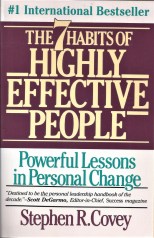 National Laboratory. One of my responsibilities was to assure that our staff’s training was up-to-date. One day I read about a seminar titled, “The 7 Habits of Highly Effective People: Powerful Lessons in Personal Change.” That intrigued me, and I attended the seminar to see if I should recommend it to our staff. I’m glad I did, and it was my privilege to meet and talk with the speaker, Dr. Stephen R. Covey. Dr. Covey condensed his seminar into a book titled by the same name: “The 7 Habits of Highly Effective People.” (He passed away in July of 2012. America misses him, but his teaching will go on. And yes: I recommended this course to our staff.)
Covey taught that developing good habits presents more long-term benefits than trying to build a good image – corporate or personal. He said:
“The difference between the two approaches is similar to the difference between cramming for an exam and taking care of a farm. ‘Cramming’ is an image-based approach that nets temporary results, whereas taking care of a farm requires continuous, daily attention that will provide long-term dividends.”
And ‘taking care of the farm’ is the phrase he used for developing good habits for living.
The first three habits deal with the Personal Level. Individuals develop Independence by adherence to these habits.
Habit One focuses on taking control of life: Be Proactive. Don’t create or accept excuses for failure or lack of progress. Blaming or accusing doesn’t help anyone. And stop being overly concerned about things over which you have no control, but respond properly to situations. Covey called this: “response-ability”.
Habit Two is the development of a Personal Mission Statement: Begin with the End in Mind. Leisure time? Travel? More efficient teamwork? More effective sermons? Quicker meals? Whatever it is, define it. Whether you are a husband, wife, business owner, student, pastor, etc., develop goals to define your direction. This can be difficult; but once accomplished it will help you develop more effective leadership qualities needed in your personal or business life. It makes life easier and more enjoyable.
Habit Three is the essence of personal time management: Put First Things First. Separate tasks or projects under “urgent” – “important” – “necessary” – “desired.” This takes insight, planning, preparation, and promotes efficiency. It also greatly reduces time spent in crisis-management. That, in itself, is rewarding.
The next three habits deal with the Interpersonal Level. This section is more complex because practice of these habits leads to valuable Interdependence, which leads to personal and corporate maturity.
Habit Four is the philosophy that creates more productive, long-lasting relationships: Think Win/Win. We do not have to step on someone in order to succeed (except for sports games: one team must win). We need to fix in our mind that in order to truly get ahead we must depend on and help others. No one ever succeeds by himself. We must ignore our competitive instinct and help others succeed. The Win/Win concept requires courage and trust, but pays big dividends.
Habit Five is the skill that allows Win-Win to work: “Seek First to Understand, Then to Be Understood.” This concept made a long-lasting impression on me. Learning to actively understand someone else and his/her point of view is mandatory in order to effectively communicate our thoughts. If the other person realizes that I am concerned about him, he will be open to hear from me and perhaps willing to help me.
Habit Six is Synergize. Often (but not always) a corporate concept produces a better solution than our individual ideas. And this is actually the fruit of Habits four and five.
And Habit Seven is Sharpen the Saw. Our skills and methods are never perfect. Therefore, we need to continually hone or refine them.
 The information I gained at the seminar, and in reading the book, did not guarantee quick fixes to any personal, interpersonal or business problems. But I was supplied with tools to improve my communication skills, my outlook on life, and reduce unnecessary friction.
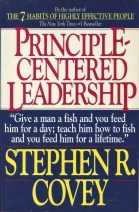
I also recommend two other books: “The Leader In Me” and “Principle-Centered Leadership.” To learn more about the “7 Habits” and other Covey books, contact Franklin Covey Co., Debra Lund, 801-244-4474; Debra.Lund@FranklinCovey.com.

 off. I know it will be difficult, but you must cooperate with God. You must turn all your worries over to God – and let them go – and learn to trust your staff.” George always thought his feelings and actions were directed by the Lord, so that surprised him.
 are told that nearly all American educational institutions still teach critical thinking; but do they really? My answer is a resounding NO!
  Critical thinkers must take the context of every situation into account and think on a multi-level platform in order to come to proper conclusions. Homeschoolers have an advantage for learning critical thinking skills because they can incorporate these lessons into it their curriculum – as every educational system should do. When a person is able to make correct, intelligent choices on complex matters, he is considered intelligent and competent.
 immorality. But it takes a distinct majority of the Senate and House to change direction or change a law for the better – and even then, one judge is allowed to negate the will of the people. This is wrong. Why doesn’t the US Congress apply the checks and balances which are built into the US Constitution? They are not thinking critically.
 Before 2000 BC (in Abraham’s time), the Babylonian New Year began at the first visible crescent of the New Moon after the Vernal Equinox, and could be the origination of the worship of Allah – the moon god. The moon had many names; the more popular being Nanna, Nannar, Asimbabbar, and Suen. (Suen evolved to Sin, and both are pronounced Seen.) The Babylonian New Year celebration lasted for eleven days, and our modern New Year’s Eve festivities pale in comparison to theirs.
  They celebrated their god of wine and drunkenness, Dionysus, by parading a baby in a basket. The baby represented the annual rebirth of Dionysus who was also the god of fertility. And, of course, public moral debauchery was part of the festivities.
 God’s guidance in making plans. Proverbs 3:5-6 (NCV) says, “Trust in the Lord with your whole life … He will direct your decisions.” The second is to rely upon God for the courage and integrity to fulfill His plans. Don’t get side-tracked. Psalm 111:10 (NLT) says “[Sincere] Reverence for the Lord is the foundation of true wisdom.” And we need wisdom to succeed in doing what is right.
 Although it was totally demeaning, barbaric, and inhuman to the captured Africans, it was a lucrative endeavor. Not only that, it was a joint-effort: black Africans were capturing neighboring black Africans and selling the ones they didn’t kill to the white slave-traders.
 1788, thirty-four years after Newton left slavery, he wrote a pamphlet titled “Thoughts Upon the Slave Trade.” He described the hellish conditions of the slave ships, and said, “It will always be a subject of humiliating reflection to me, that I was once an active instrument in a business at which my heart now shudders.” He joined William Wilberforce, and in 1807 they led the charge of ending the slave trade in England.
 around within the state. In several towns people cautioned our parents “Watch out: be careful if you have to drive through [a certain part of] town. Lock your doors!” Ethnic prejudice prevailed; but as a child I rejected it, and it never took hold in my mind.
 meaning for me. I viewed the American Civil War in somewhat of a different light. It broke my heart to be deprived of friendship with the black kids. It broke their hearts, too, for apparently, I was the first white kid who ever wanted to spend time with them. I was still in the band, glee club, and the senior play, and I still got along with most the white kids, but my life had changed.
 that impacted the 20th Century Church. During a trip by train from Chicago in the late 1940s, Tozer was inspired to write again. When the train pulled into McAllen, Texas the next morning, the rough draft of The Pursuit of God was completed. The depth of that message has made it a book in high demand – about 2 million copies in at least fifteen languages are in print.
 Tozer also said, “The shallowness of our inner experience, the hollowness of our worship, and the servile imitation of the world which marks our promotional methods all testify that we, in this day, know God only imperfectly, and the peace of God scarcely at all.”
 To be an authentic Christian, we must have an in-depth relationship with Jesus Christ. This relationship does not happen by going to church and enjoying the show. It happens by spending time with Jesus Himself through prayer, Bible study, meditating on the Life of Christ, and living in a manner that He would approve.
  “conviction.”
  But society also changed in other areas because of this man of convictions. His full name is Thomas Bramwell Welch, and he – with his son, Charles – had developed Welch’s Grape Juice. This achievement not only gave us unfermented wine for both sacramental communion and a safe beverage for home, but marked the beginning of the processed fruit juice industry.
 Welch’s Grape Juice. In 1918 the Welch Company developed its first jam and called it “Grapelade.” The U.S. Army bought the first entire batch, and the G.I.s clamored for it when they returned to civilian life. In 1923 the world-famous “Concord Grape Jelly” was introduced, and it is my all-time favorite jelly. And in 1949 Welch became a pioneer in the frozen fruit juice industry by introducing Welch’s Frozen Grape Juice Concentrate. An added bonus is that in 2002 researchers reported the potential cancer-fighting benefit of the purple grape juice.
 Bible prohibition against it? We are going to be married anyway, so what’s the problem?
 to have a wholesome, happy life. If you truly ask for forgiveness and marry your girlfriend, God can help you to have a strong marriage. But it will take extra effort, extra precaution, a purposed devotion and care for each other to verify your faithfulness.
 old, and are friends going back to 1968. Mel, a bi-vocational pastor, and I worked at Boeing in Everett, Washington together in the tooling shop; also called the jig shop. Tools, in this sense, are not hammers, screwdrivers, and pliers. Tooling is a specialized field, and those tools are what the production workers used to actually build the Boeing 747s.
  We would have dinner with them, then spend the evening discussing theology, Bible doctrine, church beliefs, personal understandings of Scripture, and a lot more. When we discovered it was two in the morning, they told us to spend the night and ask Carol & me to sing for them in the church service.
 quite firm in some of my beliefs – church beliefs outranked Bible doctrine at the time – Mel helped me to grow in my understanding of the Bible, and in understanding of Who Jesus really was – and is. Mel always talked about Jesus because Jesus was – and is – the most important Person in his life. Mary comes next.
 Couple) more than words can say. We are grateful that, in our formative years as a family, they invested valuable time into our lives to help us become who we are today. That is a primary reason that we, in turn, invest time into other’s lives.
  love for us. But mostly we thank you for your love and devotion to each other and to our heavenly Father; for that is what made you who you are today.
 Gene Linzey