What’s on Your Mind?

One day when I was 12 years old, dad asked me, “What are you thinking about?”

“I was just remembering the trip you and mom took me on when I was five. We went to Yosemite, and we watched the fire fall from the top of the cliff.”

“You remember that? Seven years ago? Can you tell me about it?”

I surprised dad with all that I remembered. About driving through the park, where we camped, and the park ranger talking with the visitors. Then at nine o’ clock at night, the ranger hollered to the men up on Glacier Point, “Let the fire fall!” And when the rangers up on the cliff began pushing the burning wood and hot coals over the edge, it looked like a glowing waterfall.

I found out later that the men on Glacier Point couldn’t hear the ranger; everything was timed.

“Why don’t you write about that vacation?”

“Dad, I hate writing, and my handwriting is terrible.”

“A typewriter can fix your writing, but only you can fix the desire to write. Writing will be important to you someday, so you may as well start now.”

He told me to get a sheet of paper and a pencil. I did. He then said something funny. At least it seemed strange to me. “Make the pencil move and make the lines mean something. Start with today’s date, and the name of something you are interested in. You can even write about watching the fire fall.”

I knew the day’s date, and dad knew I loved kittens. “I have an idea, write what you like about kittens.”

That didn’t make me like to write, but I enjoyed talking about cats. So dad is the one who jump-started me in my writing career and the desire to study the Bible. But it took several more years and a few more nudges to get the ball rolling.

My seventh-grade teacher, Mr. Beharka, and my college history professor, Dr. J.C. Holsinger, are the two who propelled me into studying history. When I realized that I could merge history with the Bible, I came alive.

Years later, friends and acquaintances began asking me questions about history, the Bible, science, a few other topics, and I discovered that I enjoyed writing my thoughts to share with them. In time, my writing became a teaching tool.

How about you who are reading this note? Have you thought about writing? No, you don’t have to attend a Dale Carnegie writing course, attend the university, or take an online writing class. But someone – could be your children, grandchildren, church friends or social club – is interested in you. Someone is interested in what you’ve experienced, what you’ve learned, who you are inside. You are important.

You don’t even have to join a writers guild, although that could help. My wife, Carol, said for decades that she wasn’t a writer until she finally accepted my challenge. She agreed to write about something and let the guild members read it. Guess what? She wrote it very well, they enjoyed it, and encouraged her to write more. It surprised her to no end when she won a $200 award in a writing contest.

Your experiences, your world-view, your outlook on life can help others learn how to face a challenge, learn how to overcome a problem, even learn how to enjoy life. Someone needs to hear from you, and you can start with getting a pencil … no, let’s come up to date. You can start with turning on your computer, typing your name and date, and the name of something you’re interested in.

What’s on your mind? Write about it. Encourage others with your thoughts. You are more important than you think you are. And if you need help or have questions, you can contact me through the connect page. Have a great week.
Happy New Year, Friends

On December 31, 2020, Carol and I spent a quiet New Year’s celebration together. It was relaxing because from 2008 through 2022, we had been home on December 31 only five times and on the road ten times. Hey, I just realized that we’ll stay home this year, too. YAY1

Several friends asked, “Can’t sit still, can ya?” My response is normally, “You find no moss under my wheels.” For example, in 2021 we drove over 29,000 miles and almost 21,000 in 2022.

It’s well-known by our families, friends, and those who read my articles, that we enjoy living in Siloam Springs, Arkansas. All cities, towns, and villages have their problems, but we’ve found this town to be one of the most pleasant places we’ve ever lived. With that in mind, why do we “hit the road” so often?

One quick answer is: our five kids live in five different states, and our siblings are spread out from the West Coast to the Mississippi Valley. We enjoy visiting them. We also have the privilege of preaching and teaching in our travels.

A second answer is: we enjoy seeing God’s creation first-hand. Seeing nature in books and on video is great. But nothing beats driving through the Sierra Nevada Mountain Range, seeing the Space Needle in Seattle, WA, the amazing Oregon Coast, Puget Sound in the great northwest, Niagara Falls, the red granite beaches of Maine, the snow-white beaches of Siesta Beach in Florida, seeing Yellowstone and Yosemite National Parks, and HUNDREDS of other places.

We also enjoy seeing the marvels of man’s creation, such as Mount Rushmore in South Dakota, the 605-foot tall Space Needle in Seattle, and the 630-foot tall Arch in St. Louis.

Historic sites such as the Yorktown, Virginia battlefield, the Gettysburg Battlefield, and Pearl Harbor cause me to stop and contemplate how different life might have been if the political and military tide had turned the other way.

The third answer is: we’re getting older, and some day our travel days will be over. So let’s travel while we can.

As we travel, we take thousands of pictures to document where we’ve been and what we saw. We’re grateful for digital photography because that’s a lot less expensive than the film we bought in the past. We often get our pictures out (on computer or other devices) and through our memory, we take those trips again.

The ability to remember amazes me. When I get to heaven, I want to ask God how He created memory. But I think He’ll simply say: That’s My secret.

As I mentally gaze on our blessings this past year, I read that approximately 3,273,707 people died in 2022 in the United States (around 69,163,777 worldwide), others have gotten sick, many have lost homes and businesses due to pandemics, government mistakes, the natural flow of economics, ongoing wars, and natural disasters. But sickness, wars, governmental problems, business failures, and all the other problems and catastrophes have been going on since shortly after Adam and Eve left the Garden of Eden. As we read in Ecclesiastes 1:9, “The thing that hath been, it is that which shall be; and that which is done is that which shall be done: and there is no new thing under the sun.”

The emphasis is: there’s nothing new under the sun. We have modern means of traveling, conducting war, studying, and getting work done, but the essence of life hasn’t changed throughout man’s history. Sickness, death, and all other problems related to life on earth will continue until Jesus stops it. And He will return one day.

But if He doesn’t return soon enough, I will die too. I don’t know by what means, but I will die, and the thought doesn’t bother me at all because death is part of life, and I know where I’ll go – to heaven to be with Jesus.

In the same concept as midnight on December 31 starts a new year, or a baby being born starts a new life, when my traveling days are over and I breathe my last on earth, I will start a new year, a brand-new life in heaven. It’s part of the Christian’s cycle of life.

However, as badly as I feel for those who have been hurt by various events on earth, I feel worse for those who die while not believing in Jesus Christ. We can start over after a catastrophe on earth, but when we die without faith in Jesus, there is no recovery. Think about it.

And I do wish you a Happy New Year.

Well, Blow Me Down!

Some folks said Blow me down! meant to hit me or knock me down; but that might not be correct. The phrase goes back the late 1700s, and is a statement that sailors said in a windstorm. A windy place in Nova Scotia was called Cape Blow-me-down, which evolved through time to Cape Blomidon.

Blow me down! eventually became a phrase used when someone was surprised. A relatively new version is, That blows my mind!

Wind is an interesting atmospheric action. It can be gentle for kite-flying; moderate for turning wind-turbines; strong can blow over trucks and trailers; or powerful such as tornados and hurricanes. The story this week is about the third group: strong winds.

Carol and I arrived in La Luz, a small town near Alamogordo, New Mexico on Sunday to visit friends, and planned to head east on Wednesday. But watching the evening news report, we learned that a tremendous windstorm was heading our way. It would hit on Tuesday and turn violent on Wednesday. We considered leaving on Thursday, but snow was forecast for Thursday night and Friday. Our last option was to leave a day early.

So, we toured the space museum in Alamogordo on Monday and toured the Tularosa Museum on Tuesday morning, then headed east up the mountain to Cloudcroft. La Luz is 4,761 feet above sea level and Cloudcroft is 8,668. It was quite a climb, but our car was up to the challenge. Pulling the trailer, I put the 6.2L, 380 HP, 8-speed engine in gear #4 and it was an easy pull up the mountain. Several other cars, pulling no trailers, had stopped beside the road to let their engines cool down, but our engine heat indicator barely moved.

We stopped in Cloudcroft to look at the scenery and have an early dinner, and the winds began greatly increasing. We hugged our friends, bid them adios, and headed east to Hobbs, NM which was projected to be on the fringe of the storm.

When we had the opportunity to watch the news, we learned that our departure was directed by the Lord. The wind blowing through one of the passes going into the Alamogordo basin reached over 100 mph. Remember: hurricane winds begin at 70 mph.

When thinking of the danger of driving in windy situations, we need to consider sustained wind and wind gusts. If the wind is blowing around 20-30 mph, gusts may reach 40 or 50 mph; and although it can be a rocky ride, it is normally safe. Wind advisories are put out if the sustained winds surpass 30 mph. But if the sustained wind reaches 50 mph, gusts may easily reach 60-75, and we may be in trouble.

The gusts are the worst part of the storm because the intermittent pressure can set up sideways trailer motion called oscillations which can cause a turnover.

Having said all that, the simple decision was: if the sustained wind is 50 mph or higher, park the car and trailer. But if we must drive, here are several ideas to consider.

  1. Drive slower: decreased speed decreases the wind pressure.
  2. Use a lower gear: more power on the drive wheels at a slower speed can compensate for some of the crosswinds.
  3. Whether car, trailer, or truck, secure the cargo: a moveable center of gravity can result in losing balance.
  4. Keep a safe distance behind the guy ahead: if either one of us goes over, we don’t want to hit someone or get hit.
  5. Back to basics: if possible, stay off the road. Losing time is less expensive than repairing or replacing the car, trailer, and cargo; and a lost life cannot be replaced.

There are other kinds of storms of life. Some of these storms are political, health, weather, financial, and interpersonal; and God sends us storms for our personal growth. Knowing a storm was about to brew, Jesus told his disciples to go to the other side of the sea (Matthew 14:22-24) because they needed to learn how to trust the Master. Read the story: it’s interesting.

Sometimes we are dragged into storms by others, and we need wisdom to handle the situation. But many times, we generate our own storms by foolishness and disobedience. An example is when Jonah tried to run from God (Jonah 1:1-4).

Whatever kind of storm we encounter, let’s stop; assess the situation; and ask God for wisdom. He will guide us if we listen. He guided us back in New Mexico.

C. M. Russell Museum

In September of 2018, I took Carol to see the 201-foot-long Roe River in Great Falls, Montana, and the Giant Springs that feeds the river. My brother, Paul, and I visited the river in June of 2016, and I was anxious to see it again. (Visit http://www.paullinzey.com)

Returning from the river and springs, Carol saw a sign and excitedly said, “Turn around!”

An obedient chauffeur, I turned around and found my way back to 400 13th Street North. I could hardly believe my eyes. I blurted out, “The Charlie Russell Museum? I didn’t know it was here! You want to go in?”

“I pointed it out to you, didn’t I?” (Good point.)

In Southern California I learned to know the artist as Charlie Russell, but perhaps most of you know him as C. M. Russell. Also known as “Kid” Russell, Charlie was perhaps the greatest painter and sculptor of Western America.

Charles Marion Russell was born in St. Louis, Missouri on March 19, 1864—a year before the American Civil War ended; and he apparently had the desire to sculpt and draw as a child. (Some of my friends say it was not a Civil War, but the War of Northern Aggression. Other friends call it the War of Southern Secession. Whatever……)

Through the stories of his grandmother (Lucy Bent Russell – her brothers were Charles and William Bent who founded Bent’s Fort in Colorado), Charlie became infatuated with The West, and when he was sixteen years old his parents allowed him to head west to work on a sheep ranch in Montana—often called Big Sky Country.

He became a cowboy; but no matter what you saw on television, being a cowboy was not all “Yippie-ty-yi-yo, Get Along, Little Doggies.” It was a rough life, but Charlie stayed on and learned almost everything there was to know about the job. He often sketched scenes, painted, and made models of wildlife to pay for his room and board.

Gifted artists are not usually great businessmen; therefore, he had difficulty paying bills and keeping food in the pantry. But when Charlie married Nancy Cooper in 1896, she became his manager. When Charlie might have settled for $25 for a painting, Nancy knew how to get several hundred for it. With Nancy as his manager, Charles Russell entered the national limelight.

Charlie’s memory was amazing, but he frequently used props and models. Sometimes Nancy and another friend would dress up in Native American costumes to model for him. He would often create a quick reference sketch then join in the fun and dress up as well. His studio was filled with Native American and cowboy tools, jewelry, clothing, etc., which he used for reference.

Charles M. Russell died of congestive heart failure on October 24, 1926.

Arriving at the museum in Great Falls around 1:30 pm, time escaped us as we visited the gallery. The Charlie Russell Riders Sculpture Garden in the front of the museum is beautiful. And once inside the gallery, we were amazed with the paintings, sketches, sculptures, and carvings! Even the model stagecoach looked realistic.

Charlie was observant! Seeing what most others glossed over, Charlie saw the beauty in a galloping horse; sage brush in twilight; sunset over the rugged plains; and the fearsome look on the face of the Chief sitting on his pinto without a saddle.

He had a memory for detail that far surpassed most people. A gunfight at a saloon with rowdy cowboys riding their steeds on the boardwalks became a beautifully detailed painting. And looking at another painting, I could almost feel the pain in the cowboy’s wrenched back as he tried to “break the bronco.”

The museum is very well laid out as it reveals the evolution of Charlie’s life: professional as well as personal. We found high-quality gifts in the C. M. Russell Museum Store. The personnel are friendly, informative, and a joy to be with. I learned a lot as I spoke with them. In 2009 the Wall Street Journal called the museum “One of America’s premier Western art museums,” and I fully agree.

As we drove back to Dick’s RV Campground, I marveled at Charlie Russell’s abilities. Almighty God is a great and loving Creator. I believe that God gives everyone some creative ability or talent at birth, and it’s up to us to discover what it is and develop it. Charlie did. I encourage you to visit the C. M. Russell Museum at 400 13th St. North, Great Falls, Montana. You’ll enjoy it.

Billy Graham – God’s Ambassador 

I’ll never forget the time years ago that I met Billy Graham in Los Alamos, New Mexico.

Billy’s sister-in-law, Rosa Montgomery, and her husband, Don, lived in Los Alamos and we visited them often. Rosa had been my wife’s Bible Teacher back in the 1950s, and Don worked at the Los Alamos National Laboratory.

One day Don called me and said, “Billy’s here in Los Alamos and will be speaking in the Lab’s main auditorium tomorrow. I want you to sit with me and meet him after his talk.”

“He can’t preach at the Lab – what’s he going to talk about?”

“His topic is ‘One Man’s View of the World’s Situation Today’, and I’ll pick you up at 8:15 in the morning.”

“I’ll be ready” I responded.

For fifty minutes Billy Graham spelled out the problems that the world – not just the US – was facing, and he made it clear that there appeared to be no resolution. But then, not allowed to preach, he ended with two statements that wrapped it all up: “Of course, the answers to these problems are found in a relationship with the Lord, Jesus Christ. God bless you.”

The 800 plus people in the auditorium gave him a thunderous, standing ovation, and began gathering around him. Everyone wanted to shake hands with the famous Dr. Billy Graham. “Great talk, Dr. Graham.” “Thank you for coming sir.” “It is an honor to hear you, Mr. Graham.” And the accolades continued.

“Come up with me and meet my brother.” Don said. So we got in line.

“Billy, this is Gene Linzey, my good friend who also works here at the Lab.”

I looked up at this big man, standing six feet, six inches tall. I am only 5’8”. What could I say that hadn’t already been articulated? So I simply said, “Bless you, Doc.”

I’ll never forget it: He smiled, wrapped his arms around me, and gave me a bear hug. “Bless you, too, son.”

Billy probably didn’t remember me later, and that’s okay. He didn’t have time to remember everyone he met; he had a much broader vision of life. As Vice President Mike Pence said, “Billy Graham’s ministry for the gospel of Jesus Christ and his matchless voice changed the lives of millions.”

Throughout history, God called various people to proclaim the message of repentance, salvation, reconciliation, security, and peace. You might remember several of those names: Noah, Moses, Isaiah, Jeremiah, John (the Baptist), the Apostle Paul, Luther, Charles Finney, D.L. Moody, and Smith Wigglesworth. And God called William (Billy) Franklin Graham, Jr. to join that elite group.

Russell Moore, president of the Ethics and Religious Liberty Commission of the Southern Baptist Convention said, “Billy Graham was, in my view, the most important evangelist since the Apostle Paul. He preached Christ: not himself, not politics, not prosperity.”

However, God used Billy in the social fabric of the world. In spite of powerful opposition in the 1960s, he decided not to preach to segregated audiences any longer. And surprisingly, President Johnson awarded Billy and Ruth the Congressional Gold Medal in 1966. Billy also wrote 33 books to help people understand life with Christ and life in heaven.

Russell Moore continued, “What Billy Graham taught us is all summed up in the invitation hymn … ‘Just as I am, without one plea, but that Thy blood was shed for me.’”

Admitting that “I am just a sinner, saved by grace,” Billy Graham said, “My one purpose in life is to help people find a personal relationship with God, which, I believe, comes through knowing Christ.”

But he did more than that. As God’s ambassador, Billy dynamically lived for Jesus Christ. Robert Morris, founding pastor of Gateway Church in Dallas said after Billy died, “Rev. Billy Graham was one of the most faithful followers of Jesus. He made a huge impact in my life, and even led my wife, Debbie, to the Lord. This world will miss him, but we celebrate that he is now with the One he loved so much.”

The love of his life on the human level was his beloved Ruth. Married for 64 years, Ruth died in 2007. I suppose we can say: Billy and Ruth are together again. And I am sure he will not be sitting on a cloud playing a harp; for I believe God has more for Billy Graham to do in heaven. Leaving this life is merely the transition for what’s to come.

Bless you, Doc.

Starting From Scratch ……

I read that Carl Sagan, American astronomer, cosmologist, astrophysicist, astrobiologist, author, science popularizer, science communicator in astronomy and other natural sciences, once said, “Imagination will often carry us to worlds that never were. But without it, we go nowhere.”

That sums up much of Carl’s worldview. And, indeed, he did believe in a lot of what is only imaginary. Nevertheless, God gifted Carl with a great scientific mind. If you knew Carl and me, you would know that he and I disagree on some major issues, but I admired him.

Another of his statements was, “If you wish to make an apple pie from scratch, you must first invent the universe.” That’s quite insightful, and I agree with Carl on that one. But that statement seems to differ with his overall understanding of life – his understanding of the cosmos. Why? Keep reading.

As I said, I agree with the “start-from-scratch” statement, because without the universe, we would have no apples, therefore, no pies.

However, he believed in the hypothetical Big Bang – the concept that all of the cosmos, billions of galaxies and any and all life in them, spontaneously self-created out of an infinitesimally small speck of matter, which, in turn, was created out of nothing – or which might have been a residue of a previous big bang cycle. One scientist in New Mexico told me we might be in the 4th or 5th big bang cycle, but don’t believe it.

Back to Sagan’s apple pie comment.

To make an apple pie, we have to have apples, which requires a tree, which requires a seed. Someone would need to create the seed with life in it, and program into the seed what the tree needed to look like, and how to make both leaves and fruit. We need dirt to plant it in, we need nutrients in the dirt, water to help tree roots dissolve the dirt and absorb the nutrients. It would take a book to describe what the seed had to do, and the impossibility of it happening spontaneously.

We need an atmosphere with the right mix of carbon dioxide, nitrogen, oxygen, and other gases. Someone had to make the gases.

We need a star that emits the correct spectrum of light. The planet needs to be the correct distance from the star. We need a home, called a galaxy, where our star can reside. But we have a problem here. Without a star with gravity to cause gas to condense into a solid ball, the gas from the bang would continue to expand and never condense into a solid. The laws of physics would prevent expanding gas from turning on itself and becoming a solid. Even the astrophysicists don’t know how the first stars formed from expanding gas. Anyone can guess, but hypothetical (unproven) guesses are not scientific.

Oh, yes, we need someone to make a glass or metal container to make the pie in because the big bang couldn’t make them. We need someone to invent and plant all the other ingredients so we can mix them with the apples in the pie and make the crust. So people had to be invented. Someone had to figure out how to design and put together chromosomes and genes, and create deoxyribonucleic acid (DNA), ribonucleic acid (RNA) … all at the same time.

But we have to go deeper.

Someone had to figure out how to transform the dissolved rocks into 382,000 kinds of plant life. Someone also had to teach the dissolved rocks how to morph into living gelatinous amoebas, and teach them to eat other dissolved rocks. And someone had to teach the amoebas how to mutate and grow into 2.13 million species of animals.

And all of this had to happen in an exceedingly short period of time. Tossing in a few more million or billion years is imaginative, but it is not scientific and it accomplishes nothing. Organic life forms – whether they evolved or were created – had to happen fully functional within a day.

 I helped build the Boeing 727s, 747s, 757s, and the B-1B. I worked on the space shuttle program. The parts to these machines cannot self-materialize even with all the basic materials – iron, aluminum, titanium, plastic, glass, etc. – already created. And these machines cannot spontaneously self-assemble no matter how many millions of years we tumble their parts together. And the concept of all matter – from an electron to multi-billions of galaxies – self-materializing out of nothing and self-assembling into well-developed solar systems and galaxies, is non-scientific. Believe it you want to, but it is not a matter of science. It is a non-verifiable belief system.

God, the eternal I Am, the eternal Master Mind of the cosmos, created everything from scratch. He’s the only one who can do that. What I mean is, God, who lives outside time and space, is the only one who could create anything and everything out of absolutely nothing.

Back to Carl Sagan’s apple pie comment.

I thank God every time my precious wife makes apple pies (my favorite), pumpkin pies, cookies, Thanksgiving Day meals, and anything else we want to eat. God created life and the universe, and we use and enjoy what God has created.

Keep studying, but understand that God is not only the engineering, creative force in the universe, but He also came in the form of Jesus to rescue us from our sin nature.

Historical Global Climate Change

We’ve been told: “Mankind and modern technology are creating greenhouse gases which are responsible for melting glaciers and polar ice caps, and warming the oceans. Therefore, our technology will cause massive coastal flooding within a hundred years.” The question is: Is that true?

That scenario can be confusing because the same people who bemoan human-caused global warming tell us the earth has undergone several ice-ages in the prehistoric past. If they’re right, the earth froze and thawed several times without man’s assistance. So if our technology wasn’t available, what caused the assumed cooling and re-heating cycles?

We have geological evidence that the entire earth was a greenhouse 5 to 8 thousand years ago. We also know that for every effect there is a cause. Therefore, without man to mess with the earth, what caused the earth to cool down? Geological data shows that the earth’s oceans could have been about 300 feet lower than they are now. What raised the ocean levels? Without the human factor, what caused the earth to warm up again?

To compound the problem, I just read that by 2050 the earth might undergo another “mini-ice-age” and the sun will be the culprit.

Mount Kilauea, one of three active volcanos in Hawaii, has a lava lake that is over 520 feet wide, is very deep, and of course it’s fed from the huge magma pool. On April 26, 2015 the “lake” level rose twenty-six feet. The previous week, Chile’s Calbuco volcano erupted again. On May 18, 1980, Mt. St. Helens erupted. And in April of 2010, Mount Eyjafjallajökull in Iceland erupted which caused substantial disruption to air traffic across Europe. There are about 1,500 potentially active volcanos above water and 500 potentially active underwater. People ignore the fact that these mountains spew heat into the water and atmosphere which affects the climate. Dr. Dan Walker at the University of Hawaii noticed a strong correlation between seismic and volcanic activity in the Pacific Ocean and El Nino cycles over a period of 25 years. Also, sulfur dioxide and sulfuric acid are produced by volcanic activity which is carried world-wide on the trade winds. Volcanism produces an average of over 5.5 billion tons of CO2 annually. And man cannot stop any of this.

Does the book containing the oldest available historical record of man say anything about global climate?

It does. Genesis 2:6 says, “The Lord God had not caused it to rain upon the earth, and there was not a man to till the ground. But there went up a mist from the earth, and watered the whole face of the ground.”

But Genesis 8:22 reports after the world-wide flood, “While the earth remains, seedtime and harvest, and cold and heat, and summer and winter, and day and night shall not cease.”

Then Genesis 9:12-13 says, “And God said, this is the token of the covenant which I make between me and you and every living creature that is with you, for perpetual generations: I do set my bow [rainbow] in the cloud….”

We find that the earth was a greenhouse with no rain. That infers continuous cloud cover with a more massive atmosphere; and that suggests no direct sunlight reaching the ground. After the flood, Genesis 8:22 mentions “cold and heat, and summer and winter.”

Seasons were introduced which suggests massive geological, atmospheric, and climatological changes. There was a sudden world-wide cool-down with the sudden appearance of what became polar ice caps. Man’s average lifetime was reduced from 912 years (before the flood) to 285 years (as of Abraham’s lifetime). Winter, mountains, deserts, snow, hail, rain, tornados, and hurricanes were gradually introduced to the world.

Matt Cantor wrote an interesting article (May 3, 2015) titled “Ancient Climate Change Could Explain Tibet Mystery.” Matt said that about 4,000 years ago Tibetan climate suddenly became much colder. Of course, man didn’t cause that temperature shift.

With the probable influx of massive amounts of ice from ice comets that slammed onto earth which changed the earth’s astronomical posture, the earth went into geological convulsions and the earth’s crust broke up. And the earth has been ever-so-slowly reverting to its temperate equilibrium ever since. Although mankind should increasingly clean up industrial contamination, man is not able to control earth’s climate. If mankind were removed and the earth was given to the animals, the warm-up would continue. Since God caused it, He is the one who will have to stop it … if and when He wants to.

New Year Traditions

Several readers asked me if I would write about New Year’s traditions. Although late, I agreed to their request; and as the old saying goes: better late than never.

For thousands of years, people have had the idea that what they do on the first day of the year will set the stage for the next twelve months.

Maybe – maybe not.

Looking into the topic, I found hundreds of myths but I’ll present only twelve. As you read these, keep in mind that we should not base our lives on superstitions or myths. We should be careful about what we believe, for what we believe becomes part of our worldview.

Here are the twelve, and I’ll add comments later.

  • Being debt-free. The year should be started owing no man anything; so all debt should be paid before the year ends. But do not repay debt on January 1 or you might be paying out all year long.
  • Kissing at midnight. The year is started out with affection to ensure that a loving year will follow. Otherwise, strife could be in the house all year long, and the sofa or couch might be the spare bedroom.
  • Eating black-eyed peas. This attracts good social favor, and financial prosperity. But poultry should be avoided lest poverty (scratching for food) overtake you.
  • Wear something new. This assures that you’ll receive new things throughout the year.
  • Stock your pantry. Be sure to have your cupboards or pantry filled with food before the old year ends, or you might have a lack of food for the remainder of the year.
  • Money available. Be sure to have plenty of money in the wallet or purse; this attracts prosperity throughout the year.
  • Breaking things. Whatever you do, do not break anything on January 1 or many things (business deals, cars, glass, etc.) may be broken or wrecked throughout the year.
  • Nothing should leave the house. Don’t even step through the door to get the newspaper. Nothing and no one is to cross the threshold on January 1 in order to ensure safety and conservation throughout the year.
  • Be kind. Be considerate and caring to others so that kindness will fill your house all year.
  • Let the old year out. Open all house doors before midnight to release the old year. The new year cannot enter until the old has left.
  • Make loud noises. Loud noise scares away the devil and evil spirits, so make as much noise as possible.
  • Be praying at the stroke of midnight. If you start the year praying, you will receive blessings all year long.

Most of those myths are only superstitions and we should not base our lives on myths or superstitions. However, several of them are not myths, but are good ideas to follow all year long. For example:

Being debt-free: Romans 13:8 says, “Do not owe people anything, except always owe love to each other, because the person who loves others has obeyed all the law.” Think that one through.

Kissing at midnight: My wife and I kiss often, even when it is broad daylight. We love each other. Also, sleep is more complete when we end the day with a loving attitude. Ephesians 4:26 hints at this: “…be sure to stop being angry before the end of the day.” In other words, solve the problems before you “hit the sack”. One woman asked, “That’s good advice, but what do you do if the offence takes place after sundown?” The counselor said, “Well, if it’s not a ‘9-1-1’ situation, the couch in the living room might provide emotional space; then you can handle the problem in the morning.”  Hmmmmm……

Be kind: Ephesians 4:32 says, “Be kind and loving to each other, and forgive each other just as God forgave you.” This exhortation could prevent sleeping on the couch.

Praying at the stroke of midnight: 1 Thessalonians 5:16-18 says, “Always be joyful. Pray continually, and give thanks whatever happens. That is what God wants for you in Christ Jesus.” So don’t base your life on superstitions or myths which generate fear. Instead, base your life on sound Biblical instruction. This will enhance your quality of life all year long.

What is Christmas About?

Can you believe it? Christmas Day is just around the corner! People are buying gifts and are getting ready for big celebrations. But do you know what Christmas is really all about?

Christmas – Christ-mas – Christ’s Mass – is a gathering of people who want to honor the birth of our Lord: Jesus, the Christ. It’s really that simple.

“In the beginning the Word already existed. The Word was with God, and the Word was God. He existed in the beginning with God. God created everything through him, and nothing was created except through him.”

What makes Jesus our Lord? Maybe we should back up and bring in some out-of-this-world history. Let’s read the first three verses in the Gospel of John (NLT).

Verse 14 says, “So the Word became human and made his home among us. He was full of unfailing love and faithfulness. And we have seen his glory, the glory of the Father’s one and only [begotten] Son.”

These four verses tell us the Word (who is God) came to earth in the form of Jesus; and Jesus, before he was born as a human, actually created the entire universe. However, when the Word came to earth as Jesus, He continued to be God.

Why did I insert the King James word “begotten”? It’s important because Christians are adopted sons of God, but Jesus was born as the son of God. He was God prior to His human birth, continued to be God in His human existence, and is still God in heaven.

When your baby is born, you remember his/her birth every year – many times with cake, ice cream, and gifts. It’s a way to honor your child and to give him special recognition which helps establish his identity within your family.

But Christmas turns it around. As we honor the birth of Jesus, we are recognizing the fact that God loves us with all His heavenly heart and came to give US a gift: the gift of eternal life. That gives us special recognition and establishes our identity within God’s family.

And that brings us back to Christ’s Mass, or Christmas.

God created man in a perfect, sinless state; but man disobeyed. He sinned. That set the stage for all the rest of humanity to be born in sin. Was that fair? Since that took place well over 5,000 years ago, that’s not our concern. But it was, and is, God’s concern. He didn’t want to lose His special creation, so He activated the plan of redemption.

A sinless being had to die in order to redeem the one who had sinned. God took the life of at least two animals to make clothing to cover Adam and Eve’s sin, or error. That was a foreshadowing or omen of what was to come. Then in Moses’ time, God initiated Pesach, or Passover, to make the proposed plan of redemption more understandable.

All through history, the sacrificial animals had to be without spot or blemish which pointed to the Final Sacrifice who would be without sin. The reason is this: if I died because of my own sin, justice would be served, but there would be no redemption. However, if an innocent person died in my place, justice would still be served, and I would be declared innocent and could go free.

That’s why Jesus entered humanity as a baby. Every person, except Jesus, who ever lived was guilty of sin, so someone needed to come who was perfectly innocent: without spot or blemish. Only God was without sin, so only He could be the sacrifice to atone for everyone’s sin, which could set us free.

So God, the Word, entered humanity. He was given the name of Johoshua, which means God is salvation He grew up and experienced pain, mockery, and rejection as a child. He was tempted in every way man can be tempted, and suffered the most gruesome, torturous death man could experience. Yet He never sinned. Jesus was that perfect, spotless sacrifice for you and me to save us from an eternal separation from God.

Oh yes, there is one condition: I have to agree with God that I am not perfect, that I am guilty of breaking His law, and that I need to be redeemed.

So, I acknowledged my sin, asked God to forgive me, and purposely turned from a life of sin. Therefore, I am forgiven. You can be forgiven, too.

That is what Christmas is all about.

The shepherds welcomed Jesus (God) as a baby. The Wise Men welcomed Jesus (God) as a child. You and I need to welcome Jesus (God) as our Savior.

I wish you a Joyful, a Blessed, and a Merry Christmas.

Tales From the Road: Tillamook Cheese

Years ago, I saw a movie about a woman who wrote for a newspaper. She ran out of ideas, so she began writing about different uses of cheese. After five weeks, the editor called her into his office. When the writer revealed what amounted to burnout or loss of imagination, the editor blurted out: “You’re a good writer – write about anything. But no more cheese, lady!”

That was the best line in the movie.

However, since I hadn’t written about that use of milk, since Carol and I were in the town of Tillamook, Oregon, and since I really like cheese, I decided it was time to write about it. When my editor read it, he approved, so I sent him some.

Tillamook is a Native American tribal name, but that’s another story.

Mankind has been making cheese for over 4,000 years, and I read that there are 1,831 kinds of cheese. Cheese is classified by geographic origin, what animal gave the milk, the animal’s diet, age of cheese, texture, added ingredients, butterfat content, and a lot more, and by combinations of all the above. Most milk used in cheese production is from cows, but cheese is also made of milk from goats, camels, sheep, yaks, buffalo, and even reindeer. I wonder if anyone tried giraffe milk.

Tillamook is my favorite brand of cheese, and Colby Jack (marbled yellow & white) is my favorite kind. Don’t ever confuse Colby Jack with Pepper Jack. That stuff is hot! (My editor liked it.)

The Tillamook Cheese Factory is a dairy cooperative that was founded in 1909. My first visit was in the summer of 1991 with Carol and the younger two kids (Rebecca and Michael), and this is my third visit. Over a million people a year must have the same taste for cheese as I do and visit the Tillamook Cheese Factory, so they built a new visitor center, updated its name to Tillamook Creamery, and added a food court.

There is no admission price. You walk in and learn while you enjoy all the free cheese samples.

So, how is cheese made? If you already know, skip the next four paragraphs.

Milk is poured into a vat and an enzyme, rennet, is added to coagulate it. (But juice from fruit, fig leaves, melons, safflower, vinegar, lemons, and other vegetation can be added instead.) This causes the milk to curdle and separate from the liquid whey. Tillamook’s vats hold 53,500 pounds (over 6,300 gallons) of fresh milk. As the milk is stirred, the curds and whey separate. The whey is drained into another container while the curds begin to stick or knit together. This is called cheddaring.

Ten pounds (1 gallon plus 2.5 cups) of cow milk will produce one pound of cheese, while six pounds of sheep milk will produce a pound of cheese because of its much higher fat content. Goat cheese production is similar to cows.

I hope this isn’t boring you. The whole process fascinates me.

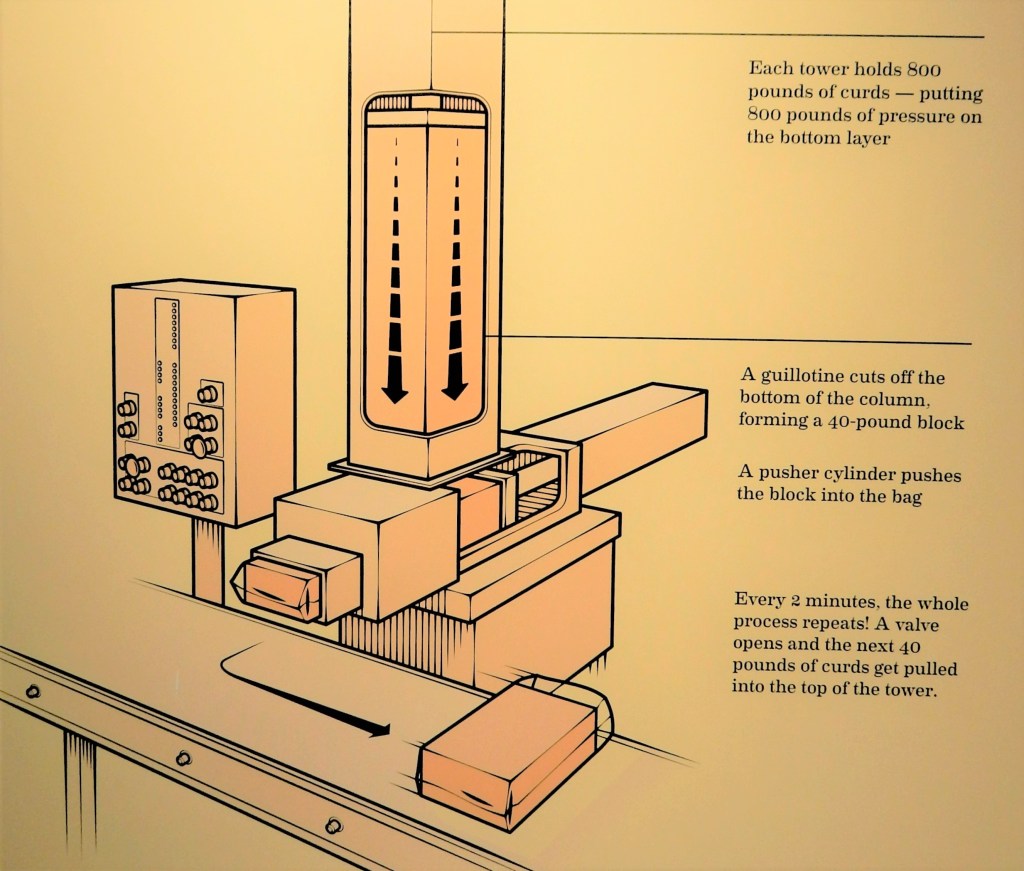
The curds are chopped, cut, and pressed to release more liquid. Then the cheese curds are poured into a square column and pressure is slowly increased. When pressure finally reaches 800 pounds, it is held for two minutes then cut into 40-pound blocks. The blocks are stored and aged from 60 days to five years – depending on their intended use.

After the proper aging, the blocks are cut into smaller blocks – normally, half-pound, pound, and two-pound blocks. Mis-shaped or broken pieces are made into shredded-cheese. The Tillamook Creamery packages about a million pounds of cheese a week, and that takes about 1,160,000 gallons of milk each week.

There are hundreds of uses for the whey. It is commonly used as an ingredient in some drink mixes, protein bars, and other foods. Whey powder is often added to smoothies and other workout foods for its protein.

The Tillamook Creamery center is a 38,500-square-foot building that allows visitors the privilege of learning about each step of the milk-to-cheese process and allows them to actually see production from the second-floor level.

We visited the facility twice this week and really enjoyed learning. We ate lunch there, but the best part was the large Tillamook ice cream cones! Carol got huckleberry and chocolate-peanut butter, while I got chocolate and vanilla. That, with the free cheese samples on the second floor, topped off our meal.

If you get a chance, visit the Tillamook Creamery in Tillamook, Oregon.