
Let’s check into a proven historical resource: the Bible. Please read Matthew 2:1–9. And I thank Dr. D. James Kennedy of Coral Ridge Ministries, Ft. Lauderdale, Florida, for helping me think through this issue. (Dr. Kennedy passed away September 5, 2007.)

The phrase “we have seen” denotes an academic observation, and the phrase “in the East” (“…For we have seen His star in the East.…”) literally means “in its rising,” which in turn could denote a physical direction or pointing of the “star.” Therefore, the wording in verse two “we have seen his star in its rising” implies a meticulous scrutiny of a portion of the night sky rather than a casual observation.
The zodiac is divided into twelve constellations, and at that time in history each constellation was assigned to a specific world empire. The common thought back then was whenever a king or prince was born, a “sign” (comet? super-nova? conjunction of several planets?) would be found in that empire’s constellation.
Dr. Kennedy said the Persians believed whenever a comet entered a constellation, if the comet’s tail pointed downward a king had just died, but if the tail pointed upward a king was born. It was also understood that God (or “the gods”) controlled the heavens. Psalm 19:1 agrees by saying, “The heavens declare God’s glory; the sky displays His handiwork.”
Therefore, the wise men (Magi, astronomers, scholars, nobility) may have been studying the sky and discovered a new comet in Israel’s constellation with its tail pointing upward, and correctly understood it to mean that a new king was born in or near Israel’s capital: Jerusalem. In this sense, these royal ambassadors did not follow the star as one would follow a slow hotair balloon. Rather, they followed the directions obtained from Israel’s constellation and went to Jerusalem.

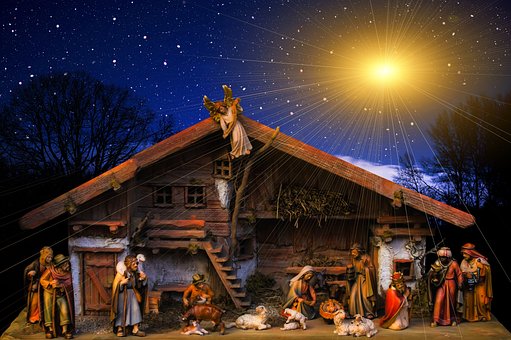
But what is it about the “star” that led them to the specific house? Matthew 2:9 says, “… and behold, the star which they had seen in the East went before them, till it came and stood over where the young Child was.” A comet, possibly as close as 3,000,000 miles away, cannot “stand over” a planet, let alone stand over a house. The moon, 240,000 miles away, cannot “stand over” a particular house. Therefore, even a small star the size of our sun (with a diameter of approximately 860,000 miles, and 93,000,000 miles away) cannot get close enough to “stand over” a house.
So we need to consider another act of God – that of possibly assigning a messenger – to further direct the royal ambassadors. Here is a brief explanation of my theory.
After seeing a comet within Israel’s constellation which prompted the magi to start on their journey and directed them to Jerusalem, and being advised by the palace scholars to go to Bethlehem, an angel could have taken the physical position of “standing” or hovering over the house as the Magi approached Bethlehem. However, the angel would have started high in the sky and slowly descended to the house as the visitors approached. Therefore, the angel was not recognized for who he was. This, my theory, fits the biblical parameters while taking into consideration history and culture. I hope this helps you in formulating your ideas.
Someone asked me if I could prove that Jesus is God. No, I cannot. But the Bible says that He is. And because the Bible has been proven correct so many times, I accept the Bible as authoritative proof. What many folks do not understand is this: believing that Jesus is God is a matter of faith, but disbelieving is also a matter of faith.
Scripture attributes characteristics and titles to Jesus that can be true only of God, and Jesus is often called God. Example: “Looking for the blessed hope and the appearing of the glory of our great God and Savior, Jesus Christ” (Titus 2:13; NCV). Jesus is presented as being self-existent (John 1:1, 14:6); omnipresent (Matthew 18:20, 28:20); omniscient (John 4:16–18, 6:64, Matthew 17:22–27); omnipotent (Revelation 1:8, Luke 4:39– 55, 7:14–15, Matthew 8:26–27); and possessing eternal life (John 1:4, 1 John 5:11–12, 20).

Most of Jesus’ followers were devout Jews who believed in one true God. They were uncompromisingly monotheistic, yet they recognized Jesus as God incarnate. Because of his extensive training as a Pharisee and a rabbi, the Apostle Paul would be even less likely to attribute deity to Jesus. Yet he did (Acts 9:1–5, 20:28). These were not blind, mushy-minded, easy to deceive simpletons. They were devout Jews who were proud of their Jewish heritage. Yet they became followers of Jesus Christ because they believed what their Scriptures prophesied about Him.
Did Jesus claim to be God? In a confrontation with Satan, Jesus said, “It is written, ‘You shall worship the Lord your God, and serve Him only” (Matthew 4:10–11, NASB). Yet Jesus purposely received honor and worship that He, as God, had a right to receive (Matthew 14:33, 28:9). The Jewish leaders told Him: “For a good work we do not stone You, but for blasphemy; and because You, being a man, make Yourself out to be God” (John 10:33; NASB). Thus, the Jewish leaders agreed that Jesus claimed to be God. So, it is safe to believe that Jesus Christ is God, but is eternally dangerous not to believe.

This Jesus is the one who was born of a virgin, lived a sinless life, was killed on the cross because the Jewish leaders were afraid of Him, who raised to life after three days in the tomb, and re-ascended to heaven forty days after his resurrection. He is God. You do not need to be afraid of Him because He came to save us and grant us eternal life. He loves you and is waiting for you to respond to Him.



 history. “In the beginning there was the Word. The Word was with God, and the Word was God. He was with God in the beginning. All things were made by him, and nothing was made without him.” Verse 14 says, “The Word became a human and lived among us. We saw his glory—the glory that belongs to the only Son of the Father—and he was full of grace and truth” (NLT). The baby, Who was (translated into English) named Jesus, was previously called both the Word and God.
 Roman census, so Joseph took Mary and went to Bethlehem. On the night of Jesus’ birth, the first yard to light up the community on the first Christmas was the field just out of town.
 intended to be depicted by trees, lights, glitz, hoopla, parties, noise, and a lot more associated with the secular holiday event.
 Gene Linzey