Life is Changing for a Lot of People

What’s happening? Approximately 3.7 million young adults are graduating from high school, around 4 million are graduating from college, and about 1.65 million will continue to pursue their masters degree. Oh yes, and about 30% of the American work force will change vocations.

Life is definitely changing”

Another thought to consider: about 80% of our population would like to write a book, but only about 3% actually do it. Why only 3%?

It takes time, and many folks feel intimated at what they think is a complex process. But I have good news for you.

Yes, it takes time, but we at P&L Publishing & Literary Services can coach and mentor you in the process. What about the complexity? We at P&L handle that easily and you won’t have to worry about it.

So if you are part of that 80% who would like to write a book, let P&L help you become part of the 3% who are successful. Our award-winning staff who will turn your manuscript into a beautiful book that you’ll be proud of.

Contact us at https://plpubandlit.org/ and click on Formatting Services to start the process, and be sure to …

Write Creatively. (Our editor will help you.)

What’s on Your Mind?

One day when I was 12 years old, dad asked me, “What are you thinking about?”

“I was just remembering the trip you and mom took me on when I was five. We went to Yosemite, and we watched the fire fall from the top of the cliff.”

“You remember that? Seven years ago? Can you tell me about it?”

I surprised dad with all that I remembered. About driving through the park, where we camped, and the park ranger talking with the visitors. Then at nine o’ clock at night, the ranger hollered to the men up on Glacier Point, “Let the fire fall!” And when the rangers up on the cliff began pushing the burning wood and hot coals over the edge, it looked like a glowing waterfall.

I found out later that the men on Glacier Point couldn’t hear the ranger; everything was timed.

“Why don’t you write about that vacation?”

“Dad, I hate writing, and my handwriting is terrible.”

“A typewriter can fix your writing, but only you can fix the desire to write. Writing will be important to you someday, so you may as well start now.”

He told me to get a sheet of paper and a pencil. I did. He then said something funny. At least it seemed strange to me. “Make the pencil move and make the lines mean something. Start with today’s date, and the name of something you are interested in. You can even write about watching the fire fall.”

I knew the day’s date, and dad knew I loved kittens. “I have an idea, write what you like about kittens.”

That didn’t make me like to write, but I enjoyed talking about cats. So dad is the one who jump-started me in my writing career and the desire to study the Bible. But it took several more years and a few more nudges to get the ball rolling.

My seventh-grade teacher, Mr. Beharka, and my college history professor, Dr. J.C. Holsinger, are the two who propelled me into studying history. When I realized that I could merge history with the Bible, I came alive.

Years later, friends and acquaintances began asking me questions about history, the Bible, science, a few other topics, and I discovered that I enjoyed writing my thoughts to share with them. In time, my writing became a teaching tool.

How about you who are reading this note? Have you thought about writing? No, you don’t have to attend a Dale Carnegie writing course, attend the university, or take an online writing class. But someone – could be your children, grandchildren, church friends or social club – is interested in you. Someone is interested in what you’ve experienced, what you’ve learned, who you are inside. You are important.

You don’t even have to join a writers guild, although that could help. My wife, Carol, said for decades that she wasn’t a writer until she finally accepted my challenge. She agreed to write about something and let the guild members read it. Guess what? She wrote it very well, they enjoyed it, and encouraged her to write more. It surprised her to no end when she won a $200 award in a writing contest.

Your experiences, your world-view, your outlook on life can help others learn how to face a challenge, learn how to overcome a problem, even learn how to enjoy life. Someone needs to hear from you, and you can start with getting a pencil … no, let’s come up to date. You can start with turning on your computer, typing your name and date, and the name of something you’re interested in.

What’s on your mind? Write about it. Encourage others with your thoughts. You are more important than you think you are. And if you need help or have questions, you can contact me through the connect page. Have a great week.

After Your Book Has Been Published ……

Many writers are happy when their book has finally – FINALLY – been published, and they immediately order 10, 25, 50, or whatever number they choose, and begin selling them and/or giving them to friends. And it’s not a bad thing to do, but it can generate a little embarrassment. I know about this because I’ve done the same thing. The basic problem is simple, but since I cannot speak for all formatter/publishers, I’ll just speak for us at P&L Publishing and Literary Services.

At the end of the formatting process, we email a PDF version of the formatted document to the author. The author is supposed to read the document very carefully and assure that the book says exactly what he or she wants it to say. The author will then notify us that it is ready to publish, or that there are a few changes or corrections that need to be made. We make the adjustments and publish the book.

However, many authors do not read it carefully. Another issue is that the document often looks different in a book than it does on your computer. It even looks different than if it were merely printed at home. Authors will often find what I call Little Stumbling Blocks that they wish they could fix. Well, they CAN fix them, and the fix should take place before everyone starts buying the book.

I recommend that, after your book has been published, you order one copy for yourself and read it carefully. Make a list of corrections you might want to make and send the list to your publisher. There may or may not be an additional charge – that will depend on the contract and the complexity of changes to be made.

But please follow the above advice, because we want you to be happy with your book. Then, order your 10, 50, or how many you want, and enjoy selling or giving them to friends.

For more information about P&L Publishing and Literary Services, please click on this url address. The web site is undergoing a New Years renovation, but the basic information is easily available. https://plpubandlit.org/

Have a great day, and Write Creatively.

The Calaveras Jumping Frog

I had no idea what to expect when Carol and I went to San Andreas to visit our son and his family. Our first three nights were in Angels Camp just eleven miles south.

No; that isn’t a place where celestial beings hunted and camped out. It is a town started by Henri Angell in 1848 as a gold mining town. Originally named Carson’s Creek, the town was incorporated under the name Angels in 1912 (located in Calaveras County) and eventually renamed to Angels Camp.

Although more than $20,000,000 in gold was processed there in the middle to late 1800s, one thing brought fame to both the town and a man: a story about a frog.

Sam Clemens, under the pen name of Mark Twain, was down on his luck and went to try his hand at panning for gold in the winter of 1864-1865. He didn’t do very well during his 88 days here in the California hills, but he heard a story in one of the taverns about a jumping frog. The veracity of the story is questionable; but embellishing it even further, Mark Twain wrote it up and sent it to his newspaper, The Territorial Enterprise, in Virginia City, Nevada.

That story, only 2,637 words including the title (The Celebrated Jumping Frog of Calaveras by Mark Twain), brought him immediate fame and fortune; that story became his “gold mine.”

Our son, Ron, took me to visit the site of his cabin on Jackass Hill where Mark Twain lived for almost three months. The hill received that name because at least once a week, a caravan of up to 200 donkeys with supplies for the miners in Carson Creek (Angels Camp) would stop there for the night.

Today, the main feature of the Calaveras County Fair is the frog-jumping contest. It is called the Calaveras County Fair & Jumping Frog Jubilee, and is one the longest-running events in the state of California—going back to 1893. Of course, as with any good county fair, it includes entertainment, livestock, food, music, and crafts.

The frog jumping contest is usually in the third weekend of May; and in a town of about 3,900 population, about 50,000 visitors attend the jubilee. People can bring their own frogs, or rent them from a company in town (who catch the amphibians in the local ponds). The winner of the contest each year gets a plaque and $900 in cash. But if a frog beats the world record of 21 feet, 5 ¾ inches, the owner gets a World Record Holder title and $5,000 cash. Now maybe you can see why this is a big deal in Calaveras County.

Frogs are placed at the starting line. They get three jumps. The actual distance they jump is immaterial – it’s how close the critter gets to the finish line that counts. (They seldom jump in a straight line.)

Another event that takes place is the Mark Twain Wild West Fest on the third Saturday of October. Gold Rush village is a kid’s area with fence-painting, knot-tying, a petting zoo, historic town with candle and soap-making, and more. There is gold-rush era music, and in honor of Mark Twain, a liar’s contest. That’s a real hoot!

Mark Twain was a good story-teller. In 1899 he wrote an article titled, “How to Tell a Story.” He said, “The humorous story is American, the comic story is English, the witty story is French. The humorous story depends for its effect upon the manner of the telling; the comic and the witty story upon the matter.”

Twain learned to tell stories in a dead-pan manner. The audience would be in a gale of laughter while Twain would sit there and watch them. That made it even funnier.

Mark Twain sent his story about the Calaveras County frog contest to The Territorial Enterprise in Virginia City, Nevada. I read recently that although the paper had gone out of business sometime ago, it is now back in operation. It was in this newspaper that Twain wrote, “If you don’t read the newspaper, you’re uninformed. If you do read the newspaper, you’re misinformed.”

Angels Camp is about 132 miles east of San Francisco by road, and about 80 miles southeast from Sacramento. My favorite eating establishment in town is called Round-Table Pizza, and the best ice cream place is called Yummy Ha-Ha. (I’m not kidding.)

Publishing Your Book the Easy and Inexpensive Way

Have you wanted to write a book but didn’t know how to start? Does the idea of writing a book seem a hard or difficult thing to do? Have you found it difficult to get information about how to get a book published?

You’ve thought about it … you’ve dreamed about it … you might have prayed about it. But now P&L Publishing and Literary Services can help you do something about it. We understand the difficulties because there’s a lot to consider. Writing is an expression of who you are, what you believe, and what you want to accomplish. Writing and publishing are important investments of your time, and we can help you make the best use of it.

The booklet I wrote a few months ago may be just what you’re looking for. The title is Publish Your Book the Easy and Inexpensive Way. When I was asked to speak at a conference, I wrote it so those attending the conference could have a way of remembering more clearly what I taught. This booklet will help dispel the mystery of getting your book in print and out to your readers.

I am S. Eugene Linzey, and I’m the president of P&L Publishing & Literary Services. My staff and I can help you turn your message into a book so it is available to people who want to read it . . . who need to read it.

What are your passions? What flows through your mind every week, if not every day? What do you wish people knew? What would you tell others if you had an audience?

By writing a book, you have an opportunity to impact hundreds . . . maybe thousands . . . of lives. Writing and publishing is your escalator to the world. But how do you even get started?

P&L Publishing & Literary Services was created in 2019 for four basic reasons.

  1. Definitive information about publishing is sometimes hard to get.
  2. Prices are often too high.
  3. Many companies won’t communicate by phone, and it’s difficult to resolve some issues by email.
  4. Waiting many months to finish the job is too long.

Therefore, P&L was formed to give an excellent product at a much lower price and a lot faster than many other companies. We also know that writers are more comfortable and feel more secure if they can talk with the people who publish their books.

We explain the process and spell out the fees up front, and our clients enter the publishing agreement with most questions answered.

But P&L’s mission goes far beyond that.

Many folks have a desire to share their stories, their personal experiences, and their views on life. People are creative, and through their writings they open their readers to new dimensions. And since all our staff members are writers, we know how to make the publishing experience a pleasant one.

Reading informs, empowers, and enables people to learn about life, and writing provides the reading material. You’ll be surprised about the impact your book will have on someone’s life!

Our goal is to make your journey as satisfying and meaningful as possible. We want you to be 100% pleased with the process and with your book.

This booklet will answer many of your questions and introduce you to our staff. But you will most likely have other questions, so please feel free to email or call us at any time. If we’re busy with a client, we will do our best to get back to you the same day.

Come with us on a journey of fulfilling your dream of publishing your story or your message. We’re here to help.

You can type in: S. Eugene Linzey Publish Your Book the Easy and Inexpensive Way, or https://www.amazon.com/Publish-Your-Book-Easy-Inexpensive/dp/B0BVT8KWN2.

I Try to Protect My Flock

In 2017 we were visited by a small flock of chickens. This blog, and the blogs for the next three weeks are about those memories.

I evicted the raccoon, ground hog, and opossum from the premises. Then I repaired the 8’x10’ barns to prevent predators from hiding close to the coop and put up new fencing to keep predators out of the chicken yard. The chickens and squirrels get along together, and the chickens love to eat little worms, frogs, and every kind of moving bug they can catch. Bugs are happy meals for happy chickens. (Yes! They do eat small frogs.)

Every night I latch the doors to the coop and latch the gate to the chicken yard. I feed the four hens and one rooster well, keeping food and water available 24-hours a day, and I give them scratch, table scraps, and other goodies every day. I try to protect my flock.

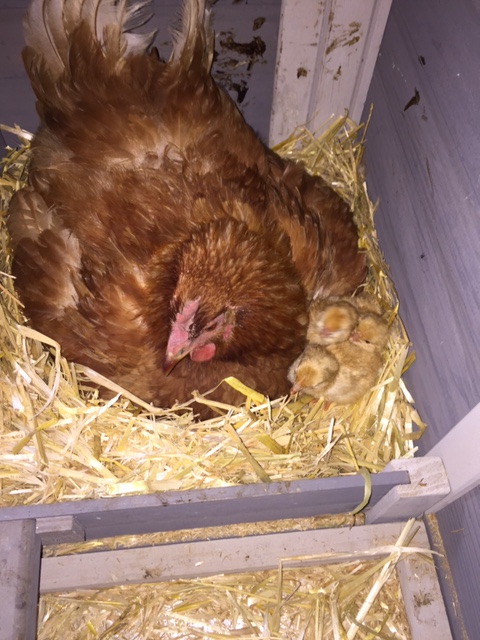
Carol and I decided to let the hens hatch a batch of chicks. All four hens took turns laying the eggs in one nest. I suppose the hens drew straws and Goldie was chosen to be the Momma. Twenty-three eggs fit inside the nest, so we began gathering the rest.

In New Mexico, we raised chickens and turkeys from 1973-1978. Buying the chicks at 3-days old, we didn’t hatch our own, therefore, this would be the first time we hatched … uh … let our hen hatch them, and we had a lot to learn.

I forgot that the mama hen turns the eggs several times a day. Thinking that one of the hens laid an egg on top of the 23, I took it and put it in the refrigerator. (We wash all the eggs we collect.) Four days later, Carol and I were negatively surprised when I cracked that egg to cook it, and dropped a fully-developed chicken as big as the first two digits on my baby finger into the pan. It had previously died in the fridge.

One night I got home late and forgot to secure the coop. The next morning, I found chicken feathers all over the yard, but no rooster. Fred (the rooster) apparently had fought the predator to protect his harem, and gave his life for them. But in the fracas, Fred also mortally wounded the opossum, and I found the opossum’s carcass in the corner of the yard. However, something else (coyote?) had jumped the fence and took Fred’s carcass.

Never again will I forget to secure the coop.

After Goldie sat on the nest for three weeks, the eggs began hatching. Eleven hatched, but one died. I called the remaining babies “Our ten chicklets.” I made sure I closed and latched the coop, but there was something else I didn’t know: the other hens would hurt or kill the babies.

Making the fatal mistake of allowing the hens to be in the same coop with the babies, the next morning I found eight dead chicklets. It was my fault, and I felt terrible. Even worse, while Goldie was trying to protect her young’uns, the other three hens attacked her. That broke our hearts, and I resolved to keep the hens away from Goldie and her remaining babies until they were older. Goldie recovered, but a week later, one of the chicklets died.

The remaining chicklet is nearly full-size now, and she has a name: Baby. So, we have Red Head, Whitey, Elona, Goldie, and Baby. Now the hens don’t attack Baby; it’s just the regular “pecking-order” that takes place.

As I’ve been thinking about all this, the Church came to mind. Too often, if someone’s theology differs from ours, they are labeled or branded as in error. Regardless of theology, if they tend to differ in other seemingly important areas, the church often tends to shun them or separate from them. We sometimes “kill” them socially by damaging their reputation. And if we allow our emotions to control us, we can even insult Jesus by splitting His Church. This ought not to be!

People who are made in the image of God should not act like animals. I Peter 4:8 informs us that we should look for ways to love and protect God’s flock.

Neither you nor I are perfect, so learn to accept others as they are. Love and honor God by loving and protecting His flock. Remember: you need their friendship as much as they need yours.

I’ll tell you more about the flock in the next three weeks.

I Nearly Missed This Week

It was July 4 and I didn’t write,

I happen to not be at home.

On the road, and enjoying life,

I didn’t write a tome.

Visiting our daughter who lives down south,

South of Dallas in Texas,

Her amazing kids are our grandkids,

And they all love and respect us.

From 15 years to 2 weeks old,

I enjoy being with them.

We play, we laugh, we always have fun,

Each one is a special gem.

Well, I’ll stop writing and get back

And see what the troops are doing.

Today is our son’s birthday

And I’ll find out what’s brewing.

May the Lord bless you and keep you,

And may you love and honor the Lord.

I’ll endeavor to write again next week;

So enjoy life, love God, and don’t get bored.

Simple Writing is Smart Writing

When I was in high school trying to write reports and term papers, I had a difficult time. No matter how hard I tried, I couldn’t get anything to sound right. Asking dad for advice, he looked at my futile attempts and said, “You’re trying to sound smart.”

“Huh?”

“You’re trying to empress your teachers. Quit it, and make it sound like yourself. Do the research, know what you’re writing about, but make it sound like yourself.” He then taught me a lesson I never forgot.

The most widely read magazine at the time, Reader’s Digest, was written on the 8th-grade level. Although enjoyed by professionals and academics, it was read and understood by 10-year-old kids. “You do need to increase your vocabulary. That’s a fact. But don’t try to impress anyone. Just convey information in a meaningful way.” Dad was right, of course.

That made life much easier for me. And as I write this today, I am reminded of a humorous conversation between my brother-in-law, Paul Anderson, and a scientist in Los Alamos, NM. Paul is an expert auto mechanic and understands everyday life quite well.

The scientist drove up to Paul’s shop one day and said, “Mr. Anderson, There seems to be a protrusion in one of my tires that allowed the air to escape.”

Paul responded, “Oh, you mean you got a flat?”

Upon which the man replied, “Yes, I guess you could say that.”

Whether we are writing or speaking, we should use concepts, syllables, and phrases that convey our thoughts in a meaningful manner to the listener and reader. That’s called proper communication.

The rule of thumb is to say things simply. If people have to ask you what you meant, you may have miscommunicated, or you simply need to explain in more detail. When I teach, tell stories, preach, or write, I communicate in such a way that children as well as scientists can understand me.

New writers, as I was back in high school, tend to use long words and complicated writing styles. That works if the writer needs an extra 150 words to fulfill the writing assignment. But if the writer understands what he/she is writing about, fewer words give space for more content. Here’s a case in point.

Back in 2004 as I began writing Bible Question & Answer articles for a New Mexico newspaper, Ralph the editor told me I had a limit of 250 words per article; and 250 words included the question. I asked, “How can I fully answer a Bible question with approximately 225 words?”

Ralph responded, “Anyone who understands what he believes can respond in 225-250 words.”

That was possibly some of the best writing mentoring I ever received! And I worked at it.

After six months Ralph said, “You’re doing very well, and I’m upping your limit to 350 words. Keep avoiding excessive words while filling the added space with content.”

Ralph then suggested that I select up to 65 of those articles and format them into a book. Following that advice resulted in my first book titled Insights on Faith & History. It has been updated and published in a second edition called Reflections on Faith & History. (See my blog for last week.)

Quoting from a Princeton University Report: “Write as simply and plainly as possible and it’s more likely you’ll be thought of as intelligent.”

Combining the advice from Dad, Ralph, and Princeton – and applying it – changed my life.

Keep in mind that writing doesn’t necessarily mean writing books. People write and mail letters to friends. We also write emails, texts, tweets, and a lot more. But depressingly, a lot of that is very poorly written.

So, if any of you want to increase your writing skills, there are several options. Here are only three. 1. Find a writer’s club and join it. 2. Sit down and write something you’re interested in and ask a friend to critique it for you. Accept his or her advice and rewrite it. Ask others to critique it next time. Learn from them. 3. Go to the internet and simply type in: Help in writing better. You’ll get a lot of good advice.

Remember: Simple Writing is Smart Writing. Have a great day, and Happy Writing.

Dickens and Christmas

Have you heard about the movie: The Man Who Invented Christmas?

Chris Knight, chief film critic for the National Post, said, “The movie is based on Les Standiford’s long-winded historical non-fiction from 2008, The Man Who Invented Christmas: How Charles Dickens’s A Christmas Carol Rescued His Career and Revived Our Holiday Spirits.” Knight also said of the movie, “By all rights, The Man Who Invented Christmas should be a humbug. Instead, it’s a humdinger.”

Charles John Huffam Dickens was a prolific writer. One article says he is regarded as the greatest novelist of the Victorian era, and that he created some of the world’s best-known fictional characters. Several of them are: Jack Dawkins, the pick-pocket in Oliver Twist; Tiny Tim, Bob Cratchit, and Ebenezer Scrooge in A Christmas Carol; Mr. Pott, the editor in The Pickwick Papers; and David Copperfield in David Copperfield.

Dickens was a prolific writer. But did he invent Christmas? Humbug!

But some pagan activities did intermingle with the sacred celebration.

Another commentary is from Ronald Hutton, an historian at Bristol University in the UK. He said, “It’s a mistake to say that our modern Christmas tradition comes directly from pre-Christian paganism. However, you’d be equally wrong to believe that Christmas is a modern phenomenon. As Christians spread their religion into Europe in the first centuries A.D., they ran into people living by a variety of local and regional religious creeds.”

One report says: “A Christian holiday honoring the birth of Jesus Christ, Christmas evolved over two millennia into a worldwide religious and secular celebration, incorporating many pre-Christian, pagan traditions into the festivities along the way. Today, Christmas is a time for family and friends to get together and exchange gifts.”  (history.com/topics/christmas)

Philip Shaw, who researches early Germanic languages and Old English at Leicester University in the UK, said, “Early Christians wanted to convert pagans to Christianity, but they were also fascinated by their [pagan] traditions.”

Stephen Nissenbaum, author of “The Battle for Christmas”; Vintage, 1997) made a good case for an old Christmas celebration when he said, “If you want to show that Jesus was a real human being, not just somebody who appeared like a hologram, then what better way to think of him being born in a normal, humble human way than to celebrate his birth?”

Christmas celebrations developed independently around the world for almost 2,000 years. And why not? Jesus’ birth was probably one of the two most important events in the history of the world!

And that’s why we celebrate Christmas – God became man in order to redeem us and restore our fellowship with Himself. And he came as a baby, born in a manger.

But as mentioned previously, many of the Christmas festivities became corrupted. Instead of candlelight services or worship services, rowdy and drunken revelries became common. Therefore, many protestants rejected paganized Christmas celebrations. Early Protestants wanted to honor Jesus Christ, our Savior – not have a festivity which obscured Christ. Denouncing sin and frivolity, they gave necessities for life as gifts; avoiding superficial parties, they shared sacred meals.

But as some Protestants squelched the pagan revelry surrounding Christmas, they also put down anything associated with Christmas celebrations. They threw out the baby with the bathwater. In this case, they threw out observing the birth of Jesus with the pagan celebrations.

Enter Charles Dickens.

Noting societal debauchery, prevalent poverty, and abusive child labor in the 1840s, Dickens vowed to do something about it – and writing was what he did best. In six weeks, he wrote A Christmas Carol. If you’ve read it, you know why it became an immediate best-seller.

Dickens wanted to insert joy and gladness into a life filled with drudgery, dreariness and death. Without ignoring the seriousness of life, he portrayed the Spirit of Christmas filled with miracles and laughter. He also reminded society of the importance of blessing others by caring for those around them.

Did Dickens invent Christmas? No. But he did encourage joy and human-kindness, and inspired a positive change in society.

Jesus, who is God (John 1:1-3), came to earth to restore man’s relationship with himself. But he came as a baby (Matthew 1, Luke 1) so, as he grew, he could personally experience mankind’s trials, hardships, and joys.

Jesus loves you and desires for you to know him as he is today – God and Savior.

May the Lord bless you this Christmas season.

Down Memory Lane (pt.2)

For a couple of years, my brother, Paul, and I’ve been talking about preserving family memories. Our parents and parents-in-law are gone, two of our siblings are gone, and we don’t know what the future holds. Every time someone leaves this life, an encyclopedia of information evaporates into thin air.

How many times have you heard, or even said, “I didn’t really know him”? How many times have you thought, “How would he respond in this situation?” Or, “I know we grew up together, but what happened that gave her a different outlook on life than I have?”

It was time to start documenting Linzey family memories!

To begin, two major factors had to be considered.

1) Because everyone is so busy, the process must be simple. And

2) Because writing is seen as a chore, the process must be enjoyable.

The brainstorming session began.

Proverbs 17:22 informs us that a cheerful disposition (“a merry heart”) is good medicine to the body, but discouragement causes our health to deteriorate (“dries up the bones”).

We could let each sibling take turns choosing a topic to write about, but people’s minds sometimes go blank. Several of our siblings asked, “How do we choose a topic?” So Paul chose the Rememory Card® system. (Look up “Rememory Cards” on the web.) Nevertheless, with or without cards, here is the simple process Paul wrote.

  1. Decide how many months you would like the project to continue.
  2. Each week, take turns selecting a writing prompt and those joining the fun will write a memory on that topic. Write from a half to 2 pages per memory. Paul and I decided on one memory per week, but you can choose your own time cycle. We realized that if we waited too long, we’d lose the enjoyment and the momentum.
  3. Write whatever you want. Nobody will censor your language or stories.
  4. There is no pressure or mandate to write about every topic selected. If you don’t want to write about something, skip it.
  5. You may write about anyone in the family. Your stories don’t have to be only about yourself, however, you should be considerate of others’ feelings when writing about your family.
  6. You can draw from your whole history. Consider your whole childhood as well as your adult interaction with the family.
  7. This is a memoir project. Memory is not always accurate. In fact, it’s been demonstrated that nobody remembers perfectly. Also, we tend to interpret as we remember. We subconsciously fill in the blanks, expand, and erase some aspects of our experiences. So, we don’t challenge anyone’s memory. Memory is specific to the individual.
  8. Every family has both good and bad, painful and pleasant, positive and negative, funny and serious memories. Try to get your stories to reflect a balance and a blend of these dynamics.
  9. Not everybody will remember what you remember, so it might be a good idea to identify the year, the location, and the writer’s name after each person’s story.
  10. It’s OK if your stories focus on yourself, but, if possible, find a way to bring at least one other family member into the anecdote.
  11. This endeavor can create priceless documentation of your family history that your grandkids and great grandkids might never know otherwise.
  12. Simply take turns choosing a topic, gather the stories, and have someone compile them. If the family agrees, you may find a publishing company (expensive traditional or affordable self-publishing company) to format it and turn it into a family treasure.
  13. Keep in mind that this memory project is for your own benefit as well as for the rest of the family. And if you get brave, as my family might, you can have it published for the general public.

Our family started in January and will complete it in October. With six of us writing, we’ll have well-over 400 pages to edit and format into a family treasure.

There are ten kids in our family, with fifteen years between the oldest and youngest. Knowing that fact alone, you may understand why there’s a lot about each other that we don’t know – even coming out of the same family, same church, and same basic culture.

The fact is, we are all different and we all interpret life differently. But all six of us thoroughly enjoyed it, and, as a side benefit, this project has drawn us all closer than we’ve ever been before.