The Joy of Family

In the summer of 2019, our daughter, Darlene, and her husband asked Carol and me to join them for a 5-day vacation in Pagosa Springs, Colorado. Our other daughter, Rebecca, and her family came up from Texas, and some dear friends, Charles and Cathy Knoop, trekked from New Mexico.

What’s going on? We found out.
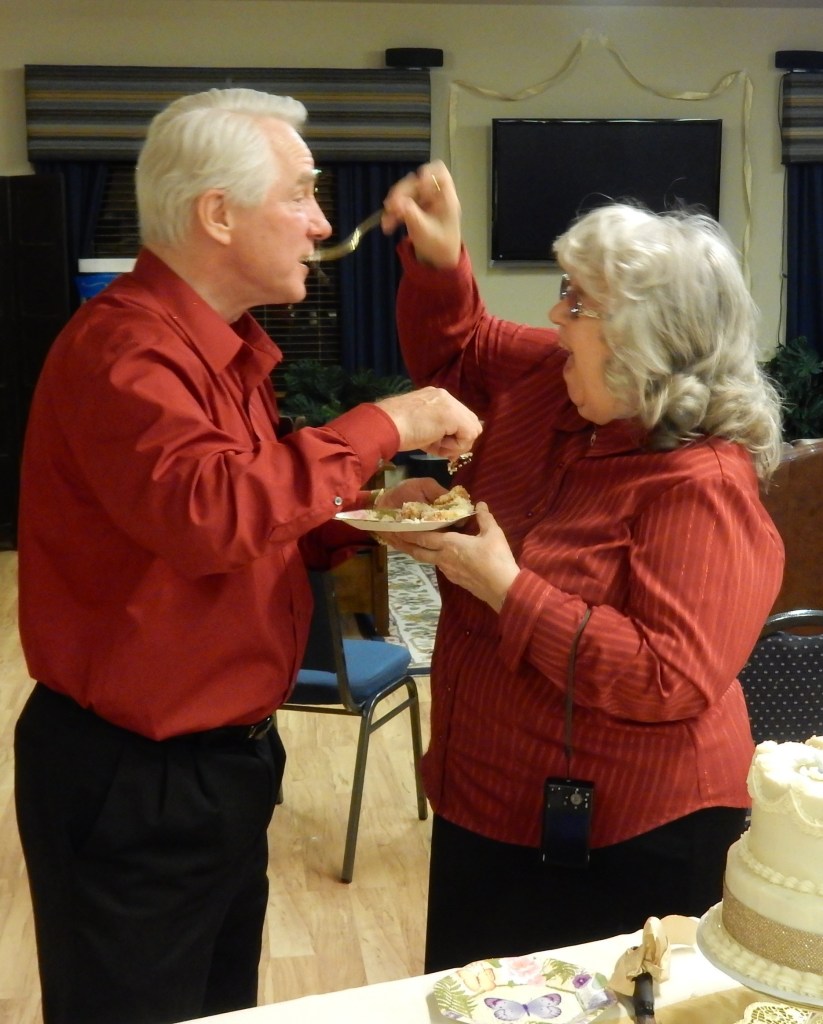
They all gave Carol and me a surprise 53rd wedding anniversary party! At our age, we don’t feed each other, but we tried it this time, and as you can see, we had fun.

We had a great time in Pagosa Springs. Breakfast was on our own; Rebecca, a certified Health Coach for Dr. Sears Wellness Institute, gave us ground-breaking ideas of how to enjoy our retirement years – beginning with proper eating-habits (we began our new eating plan after the ice cream & cake); and nightly dinner was in Charles and Cathy’s condo. What a time we had!

I enjoyed Rebecca’s teaching as a Health Coach. Implementing her information helped me to get down to my target weight. Starting at 183 pounds, I got down to 164, and there’s no special diet. I eat plenty of food, I have more energy, and my clothes fit better. If you would like to hear more about this, email me your interest, and I’ll get you in touch with Rebecca.

Charles and I did what we always did in Pagosa – we went fishing! You can see the joy on his face with this catch. I kept two of the three catfish and all six rainbow-trout I caught. I should tell you: I like to eat catfish, but in the future, I’ll leave the catfish catching & cleaning business to the restaurants. Those critters are difficult to clean! The restaurants also cook them better than I did.

The smallest trout we caught was 14 inches, and the largest was 19. The trout are easy to clean, wonderful to eat, and Carol makes trout-fish sandwiches with the leftovers. I like that better than tuna-fish sandwiches.

One daughter and family lives in Colorado, and the other daughter and family lives in Texas. One son and family moved to California, and another son and family moved to Indiana. But Carol and I don’t plan on moving, so one son here in Arkansas visits us often. We play racquetball and he beats me 95% of the time; but I enjoy the game. Maybe I should mention: the 5% of the times I win are a gift: he humors me by letting me win.
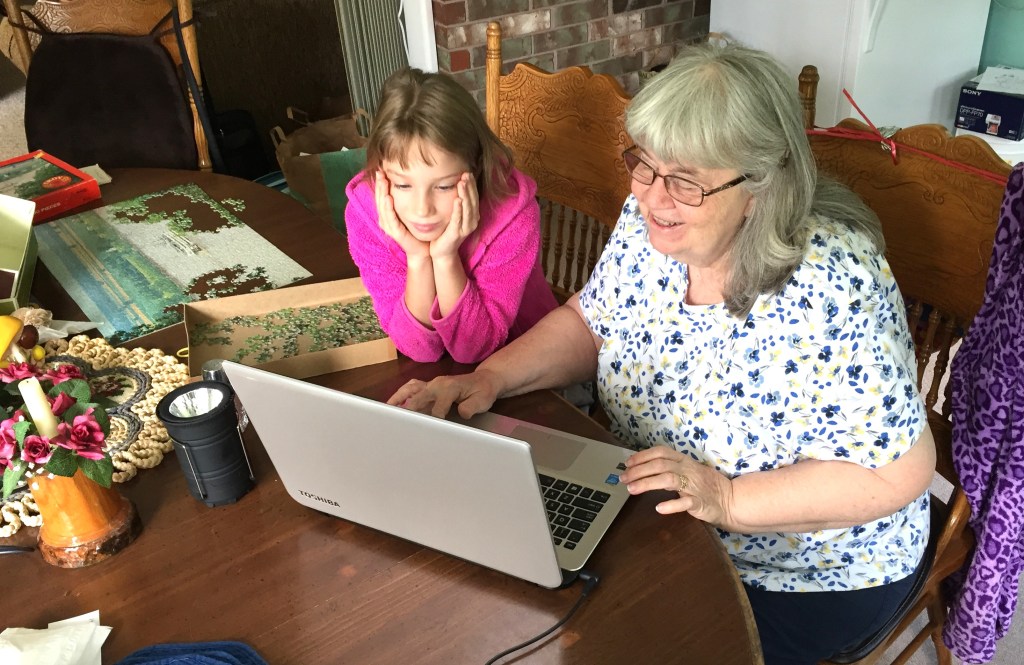
When it was time to part ways in Pagosa, we asked if Serena, Rebecca’s 3rd daughter, could spend a couple of weeks with us. The request was granted.

Carol and I haven’t had small children staying with us for quite a while, and this was a treat for us.

Seven-year-old kids are smart. They know what they want, and endeavor to get it. But Serena is polite, and learned my house-rules quickly. She learned to clean her plate, make her bed, and pick up the toys before bed-time. And it didn’t take long for her to learn to like my Honey Bunches of Oats cereal. She already liked Braum’s vanilla ice cream. I had to make sure I got my fair share of it.

My name for Serena is Bunny, and she calls me the Old Goat. Bunny and I hopped around and had a good time. In fact, we had such a good time that Grandma (Carol) had to settle us down several times.

Bunny likes animals, and surprised Grandma with a palm-sized Anura. That word in Ancient Greek means without tail, and is a frog. There are over 6,300 recorded species of Anurans which amount to about 88% of amphibians today. But even one frog was enough for Grandma. “Keep it out of the house.”

Bunny didn’t talk much around people whom she didn’t know, but she was a talking machine around the house. Bunny also put puzzles together with Grandma,.

The day after we returned Bunny to her parents, the house felt almost empty. In fact, after breakfast, I turned to see if Bunny had picked up her plate – but no Bunny. Carol said, “I miss her, too.”

The joy of family is one of the greatest gifts of God to us. Spend time with your family, and cultivate the loving friendship that only family can give. You’ll be glad you did.

Reaching for Life

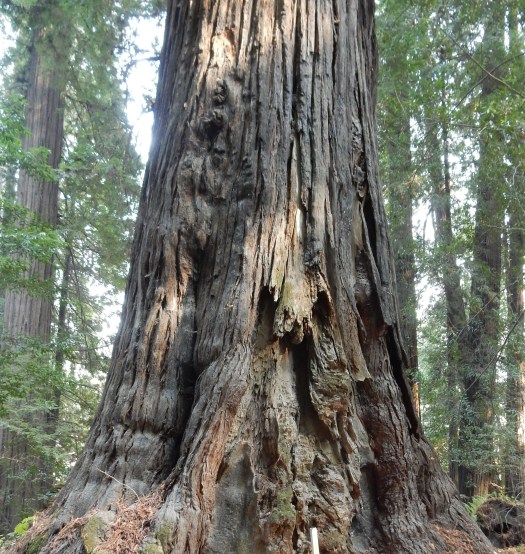
I’ve been looking at my pictures of the redwood forest in Northern California. The trees are big! Our pine tree in the back yard that is over two and a half feet in diameter looks big, but it is small compared to a relatively small five-foot diameter redwood tree. Amazingly, redwoods that are 10-15 feet in diameter are common; and it staggers the imagination knowing that the diameter of the General Sherman Redwood is over 32 feet!

A typical farmed redwood tree may weigh 50,000 pounds, but some redwood trees weigh over 2,000,000 pounds! Interestingly, about half the weight is in the water. The redwood bark may be over 18 inches thick, and a huge redwood tree may provide wood to build 30-35 homes.

Water is necessary for life. The redwoods grow to 250-350 feet tall and require over 100 gallons per tree per day. But it rains a lot in these forests, snows in the winter, and fog is prevalent; therefore, they are seldom thirsty. The root systems of redwoods are shallow, and that would mean a heavy wind or flood could topple them easily. But as they reach for life-giving water, a mature tree spreads its roots over 2 to 4 acres; and with an average of over 30 trees per acre, the root systems overlap and intertwine which results in a strong foundation for these top-heavy giants. They effectively support each other in rough times.

Light is also necessary for life. God engineered plants to reach for or aim toward light. This is called phototropism. The same is true of these giant trees. Programmed to be tall anyway, they continue to reach for life – for sunlight. Lone trees out in the open will not be as tall as those in the forest with a thick canopy of foliage, therefore, they are open to more danger. There is protection among neighbors.

The mature redwoods are basically fire-resistant. The thick, fibrous bark does not burn easily, and as a protective shell, it insulates the tree which allows it to survive most fires. The thick bark also provides protection of another kind: it has the ability to withstand fungus, disease, and insect attacks. This is why these trees live so long. The oldest known redwoods are about 3,000 years old. Only the bristlecone pines (about 5,000 years old) are known to be older.

Looking at the pictures of these magnificent trees, my mind gravitates toward humanity. I see similarities. No – not about size, but about other features and qualities.

The redwood’s root system covers a wide area which gives it stability in inclement weather. In the same way, our roots in healthy relationships with family, church, and society give us stability during “inclement” situations such as death, job loss, health deterioration, and more. In our many storms of life, we need each other for emotional and physical support.

But strong roots in a healthy relationship with Jesus Christ will help us even more in this life on earth, as well as throughout eternity.

 A straight tree is stronger than a crooked tree, and its wood is useable in more situations. Likewise, a morally and intellectually straight man is stronger and more trustworthy, where an immoral or double-minded man is weak, confuses people, and leads people down the path of destruction.

Trees must reach for the light to survive. In the same manner, man must reach for light – truth – to survive. We cannot survive very long, either societally or spiritually, if we live in spiritual and moral darkness. We cannot mature as morally strong individuals if we resist truth.

As the thick bark protects the trees, living in truth will protect us. Knowing the truth about various aspects of life – food, environment, chemicals, health, morals, physiology, and a lot more – can help us live safely. And purposefully living according to the truths found in the Bible will protect us in many ways most people don’t yet understand.

As the trees depend on water from the sky for life, man depends on guidance from the sky – from God – for life. Psalm 1:1-2 tells us not to follow the advice of ungodly people, but to meditate on and live according to the words of the Lord. Psalm 33:11 tells us that God’s plans are good, healthy, and beneficial. And Proverbs 14:11-12 warns us that man’s apparently powerful plans will fail in the end, but God’s seemingly weak plans are actually strong and will stand forever.

Trust in Jesus: Reach for Life. And live forever.

Be Ready for Surprises

Carol and I have an exciting life. We often don’t know from one day to the next what we’ll encounter – whether we’ll enjoy the events or be disappointed that we got out of bed. However, we understand that every day and in every situation in life, we have choices about how we’ll respond to circumstances. Sometimes events may be planned, but often they seem to pop up out of the blue. But we choose to respond in ways that honor the Lord.

For example, I wanted to visit my brother in California who was having health problems. Stopping for the weekend to visit with a dear, life-long friend who is a pastor, at 5:30 on Saturday evening, the pastor asked, “Would you be willing to preach for us tomorrow?”

I could have reacted with, “This is too short of a notice. I need more time to prepare.” But that’s not how God works. God had a plan in mind for both the church and for me, and I didn’t need much time to prepare. God had already been preparing the message in my mind and heart.

Another example developed as we were planning our route west from Albuquerque. Snow was forecast for Flagstaff, and pulling a trailer uphill in snowy weather is not my idea of safe traveling. So, we decided to take the southern route through Las Cruces, NM, and west through Mesa and Phoenix, Arizona.

However, we found out that God guided us in choosing the southern route because another friend who lived in Mesa had passed away. Her husband, Bill, called and asked if we could be with him at the home-going ceremony which would be at 10:00 AM on Monday. We agreed and arrived in Mesa on Saturday and stayed with Bill through the weekend.

Arriving at the cemetery at 9:30 AM on Monday, we interacted with Bill and the other family members, but the pastor hadn’t arrived yet. Finally, at 9:55 AM, I asked Bill, “Where’s your pastor?”

“Oh, didn’t I tell you? You’re him.” Surprised, I asked if he had an agenda. He said, “You’re it.”

I turned to the funeral director and asked him about his agenda. He responded, “I was told you’d have it.”

Again, I could have complained about not being informed beforehand. But if we are truly followers of the Lord Jesus Christ, our lives and schedules are in His hands, and He has the freedom to guide our paths. That eliminates a lot of potential stress.

I took a deep breath, sent up a quick prayer, and reprogrammed my mind. Four minutes later we began our Celebration of Life service. It didn’t take any time for preparation because God was in charge, and Jo had been Carol’s and my friend since the early 1990s. I opened the meeting with prayer, then related an interaction with her when I was music minister where she played trumpet in the orchestra. Other friends who had known Jo since the 1980s were there, along with Jo’s husband and family. They, and others, added stories from their past. We truly celebrated her life, and it seemed like it was all planned.

Guess what? It WAS all planned – in the mind of God.

When a surprise springs up in front of us, all we need to do is ask the Lord for guidance. God likes that, and always has an answer. He’s in charge, and all we need to do is communicate with Him and be ready to obey.

That reminds me of another interaction many years ago.

In 1978 when Carol & I, with our 3 older kiddos were getting ready to relocate from New Mexico to Oklahoma, an older pastor in Albuquerque gave me this admonition:

“Gene, don’t open your own doors. You, and others who are like you, have a tendency to open doors that God doesn’t want open. Keep your hands off the doorknobs. Let God open the doors for you, but be sure to go through the ones He opens.”

“May I try the doors and see if they’re unlocked?”

“You may lightly push – with one finger. But keep your hands off the knobs.”

I’ve lived by that rule and God has led in wonderful ways.

Many surprises await us, so trust God for His guidance. Psalm 28:7a says, “The Lord is my strength and shield. I trust him with all my heart. He helps me, and my heart is filled with joy.” Be ready to obey, and enjoy the surprises.

Is There Life Without Internet?

This is a follow-up of my blog last week. But this trip, in late 2018, took us up to the Great Northwest. We were staying at the Silver Lake RV Resort about 48 miles west of Mount St. Helens, not far from Castle Rock, Washington, .

My Precious Carol and I have been staying at an RV Campground since September 15 that does not provide wi-fi service for us. They do provide it for people staying for two weeks or less, but those of us who stay long-term have to pay for our own internet service, wi-fi, and electricity. All you veteran RVers probably know what I’m talking about, but this was new to us.

I laughingly and facetiously asked my Bride of 52 years, “Is there life without internet?”

She reminded me of when our three older kids were in elementary school. The school officials were going to conduct an experiment that was titled: Is there life after TV? The Public Schools were cooperating in a research endeavor regarding the effects of television on family life.

This was not mandatory for everyone, but on Monday morning all kids in the school were encouraged to refrain from watching television for the next 7 days. The kids took notes home to their parents asking them to participate with the project.

The kids were asked to bring in daily reports of what they did each day and how life changed; but in our house, we watched very little TV so I didn’t expect quality of life to change. Darlene, Ron, and Jeremy practiced their musical instruments a little more, we played a few more family games, and we got into more family discussions. But I was surprised when Carol told me how much better we all got along with each other.

Guess what? Shortly after that educational experiment, we sold the TV and used the money for music lessons. Our kids were in on the family pow-wow, and that decision was unanimous.

For the rest of the school, was there life after television? After just two days, there was weeping, wailing, and gnashing of teeth in many of the homes – and much of that came from the parents!

It was surprising how many families had wrapped and warped their lives around the box that usurped so much of their time. Unplugging the television was like a divorce, and life was shattered. Many families couldn’t take it and turned the TV back on. Relief flooded their homes as each family member resumed going his or her separate way.

That was in 1979 and we still do not immerse ourselves in television, theater, entertainment, etc. Our daughters and Carol & I own televisions, but the TVs are tools we use at our discretion. On the other hand, our two married boys, Ron and Jeremy and their large families, don’t own television sets. We all understand what life is about.

Now, where was I? Oh yes … is there life without the internet?

The first question my Precious Carol and I asked ourselves is: What is the purpose of this extended trip?

The purpose is two-fold. We realized that if nothing in our lives changed in these, our later years, we would not be making any new memories. So 1) I resigned from all my responsibilities to reduce stress, and be with Carol. And 2) I need time to write two or three books.

And guess what? It is great! Even without internet.

But let me be open with you: I do need wi-fi and internet periodically, but not 24/7. I need internet capability – as when I need to email you folk, send my Reflection articles to the newspaper, and do research – and the park officials allow me to intermittently use their service in the lodge. But leaving the RV to do that means I plan my time judiciously because this trip was mainly about spending time with Carol.

So, are there benefits of not having internet and TV? Yes, that’s why I am not paying for it at RV campsites. But we are paying for electricity. That comes in handy if we want to have lights, heat, and use of the computer – wi-fi or not.

One man asked me, “Don’t you want continuous use of your e-mail service?”

I told him that I can live without most of the e-mail I receive, and e-mail that friends and family send can be answered when I have time. I reminded him of the benefit of e-mail: others can send e-mail at THEIR convenience, and I can respond at MY convenience. I am not hog-tied to the internet or e-mail; the telephone is what’s needed for immediate interaction.

 Well, since you’re reading this, I suppose the e-mail worked and my blog got through the internet. Have a great day.

You’ve Got to be Kidding!

The following event took place in 2018.

“Where are you going this time?” Ed seemed to think my Precious and I should stay put for a while. “And how long will you be gone?”

“We’re going to The Ridges Resort in Young Harris, Georgia. It’s time for the annual reunion of the USS Yorktown (CV-5) Survivor’s Club, and we’re meeting in northern Georgia this year. The reunion will run from May 2-6. I’m the chaplain for the group”

“Oh yeah. Your dad was on the Yorktown at the Battle of Midway, wasn’t he? When was that battle?”

“June 3-6, 1942, and the ship sunk on June 7. I replaced Dad as chaplain of the survivor’s club when Dad died. We’re wrapping a trip around the reunion.”

“Young Harris? Funny name for a town.”

“It’s a real town – a small one – about six miles south of the Tennessee border and about 110 miles by road south of Gatlinburg, Tennessee.”

I told Ed we bought a travel trailer, and that it’ll be our home on the road for a month. I also mentioned that we would visit the Museum of the Bible in Washington D.C., the Gettysburg Battlefield, Niagara Falls, and maybe Noah’s Ark in Williamstown, Kentucky again before coming home.

 “The trip sure sounds interesting. But I know you: you wouldn’t buy a trailer for only a one-month trip, and I know you have to be home for your writer’s conference in June. So, why the trailer?”

“Okay, Ed; I’ll give you a hint. Starting in late July or early August, we’ll be on the road for about a year.”

“A year! Are you serious?”

“Yes, we’ll be gone for about a year, and the trailer will, indeed, be our home on the road. We’ll need a renter for the house. If you know of a family who needs a home for a year, let me know. But regarding the trip, I’m going to conduct an informal survey of churches across America while we travel the country. And, yes, we’ll do a lot of sight-seeing as we go.”

Shaking his head, “More like a spot-check survey. I think you ought to stay home. You going to keep writing for the paper?”

“Oh yes. For some reason Graham Thomas puts up with me, so you’ll see me every Wednesday in the Herald-Leader. And I’ll send Graham Tales From the Road periodically.”

Ed said he would pummel me with more questions later; but he had errands to run.

We never had a trailer before, so we made a preliminary week-end excursion to the Dallas area in March to learn about pulling one. We’ve named the car Traveler and the trailer Casita. In US Navy terms, the Dallas trip was the trial-run; the month-long Yorktown Reunion trip will be the shake-down cruise; and the year-long excursion will be the maiden voyage. (The month-long stretched into a 7-week trip.)

I chuckle as I think about Ed’s and my conversation. It’s true that Carol and I travel a bit, and I’m thinking of a trip back in June of 1970. Renting a U-Haul truck, we were moving from Everett, Washington to Los Alamos, New Mexico. Carol and our two kids flew by United Airlines, and a friend, Oscar Moe, drove the truck with me. Stopping in Pinehurst, Idaho for gas, Oscar struck up a conversation with the gas-station attendant.

“How long have you lived here in Pinehurst?” Oscar asked.

“All my life.”

“Have you traveled much throughout the Great Northwest?”

“Never been outa Pinehurst.”

“I don’t mean to be rude, but you said you are 38-years-old, and you’ve never been out of town?”

“Yup. Don’t need to go nowhere. Family’s here, dog’s here. Ma and Pa’s buried here.”

That amazed me! I was almost 24-years-old, married almost 4 years, and had traveled coast-to-coast with my Navy parents. Meeting someone who had never been out of town? That was almost beyond my comprehension.

Well, back to the 2018 trip.

Ed didn’t think we were really serious about this trip in a small trailer, and when he saw it, he burst out, “You’ve got to be kidding!”

I agreed with him that this will be living in close quarters for a while, and the weekend trip to Dallas would introduce us to living with each other in a portable house that is about half the size of the living room in our house. Will there be tension or misunderstandings? We are human, so the answer was yes. The inside space of a 20-foot trailer has only about 120 useable square feet, and that’s a lot less personal space than a 1750-square-foot house!

But our dedication to Jesus Christ was foundational and our love for and devotion to each other is a close second. We understand human nature. but no matter what happens on this ball we call earth, I’d rather be with Carol than with anyone else in the world. Therefore, overcoming problems is a given, and we will grow through them.

That was five years ago, and Carol & I have slowed down a little. But don’t be surprised if you hear that we took off on another trip. After all, the Casita is still on our driveway in front of the house. Tires are good, and — come to think of it, we are going to Texas in 2 weeks. Hmmmm………

The Calaveras Jumping Frog

I had no idea what to expect when Carol and I went to San Andreas to visit our son and his family. Our first three nights were in Angels Camp just eleven miles south.

No; that isn’t a place where celestial beings hunted and camped out. It is a town started by Henri Angell in 1848 as a gold mining town. Originally named Carson’s Creek, the town was incorporated under the name Angels in 1912 (located in Calaveras County) and eventually renamed to Angels Camp.

Although more than $20,000,000 in gold was processed there in the middle to late 1800s, one thing brought fame to both the town and a man: a story about a frog.

Sam Clemens, under the pen name of Mark Twain, was down on his luck and went to try his hand at panning for gold in the winter of 1864-1865. He didn’t do very well during his 88 days here in the California hills, but he heard a story in one of the taverns about a jumping frog. The veracity of the story is questionable; but embellishing it even further, Mark Twain wrote it up and sent it to his newspaper, The Territorial Enterprise, in Virginia City, Nevada.

That story, only 2,637 words including the title (The Celebrated Jumping Frog of Calaveras by Mark Twain), brought him immediate fame and fortune; that story became his “gold mine.”

Our son, Ron, took me to visit the site of his cabin on Jackass Hill where Mark Twain lived for almost three months. The hill received that name because at least once a week, a caravan of up to 200 donkeys with supplies for the miners in Carson Creek (Angels Camp) would stop there for the night.

Today, the main feature of the Calaveras County Fair is the frog-jumping contest. It is called the Calaveras County Fair & Jumping Frog Jubilee, and is one the longest-running events in the state of California—going back to 1893. Of course, as with any good county fair, it includes entertainment, livestock, food, music, and crafts.

The frog jumping contest is usually in the third weekend of May; and in a town of about 3,900 population, about 50,000 visitors attend the jubilee. People can bring their own frogs, or rent them from a company in town (who catch the amphibians in the local ponds). The winner of the contest each year gets a plaque and $900 in cash. But if a frog beats the world record of 21 feet, 5 ¾ inches, the owner gets a World Record Holder title and $5,000 cash. Now maybe you can see why this is a big deal in Calaveras County.

Frogs are placed at the starting line. They get three jumps. The actual distance they jump is immaterial – it’s how close the critter gets to the finish line that counts. (They seldom jump in a straight line.)

Another event that takes place is the Mark Twain Wild West Fest on the third Saturday of October. Gold Rush village is a kid’s area with fence-painting, knot-tying, a petting zoo, historic town with candle and soap-making, and more. There is gold-rush era music, and in honor of Mark Twain, a liar’s contest. That’s a real hoot!

Mark Twain was a good story-teller. In 1899 he wrote an article titled, “How to Tell a Story.” He said, “The humorous story is American, the comic story is English, the witty story is French. The humorous story depends for its effect upon the manner of the telling; the comic and the witty story upon the matter.”

Twain learned to tell stories in a dead-pan manner. The audience would be in a gale of laughter while Twain would sit there and watch them. That made it even funnier.

Mark Twain sent his story about the Calaveras County frog contest to The Territorial Enterprise in Virginia City, Nevada. I read recently that although the paper had gone out of business sometime ago, it is now back in operation. It was in this newspaper that Twain wrote, “If you don’t read the newspaper, you’re uninformed. If you do read the newspaper, you’re misinformed.”

Angels Camp is about 132 miles east of San Francisco by road, and about 80 miles southeast from Sacramento. My favorite eating establishment in town is called Round-Table Pizza, and the best ice cream place is called Yummy Ha-Ha. (I’m not kidding.)

Well, Blow Me Down!

Some folks said Blow me down! meant to hit me or knock me down; but that might not be correct. The phrase goes back the late 1700s, and is a statement that sailors said in a windstorm. A windy place in Nova Scotia was called Cape Blow-me-down, which evolved through time to Cape Blomidon.

Blow me down! eventually became a phrase used when someone was surprised. A relatively new version is, That blows my mind!

Wind is an interesting atmospheric action. It can be gentle for kite-flying; moderate for turning wind-turbines; strong can blow over trucks and trailers; or powerful such as tornados and hurricanes. The story this week is about the third group: strong winds.

Carol and I arrived in La Luz, a small town near Alamogordo, New Mexico on Sunday to visit friends, and planned to head east on Wednesday. But watching the evening news report, we learned that a tremendous windstorm was heading our way. It would hit on Tuesday and turn violent on Wednesday. We considered leaving on Thursday, but snow was forecast for Thursday night and Friday. Our last option was to leave a day early.

So, we toured the space museum in Alamogordo on Monday and toured the Tularosa Museum on Tuesday morning, then headed east up the mountain to Cloudcroft. La Luz is 4,761 feet above sea level and Cloudcroft is 8,668. It was quite a climb, but our car was up to the challenge. Pulling the trailer, I put the 6.2L, 380 HP, 8-speed engine in gear #4 and it was an easy pull up the mountain. Several other cars, pulling no trailers, had stopped beside the road to let their engines cool down, but our engine heat indicator barely moved.

We stopped in Cloudcroft to look at the scenery and have an early dinner, and the winds began greatly increasing. We hugged our friends, bid them adios, and headed east to Hobbs, NM which was projected to be on the fringe of the storm.

When we had the opportunity to watch the news, we learned that our departure was directed by the Lord. The wind blowing through one of the passes going into the Alamogordo basin reached over 100 mph. Remember: hurricane winds begin at 70 mph.

When thinking of the danger of driving in windy situations, we need to consider sustained wind and wind gusts. If the wind is blowing around 20-30 mph, gusts may reach 40 or 50 mph; and although it can be a rocky ride, it is normally safe. Wind advisories are put out if the sustained winds surpass 30 mph. But if the sustained wind reaches 50 mph, gusts may easily reach 60-75, and we may be in trouble.

The gusts are the worst part of the storm because the intermittent pressure can set up sideways trailer motion called oscillations which can cause a turnover.

Having said all that, the simple decision was: if the sustained wind is 50 mph or higher, park the car and trailer. But if we must drive, here are several ideas to consider.

  1. Drive slower: decreased speed decreases the wind pressure.
  2. Use a lower gear: more power on the drive wheels at a slower speed can compensate for some of the crosswinds.
  3. Whether car, trailer, or truck, secure the cargo: a moveable center of gravity can result in losing balance.
  4. Keep a safe distance behind the guy ahead: if either one of us goes over, we don’t want to hit someone or get hit.
  5. Back to basics: if possible, stay off the road. Losing time is less expensive than repairing or replacing the car, trailer, and cargo; and a lost life cannot be replaced.

There are other kinds of storms of life. Some of these storms are political, health, weather, financial, and interpersonal; and God sends us storms for our personal growth. Knowing a storm was about to brew, Jesus told his disciples to go to the other side of the sea (Matthew 14:22-24) because they needed to learn how to trust the Master. Read the story: it’s interesting.

Sometimes we are dragged into storms by others, and we need wisdom to handle the situation. But many times, we generate our own storms by foolishness and disobedience. An example is when Jonah tried to run from God (Jonah 1:1-4).

Whatever kind of storm we encounter, let’s stop; assess the situation; and ask God for wisdom. He will guide us if we listen. He guided us back in New Mexico.

Weather Woes

Before we begin, you need to know that we stayed on the positive side of life all through these weather woes, and you can, too. Now, on with the story.

Carol and I began the trip on July 30, 2018. Throughout portions of Colorado, Wyoming, Montana, Idaho, and Washington, we breathed smoke from forest fires, and I had to take allergy pills to reduce sneezing.

In early October, the smoke had cleared out of western Washington where we were staying, but something changed. In mid-October we felt the cold hand of winter tapping us on the shoulder, so we made plans to head south. By November 1, we heard that snow was on its way, and we started driving.

Heading down through Oregon, snow was no threat, but rain was visiting us often. We had some days of sunshine, and we enjoyed the trip, but rain was becoming much more prevalent. We cut the scenic trip short and headed south to sunny California.

On November 17, our son and his family moved to Mountain Ranch, just sixteen miles east of San Andreas, California, so we went to visit them. Now in California, we were south of wintery Washington and rainy Oregon. We are not classified as Snowbirds, but we do prefer a little warmer and drier climate.

I grew up in California, and winters on the golden coast were normally mild. For example: In February of 1993 we drove to Southern California for my grandmother’s funeral. Our ten-year-old son, Michael, said, “Dad, a California winter is like a New Mexico summer!” I laughed and said, “You’re right.” (Our home in New Mexico was at 7,830 feet above sea level.)

Back to the trip.

I had planned to stay in Northern California only through December. But the pastor of the church, asked me to teach on the Beatitudes (found in Matthew 5:1-12), so we stayed another month. Our son had a full-hookup on his property for our trailer, so we got settled in and really enjoyed the time with their family.

California had been in a drought for a number of years, so we were surprised to hear that a heavy rainstorm was on its way. That would be okay because, based on history, it wouldn’t last long, and the state needed the water.

But we got pounded! Rain came fast and furious. Any roof that could leak DID leak, some houses slid into rivers, and mudslides had to be removed from many streets. Our trailer was rocked by rain and heavy wind, but we survived the onslaught.

Then my cell phone warned me: “Weather Alert – Winter Advisory in effect for the next 48 hours. Snow accumulation of two to four inches.”

Our son said that might be an exaggeration because they haven’t received much snow for about 12-15 years. Good. Nothing to worry about.

But within the next 36 hours, we received 16 inches of heavy, wet snow. California needed the snowpack for its water supply, but it made things difficult for us. Snow-laden trees toppled onto power lines, and electrical power was out for almost a week. I made plans to move south as soon as I completed the Bible series. (Power was restored, but with damaged trees, branches kept falling and power was intermittent for two more weeks.)

By February 5, the snow had melted enough to allow me to pull the trailer off the property and down the mountain. So, with another winter advisory set for February 7, we pulled out on the 6th, and we headed for Bakersfield, California.

We wanted to stay in Bakersfield for two nights, but a portion of Interstate-5 called Tejon Pass is over 4,100 feet, and snow was predicted in two days. We stayed only one night.

We reached Oak Grove, CA (adjacent to Palomar Mountain) where my sister and brother-in-law, lived; and breathing a sigh of relief, I said, “We are finally out of the weather.”

That was a misunderstanding!

On February 14, Valentine’s Day, our area got the heaviest rainstorm on record and received over six inches of rain in two days. Roads washed out and several bridges were ripped up.

You might understand that, as soon as the dirt road was repaired, we headed further south to San Diego. Yes, we visited the zoo and Sea World. We had sunny skies for the next week – and hit the road to Phoenix before the next storm descended.

Where am I going with this tale-of-weather-woes? Simply this: we cannot always escape problems – weather or otherwise. Whatever we’re facing, we must pray for guidance and wisdom. 1 Peter 5:7 tells us to give our worries to the Lord because he cares for us. If we keep a cheerful outlook and trust the Lord, He will guide us.

C. M. Russell Museum

In September of 2018, I took Carol to see the 201-foot-long Roe River in Great Falls, Montana, and the Giant Springs that feeds the river. My brother, Paul, and I visited the river in June of 2016, and I was anxious to see it again. (Visit http://www.paullinzey.com)

Returning from the river and springs, Carol saw a sign and excitedly said, “Turn around!”

An obedient chauffeur, I turned around and found my way back to 400 13th Street North. I could hardly believe my eyes. I blurted out, “The Charlie Russell Museum? I didn’t know it was here! You want to go in?”

“I pointed it out to you, didn’t I?” (Good point.)

In Southern California I learned to know the artist as Charlie Russell, but perhaps most of you know him as C. M. Russell. Also known as “Kid” Russell, Charlie was perhaps the greatest painter and sculptor of Western America.

Charles Marion Russell was born in St. Louis, Missouri on March 19, 1864—a year before the American Civil War ended; and he apparently had the desire to sculpt and draw as a child. (Some of my friends say it was not a Civil War, but the War of Northern Aggression. Other friends call it the War of Southern Secession. Whatever……)

Through the stories of his grandmother (Lucy Bent Russell – her brothers were Charles and William Bent who founded Bent’s Fort in Colorado), Charlie became infatuated with The West, and when he was sixteen years old his parents allowed him to head west to work on a sheep ranch in Montana—often called Big Sky Country.

He became a cowboy; but no matter what you saw on television, being a cowboy was not all “Yippie-ty-yi-yo, Get Along, Little Doggies.” It was a rough life, but Charlie stayed on and learned almost everything there was to know about the job. He often sketched scenes, painted, and made models of wildlife to pay for his room and board.

Gifted artists are not usually great businessmen; therefore, he had difficulty paying bills and keeping food in the pantry. But when Charlie married Nancy Cooper in 1896, she became his manager. When Charlie might have settled for $25 for a painting, Nancy knew how to get several hundred for it. With Nancy as his manager, Charles Russell entered the national limelight.

Charlie’s memory was amazing, but he frequently used props and models. Sometimes Nancy and another friend would dress up in Native American costumes to model for him. He would often create a quick reference sketch then join in the fun and dress up as well. His studio was filled with Native American and cowboy tools, jewelry, clothing, etc., which he used for reference.

Charles M. Russell died of congestive heart failure on October 24, 1926.

Arriving at the museum in Great Falls around 1:30 pm, time escaped us as we visited the gallery. The Charlie Russell Riders Sculpture Garden in the front of the museum is beautiful. And once inside the gallery, we were amazed with the paintings, sketches, sculptures, and carvings! Even the model stagecoach looked realistic.

Charlie was observant! Seeing what most others glossed over, Charlie saw the beauty in a galloping horse; sage brush in twilight; sunset over the rugged plains; and the fearsome look on the face of the Chief sitting on his pinto without a saddle.

He had a memory for detail that far surpassed most people. A gunfight at a saloon with rowdy cowboys riding their steeds on the boardwalks became a beautifully detailed painting. And looking at another painting, I could almost feel the pain in the cowboy’s wrenched back as he tried to “break the bronco.”

The museum is very well laid out as it reveals the evolution of Charlie’s life: professional as well as personal. We found high-quality gifts in the C. M. Russell Museum Store. The personnel are friendly, informative, and a joy to be with. I learned a lot as I spoke with them. In 2009 the Wall Street Journal called the museum “One of America’s premier Western art museums,” and I fully agree.

As we drove back to Dick’s RV Campground, I marveled at Charlie Russell’s abilities. Almighty God is a great and loving Creator. I believe that God gives everyone some creative ability or talent at birth, and it’s up to us to discover what it is and develop it. Charlie did. I encourage you to visit the C. M. Russell Museum at 400 13th St. North, Great Falls, Montana. You’ll enjoy it.

Trouble Breathing

Carol and I enjoyed the drive from Arkansas through Oklahoma, Texas, and New Mexico. After visiting friends and family, we enjoyed the trip through Colorado and Wyoming. We’ve done it many times and we never tire of looking at God’s handiwork in nature. But things began to change in Wyoming.

We received some rain east of Cheyenne as we drove toward Rawlins, but it wasn’t rain that was discoloring the sky. After the rain let up, the sky began turning hazy. Going north to spend the night in Lander, WY, we were wondering what was going on. The haze was too light to be dust in the air, and the wind wasn’t blowing very hard, anyway. But going north from Lander, we began to figure it out.

Smoke in the atmosphere! Forest fires are out of control!

Prior to leaving on this trip, Carol and I saw reports of the fires on the television news reports, so we were aware of what was happening. But we didn’t know the extent of the fires, and we didn’t know how far the smoke had spread.

By the time we reached Coulter Bay north of Jackson, Wyoming, we could smell the burning wood although the forest fires were hundreds of miles away; and the Grand Teton Mountains were difficult to see.

The folks from the medical fields were telling people with health issues to stay indoors, and to wear proper masks or respirators if they had to go outside. However, many folks had only simple dust-masks over their nose and mouth. I’m not sure how effective they were others in blocking the smoke from the lungs, but they did not help me.

We travelled up into Yellowstone National Park and were happy to see that the atmosphere over the Fishing Bridge Campground where we were staying was relatively clear. But smoke had blown in around Old Faithful Geyser Basin.

A week later, we were heading up to Eureka, Montana, and the farther north we went, the worse the smoke was. When we reached my cousin’s home, we could not see the mountains which were only three miles away.

I had trouble breathing, sneezing spells hit me quite often, and my allergy pills were not helping me.

I thought of our fire-fighters and the life-threatening conditions they face every day. I pray for them often. I thought about people trapped in burning buildings and how hellish that must be. Many of them die in those infernos. And the thought of people caught in these diabolical forest fires is almost beyond my comprehension.

Thinking of people who smoke both tobacco and electronic cigarettes I wondered about their sanity. Why do people purposely inhale smoke and gas that can eventually kill them? It doesn’t make sense.

We had a good rain on Sunday night, and the wind had shifted. Both those events cleared the air over Eureka, and we rejoiced Monday as we breathed clearly and deeply. The air almost tasted wonderful!

Then I thought of the contrast between the eastern states and the western states. The east was being devastated with rain, and the west devastated with fire. Whether enshrouded in smoke and fire or caught in a flood, it can be difficult to breath and death can be quick.

And that turned me to thinking about people who are caught in the warped world of sin and who cannot seem to break free of it. They might want to live a better life, but they can’t see past the “clouds of smoke” or the “swirling waters” of their ungodly lifestyle. But unless they change their way of thinking and living, they will eventually die in the tangled mess they have created. Read Romans 12:2.

People may be involved in alcohol, tobacco, gambling, drugs, sex, identity confusion, theft, or any other of the hundreds of lifestyles that causes the person, with every breath they take, to sink deeper into the enshrouding smoke or swirling waters of that devastating activity. That can cause them to lose their joy of living both here on earth and for eternity.

I would like to shout to them, “If you could understand the direction you’re going, if you would turn away from the warped lifestyle, if you would stop diving head-long into your black hole of oblivion and learn to trust in Jesus, you could hold your head higher, breathe easier, and live freely! If you turn to Him, Jesus can give you wisdom to live – really live!

If you do, your life both on earth and for eternity will be a lot better.

Read John 3:16, Luke 19:10, 1 John 1:9.

And Proverbs 3:5-8 says, Trust in the Lord with all your heart and mind; do not depend on your own understanding. Seek his will in all you do, and he (God) will show you which path to take. Don’t be impressed with your own wisdom. Instead, fear – respect and honor – the Lord and turn away from evil. Then you will have healing for your body and strength for your bones.

You’ll be able to “breathe easier” both now, and forever.