Is There Life Without Internet?

This is a follow-up of my blog last week. But this trip, in late 2018, took us up to the Great Northwest. We were staying at the Silver Lake RV Resort about 48 miles west of Mount St. Helens, not far from Castle Rock, Washington, .

My Precious Carol and I have been staying at an RV Campground since September 15 that does not provide wi-fi service for us. They do provide it for people staying for two weeks or less, but those of us who stay long-term have to pay for our own internet service, wi-fi, and electricity. All you veteran RVers probably know what I’m talking about, but this was new to us.

I laughingly and facetiously asked my Bride of 52 years, “Is there life without internet?”

She reminded me of when our three older kids were in elementary school. The school officials were going to conduct an experiment that was titled: Is there life after TV? The Public Schools were cooperating in a research endeavor regarding the effects of television on family life.

This was not mandatory for everyone, but on Monday morning all kids in the school were encouraged to refrain from watching television for the next 7 days. The kids took notes home to their parents asking them to participate with the project.

The kids were asked to bring in daily reports of what they did each day and how life changed; but in our house, we watched very little TV so I didn’t expect quality of life to change. Darlene, Ron, and Jeremy practiced their musical instruments a little more, we played a few more family games, and we got into more family discussions. But I was surprised when Carol told me how much better we all got along with each other.

Guess what? Shortly after that educational experiment, we sold the TV and used the money for music lessons. Our kids were in on the family pow-wow, and that decision was unanimous.

For the rest of the school, was there life after television? After just two days, there was weeping, wailing, and gnashing of teeth in many of the homes – and much of that came from the parents!

It was surprising how many families had wrapped and warped their lives around the box that usurped so much of their time. Unplugging the television was like a divorce, and life was shattered. Many families couldn’t take it and turned the TV back on. Relief flooded their homes as each family member resumed going his or her separate way.

That was in 1979 and we still do not immerse ourselves in television, theater, entertainment, etc. Our daughters and Carol & I own televisions, but the TVs are tools we use at our discretion. On the other hand, our two married boys, Ron and Jeremy and their large families, don’t own television sets. We all understand what life is about.

Now, where was I? Oh yes … is there life without the internet?

The first question my Precious Carol and I asked ourselves is: What is the purpose of this extended trip?

The purpose is two-fold. We realized that if nothing in our lives changed in these, our later years, we would not be making any new memories. So 1) I resigned from all my responsibilities to reduce stress, and be with Carol. And 2) I need time to write two or three books.

And guess what? It is great! Even without internet.

But let me be open with you: I do need wi-fi and internet periodically, but not 24/7. I need internet capability – as when I need to email you folk, send my Reflection articles to the newspaper, and do research – and the park officials allow me to intermittently use their service in the lodge. But leaving the RV to do that means I plan my time judiciously because this trip was mainly about spending time with Carol.

So, are there benefits of not having internet and TV? Yes, that’s why I am not paying for it at RV campsites. But we are paying for electricity. That comes in handy if we want to have lights, heat, and use of the computer – wi-fi or not.

One man asked me, “Don’t you want continuous use of your e-mail service?”

I told him that I can live without most of the e-mail I receive, and e-mail that friends and family send can be answered when I have time. I reminded him of the benefit of e-mail: others can send e-mail at THEIR convenience, and I can respond at MY convenience. I am not hog-tied to the internet or e-mail; the telephone is what’s needed for immediate interaction.

 Well, since you’re reading this, I suppose the e-mail worked and my blog got through the internet. Have a great day.

Well, Blow Me Down!

Some folks said Blow me down! meant to hit me or knock me down; but that might not be correct. The phrase goes back the late 1700s, and is a statement that sailors said in a windstorm. A windy place in Nova Scotia was called Cape Blow-me-down, which evolved through time to Cape Blomidon.

Blow me down! eventually became a phrase used when someone was surprised. A relatively new version is, That blows my mind!

Wind is an interesting atmospheric action. It can be gentle for kite-flying; moderate for turning wind-turbines; strong can blow over trucks and trailers; or powerful such as tornados and hurricanes. The story this week is about the third group: strong winds.

Carol and I arrived in La Luz, a small town near Alamogordo, New Mexico on Sunday to visit friends, and planned to head east on Wednesday. But watching the evening news report, we learned that a tremendous windstorm was heading our way. It would hit on Tuesday and turn violent on Wednesday. We considered leaving on Thursday, but snow was forecast for Thursday night and Friday. Our last option was to leave a day early.

So, we toured the space museum in Alamogordo on Monday and toured the Tularosa Museum on Tuesday morning, then headed east up the mountain to Cloudcroft. La Luz is 4,761 feet above sea level and Cloudcroft is 8,668. It was quite a climb, but our car was up to the challenge. Pulling the trailer, I put the 6.2L, 380 HP, 8-speed engine in gear #4 and it was an easy pull up the mountain. Several other cars, pulling no trailers, had stopped beside the road to let their engines cool down, but our engine heat indicator barely moved.

We stopped in Cloudcroft to look at the scenery and have an early dinner, and the winds began greatly increasing. We hugged our friends, bid them adios, and headed east to Hobbs, NM which was projected to be on the fringe of the storm.

When we had the opportunity to watch the news, we learned that our departure was directed by the Lord. The wind blowing through one of the passes going into the Alamogordo basin reached over 100 mph. Remember: hurricane winds begin at 70 mph.

When thinking of the danger of driving in windy situations, we need to consider sustained wind and wind gusts. If the wind is blowing around 20-30 mph, gusts may reach 40 or 50 mph; and although it can be a rocky ride, it is normally safe. Wind advisories are put out if the sustained winds surpass 30 mph. But if the sustained wind reaches 50 mph, gusts may easily reach 60-75, and we may be in trouble.

The gusts are the worst part of the storm because the intermittent pressure can set up sideways trailer motion called oscillations which can cause a turnover.

Having said all that, the simple decision was: if the sustained wind is 50 mph or higher, park the car and trailer. But if we must drive, here are several ideas to consider.

  1. Drive slower: decreased speed decreases the wind pressure.
  2. Use a lower gear: more power on the drive wheels at a slower speed can compensate for some of the crosswinds.
  3. Whether car, trailer, or truck, secure the cargo: a moveable center of gravity can result in losing balance.
  4. Keep a safe distance behind the guy ahead: if either one of us goes over, we don’t want to hit someone or get hit.
  5. Back to basics: if possible, stay off the road. Losing time is less expensive than repairing or replacing the car, trailer, and cargo; and a lost life cannot be replaced.

There are other kinds of storms of life. Some of these storms are political, health, weather, financial, and interpersonal; and God sends us storms for our personal growth. Knowing a storm was about to brew, Jesus told his disciples to go to the other side of the sea (Matthew 14:22-24) because they needed to learn how to trust the Master. Read the story: it’s interesting.

Sometimes we are dragged into storms by others, and we need wisdom to handle the situation. But many times, we generate our own storms by foolishness and disobedience. An example is when Jonah tried to run from God (Jonah 1:1-4).

Whatever kind of storm we encounter, let’s stop; assess the situation; and ask God for wisdom. He will guide us if we listen. He guided us back in New Mexico.

The Mighty “A”

I’ve visited many forts in the USA. Among them are an underground bunker near Boston, Massachusetts, Fort Sumter in Charleston Harbor in South Carolina, and Fort Worden near Port Townsend on the Washington Peninsula. Forts were strategically placed on our borders for training and for protection in wartime. Some forts were ready for battle during both World Wars in case the Germans or Japanese attacked the mainland.

But land-based forts are for defense, and are useless in battles we fought across the seas. We needed portable offensive forts: forts that could be hauled across the world so we could take the fight to the land of those attacking us. Our first serious effort to build a floating fortress was in 1892 when we built the USS Texas. That was a good start and we learned a lot, but we needed something more substantial.

The US experimented with several ideas from 1894 through 1932, and we finally succeeded in designing and building fully decked-out citadels. However, because of a tactical error, eight of these sea-going fortresses were sitting-ducks in Pearl Harbor on December 7, 1941 and all eight battleships were bombed. The USS Nevada, USS Tennessee, and the USS Maryland were repaired and returned to service the next year. Three others returned to service in 1943-1945, but we needed new and improved fighters.

Interestingly, no US battleship was sunk in any war after December 7, 1941.

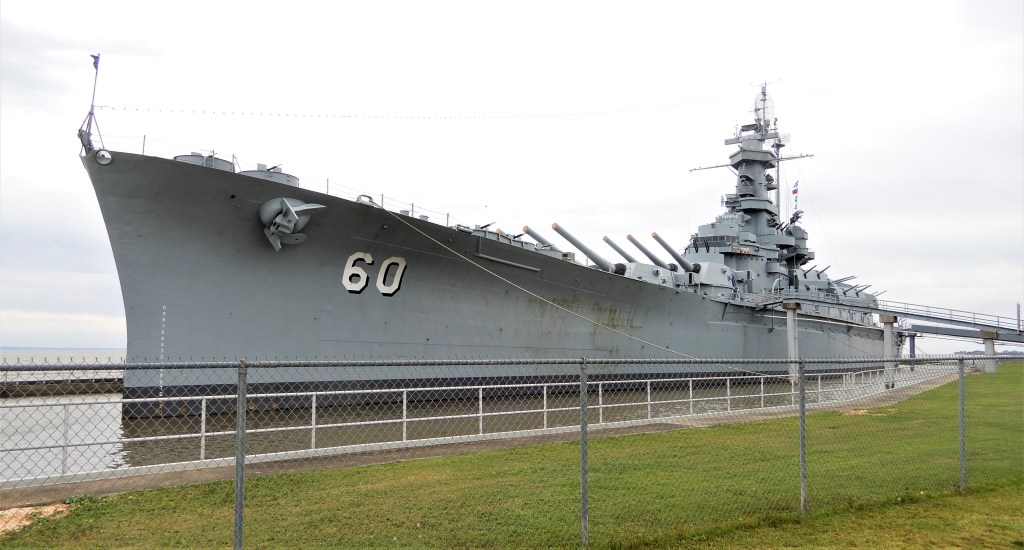
The USS Alabama was one of the new sea-going fortresses coming on line, and was commissioned in February of 1942 prior to the battles of the Coral Sea and Midway. The Alabama, weighing about 45,000 tons and had a crew of 1,793 men, was a fast battleship that could cruise at 27.5 knots (32 mph), and could sail for 14,773 nautical miles (17,000 miles) before refueling.

The ship bristled with firepower. It had 20 five-inch (inside diameter) guns firing 54-pound projectiles, and had 46 anti-aircraft guns. Its massive fire-power came from 9 sixteen-inch (inside diameter) guns which fired projectiles (large, bullet-shaped bombs) weighing an average of 2,400 pounds. These fortresses didn’t need to be near the shore, for they could hit the enemy 24 miles away with these weapons. Amazing!

For weight comparison to the sixteen-inch projectiles: a Chevy Spark (automobile) weighs about 2,269 pounds and a Nissan Versa weighs about 2,400 pounds.

The ship had a belt (steel-plating) at and below the waterline that was over a foot thick to deflect the concussion of near-miss bombs, and deflect or dull the blast of torpedoes.

The USS Alabama has seen battle action around the world: throughout the Atlantic, the Mediterranean, the Philippines, and all through the Pacific Ocean. But its legend continued even after the war. In 1947 it was taken to the Puget Sound Naval Shipyard in Bremerton, Washington to await further orders. The USS New Jersey was the only battle wagon activated for the Viet Nam war, so the Alabama was decommissioned. In 1964 it was towed to Mobile, Alabama and became a floating museum. Yesterday I met several folks who donated money for that effort.

But there’s more to the Mighty “A” to know.

The Alabama is also a movie-star – although, uncredited. It had a major role in the 1975 movie Movin’ On. It was used in the 1988 miniseries War and Remembrance representing the USS Iowa. Nicolas Cage starred in USS Indianapolis: Men of Courage with the Alabama posing as the USS Indianapolis. And it was used in most of the battleship scenes in the 1992 film Under Siege.

I’ve been on aircraft carriers, cruisers, destroyers, frigates, PT-boats, tug-boats, and many others. But I had never been on a Battle-Wagon. Seeing the ship often as I drove by on Interstate 10, I always wanted to visit it, and decided that I would … someday.

That day finally came on April 25, 2019.

As I walked up the gangplank, I said the traditional, “I request permission to come aboard.” The tour guide was a retired Master Chief Petty Officer. Smiling, he responded, “Permission granted. Welcome aboard, Chaplain.” We both laughed and saluted.

I walked every available passageway from stem-to-stern. I slowly walked the main deck and recalled what our US Navy personnel experienced in battle. I honor and admire them for fighting to maintain our freedoms.

With the advent of jet planes, rockets, and missiles, Battleships are now obsolete; but I am in awe of this magnificent ship. I am grateful to the Mobile, Alabama city fathers for preserving this historic memorial – the Mighty “A” – for future generations to experience.

Historical Trivia

I thought I’d follow up last week’s blog of New Years myths with a few tidbits of historical trivia.

Many things are going on in the world today and we tend to get tense, worried, and cynical.  But I think we need to “lighten up” … for at least a week. Also, I think humor is appropriate since Proverbs 17:22 says “A cheerful heart is good medicine, but a broken spirit saps a person’s strength” (NLT). So, here is some light-hearted trivia that I found many years ago. When I first read them, it looked like some had incorrect information so I did a little “lookin’ up” to get as close to the truth as I could. So sit back, relax, and enjoy the next five minutes.

Have you heard the saying “God willing and the creek don’t rise”? Some folk have a picture of an uncrossable stream or creek rising during a torrential downpour – especially with all the flooding happening in parts of the world today. However, there is one small error in that quote. The statement was written by Benjamin Hawkins, a politician and Indian diplomat in the early 1800s. While on the job in the southern USA, Hawkins was requested by President Thomas Jefferson to return to Washington D.C. and give a report about what was happening. His response was, “God willing and the Creek don’t rise.” Because of his job, and the fact that he capitalized the word “Creek,” it is deduced that he was referring to a potential Creek Indian uprising, and not a flooded body of water.

In George Washington’s days, there were no cameras. One’s image was either sculpted or painted. Some paintings of George Washington show him standing behind a desk with one arm behind his back, while others showed both legs and both arms. In fact, many paintings show people with arms or legs out of sight. That’s because prices were based on how big the canvas was, how many objects (things and people) were to be painted, and by how many fingers, hands, arms, legs, and feet were to be painted. Arms and legs are more difficult to paint, therefore painting them raised the price considerably. This is one probable origin of the expression, “It’ll cost you an arm and a leg.” By the way, that’s why many (if not most) cartoons show the characters with only three fingers and a thumb. Omitting the fourth finger reduced the production costs.

In centuries past, personal hygiene was not understood, and people didn’t bathe very often, which aided in the profusion of lice. Therefore, many women and most men in the European higher social strata shaved their heads because of lice and bugs, then wore wigs. This continued in colonial America – which, of course, was primarily an extension of British society. Wealthy and influential people could afford to buy larger wigs – and they did. Today we still use the term “He’s a big wig” because someone appears to be, or is, powerful and wealthy.

You might have heard various stories about the origin of “chairman of the board.” Well, some of the stories are flakey, but this is probably correct. The word “chair” infers sitting in the chair, or seat of authority (at times, perhaps the only chair while others sat on benches), and “board” (as we know it) was first heard of in the 13th century spelled borde, and means “table” – such as “God’s borde” (meaning “the Lord’s table.”) A mother’s call to the family was: “Mi bord is maked. Cumed to borde.” – meaning, “The table is set [for a meal]. Come to the table.” Also, people pay a fee or rent for “room and board” – sleeping quarters and food at the table. So, chairman of the board would be the person in charge at the table where business is conducted: be it church, industry, restaurant, or government.

Here’s one more. Have you heard the phrase, “turn a blind eye” in a situation?

In the naval battle of Copenhagen in 1801, British Admiral Horatio Nelson (who was blind in one eye) lead the attack against a joint Danish/Norwegian flotilla. The British fleet was commanded by Admiral Sir Hyde Parker. Sensing defeat, Parker sent a signal for Nelson to disengage, but Nelson was convinced he could win if he persisted. In Clarke and M’Arthur’s biography, Life of Nelson, published around 1809, they printed what they said was Nelson’s actual words at the time: [Putting the field glass to his blind eye and addressing his assistant] “You know, Foley, I have only one eye – and I have a right to be blind sometimes. I really do not see the signal.” So, turning a blind eye to Admiral Parker’s order, Nelson proceeded to defeat the enemy.

Thank you for reading, and I hope you have a pleasant week.

Pearl Harbor: December 7, 1941

On December 7, 1941, at 7:55 a.m. Hawaii time, a dive bomber from the Japanese Imperial Navy flew unchallenged over the mountains on the island of Oahu. Then 360 Japanese warplanes, following closely behind, thundered over the mountains, descended on and attacked the U.S. naval base and the Army air base at Pearl Harbor. That catapulted the United States into World War II.

President Franklin D. Roosevelt then galvanized the US Congress and the nation into action with his memorable speech which started with: “Yesterday, December 7, 1941 – a date which will live in infamy – the United States of America was suddenly and deliberately attacked by naval and air forces of the Empire of Japan.”

Part of our Pacific fleet was crippled. Included in the destruction were: four battleships, three cruisers, three destroyers, several other ships and subs, and almost 200 planes. Over 2,300 Americans were killed and 1,200 wounded in that disaster. That debacle could not and would not be ignored.

Interestingly, the attack was engineered to prevent the United States from entering the war which would have enabled Japan to advance her imperialistic goals.

Dad’s 1999 book was updated and in December of 2021 was released under a new title: Dead in the Water. I put in new Introduction and numerous pictures, and my brother, Paul, put in a new Afterword. You can find the book on Amazon, and you’ll be glad you bought the book.

Japan’s surprise attack – prior to declaring war – propelled this mighty nation into action. The US aircraft carriers which Japan intended to sink at Pearl Harbor were not at Pearl. Admiral Chester Nimitz, also a Texan, had sent them elsewhere, and the aircraft from those ships destroyed the core of the Japanese Imperial Navy six months later in the Battle of Midway. My father was on the USS Yorktown in that battle.

Recently we seem to have forgotten about the attack on Pearl Harbor. No, we don’t hate the Japanese, but if we forget history, we’ll forget who we are and why our nation exists.

When I worked at the Los Alamos National Laboratory – where our first atomic bombs were constructed – every year well-meaning people protested on August 6 and 9. Those were the dates the US dropped the bombs on Hiroshima and Nagasaki. They thought we should never have bombed Japan.

The fact is, we didn’t want to bomb Japan; we didn’t even want to get into the war. But when we are attacked, we do respond.

Suicide Doesn’t Help

Carol and I had been at the Niagara Falls for five minutes when the State Trooper walked up and asked, “Sir, I don’t understand a thing any these folks are saying, but you look like you speak English. Have you heard anything about a man jumping over the edge?”

“No, sir. I’ve been here for about five minutes, and I haven’t heard anything about that.”

 “The rumor is that he jumped over about seven minutes ago. If you hear anything about it, I’d appreciate it if you’d find me and let me know. I’ll be in the State Trooper booth over there.”

“Yes, sir. Will do.”

An estimated 12,000,000 people visit the Falls annually, and every year about 40 people are killed going over the Falls – most of them suicides. The horrendous water pressure mangles the person against the rocks below and sometimes the bodies are never found.

We walked to the railing that is supposed to keep people out of the Niagara River. Here is basic information about the Falls.

The water plunges onto the rocks and slowly erodes the cliff at the rate of less than a foot per year. The confluence from the Canadian Horseshoe Falls and the American Falls creates the large whirlpool below. The American Niagara plunges down a total of 167-188 feet (depending on the specific location), but the water hits the mound of boulders around 70-110 feet.

The river flows about 25 miles per hour with an average of 150,000 gallons going over the edge each second; but the highest recorded volume was about 700,000 gallons per second. Its speed is estimated to be 68 mph as it hits the jagged boulders with multiple tons of pressure.

On the lighter side: As I read other information about the five Great Lakes, the Niagara River, and the Falls, I leaned back and laughed. For an unknown number of centuries, the Laurentide Ice Sheet covered Canada and a portion of the Northern US. According to one theory, the last ice age ended about 18,000 years ago, and the ice sheet which gouged out the lakes began receding.

I read: “20,000 years ago, earth started to warm, and the Laurentide Ice Sheet began to disappear. By approximately 10,500 BC, the Niagara Peninsula was free of the ice.”

This is why I laughed. Man is accused of causing global warming, but man wasn’t capable of generating substantial local heat until about 1500 BC, and no substantial regional heat until the 1700s AD. But the ice sheet began melting around 18,000 BC.

If man wasn’t the culprit 20,000 years ago, what caused the global warming back then? For that matter, what caused the earth to warm and freeze to generate the multiple theoretical ice ages? If the earth can cool and warm by itself, why blame man now? This is simple logic and easy to think through.

Back to Niagara Falls.

Carol and I spent the next four hours looking at the beauty and wondering about the power of nature on this spot on the map in northwest New York. Standing on the observation tower several hundred yards away or at the railing a few feet from the water’s edge, the sight of the water plunging over the edge and the roar of the cascading water crashing on the rocks was almost mesmerizing. Is that what prompted the man to take the leap? Or was it sorrow, loneliness, embarrassment, or emotional pain that prompted him to end his life?

The Niagara Falls is called The Honeymoon Capital of the World, so why do so many people end their lives here?

For the western mindset, the thought might be, I just can’t take the pain any longer; I’ll end it all. For the New Age or oriental religions, the mindset might be, This life hurts too much; perhaps it will be better next time.

But suicide neither solves nor ends any problems; it only creates more. Hebrews 9:27-28 says, “Just as everyone must die once and then be judged, so Christ was offered as a sacrifice one time to take away the sins of the people. And he will come a second time, not to offer himself for sin, but to bring salvation to those who are waiting for him.” Suicide will not help anyone, but Jesus can help whoever asks Him for help. Turn to God, and to friends, for help, comfort, and direction for life, because you are loved. Your life is valuable, and people need you.

John 3:16: For God so loved the [people in the] world, that He gave His only begotten Son, that whoever believes in Him shall not perish but have everlasting life.

Pray for Others

A friend sent a rather lengthy tale to me several decades ago, but I never learned the identity of the author. The story is not a historical account, but more like a parable to illustrate a moral, and the following is a portion of the narrative.

**************

A ship was wrecked during a storm at sea and only two of the men survived and managed to get to a small island. Not knowing what else to do, they agreed that they had no other recourse but to pray to God.

The first thing the one man prayed for was food. The next morning, he saw a fruit-bearing tree on his side of the island, but the other man’s parcel of land remained barren.

However, to find out whose prayer was more powerful, they agreed to divide the territory between them and stay on opposite sides of the island.

After a week, the first man was lonely and he decided to pray for a puppy. The next day, he found a pooch swimming to his side of the island. On the other side of the island, nothing came ashore.

Soon the first man prayed for a house, clothes, more food. Each time, somehow, the food and the material for all of these came ashore.  However, the second man still had nothing. The first man did, begrudgingly, share some of his food with him.

Finally, the first man prayed for a ship, so that he and his puppy could leave the island. By morning, the wind had blown a deserted boat to his side of the island. He boarded the boat with his puppy and decided to leave the second man on the island.

He thought the other man was unworthy to receive God’s blessings, since none of his prayers had been answered.

As he was about to leave, he heard a voice from heaven booming, “Why are you leaving your companion on the island?”

“My blessings are mine alone, since I was the one who prayed for them. His prayers were all unanswered and so he doesn’t deserve anything.”

“You are mistaken!” the voice rebuked him. “He had only one prayer, which I answered. If not for that, you wouldn’t have received any of my blessings.”

“What did he pray for that I should owe him anything?”

“His only prayer these past two months was that I would answer your prayers.”

**************

In the legend, both men initially understood their plight, realized that prayer was the only recourse available to them, and amicably began their experiment.

The reason this stood out so strongly to me is that I’ve seen the same qualities in people wherever I go. Some folks are humble, good-hearted, and want what’s best for others. They go out of their way, even to the point of depriving themselves of some benefits of life so they can reduce the hurt and pain others are experiencing. These people are obeying Jesus.

But I’ve also seen other folks who are out to get what they can for themselves. Not helping others in a material way, these self-centered people sometimes go out of their way to destroy reputations, mock others, and make life hard for their imagined enemies.

What those self-absorbed people don’t understand is, the people they are attempting to hurt could be cherished friends if allowed to be.

But let’s continue about the fable above, and perhaps we should reconsider the concept of prayer.

The blessings we receive might not always be the fruit of our prayers alone, but are perhaps benefits from others praying for us. I can write a book about dangerous and life-threatening situations people have faced and how they escaped or survived, but I’ll tell about only one.

My father was in the USS Yorktown during WWII, heading for what would erupt into the Battle of Midway. A terrible fear gripped dad’s mind and he couldn’t do his job. Five thousand miles away, mom had a powerful burden to pray for him … not even knowing where in the world he was. After an hour of intense prayer, mom stopped praying, and the fear suddenly lifted from dad’s mind. Unknown to dad, God answered mom’s prayers.

I encourage all you who are reading this blog: when someone comes to your mind, pray for him or her. Pray however you feel like it, but pray. You may be the “ministering angel” God uses to rescue or help someone.

Walking Toward the Light

I spent three hours working through a research problem, and I needed to stretch my legs and clear my mind.

“Precious, “I’m going for a short walk. Would you like to go with me?”

“It’s 9 o’clock, it’s dark, it’s cold, and no. I don’t want to go for a walk.”

“The walk will be good for you.”

“It’ll be better for me to stay warm here in the RV.”

“Okay; I’ll be back in ten or fifteen minutes. I love you.”

“I love you, too. Take your jacket.”

I didn’t take the jacket because it was still 69 degrees outside; but I didn’t realize it was so dark! I turned on the RV porch light but it is quite dim, and I couldn’t see the moon. Oh well, I’ll just step carefully, and my feet will let me know where the path is.

After walking about twenty paces past the car, I quickly stopped. Something wasn’t right.

I reached out with my right hand and felt prickly pine needles that I couldn’t see. I also couldn’t see my hand. I rubbed my foot on the ground and discovered I was off the path. Because it was dark and I didn’t use the porch light as a point of reference, I hadn’t walked in a straight line.

Well, what do you know? I thought. I’m off the road. My plan didn’t work out the way I thought it would. Hmmm … Carol might gloat over this.

I looked around and saw the RV porch light, but I still couldn’t find the moon. (I later discovered it hiding behind some clouds.)

Walking toward the light, I returned to the RV.

“I thought you were going to be gone for ten or fifteen minutes. What happened? Where’s your jacket?”

“I didn’t need the coat, but it’s a good thing you didn’t go with me.”

“I know: it’s cold and dark.”

Here comes the gloating.

“Believe-it-or-not, Precious, unless I was looking toward the RV, I couldn’t see my hand in front of me.”

“You were smart to come back. I told you it was … oh, never mind. You want some coffee?”

She didn’t gloat. I love her! “Yes, thank you.”

That three-minute episode in the dark reminded me of a recent news report. A man on a 4-day back-country hike found the body of a woman who had been missing for over two months. Apparently, she didn’t file a plan with the forest rangers, nor had she told friends or family where she planned to hike; and a compass was not in her backpack.

Without proper planning, it is easy to get lost!

What do we need for a successful outing? First, tell someone where you’re going.

Next, REI co-op (https://www.rei.com/learn/expert-advice/ten-essentials.html) lists ten essential things: navigation (such as map, compass, GPS, etc.), headlamp and extra batteries, sun protection, first aid kit, knife, fire-starters, shelter, extra food, water, and clothing.

The REI author said, “The exact items from each system that you take can be tailored to the trip you’re taking. For example, on a short day hike that’s easy to navigate you might choose to take a map, compass and PLB, but leave your GPS and altimeter behind. On a longer, more complex outing, you might decide you want all those tools to help you find your way. When deciding what to bring, consider factors like weather, difficulty, duration, and distance from help.”

That is good advice, but many people are short-sighted and don’t invest the time to learn about it.

I find the same goes for people traversing this journey we call life. They are raised to fend for themselves and fight to get ahead – often by stepping on others. But they do not plan for the longer journey: the one that begins at death. Without planning for this final trip, it is easy to get lost – permanently.

What do we need? The map is the Bible and is also our most valuable point of reference. Food and water are wisdom and knowledge we learn in the Bible. The headlamp is the Holy Spirit; He will help us see life properly and walk straight. Clothing is the helmet of salvation, breastplate of righteousness, and the rest of the spiritual armor found in Ephesians 6:11-18. God, Himself, is our shelter.

Your most important trip is ahead of you. Plan well for it by reading the Bible and learning to live for the Lord. Walk toward the Light.

Protected by a Spider

Okay, I know that title above sounds a little goofy, but I want you to think about something. What does it take to protect us?

Since there are thousands of dangers in the world, let’s get to the spider and branch out from there.

Now, to put it succinctly – or bluntly, if you prefer – a busy spider protected the future King David when he was hiding from the current King Saul. I read a story some time ago in Hebrew literature, and I’ll write it here to the best of my memory.

When King David was a boy, he enjoyed walking through the fields while taking care of his father’s sheep and enjoying nature. He was thrilled to see how each creature gave something to the world. Several examples are, hens lay eggs, bees make honey, goats produce milk, and sheep give us wool. But he couldn’t figure out a good purpose for the lowly spider.  

“What’s the purpose of the spider?” David wondered. He didn’t even find a good use for the web, although he must have forgotten about it catching bugs. As an answer to the question, God seemed to impress on him that everything in creation had its purpose, and that one day he would understand that the spider also had a purpose.

Years went by and David became a hero who saved his people from the enemy by killing giant Goliath. King Saul was envious of him, feared for his throne, and decided to kill David.

David ran for his life and hid in the hills but Saul, with a portion of his army, was hunting for him. One day hearing that Saul was closing in on him, David hid in a nearby cave. Saul’s spies told him that David was in this area and figured they would kill him within an hour or so.

David was now in mortal danger and cried out to God, “Who will help me?”

Unknown to David, as soon as he entered the cave, a spider quickly spun a beautiful, well-developed circular web across the cave’s entrance. Saul’s men reached the cave where they were sure David was hiding and were about to enter it. But when they saw the intricate web, they said, “If David were here, he’d have torn the web to pieces. He must be hiding somewhere else. Let’s go!”

That’s how David realized that the spider, like all other creatures, can be useful, and he immediately thanked God for creating spiders.

What did it take to save David’s life? A spider.

That makes me stop and wonder how many times diversions, incidents, delays, etc., have saved me from danger.

Returning home from Maryland last month, I made a wrong turn somewhere in Pennsylvania which delayed me for about thirty minutes. No big deal. We normally give ourselves extra time because we don’t enjoy being in a hurry. But when we got back to the right highway, there was quite a slow-down. We eventually saw the tow trucks hauling off two mangled cars.

Would we have been in that wreck if we hadn’t taken the wrong turn? I’ll never know, but checking the timing of my wrong turn, that error could have saved our lives.

A spider protected David. A wrong turn might have protected us. What else protects us?

Some years ago, we were attending a local church that we enjoyed. I was a deacon, Carol and I sang in the choir, a couple of our kids were in the orchestra. But one day the idea came to me that we were supposed to leave that church.

I prayed about it, and the Lord impressed me with, “It’s time to go.”

I didn’t understand why, but I had long-since stopped questioning God. So we talked with the pastor and developed a gentle way of stepping out without raising too many eyebrows.

Within a short time, a major problem broke out in the church and reputations were hurt. But because we had already stepped away, we were not affected in any negative way. We were protected by “the still, small voice” we read about in 1 Kings 19:11-13.

Spider. Wrong turn. Still small voice. God protects us in many ways. All that’s required of us is to obey the Lord. John 10:27 says, “My sheep hear my voice, and I know them, and they follow me.”

Don’t allow delays and problems to ruin your day. Those delays might prevent a bigger problems.

Water!

“Water, water, everywhere, and all the boards did shrink; Water, water, everywhere, nor any drop to drink.” So states the 29th stanza of the The Rime [Rhyme] of the Ancient Mariner by Samuel Taylor Coleridge. The somewhat confusing poem is too long for me to remember, but those lines stick with me.

One of Bob Nolan’s songs sung by the Sons of the Pioneers is Cool Water. The first stanza is: “All day I face the barren waste without the taste of water; Cool water. Old Dan and I with throats burned dry and souls that cry for water, Cool water.” By the way, Old Dan is the mule or horse.

There’s much water in the poem and no water in the song – but in both situations, drinkable water is not available. Mankind has fought for thousands of years over water rights, but what’s the reason for this obsession?

Simply this: Humans can live for four or five weeks without food; but barely a week without water.

However, earth is a watery world. Earth is the only planet in our solar system that is naturally and readily habitable for mankind. Water is found almost everywhere either on or under the surface of the earth: from the polar ice caps to boiling geysers.

The oceans are an integral part of our lives because their influence dominates the world’s weather systems. About 96% of earth’s water covers approximately 71% of the earth’s surface. I read that under current atmospheric conditions, the atmosphere can hold approximately 37 million, billion gallons of water – enough to cover the entire surface of the world, including oceans, with one inch of water.

But if the solid earth were a smooth, round ball, one estimate is that the existing surface water – from oceans, lakes, and rivers – would be about 1.5 miles deep.

A water molecule is made of 2 hydrogen atoms and 1 oxygen atom – H2O – and water aids in sustaining a breathable atmosphere and a viable temperature. It is water that keeps vegetation, animals, and people alive.

Solar radiation heats the atmosphere, land, and oceans. As the warm air rises, water vapor rises with it. As the moisture enters the upper atmosphere, it cools, forms clouds, and spreads the live-sustaining liquid across the world as rain, hail, and snow.

Water is the world’s greatest solvent – humorously, but correctly, called dihydrogen monoxide (H2O). It is called the universal solvent because it dissolves more minerals and compounds than any other chemical known. Scientists have proven this by extracting gold, silver, lead, copper, and a host of other elements from sea water. Water from rain and snow dissolves those minerals from mountains and prairies and deposits them into lakes and oceans.

As corn, beans, wheat, potatoes, and all the other crops grow, their root systems absorb these minerals, and they become part of us as we eat the food. It takes water a long time to break down organic material; therefore, the body creates HCL (hydrochloric acid) to break down or digest food, and the watery blood system distributes food, vitamins, and minerals to every cell of the body.

Water is a major component of the human body. Bodies of newborn babies average 78% water but the adult body averages about 60%. The average water content in adult blood is 80%, and lungs are about 90% water.

Water has enabled mankind to build or advance civilization in many ways. Rivers, lakes, and oceans have been major highways of the world for thousands of years. Dams have been built across major rivers around the world, and the rushing water turns huge hydroelectric turbines to produce electrical power for untold millions of homes and factories. The oceans provide food for people and help to regulate climate by redistributing heat around the world.

Water is critical for life; and without water, live cannot exist.

But there is another kind of water that is critical for humanity. As H2O is mandatory for human life, Jesus has provided “living water” that is mandatory for Eternal Life. Jesus said in John 4:14, “Those who drink the water I give will never be thirsty again.”

How? That means He will sustain or help us throughout life. We “drink” of this living water by learning to know Jesus, purposely obeying Him, and living to please Him. This water includes wisdom that we need as we interact with others; and this water is necessary in every other aspect of human life.

Without this living water, we cannot enter the kingdom of God. Have you partaken of God’s living-water? Quench your spiritual thirst. Start by reading the Gospel of John. Follow it up by reading the book of Romans.