Part 2: Who were the Wise Men?

Who were the wise men, and why did they search for the new king? Matthew 2 says in part, “wise men came from the east to Jerusalem saying we have seen his star in the east… When they entered the house, they saw the young child with his mother.…”

The east is a big area, so we need to know what Eastern societies employed those who might be watching or studying the stars. China, India, and Persia are possible candidates.

China is the first that comes to mind, for they have written many things about the stars and the heavens throughout their history. But China’s Daoism (Taoism) was basically passive and stressed ethical action, and Confucianism stressed conformity as related to society, government, and family. Neither group was interested in religion or other governments at the time.

India is also an unlikely candidate because Buddhism (with its focus on the negative aspects of materialism) and Hinduism (with perhaps over 300 million gods, although possibly based on one central deity) were not interested in either the religions or the governments of other civilizations.

That leaves us with Persia. The main religion in Persia at the time was Zoroastrianism, and their priests were of a class called Magi (from whence we get magician). They were basically monotheistic. They acknowledged an evil one who was in opposition to the true Wise Lord, they believed the world would end when light finally conquered darkness, and they believed the Wise Lord was a loving God who desired communication with humans. These wise men, or scholars, studied the stars, and the languages, writings, cultures, botany, etc., of other civilizations.

They were the scientists of the day and carried status of nobility. In fact, the words “wise men” in Scripture refer to Babylonian officials who were of the Magian class. Remember also when the Jews (including Daniel who was Nebuchadnezzar’s personal counsel for years) were in captivity in Babylon in the sixth century BC, the Zoroastrians learned about the prophesies in the Hebrew Scriptures. Until about 220 AD, Zoroastrianism was sympathetic to any religion, including Judaism and Christianity, that taught kindness, justice, righteous thinking, truth, monotheism, etc.

The magi had various fields of expertise, including astronomy and astrology. Whenever a sign or star indicated a royal birth (Psalm 19:1), or when they learned of a royal birth through the communication system of the day, a delegation of three to seven was sent to acknowledge that royal event with expensive gifts fit for a king. Traveling with a caravan, they timed their arrival for when the child was about a year old (Matthew 2:11) because of the high infant mortality rate, and the visit was intended as an honor to God as well as an honor to the reigning king and the new prince.

Therefore, I believe that the Magi were monotheistic Zoroastrians from Persia, and they spread the good news of the new King throughout Persia when they returned home.

There is a small group of Zoroastrians today in India, but they believe somewhat differently than the Magi who took gifts to honor the Messiah, Jesus Christ.

Read part 3 tomorrow.
The Jewish Gospel of John

I seldom find a book that grabs my attention so strongly that I would rather read it than eat dinner. I discovered this book in February of 2016 and have kept it nearby for continual reference. It isn’t a novel, but it’s intriguing.

Since the Bible is my all-time favorite book, what am I talking about? For decades, I’ve told people if they want to know Jesus, read the Gospel of John. But people have read it for centuries; and because they don’t know the history, they don’t get the full impact of what took place.

Some folks tell us that the Gospel of John is anti-Semitic; but in the first chapter of this new book, it informs us that the Gospel of John is not anti-Jewish; it is pro-Christ.

Some scholars who can’t or won’t accept the Christ of the Bible, go to great lengths to try to explain the mysteries of the Bible and of the universe. Rather than accept the Christ of the Bible, they laboriously talk about the cosmological christ – the concepts of God, but without a real personal God. More on that in a minute.

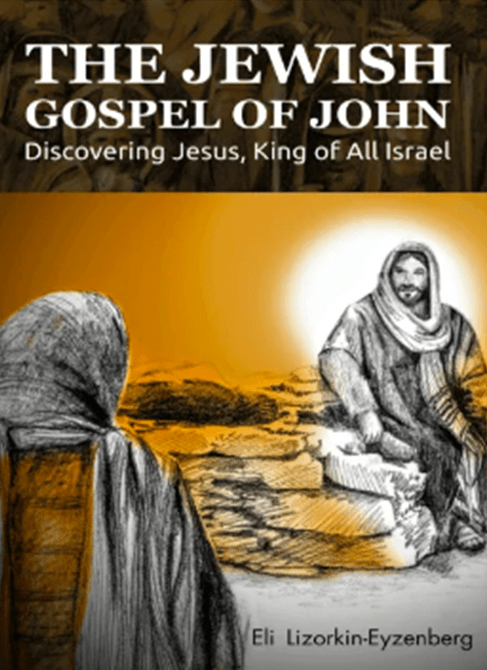
So, what is it that grabbed my attention? The Jewish Gospel of John – Discovering Jesus, King of All Israel.

The author is Dr. Eli Lizorkin-Eyzenberg who teaches Jewish Studies for Christians in Tel Aviv, Israel.

Many with a higher-criticism mentality search for the Cosmological Christ, or the Historical Jesus. They attempt to find “it” or “him” in the depths of eastern religions, ancient philosophies, outer space, and/or human kindness – whatever that is. They spend enormous amounts of time and money to search for a quality of life this mythical Christ presents, but they don’t want to accept the God that Jesus ultimately is. Much of this is because they haven’t been able to understand the message in the Bible. It’s true that sometimes the Bible can be difficult to understand because many of the translators failed to recognize both the culture-specific idioms, idiomatic phrases, and the history behind the cultures. But Dr. Eli’s book, The Jewish Gospel of John: Discovering Jesus, King of all Israel, helps to overcome many of these shortcomings.

One of my favorite paragraphs in the book is on page 10. Dr. Eli said: ‘While the juxtaposition of law and the gospel was present in the Church Fathers, it is not until the time of the Reformation that the juxtaposing [contrasting] of law and grace became pronounced. This became a dominant emphasis. The opposite of grace became law; the opposite of law became grace. In all reality, the opposite of law was never grace but lawlessness. Just as the opposite of grace was never law but disgrace.’ I heartily agree.

The Jewish Gospel of John is not just another book about Jesus that was written from a Jewish perspective. We current readers need to step outside of our Gentile understanding and read the Bible from the point of view that aligns with the Hebrew culture; and Dr. Eli enables us to do that.

Instead of reading it as though it was written for Gentile Christians today, The Jewish Gospel of John reveals the Gospel in light of first-century Israel. The book proves what the late Krister Stendahl (Swedish theologian and New Testament scholar, and Church of Sweden Bishop of Stockholm) stated long ago: “Our vision is often more abstracted by what we think we know than by our lack of knowledge.”

Instead of challenging the long-held interpretations (and many misunderstandings) of well-known stories, Dr. Eli, with the skill of an experienced tour guide, lets us hear the Gospel fresh with those who heard it in the first century. The real Jesus is revealed in his book.

Ishay Rosen-Zvi, formerly head of the Talmud and Late Antiquity Department, Tel-Aviv University, now Full Professor teaching rabbinic literature in the department of Jewish Philosophy and Talmud at Tel-Aviv University said, “For some time, research on the Gospels has suffered from stagnation, and there is a feeling that there is not much new that one can say. In light of this, Dr. Eli Lizorkin-Eyzenberg’s commentary on the Gospel of John, with its original outlook on the identity of the original audience and the issues at stake, is extremely refreshing.”

I heartily recommend The Jewish Gospel of John: Discovering Jesus, King of all Israel.

The book can be found at Amazon.com. Or you can go right to the site by typing in: Eli Lizorkin-Eyzenberg (Author of The Jewish Gospel of John) (goodreads.com) You’ll be glad you did.

I Won’t Go Back to This Church

Several years ago, Carol and I visited a church in California. It was the largest church in town with four weekend services: one Saturday evening and three on Sunday. I was really looking forward to hearing the pastor to see what was drawing the people.

One of the Sunday services was designated for the youth, and one parishioner said, “You don’t want to visit that one – it’s the loudest kid’s service in this part of the state!”

Well, that explained one drawing card. It’s too bad that neither the kids nor the church staff understand the destructive effect that high decibel levels have on our physical bodies – including our heart and nervous system.

Here is some information regarding noise levels measured in decibels (db).

Calm conversation level between 2-3 people is around 50 db.

60 db is 10 times louder than 50.

70 is 100 times louder than 50.

80 is 1,000 times louder than 50.

90 is 10,000 times louder than 50.

100 is 100,000 times louder than 50.

And so on.

Hearing damage starts at a continuous 80 decibels.

We hear about 85 dbs from locomotives going 45 mph about 100 feet away.

Motorcycles produce about 95-100 dbs.

Chainsaws produce about 105 dbs.

Many churches try to stay between 95–115 dbs during their music.

Clubs and concerts try for 105-125 dbs.

Jet engine at takeoff is about 140 dbs.

150 db can burst the eardrums.

185 db can kill a person.

Hearing degrades dramatically after only two minutes of exposure of 110 dbs without ear protection,

I also found that the church has many weekly and monthly games and activities for kids; various support groups for people; outings for men, women, and senior’s groups; and a school. The church is serving as an overall social organization for a large part of the community with some of the kids’ activities mirroring those provided by the non-Christian world. At least some hurting folks are receiving help, and that’s good.

We discovered something else interesting about that church. The pastor openly proclaimed in his message that we do not need to believe the Bible; we don’t need to live by any moral rules – either health or Biblical; and we don’t need to adhere to Bible doctrine. We don’t need any of that in order to go to heaven. How we live – be it as a prostitute, liar, whatever – has no bearing on our relationship with God.

I communicated with the pastor by email later that week to learn more of his point of view. He informed me that we can live any way we want to, by any code of ethics we choose, participate in any activity we want – be it evil or holy – and believe anything – Biblical or not – that we want to. It won’t make any difference in whether or not God will accept us, because God has already chosen us for heaven or chosen us for hell. Period. And there is nothing we can do about it.

I asked him if we should believe what Jesus taught in Scripture, and he said we don’t have to.

He asserted that it doesn’t matter whether or not people repent and turn from their sin and live a holy life, because if God didn’t choose them, they would go to hell anyway. Obeying the Lord and living for the Lord is not necessary.

I will state emphatically: That is not the God I find in the Bible. And that pastor does not represent Jesus who died for us. John 14:21 says, “Those who accept my commandments and obey them are the ones who love me. And because they love me, my Father will love them. And I will love them and reveal myself to each of them.”

John 3:16 says, “For God so loved the world, that he gave his only begotten Son, that whosoever believeth in him should not perish, but have everlasting life.”

2 Peter 3:9b says, “…But God is being patient with you. He does not want anyone to be lost, but he wants all people to change their hearts and lives.”

I believe that pastor is confused and is defrauding the people. It’s a large social club, and I am concerned for the people attending those social clubs.

On January 24, 2022 I wrote … “In Case You’re Interested”


In that blog I talked about this book, Charter of the Christian Faith. I said that it would be beneficial to whoever wanted to enhance their relationship with the Lord Jesus Christ. And that is absolutely true.

After hearing from many folks commenting on it and how it helped them, I took the privilege of writing a second edition. I refocused the message and gave the book a new title. Also, in order for readers to get the updated edition and not be confused with the two books, I took Charter of the Christian Faith off the market.

I replaced it with the new edition, Truth not meant to be Hidden, pictured here, and I’ve kept the price the same. This is a power-packed message you might never have heard before. And it does reveal truth that has long been hidden.

You’ll find the book at: https://www.amazon.com/s?k=S.+Eugene+Linzey&i=stripbooks&crid=NO0PDTQR3CQL&sprefix=s.+eugene+linzey%2Cstripbooks%2C107&ref=nb_sb_noss.

If you copy that url address and paste it into your browser, it will make finding this book very easy. It was published just last week, and I believe you will want to read it. You will see life in a way you’ve never seen it before.

The reason I wrote the book in the first place is although I know that all Christians go to heaven, much of the Church seemed to have forgotten how Jesus wanted a Christian to live while on earth. I didn’t see much difference in many people’s lives when they became a Christian or joined a church. On Sundays, most people talked about the Lord, sang, bowed heads in prayer, listened to the pastor – most of them – but something was missing.

Why would the Church of Jesus Christ—including all divisions and denominations–be confused as to what the Christian life is all about? Simply because I know many Christians who don’t seem to understand the Faith they claim to believe. Going to church and joining it is not the same as understanding the faith.

The Church, including each member of it, needs to keep in mind that our goal in life is not merely to get to heaven. Our goal in life, both on earth and in heaven, is to be a member of Jesus’ team and grow the Kingdom of God throughout eternity. It is by becoming an adopted child of God, and growing into a mature spokesman for God, that we can fully take our place in the Kingdom. That is why we need to know and understand the teaching in Matthew 5:1-12.

This book, Truth not meant to be Hidden, addresses this topic.

Bible Versions

The first time I was asked about my preferred version of the Bible, I said I preferred the KJV – the King James Version. I was in high school and had only recently been introduced to the Amplified and the New American Standard versions.

But in the past 56 years (my entire married life) I have studied out of numerous versions. When someone recently asked me the question of my preferred version, I told him, “I prefer the NCV – New Century Version. However, the KJV is the one I take with me wherever I go simply because I grew up with it and my Bible memorization came from the KJV.”

Some time ago a man told me that I was wrong for not sticking with the KJ because, he claimed, it was the only accurate Bible in the world. I tried to discuss the topic with him, but he wouldn’t consider my point of view. I finally said, “In that case, you have just presented one of the greatest miracles in the history of the world.”

Asking what it was, I responded, “If the King James Bible, published in 1611 AD (or CE), is the only real Bible, the Christian church existed for almost 1,600 years without a Bible and the Jewish Church existed for about 3,500 years without a Bible. Isn’t that amazing?”

He hadn’t thought about that. Many others haven’t thought about it, either. But neither had he thought about the fact that the KJV is only English. If the KJV were the only real Bible, no other language group in the world would have a true Bible.

With that said, people should not spend so much time creating more English versions. Instead, they should invest money to translate Bibles for the ethnic groups who have no Bible in their language.

I remember being in Bible studies when the leader asked, “How do you interpret this Scripture?” Since those studies didn’t involve linguistic experts, the question didn’t make any sense to me. The leader should have asked, “How do you apply this verse?” or “What does this verse convey to you?” or “What is the Lord saying to you through this verse?”

Two major problems most people have of interpreting Scriptures are: 1) many people, if not most, do not understand the history and culture of the Biblical era, and 2) most people do not understand many of the idioms and idiomatic phrases the original authors used. 

There are books to help us with culture and history, but idioms and idiomatic phrases trip us up. (That’s an idiomatic phrase and might be difficult for someone to understand and translate properly 500 years from now.)

A current example of translating idiomatic phrases is the following. Mark 14:38, “The spirit is willing, but the flesh is weak” was translated into Russian by an American, then retranslated into English by a Russian. The result was “The Vodka is strong, but the meat is rotting.” Both non-Christian translators tried to be literally correct, but they missed the intent.

Some of the problems generated today are by many church leaders and Bible scholars who normally filter the Bible text through their own cultural background. But the only proper way of understanding Scripture is through the context of the original writers who wrote the Bible.

Dr. Eli Lizorkin-Eyzenberg (professor of Jewish Studies for Christians in Tel Aviv, Israel) said in his book, The Jewish Gospel of John: Discovering Jesus, King of All Israel, “The proper context for interpreting the Bible is the context of the biblical writers – the context that produced the Bible. Every other context is alien to the biblical writers and, therefore, to the Bible. Yet there is a pervasive tendency in the believing Church to filter the Bible through creeds, confessions, and denominational preferences.”

That’s why we need Bible scholars, pastors, and teachers who have studied the culture and language of the Bible times to help us.

No matter how we cut it (idiomatically speaking), it is dynamically important that we read the Bible. Study it. Apply the truths and morals to your life. Honor the Lord Jesus Christ by the way you live. Studying the Bible will help you do that.

Pray for Others

A friend sent a rather lengthy tale to me several decades ago, but I never learned the identity of the author. The story is not a historical account, but more like a parable to illustrate a moral, and the following is a portion of the narrative.

**************

A ship was wrecked during a storm at sea and only two of the men survived and managed to get to a small island. Not knowing what else to do, they agreed that they had no other recourse but to pray to God.

The first thing the one man prayed for was food. The next morning, he saw a fruit-bearing tree on his side of the island, but the other man’s parcel of land remained barren.

However, to find out whose prayer was more powerful, they agreed to divide the territory between them and stay on opposite sides of the island.

After a week, the first man was lonely and he decided to pray for a puppy. The next day, he found a pooch swimming to his side of the island. On the other side of the island, nothing came ashore.

Soon the first man prayed for a house, clothes, more food. Each time, somehow, the food and the material for all of these came ashore.  However, the second man still had nothing. The first man did, begrudgingly, share some of his food with him.

Finally, the first man prayed for a ship, so that he and his puppy could leave the island. By morning, the wind had blown a deserted boat to his side of the island. He boarded the boat with his puppy and decided to leave the second man on the island.

He thought the other man was unworthy to receive God’s blessings, since none of his prayers had been answered.

As he was about to leave, he heard a voice from heaven booming, “Why are you leaving your companion on the island?”

“My blessings are mine alone, since I was the one who prayed for them. His prayers were all unanswered and so he doesn’t deserve anything.”

“You are mistaken!” the voice rebuked him. “He had only one prayer, which I answered. If not for that, you wouldn’t have received any of my blessings.”

“What did he pray for that I should owe him anything?”

“His only prayer these past two months was that I would answer your prayers.”

**************

In the legend, both men initially understood their plight, realized that prayer was the only recourse available to them, and amicably began their experiment.

The reason this stood out so strongly to me is that I’ve seen the same qualities in people wherever I go. Some folks are humble, good-hearted, and want what’s best for others. They go out of their way, even to the point of depriving themselves of some benefits of life so they can reduce the hurt and pain others are experiencing. These people are obeying Jesus.

But I’ve also seen other folks who are out to get what they can for themselves. Not helping others in a material way, these self-centered people sometimes go out of their way to destroy reputations, mock others, and make life hard for their imagined enemies.

What those self-absorbed people don’t understand is, the people they are attempting to hurt could be cherished friends if allowed to be.

But let’s continue about the fable above, and perhaps we should reconsider the concept of prayer.

The blessings we receive might not always be the fruit of our prayers alone, but are perhaps benefits from others praying for us. I can write a book about dangerous and life-threatening situations people have faced and how they escaped or survived, but I’ll tell about only one.

My father was in the USS Yorktown during WWII, heading for what would erupt into the Battle of Midway. A terrible fear gripped dad’s mind and he couldn’t do his job. Five thousand miles away, mom had a powerful burden to pray for him … not even knowing where in the world he was. After an hour of intense prayer, mom stopped praying, and the fear suddenly lifted from dad’s mind. Unknown to dad, God answered mom’s prayers.

I encourage all you who are reading this blog: when someone comes to your mind, pray for him or her. Pray however you feel like it, but pray. You may be the “ministering angel” God uses to rescue or help someone.

Revisiting Noah’s Ark

A couple of years ago, I mentioned that we went to see Noah’s Ark. This one really isn’t Noah’s because he’s not here, and he didn’t build it. But according to the dimensions listed in the Bible, this structure is a life-sized model. Is it the exact same shape? We don’t know because no one alive has seen the original ark. Many people doubt whether the flood was world-wide, but their doubt does not disprove what the Bible says.

At the turnoff from I-75 onto State Road 36 in Williamstown, go east for about a mile, and the ark is behind several small hills. When it first comes into view, it doesn’t look so large, but there is still another mile to go. When the shuttlebus drops us off, the ark looks large, but not huge. But we’re still an eighth of a mile away.

As we walk up to it, the enormity of the structure is striking!

How big is this boat? Genesis chapter 6 gives the dimensions in cubits: 300 long, 50 wide, and 30 high. The length of the cubit has varied with time and people, and historically has been between 18-22 inches. The Builders of this model used a nominal 20-inch cubit.

The ark in Williamstown is 510 feet long, 85 feet wide, and 51 feet high. The internal volume is equivalent to the volume of 570 modern railway boxcars.

For size comparisons, a football field is 360 feet long from the back of one end zone to the back of the other, so both the original ark and the model in Williamstown are too long to fit inside the football stadium. The size of the ark is truly impressive!

Can this boat in Kentucky float? No. It wasn’t built to float, but to illustrate what Noah, his boys, and probably many hired hands built. I believe it took Noah and company about 100 years to build the original because of what God told Noah in Genesis 6:3. “My Spirit shall not strive with man forever, because he also is flesh [meaning, evil]; his days shall be one hundred and twenty years.” I believe those words informed Noah that the flood would take place 120 years after that discussion.

Prior to entering the ark, we watched a video of the construction of the ark. It was quite a feat and was done without any government financial assistance. That means, no tax money was involved.

I wish I could show you some of the 545 photos Carol and I took. The builders of this model indicated how the thousands of animals might have been housed or caged. Noah might not have had full-grown elephants, hippos, giraffes, etc., but perhaps young ones. However, it was God who brought the animals to the ark, not Noah, so the age and size of the critters didn’t matter. God somehow tamed all the animals that He brought to the ark, and, as you might guess, the heavier animals were on the bottom of the three decks.

It’s also amazing how food might have been stored for a year for all the animals and for up to two years for the eight human passengers. With our current understanding of how much animals and people eat, and of how many kinds of animals there probably were back then, it’s easy to figure how much food would have been required. And there was still plenty of extra room.

Animal excrement removal must have been a chore!

I enjoyed the way they imagined living quarters for the four families, and the names they supplied for the four wives were relevant to the times. Much geologic, social, and cultural history is shown by several videos, and by many charts and graphs throughout the ark. Cultural history prior to the world-wide flood, therefore, the reason for the world-wide judgment, was highlighted.

In planning for this ark, the people did their research and identified many animals that have become extinct in the past 4,500 years, many of which would have been on the ark. That enhances the educational aspect of the visit to the ark. In fact, we saw four public school buses bringing students to the ark for an educational field trip.

If you ever have an opportunity to go east, go to Williamstown, Kentucky and visit the ark. It’s only 40 miles south of Cincinnati, Ohio.

It rained while we were there, but we were safe in the ark.

God’s Limiting Factor

I can hear the Reformed Theologians now: You Can’t Limit God. God is supreme. God is sovereign. God does what He wants to do without regard to man, beast, or nature.

But this Reflection is not about Calvinism versus Arminianism, or the misunderstood and misnamed Sovereignty-versus-Grace controversy; so let’s put those arguments aside.

I propose that humans are the only factor in limiting what God will do in our own lives. Not what God CAN do, but what He WILL do. Why? Are we superior to God? Absolutely not! Is God sovereign? Yes, absolutely!

God can side-step mankind when He wants to, and He often does. No one, including Lucifer, can thwart God’s ultimate plan. However, Scripture makes it clear that God does not mandate our lifestyle. We are not robots; therefore, God does not commandeer man’s will. God would receive no honor or glory if He programmed us to worship Him. Instead, He programmed us to be worshippers – but it’s our decision whom or what we will worship.

As I obey God, I can accomplish my part of His will on earth. He directs me in the decisions I make and the direction I go. But if I disobey Him, He does NOT direct me. He may direct other situations to guide me back to where He wants me, but it’s up to me to cooperate. God is omniscient: there’s no doubt about it. And since God already knows what I will do or not do, He already knows what He will do or not do regarding my life.

Scripture makes it clear that God hates sin; therefore, God does not make me disobey Him. But neither does He make me obey Him. Obedience is my decision. All through Scripture, and with assistance from the Holy Spirit, God implores man to listen to Him, to obey Him, to follow His leading. Jesus said in John 14:15, “If you love me, you will keep my commandments.” That statement alone reveals our freedom of choice, and reveals that God does not make the choice for us.

Is God stressed out about my disobedience? Heavens, no. God is bigger than that.

God’s imploring or pleading with us is not because of His inadequacy, but for our benefit. God is encouraging us to grow in our relationship with Him so that we can cooperate with Him in fulfilling our portion of His plan both here on earth and throughout eternity. Yes: God has plans for us!

Genesis 1:26A says, “Let Us make man in Our image, according to Our likeness ….” In that regard, God gave man a say-so about how he (man) will live.

Deuteronomy 28:1-14 spells out the blessings God promised Israel if they would obey Him, and verses 15-29 spell out the problems they would encounter if they deserted or rebelled against God. It identifies our freedom of choice without God’s intervention. But it also shows that God strongly desires us to obey Him.

Joshua 24:15 further clarifies it: “Now if you are unwilling to serve the Lord, choose this day whom you will serve, whether the gods your ancestors served in the region beyond the River or the gods of the Amorites in whose land you are living; but as for me and my household, we will serve the Lord. (NASB)”

Then Deuteronomy 30:19 gives the conclusion: “I call heaven and earth to witness against you today, that I have set before you life and death, the blessing and the curse. So choose life in order that you may live, you and your descendants.”

Do you see it? God is clearly telling man to make a choice. You might ask, “So, what’s your point?”

You are the only person in the universe who can affect the quality of God’s interaction in your life. Therefore, you are the only one who can limit your relationship with God. Others may battle you, interfere with you, try to stop your progress in various ways. Others may hurt you, persecute you, belittle you, slander you, and so forth. Although God knows if and when that will happen, none of that can hinder your relationship with Almighty God if you don’t let it.

Not even Lucifer has the authority to control or guide you.

It is your response to people or reaction to those situations that affect your relationship with the Lord – either positive or negative – and that determines how God will interact with you.

God will not mandate your reaction, and you cannot react properly without His help. It is a team effort. So in every situation in life, no matter the circumstances, learn to look to the Lord to see how you should respond.

How God will use you in heaven depends on how you cooperate with Him here on earth. So choose Life. Choose Christ and live.

Itching Ears, Misplaced Devotion

Carol and I know many people who are dis-satisfied with church-life. They want to go deeper into the Word of God. They want to get into the mind of Christ so that they can know God’s thoughts on every issue, but they think of church services as on the level of kindergarten. They place themselves on a higher plane than the Church and look down on others.

However, when I look at their lives, I find many of them to be spiritually arrogant. Many of them do weird things – in the name of Christ, of course. I am reminded of Second Timothy 4:3-4 that says, “The time will come when they will not endure sound doctrine; but after their own lusts shall heap to themselves teachers, having itching ears; and they shall turn away from the truth, and shall be turned unto fables.”

One Sunday evening, I watched Pastor Frank tell a parishioner, “If you believe and stick your head out the church window and yell ‘Jesus’ three times as loud as you can, you will be healed.” The woman obeyed and Frank victoriously pronounced her healed. When she died a month later, Pastor Frank merely intoned, “She didn’t have faith.”

I watched Pastor Carey announce to his congregation, “If you believe, and sign the book of life in the back of the church, you’ll never die. No matter how long Jesus delays His return, you’ll live until He comes back.” With people lining up to sign his book, I asked my father, “When Brother Carey dies, that will disprove his theory, won’t it?” Dad responded, “No, son. His followers will just think the pastor didn’t have faith.” Brother Carey died in 1993 and people continue to propagate his fables.

One day while praying, Jack had an experience with the Lord that could have changed his life. Jack was excited and wrote down every detail so he would never forget it; and every time visitors came, Jack excitedly read the experience to them. One day a minister he hadn’t seen for some years came to visit, and Jack went to his room to get the document. The visiting minister wondered what happened when he heard Jack yell, “Oh no! The rats ate my experience!”

Yes, the rodents found their way into the desk and destroyed the document. However, Jack had lost the reality of his experience to spiritual rats long before. Why? He placed his affection on an experience rather than on the Lord of the experience.

Let’s back up for a minute. I am from a Pentecostal background and have been affiliated with various denominations. I’ve also been dis-satisfied with church at times. I always want to go deeper into the Word of God, and I want to know God’s thoughts on every issue. So, what’s the difference?

Many of the folks to whom I referred place their faith in spiritual experiences, spiritual knowledge, and spiritual gifts; but that emphasis tends to overshadow Jesus. Scripture tells us to exalt Jesus, the resurrected Christ, the Giver of the experiences, knowledge, and gifts. That’s where I am. There is a world of difference here. If we are devoted to or focused on Jesus as we study the Bible, He will help us gain the knowledge, experiences, and gifts as He sees appropriate. But our priorities will be correct.

Some friends remind me that First Corinthians 12:31 says “Earnestly desire the best gifts.” They think that’s an exhortation to go after gifts that appeals to them. But I respond, “You are seeking the gifts while side-stepping the Giver of the gifts. That’s backwards. Instead, that verse encourages us to utilize the gift that is most appropriate for the situation, for there is NO spiritual gift that is more important than any other. And if we seek God’s input, He will grant us the wisdom we need as we respond to any and every situation.”

I’ve seen people healed of terminal diseases and seen other miracles take place. But I understand the purpose of miracles and spiritual experiences. Yes, they benefit man, but they are supposed to help us focus our attention on the Lord, to honor and bring glory to God.

First Corinthians 2:16b tells us, “We have the mind of Christ.” That is, Jesus will reveal His thoughts as we remain true to Scripture and turn away from those who exalt either themselves or their ideas.

“Itching ears” generates misplaced devotion and causes us to put our faith in miracles or in experiences. Instead, we should put our faith in the Scripture and on the Lord Jesus Christ.

Do You Trust God?

What in the world is “trust”? Can “trust” be qualified? What I am getting at is… oh, let’s start over.

Let’s define the word. Trust is a firm belief in the reliability, truth, ability, or strength of someone or something. It is conviction · credence · reliance

Can a person live without ever trusting someone or something? No.

You think I’m wrong? Let’s check it out.

Are you sitting on a chair or standing up? Either way, you are trusting something. You either trust the chair to hold you – as I am doing right now – or you trust the floor to hold you; and the floor is holding the chair. I don’t care if you weigh 75 pounds or 575 pounds: you trust the floor, chairs, the bed, even a motor vehicle to hold you; which proves you trust their manufacturers. So we just proved that everyone on earth trusts someone or something. It’s just a matter of in what or in whom we will place that trust.

Next: can “trust” be qualified? That is, can you partially trust someone? Or is it an all-or-nothing concept?

When I was five years old, we lived in El Cajon, California. My dad put me on the top bunkbed, and said, “When I say ‘jump’, you jump to me. (Yes, the lights were on.) But I was afraid of falling, so I told dad I didn’t want to jump. Dad promised me that there was absolutely no way I could fall; because even if I jumped awkwardly or inadvertently fell off the bed, he would still catch me.

I don’t know if you understand the fear of falling, but I was almost scared to death! I was emotionally paralyzed. But dad said very gently, “Eugene, if you can’t trust me, how will you ever learn to trust God?” You see, the proof or result of trust is obedience.

 Well that made sense – even to a 5-year-old.

So I suddenly leapt off the bed and hit dad in the chest with my 40 pounds and nearly knocked him over. Dad caught his balance and asked, “Why didn’t you warn me you were going to jump?” I responded, “You said you would catch me.” Dad chuckled, hugged me, and said, “Good job.”

Dad taught me about trust. Dad taught me a lot about life.

Did I fully trust dad, or did I partially trust him? If we consider my fear, we might say I partially trusted him. But if we consider my obedience, we say I absolutely trusted him. Obedience verifies trust.

What was it dad said? “Eugene, if you can’t trust me, how will you ever learn to trust God?”

As I grew older, I learned to trust God with my entire life.

How would my faith in God have been affected if dad dropped me? That’s hard to say because dad caught me. However, Dad most likely would have picked me up, apologized profusely to mom (who was watching), and tenderly talked to me about what went wrong. And because of that, I think I would still have learned to trust God.

I’ve experienced many situations since I left my parents’ home where I could have forfeited my faith and lost trust in God. But I am reminded of John 6:65-68. Many of Jesus’ disciples left Him, and Jesus asked if the twelve would also leave. “Peter responded, Lord, to whom shall we go? You have the words of eternal life.”

Job was one of the richest men in the world, and he lost everything. He lost his children, livestock, respect and admiration of friends and business associates, and was accused of being a terrible sinner.

But in spite of all of that, Job never lost his faith in God. He wanted to talk to God face-to-face and defend himself, but he never lost his faith. Job 13:15a says, “Though he [God] slay me, yet will I trust in him.” In chapter 19 verse 25, Job proclaims, “I know that my Redeemer lives, and he will eventually come to the earth.” And God, in the form of Jesus of Nazareth, did come to earth to redeem us.

Human mistakes and misfortunes should not deter us from trusting God. Jesus said if we love him, we will obey him. And Obedience is a manifestation of trust.

So, do you trust God?