
 “Okay – we’ve taken Sharon and Jim to the airport. What would you like to do next?” (The year was 2016.)
“What do I want to do next?” Carol responded. “It’s 5:45 in the morning. The only thing to do now is have breakfast.” She was right – as usual.
We wound our way out of Lindberg Field (the San Diego airport) without getting lost. Turning onto the Pacific Coast Highway in the dark, we headed north but missed the entry onto I-8 which would take us east up Mission Valley; but a quick u-turn took care of it. (Don’t worry: our’s was the only car on the street.)
Finally sitting at the booth in Denny’s – with Coffee! – we planned our day.
We attended the early church service where David Jeremiah is pastor. I heartily recommend visiting Shadow Mountain Community Church in El Cajon, California if you have a chance. His mailing address is listed as San Diego, but the church is on the east side of El Cajon – pronounced El Cahone.
Afterwards, we headed west on I-8, north on highway 67, then west on highway 52 which took us to the town of La Jolla (La Hoya) on the coast. We decided to drive north on beautiful Scenic Highway 101 up to Oceanside.
Friends, pay attention: It’s a beautiful drive, and we enjoyed it. But if you are in a hurry, don’t do that. Highway 101 meanders through all the towns, and you can make more time on I-5 – unless it’s slow-hour. I think most folk call it “rush-hour” but believe me: there is no such thing as rushing down the freeways if they are jammed with cars. I call it slow-hour.
In the town of Carlsbad at 1:15 pm, we began looking for a place to eat and a nice place to stay. (We celebrated our 50th wedding anniversary all year long.) Turning onto a side street, we found Ocean Street that looked more like an ally; but we turned north on it hoping to find our way back to 101. The street was separated from the Pacific Ocean by one row of buildings, so Ocean Street is a good name for that road.
Before turning east on Christiansen Way to return to Highway 101, Carol spotted a place called Beach Terrace Inn. “I wonder how much they charge for a night’s stay.” Translated into a man’s language, it actually means, “Find out how much it costs to stay here.” Yes, Ma’am.
THAT was a good idea!
Beach Terrace Inn, the only oceanfront hotel between Oceanside and La Jolla, was built in three stages. The first edifice was built on the beach (on the sand) and was constructed around 1960. The second stage, which includes the current lobby, was built in 1976. And the third stage, which includes breakfast – and coffee – was built in 1988.
Ryan Roark, the assistant manager, greeted me. I know there are many friendly folk up-and-down the coast and throughout the country, but Ryan is one of the best. He personally walked to my car, helped carry in our luggage, and showed us where to eat. Sure, he wants our business, but that is the first time a hotel manager ever helped me with the heavy work. As we walked, Ryan said, “Those who stay here are not guests – they are family. So you are now part of the Beach Terrace Inn Family.” Thank you, Brother Ryan.
Thomas Burke, the Guest Service Ace, stopped for ten minutes and filled us in on a lot of the history of the place. He even brought extra coffee to our room. Thank you, Thomas. These folks really know how to make people feel welcome and important – like family.
In the evening, we walked down the steps to the beach and I swam in the surf. After tiring myself out, Carol and I walked the beach looking for sand dollars.
The Inn’s advertisement (http://beachterraceinn.com/) says, “We believe size matters, so we’ve chosen to be a small hotel with big rooms rather than a big hotel with small rooms. We’ve remained owned by the same family since the 1960’s. We believe in personality and choose to be remarkable rather than  flashy.” Carol and I found that to be true.
If you find yourself in Southern California, go to Carlsbad and visit the Beach Terrace Inn on Ocean Street. You’ll be glad you did. Tell them Gene and Carol Linzey sent you.
Now, where’s the coffee?
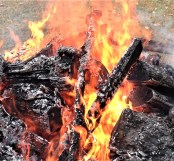
 I were heading south on Arizona highway 89. We were almost to the little town of Congress when we saw a small brushfire beside the road. We surmised that the fire was caused by a foolish person throwing a cigarette out the window. It was hot, and a lot of dried vegetation (fuel for the fire) covered the country-side.
 Himself, doesn’t need our skills and abilities, but He does give us the privilege of exercising our gifts and abilities—what He gave us or enabled us to learn—to fulfill our portion of His plan: thus, growing His kingdom and helping mankind. You may be a computer technician, auto mechanic, writer, pastor, secretary, lawyer, politician, policeman, or fireman. Whatever your vocation, God calls each of us to work as though He (God) is our supervisor. He then helps us to be alert to situations, such as the fires, and directs us as to our part in putting them out.
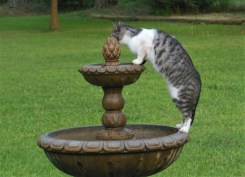 Cats are my favorite land animal, and I talk with them. No, I am not weird. I have learned to meow like kittens and cats. I can snarl a little like them too. Let me tell you about a special cat.
 night visit.
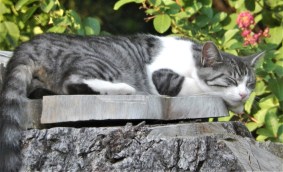 Don’t do it on the floor. Okay?” Tiger agreed with a soft, “Meow.”
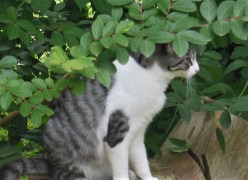 Tiger with me as long as I needed him because Tiger was God’s gift of healing to my hurting soul. But, also in His love for me, God allowed Tiger to leave when I was emotionally well enough and mature enough to re-attach with my siblings and parents. God loves us and brings into our lives special gifts at crucial times.
 It takes the earth approximately 365 days, 5 hours, 48 minutes, and 45.99 seconds (a tropical year) to make the 584,336,233 mile trip around the sun at approximately 66,659 mph.
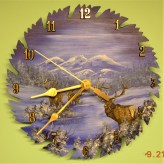 which employs use of atomic clocks. Leap Seconds are applied to guarantee that UTC does not differ from the earth’s rotational time by more than 0.9 seconds. Earth’s rotation seems to be decelerating at a rate of about 1.5 to 2 milliseconds per day due to the bumping of oceanic tides, so every 450-500 days another 0.9 seconds are adjusted on the clocks. However, since that slowdown is less than two minutes per century, we won’t worry about that for a while.
 People born on February 29 are all invited to join “The Honor Society of Leap Year Day Babies”; and the Guinness World Book of Records lists a family that produced three consecutive generations born on February 29.
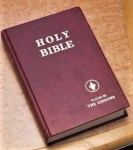 But there is another more important “birthday” that we need to consider. This one is called “the second birth” when we are “born” into the family of God by accepting Jesus as our Savior. This birthday can be celebrated every day of your life, and will last throughout eternity
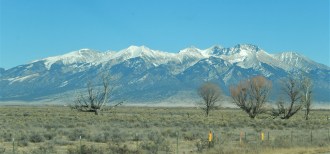 see it.
 and the underlying soil was good for the tree. The owners gladly allowed us to take as many apples as we wanted, and we belatedly enjoyed the fruit of our labors. The apples were delicious in pies, strudel, crisp – and eating raw. They were good!
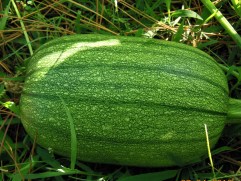 programmed to grow at different rates, to different sizes, to look differently, and to taste differently. The same ground produces different results.
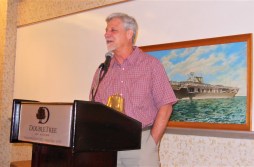 We also “plant” seeds into other people’s lives. What we say to others – whether good or bad – produces a harvest. We either help others live a higher quality, more productive life, or we stunt their growth to where they don’t live up to their God-given potential. We must assure that we make positive comments for people to meditate on.
 Sometimes a sterile tree looks wonderful until “harvest time”. That’s when the real nature of the tree is revealed. (Read Matthew 13:25-30 about the wheat and tares.)
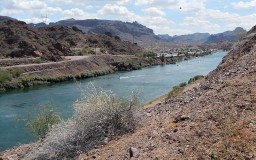 know we won’t be far from the Salton Sea?”
 “If you get there by driving on the freeways through Riverside, it is about 182 miles; and if you go through the mountains through Julian, it is about 138 miles. But if you get there by helicopter, it is only about 70 miles.”
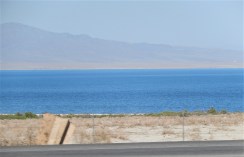 Development Company were trying to increase water flow from the Colorado River into the valley for farming. But the powerful river overcame their barriers, gouged deep channels into the land, and poured into the Salton Sink basin for eighteen months. The engineers were finally able to stop the flow in 1907. Interestingly, the Salton Sea sits squarely on a portion of the San Andreas Fault.
  vacated houses with broken windows. We did see a few sandy residential areas with very small town centers, but the thriving resort and retirement communities I had read about years ago seemed to be non-existent. The lake had been receding in the past several decades but more rapidly during the recent California drought. The badly-receding shoreline was salt-encrusted, and badly deteriorated boats were rotting in the salty sand.
 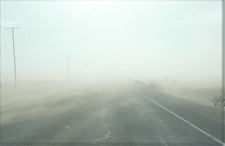 in the midst of the length of the storm to Brawley, or drive across the storm for twelve miles. Either way, we would drive slowly for we couldn’t see very well more than 75 feet ahead of us. We chose the shorter hazard.
  Northern New Mexico. Our house was situated on a half-acre with 78 pine trees throughout the yard, and eight acres of meadow and forest were next door. We were at 7,830 feet altitude and it was a cool autumn day with no clouds in the blue sky. A light breeze was blowing which caused the pine trees to gently sway, polka-doting the ground as they dropped their pine cones. As we sat on our deck, Carol brought out iced tea and sandwiches as we discussed whatever came to our minds. We’ve known the Whittleseys–who now live in Tulsa–since October of 1970, and they are life-long friends. Correction: they are eternity-long friends.
 zipped down to where the bird had fallen. It picked up a lifeless sparrow with its needle-sharp talons and flew away.
 In Pagosa Springs, Colorado, I saw a Bald Eagle swoop down and grab a fish, but was almost pulled under water. After a brief struggle, it managed to lift off with a sixteen-inch rainbow trout in its iron grasp. Struggling to gain altitude, it managed to fly a hundred yards to a tree. Then, after resting for a few minutes, while almost dropping its catch, it finally began eating its fresh trout dinner.
 of weapons. These evil people want our money, our property, our identification, and our reputation. They use scams, casinos, pyramid schemes, loan shark offices, guns, online threats, and even steal information at ATM machines. Concerning casinos, one man said that as long as you’re willing to expose yourself to the money-losing game, the casino operators need only sit back and wait. And with increasing availability of casinos across the U.S., they don’t need to wait long.
 whatever that meant. But I grew up with many funny ideas, such as: dawn can crack, night can fall, stories have sharp points, and there are different zones in town where we can speed. And now sound has a barrier that can break? Maybe it could. We learn a lot as we grow up, don’t we?
 and meteorites crash into the atmosphere. Of course, the larger the object that breaks the sound barrier, the louder the boom. Meteor Crater near Winslow, Arizona was created by a meteor that was possibly 150 feet in diameter and weighed possibly 300,000 tons, and hit the desert at possibly 27,000 mph – over 33 times the speed of sound. The resulting explosion generated energy that might have exceeded 1,000 times the power of the atomic bomb over Hiroshima, and the sonic-boom might have been heard hundreds of miles away.
 times the speed of sound) and friction between the plane and the atmosphere generated heat of about 1,100 F. It took four air conditioning units to cool both the interior and the exterior surfaces of the plane in flight.
 God. You talk with God just like you talk with anyone whom you can see. There is no special formula, and you don’t have to use the King James language. Tell God what’s on your mind.
 safe in the leafy maze. Our granddaughters play all around the yard, including near the vines, but the birds know the girls are not a threat to the eggs and fledglings.
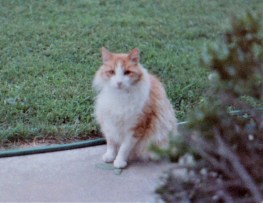 and the golden retrievers next door when we lived in New Mexico. Although separated by a five-foot chain-link fence, the retrievers wanted to kill Taffy and always “barked their heads off” every time they saw him.
 rejection are storms.
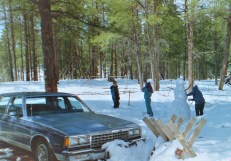 feet above sea level, we lived about a half mile higher than Denver. When folks who live near sea level take a trip up there and start chopping wood or do some other vigorous activity, they find out what it means to be out-of-breath. Why is that?
 we had to remove a tree that had fallen across the road. Many of us carried chain saws in the back of our 4-wheel drive vehicles, so if the tree was too large to move by hand or truck, we would cut the tree to manageable chunks to clear the road.
 sawdust all over the road. With the saw revved at full speed, I attacked the tree. But nothing happened.
 about their lack of finances, but they squander their money at the casinos. Other folks make disastrous or poor decisions because they didn’t pray about them or seek counsel. These folks aren’t thinking properly.
 Gene Linzey