Artificial Intelligence?

How many of you have thought about – I mean, deeply thought about – what is called AI, or Artificial Intelligence? Before we talk about it, let’s define and understand it.

At some point in history, the word “artificial” was given the meaning of insincere, fake, or forced. But that’s not what it means.

According to an etymology dictionary, “artificial” comes from the Latin in the 14th century, artificialis, which came from artificium, and that is: a work of art; skill; theory; system. The overall concept is: “made by man; contrived by human skill and labor.” The artificium was not the THING that was made; it was the SKILL, CRAFT, or TRADE that made the item.

Today, when we talk about Artificial Intelligence – or AI – there’s a lot of misunderstanding. AI today, in its broadest sense, is the intelligence or knowledge manifested by machines that are run by computer systems, and you might be surprised at how much of our industry is run by computers.

AI applications are systems such as web search engines (Google, et. al.), YouTube, Amazon, Netflix, Alexa, Siri, electronic chess games, cell phones, and thousands more! But remember, they are all run by computers. However, AI is used in so many systems – such as the computer I’m using at the moment – that they are not thought of as Artificial Intelligence any longer.

There shouldn’t be any mystery associated with AI. Remember, all Artificial Intelligence is man-made. There is nothing spooky, weird, or mysterious about it. Everything the computer or computer-operated machine can do or say has been programmed by man. And humans have been programmed by our Creator God to be very creative.

For example: One time I asked my cell phone, “Hey Siri, where’s my wife?” The machine answered, “If you don’t know, you’re in trouble.” (My wife and I burst out laughing!) That’s an application of AI, and someone programmed that as one of the possible responses.

Please understand this: Computers and computer-operated machines cannot – repeat, CANNOT – create information or responses without the information to generate those responses being programmed into it. They are wired and programmed by humans to scan thousands of computers and hard drives, then copy various bits of information and paste them together to give coherent responses. And the science involved has grown so well that it seems that the computer is thinking as a human. But it is not, and it cannot think as a human.

The most complex device or machine you can think of might seem to have a mind – or spirit – of its own. But remember that many primitive people thought compasses were possessed of spirits, and early native Americans thought photographs captured people’s souls. But, that was only because they didn’t understand the science involved.

So we need to understand that machines are not people, and they cannot think and respond like people. The movie, 2001 – Space Odyssey, was only science fiction; and the computer, HAL, was not real.

AI, in and of itself, is not evil. Here are several comparative examples:

Guns, by themselves, cannot kill or hurt anyone; people do.

Bows & arrows cannot hurt anyone; people do.

Knives cannot hurt anyone; people do.

Bats cannot hit a ball; people hit the ball with the bat.

Cameras, both movie and still, are not evil; but some people use them to glorify immorality, heinous murder, and evil spirits.

In like manner, AI is not bad. Instead, it’s being used in thousands of applications for the benefit – and amusement – of humanity. However, as with guns, bows & arrows, bats, knives, movies, and almost every other good thing, AI can be used wrongly for the detriment of man.

But listen: there definitely is an intelligence that overshadows anything and everything that man can do and ever could do. He is Almighty God.

When we pray, answers can come immediately: not because some AI can process at super speed, but because the Holy Spirit already knew what we were going to ask. The Bible says in I Chronicles 28:9b, “the Lord examines all minds and understands every motive of one’s thoughts.” And Isaiah 65:24a tells us, “Before they call, I [God] will answer.” Now that is fast!

So, if you want to know when Alexander the Great was born, and why some people thought of him as a god, check AI – the internet.

But when you need wisdom and guidance for living, call on the real God we read about in the Bible, and He will answer. God is omniscient – all knowing – and He cares for us.


Actively Listening Can Enhance Your Writing

In my opinion, learning to actively listen can make us a better writer. Let’s look into it.

In her book, Listening: Its Impact at All Levels on Reading and Other Language Arts (1979), Sara Lundsteen said, “Listening is the foundation for speaking, which is the foundation for reading, which is the foundation for writing.” She taught that since listening is a foundation for writing, active listening can further enhance the author’s writing. I want to follow up on that.

Actively listening to others – rather than passively listening, or interrupting – can increase our vocabulary. An increased vocabulary allows us to give people in our stories a wider range of expression.

Actively listening to others can teach us how others think. Learning how others think allows us to create a greater number of characters, with wider intellectual capacity, and more complex personality. That, in turn, can give us the potential for a more complex and a much more interesting story.

But actively listening also helps us personally. I found that when I learned how to actively listen, without interrupting, I began interacting on a more mature level, and people began asking for my thoughts and opinions. By listening, I gained a broader audience and became a better writer.

Listening will help you too, and help you to …

Write Creatively.

Life is Changing for a Lot of People

What’s happening? Approximately 3.7 million young adults are graduating from high school, around 4 million are graduating from college, and about 1.65 million will continue to pursue their masters degree. Oh yes, and about 30% of the American work force will change vocations.

Life is definitely changing”

Another thought to consider: about 80% of our population would like to write a book, but only about 3% actually do it. Why only 3%?

It takes time, and many folks feel intimated at what they think is a complex process. But I have good news for you.

Yes, it takes time, but we at P&L Publishing & Literary Services can coach and mentor you in the process. What about the complexity? We at P&L handle that easily and you won’t have to worry about it.

So if you are part of that 80% who would like to write a book, let P&L help you become part of the 3% who are successful. Our award-winning staff who will turn your manuscript into a beautiful book that you’ll be proud of.

Contact us at https://plpubandlit.org/ and click on Formatting Services to start the process, and be sure to …

Write Creatively. (Our editor will help you.)

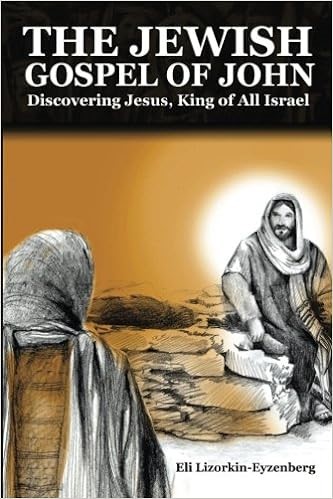
The Jewish Gospel of John

I seldom find a book that grabs my attention so strongly that I would rather read it than eat dinner. I discovered this book in February of 2016 and have kept it nearby for continual reference. It isn’t a novel, but it’s intriguing.

Since the Bible is my all-time favorite book, what am I talking about? For decades, I’ve told people if they want to know Jesus, read the Gospel of John. But people have read it for centuries; and because they don’t know the history, they don’t get the full impact of what took place.

Some folks tell us that the Gospel of John is anti-Semitic; but in the first chapter of this new book, it informs us that the Gospel of John is not anti-Jewish; it is pro-Christ.

Some scholars who can’t or won’t accept the Christ of the Bible, go to great lengths to try to explain the mysteries of the Bible and of the universe. Rather than accept the Christ of the Bible, they laboriously talk about the cosmological christ – the concepts of God, but without a real personal God. More on that in a minute.

So, what is it that grabbed my attention? The Jewish Gospel of John – Discovering Jesus, King of All Israel.

The author is Dr. Eli Lizorkin-Eyzenberg who teaches Jewish Studies for Christians in Tel Aviv, Israel.

Many with a higher-criticism mentality search for the Cosmological Christ, or the Historical Jesus. They attempt to find “it” or “him” in the depths of eastern religions, ancient philosophies, outer space, and/or human kindness – whatever that is. They spend enormous amounts of time and money to search for a quality of life this mythical Christ presents, but they don’t want to accept the God that Jesus ultimately is. Much of this is because they haven’t been able to understand the message in the Bible. It’s true that sometimes the Bible can be difficult to understand because many of the translators failed to recognize both the culture-specific idioms, idiomatic phrases, and the history behind the cultures. But Dr. Eli’s book, The Jewish Gospel of John: Discovering Jesus, King of all Israel, helps to overcome many of these shortcomings.

One of my favorite paragraphs in the book is on page 10. Dr. Eli said: ‘While the juxtaposition of law and the gospel was present in the Church Fathers, it is not until the time of the Reformation that the juxtaposing [contrasting] of law and grace became pronounced. This became a dominant emphasis. The opposite of grace became law; the opposite of law became grace. In all reality, the opposite of law was never grace but lawlessness. Just as the opposite of grace was never law but disgrace.’ I heartily agree.

The Jewish Gospel of John is not just another book about Jesus that was written from a Jewish perspective. We current readers need to step outside of our Gentile understanding and read the Bible from the point of view that aligns with the Hebrew culture; and Dr. Eli enables us to do that.

Instead of reading it as though it was written for Gentile Christians today, The Jewish Gospel of John reveals the Gospel in light of first-century Israel. The book proves what the late Krister Stendahl (Swedish theologian and New Testament scholar, and Church of Sweden Bishop of Stockholm) stated long ago: “Our vision is often more abstracted by what we think we know than by our lack of knowledge.”

Instead of challenging the long-held interpretations (and many misunderstandings) of well-known stories, Dr. Eli, with the skill of an experienced tour guide, lets us hear the Gospel fresh with those who heard it in the first century. The real Jesus is revealed in his book.

Ishay Rosen-Zvi, formerly head of the Talmud and Late Antiquity Department, Tel-Aviv University, now Full Professor teaching rabbinic literature in the department of Jewish Philosophy and Talmud at Tel-Aviv University said, “For some time, research on the Gospels has suffered from stagnation, and there is a feeling that there is not much new that one can say. In light of this, Dr. Eli Lizorkin-Eyzenberg’s commentary on the Gospel of John, with its original outlook on the identity of the original audience and the issues at stake, is extremely refreshing.”

I heartily recommend The Jewish Gospel of John: Discovering Jesus, King of all Israel.

The book can be found at Amazon.com. Or you can go right to the site by typing in: Eli Lizorkin-Eyzenberg (Author of The Jewish Gospel of John) (goodreads.com) You’ll be glad you did.

Tales From the Road: Tillamook Cheese

Years ago, I saw a movie about a woman who wrote for a newspaper. She ran out of ideas, so she began writing about different uses of cheese. After five weeks, the editor called her into his office. When the writer revealed what amounted to burnout or loss of imagination, the editor blurted out: “You’re a good writer – write about anything. But no more cheese, lady!”

That was the best line in the movie.

However, since I hadn’t written about that use of milk, since Carol and I were in the town of Tillamook, Oregon, and since I really like cheese, I decided it was time to write about it. When my editor read it, he approved, so I sent him some.

Tillamook is a Native American tribal name, but that’s another story.

Mankind has been making cheese for over 4,000 years, and I read that there are 1,831 kinds of cheese. Cheese is classified by geographic origin, what animal gave the milk, the animal’s diet, age of cheese, texture, added ingredients, butterfat content, and a lot more, and by combinations of all the above. Most milk used in cheese production is from cows, but cheese is also made of milk from goats, camels, sheep, yaks, buffalo, and even reindeer. I wonder if anyone tried giraffe milk.

Tillamook is my favorite brand of cheese, and Colby Jack (marbled yellow & white) is my favorite kind. Don’t ever confuse Colby Jack with Pepper Jack. That stuff is hot! (My editor liked it.)

The Tillamook Cheese Factory is a dairy cooperative that was founded in 1909. My first visit was in the summer of 1991 with Carol and the younger two kids (Rebecca and Michael), and this is my third visit. Over a million people a year must have the same taste for cheese as I do and visit the Tillamook Cheese Factory, so they built a new visitor center, updated its name to Tillamook Creamery, and added a food court.

There is no admission price. You walk in and learn while you enjoy all the free cheese samples.

So, how is cheese made? If you already know, skip the next four paragraphs.

Milk is poured into a vat and an enzyme, rennet, is added to coagulate it. (But juice from fruit, fig leaves, melons, safflower, vinegar, lemons, and other vegetation can be added instead.) This causes the milk to curdle and separate from the liquid whey. Tillamook’s vats hold 53,500 pounds (over 6,300 gallons) of fresh milk. As the milk is stirred, the curds and whey separate. The whey is drained into another container while the curds begin to stick or knit together. This is called cheddaring.

Ten pounds (1 gallon plus 2.5 cups) of cow milk will produce one pound of cheese, while six pounds of sheep milk will produce a pound of cheese because of its much higher fat content. Goat cheese production is similar to cows.

I hope this isn’t boring you. The whole process fascinates me.

The curds are chopped, cut, and pressed to release more liquid. Then the cheese curds are poured into a square column and pressure is slowly increased. When pressure finally reaches 800 pounds, it is held for two minutes then cut into 40-pound blocks. The blocks are stored and aged from 60 days to five years – depending on their intended use.

After the proper aging, the blocks are cut into smaller blocks – normally, half-pound, pound, and two-pound blocks. Mis-shaped or broken pieces are made into shredded-cheese. The Tillamook Creamery packages about a million pounds of cheese a week, and that takes about 1,160,000 gallons of milk each week.

There are hundreds of uses for the whey. It is commonly used as an ingredient in some drink mixes, protein bars, and other foods. Whey powder is often added to smoothies and other workout foods for its protein.

The Tillamook Creamery center is a 38,500-square-foot building that allows visitors the privilege of learning about each step of the milk-to-cheese process and allows them to actually see production from the second-floor level.

We visited the facility twice this week and really enjoyed learning. We ate lunch there, but the best part was the large Tillamook ice cream cones! Carol got huckleberry and chocolate-peanut butter, while I got chocolate and vanilla. That, with the free cheese samples on the second floor, topped off our meal.

If you get a chance, visit the Tillamook Creamery in Tillamook, Oregon.

Lessons From the Flock – Stay Focused

What are they doing out there?”

I was pouring a cup of coffee – my first one of the day – and had my back to Carol.

“What are who doing out where?”

“You have to look and see.”

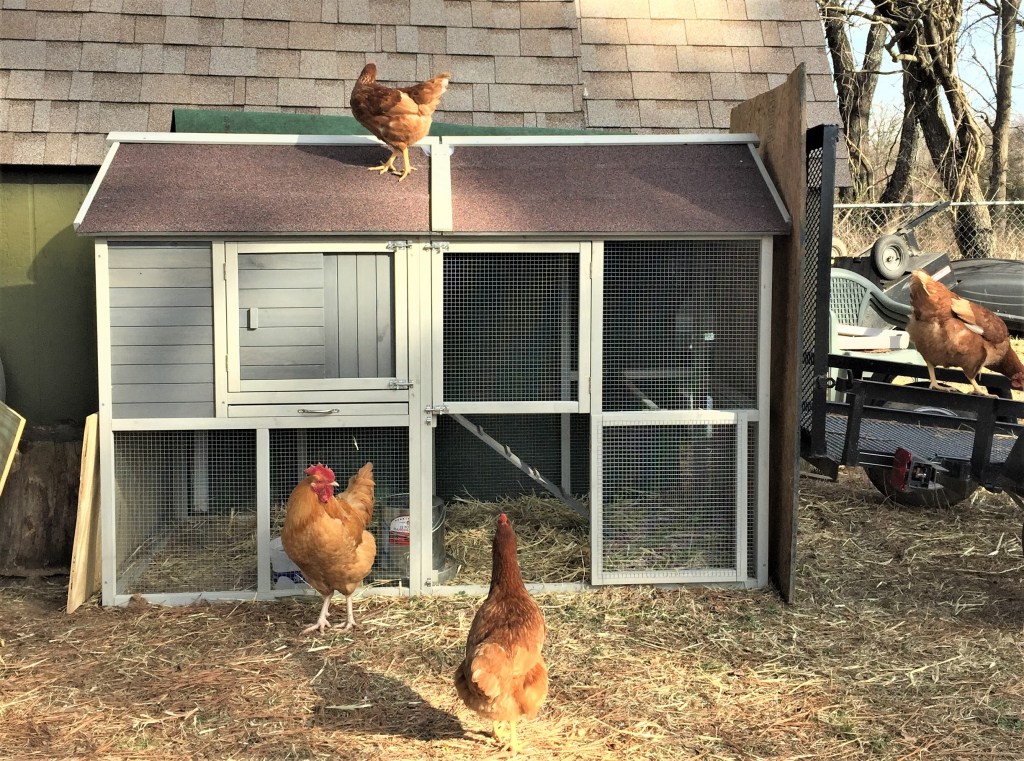
It was around 7:15 in the morning and I had already gone out to let the girls (chickens) out of the coop. As I prepared their mix of goodies, they followed me so closely that I nearly stumbled over them. Goldie and Elona pecked my britches as a sign to pick them up and love them a little – which I did. Then, as they began gobbling up the morning meal, I returned to the house where my coffee was waiting.

As I set my cup down, Carol reached for her camera to take a video of what was taking place. I began laughing. I had seen this many times previously but had never seen it from Carol’s viewpoint.

Goldie had entered the coop but left it within a few seconds. Whitey was walking toward the entrance of the coop. When Goldie walked out, Whitey entered, but quickly exited and stood at the entrance. Red Head was pacing a few feet away.

“Elona must be on the nest, Precious, and the other girls are waiting. No one will go in to make their deposit until Elona leaves the nest. And it looks like Whitey will be next.”

“That doesn’t make sense. Even if she’s on the nest, there are four more nests available. “Why don’t they use the other nests?”

I poured milk into my coffee to cool it and to give it a better flavor. I don’t like black coffee. I don’t like it hot, either.

“That’s human logic, Precious, but not necessarily bird logic. Remember when Goldie became a brooder and sat on twenty-three eggs?”

“Yes. All four birds laid the eggs in one nest.”

“They still do that quite often.”

“But Fred has been gone for eleven months now; do they think they can raise another flock?”

(Fred was the rooster.) “Who knows? I can figure out part of their thinking, but not all of it. All I can say is the girls seem to be waiting in line until it’s their turn to pay their dues.”

“You mean, lay their eggs. I didn’t know chickens could be so patient. Look!”

Elona walked out, and Whitey entered. Goldie moved up and stood at the entrance – Red Head continued pacing a few feet away. She would go last.

Putting her camera down, Carol finally said, “When it comes to eating, they will grab worms, cockroaches, moths, and other choice morsels from each other’s beaks; and Elona and Goldie fight each other vying for your attention. But when it comes to taking dust baths or laying eggs, they patiently wait in line? I don’t get it.”

“I don’t know if it is about patience; it might be a matter of being focused.”

The day before, Goldie and Red Head were chasing Elona all over the quarter-acre backyard trying to get the night-crawler away from her. Focused on that worm, they cornered Elona, and all three birds managed to eat a portion of that 7-inch fish-bait.

 The birds know how to be focused. God programmed that into them. As they meander around the yard, they are always on the alert for a bug – either flying or creeping. Sometimes one of them will half-run and half-fly all the way across the yard, leap or fly up several feet and grab a butterfly that is flying low. Now that’s being focused!

Is there something we can learn from our flock? Yes.

Not able to focus on eternal values, chickens are focused on what will keep them alive physically. But it’s supposed to be different with humans. What are you focused on? Fun? Personal gain? Entertainment? Vocational advancement? Vengeance? Disappointments? None of that will help you when you stop breathing. God built within us the ability to focus on eternal values.

Philippians 3:13b-14 says, “I focus on this one thing: Forgetting the past and looking forward to what lies ahead, I press on to reach the end of the race and receive the heavenly prize for which God, through Christ Jesus, is calling us. (NLT)”

The prize the Apostle Paul was focused on was eternal life with God which he gained by living for and honoring Jesus Christ while here on earth. We must fulfill our responsibilities on earth, but let’s stay focused on honoring our Heavenly Father by obeying our Lord, Jesus Christ.

Lessons From the Flock – Security

Two of my chickens don’t like to be picked up, but something was different today.

I prepared their mix of goodies which consists of whole-grained rolled-oats, dried meal worms, cut-up apples, bread bits, and scratch. Water and the 16% protein meal called Crumbles are available 24/7.

As I tossed the mix out for them, Elona and Baby wanted to be picked up. These two, and Goldie, are the ones who always want to be loved on. I picked up Baby, then Elona. But this time, Whitey and Red Head came up. That’s unusual because they are the more elusive ones.

As I held and talked with Elona – she was explaining life to me – Whitey stood at my feet.

“You want up, Whitey?” She took a step closer.

I put Elona down and scooped up Whitey. She cocked her head, looked at me from both sides of her head, and talked – but not freely as do Baby, Elona, and Goldie. They chatter with me, but Whitey merely said a few syllables. (I’m not joking.)

Then Goldie walked up and began pecking on my britches. That’s her signal to pick her up. Elona does that, too.

I put Whitey down and scooped up Goldie, and she began telling me what she’s been doing lately. I then felt Red Head bump against me as she was looking for more worms. I put Goldie down and picked up Red Head.

She squirmed a bit but didn’t try to get away. However, she wouldn’t talk at all. Red Head merely looked at me as if to say, “Are you happy now that I let you pick me up?” When she looked at the ground and wiggled her legs, I put her down, and she continued her search for worms. I had an extra worm in my hands, so I said, “Red Head – you want this?”

Without hesitation she jumped up, and with outstretched neck grabbed it with her beak. At that movement, the others came running. They wanted it! Do you know the chicken’s philosophy of life? Here it is: If I have it, it’s mine. If you have it, it’s mine. And if I had it but you took it, it’s still mine!

So, I threw out another handful of dried meal worms; that generated another feeding-frenzy.

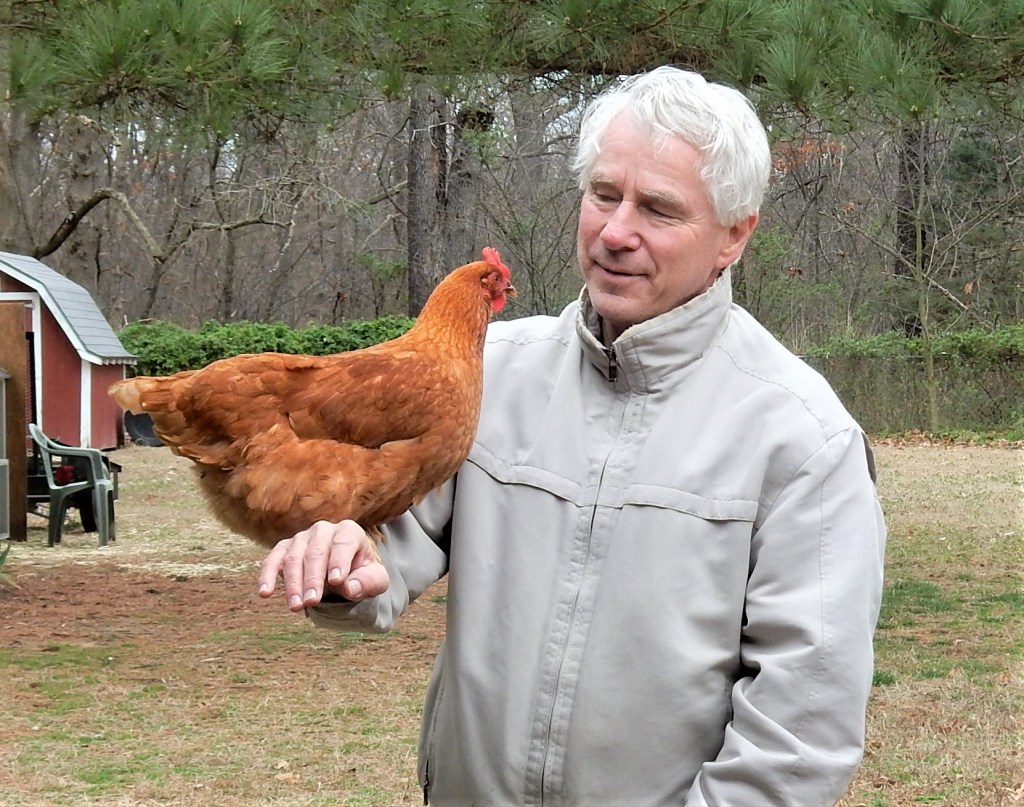
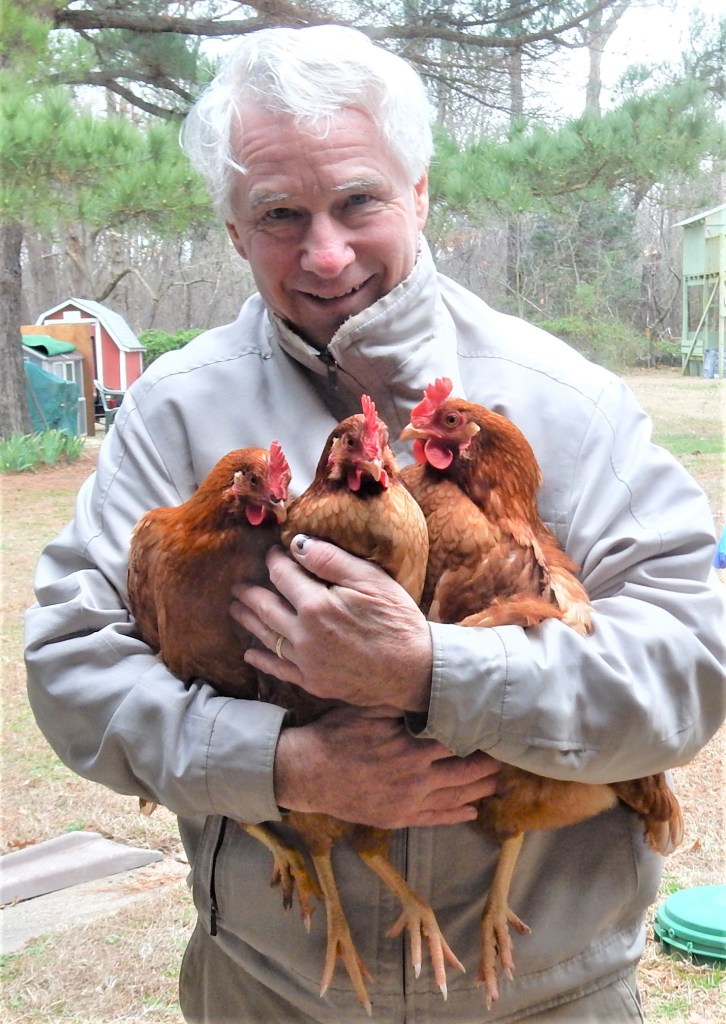
I often hold all five of the chickens – no more than three at a time, of course. I watch over my flock because (this may sound strange) I love them. I care for them and feed them very well. After losing the rooster (Fred) because I forgot to lock the coop, I always make sure they are safe and secure at night. They, in turn, come running to me every time I go out the back door. Again, as strange as it sounds, these babies love me – at least, as much as chickens know how to love.

Do you know that God loves us and wants to take care of us? But He does much more than I can do for my birds. I watch over my flock on a limited scale at best, but our Creator-Savior is a good shepherd and watches over His flock 24/7. He knows what’s happening with us every second of the day. He desires to “hold us” and care for us, and He goes out of His way to keep us safe and secure – if we let Him.

Amazingly, God is also limited in what He can do for us. What’s the limitation?

We are the limiting factor.

If my chickens wanted to, they could fly over the fence and escape my protective, nurturing care. They would be independent to roam freely. But they don’t. They stay with me, they trust me, they’re secure with me.

But many humans don’t have the wisdom my chickens have, and they run from God. Desiring independence, they “fly over the fence.” They fly from safety and into danger. They run from plenty, and into poverty. That’s not wise.

John 14:21 tells us that whoever loves the Lord – those who listen to and obey Him – are the ones to whom God the Father will reveal Himself.

If we run to God, and remain in His protective care, we can receive the “mix of goodies” that He wants to give us – in addition to His sustaining care available 24/7.

God loves you and desires to communicate with you. Study the Bible, learn to know Jesus, and find your security in and with Him. You may be surprised at the results.

Lessons From the Flock – Eggs

“We got six eggs from five chickens? How’d that happen?”

“Maybe it’s because my babies love me and want to stay in my good graces.”

 “Yeah, right!” Carol laughed. “But who gave the extra egg?”

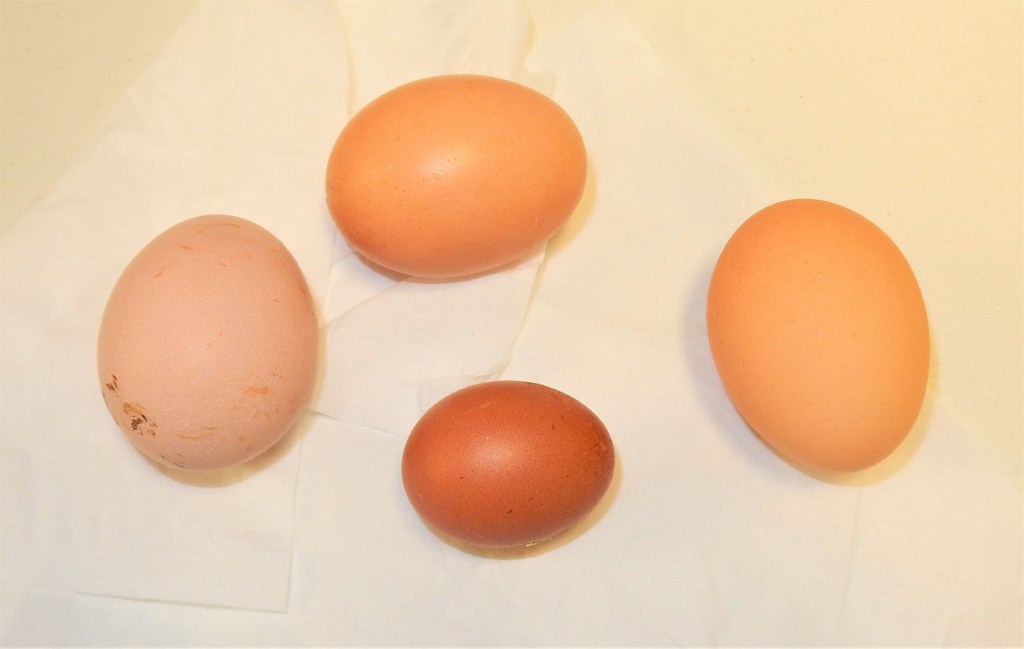
I studied the eggs. Each bird colors her eggs differently although some are very close. “Goldie gives dark brown eggs; Elona’s and Red Head’s are lighter brown; Whitey and Baby give light brown eggs with a pink hue. That’s why, although Goldie was the brooder who sat on the eggs, I think Whitey was the biological mama. But Goldie gave us two eggs today.”

“So Goldie is trying to stay in your good graces? She’s also the one who has been giving us double-yolkers.”

Carol was right. Within the past three weeks Goldie gave us five double-yolkers.

Carol had another question: “Don’t forget that Goldie also gave us several tiny eggs with no yolks; that was strange! How do they make eggs, anyway?”

It was time to study.

As with women, hens enter the world with all the eggs they will ever have. Our birds started laying eggs at six months of age, although some chickens lay at five months. Here, briefly stated, is the process.

Light entering the eyes starts the activity. Light and heat are the stimulants which help chickens produce an egg on the average of every 25 to 26 hours. However, rather than delaying the egg several hours each day, our birds usually lay them between 8:00 and 10:00 every morning and skip a day periodically. Hens normally don’t lay eggs in the dark, so if the egg is ready to be laid at night, she will “hold it” until morning.

The oocytes (eggs in the ovary which become yolks) begin growing. Normally, one a day is released into the oviduct where fertilization can take place, but several may be traveling down the oviduct simultaneously – growing as they move. If a rooster is on the job, the yolk is fertilized early in the journey. The chick will grow on the outside of the yolk, and the yolk and albumin (egg-white) are the food for the developing chick. The birds need plenty of clean water in order to manufacture eggs.

At about the half-way point, the albumin begins to accumulate. The mass is then wrapped in a membrane which holds things together for the calcite shell. Chickens need calcium to create the shells. About four days a week, I crush three or four of their own dried shells and mix it with their feed. (Our chickens don’t prefer oyster shells.)

The membrane, containing the yolk and albumin, sits in a calcium-rich fluid at the end of the oviduct where the calcite settles or is deposited all around the membrane. It takes over twenty hours for the shell to form. One end of the egg is more pointed, and the other is gently rounded; and normally, the rounded end comes out first.

If the egg is brown, the pigment is the last step of the process because the brown coloring is only on the surface; but green eggs are green throughout the shell.

I mentioned that Goldie gave us several yolk-less eggs. Those are called “no-yolkers” or “wind-eggs.” That happened after she gave us several double-yolkers where two yolks traveled close together and were caught in the same shell. The double-yolkers were the size of goose-eggs, but the wind-eggs were the size of half my thumb. (The wind-egg whites are as good to eat as are the whites in normal eggs.)

All five birds lay the eggs in the same nest – one at a time, of course. And it’s fun hearing each one “sing” as she ascends the ramp to deposit her gift.

Remember Carol’s question? She wanted to know how we got six eggs from five birds in one day. I had the answer: Goldie had an egg ready to lay sometime during the night but held it until daylight. By then, the next egg was almost ready. When she laid it a couple of hours later, we had six eggs for the day.

As I was preparing this article, I began laughing. “What’s up?” Carol asked.

“I’m laughing at the concept of Evolution. There is absolutely no way that birds – with their built-in egg-manufacturing process – could have evolved from a non-bird life-form. It is, also, impossible for any life-form to self-generate from dissolved rocks. Life, including vegetation, requires the engineering genius of our Creator: Almighty God.”

“Okay. And I suppose your research also answers another question.”

“Which one?”

“Which came first: the chicken or the egg?”

“You are smart! And we understand from the scientific viewpoint that, indeed, the chicken came first.”

I Try to Protect My Flock

In 2017 we were visited by a small flock of chickens. This blog, and the blogs for the next three weeks are about those memories.

I evicted the raccoon, ground hog, and opossum from the premises. Then I repaired the 8’x10’ barns to prevent predators from hiding close to the coop and put up new fencing to keep predators out of the chicken yard. The chickens and squirrels get along together, and the chickens love to eat little worms, frogs, and every kind of moving bug they can catch. Bugs are happy meals for happy chickens. (Yes! They do eat small frogs.)

Every night I latch the doors to the coop and latch the gate to the chicken yard. I feed the four hens and one rooster well, keeping food and water available 24-hours a day, and I give them scratch, table scraps, and other goodies every day. I try to protect my flock.

Carol and I decided to let the hens hatch a batch of chicks. All four hens took turns laying the eggs in one nest. I suppose the hens drew straws and Goldie was chosen to be the Momma. Twenty-three eggs fit inside the nest, so we began gathering the rest.

In New Mexico, we raised chickens and turkeys from 1973-1978. Buying the chicks at 3-days old, we didn’t hatch our own, therefore, this would be the first time we hatched … uh … let our hen hatch them, and we had a lot to learn.

I forgot that the mama hen turns the eggs several times a day. Thinking that one of the hens laid an egg on top of the 23, I took it and put it in the refrigerator. (We wash all the eggs we collect.) Four days later, Carol and I were negatively surprised when I cracked that egg to cook it, and dropped a fully-developed chicken as big as the first two digits on my baby finger into the pan. It had previously died in the fridge.

One night I got home late and forgot to secure the coop. The next morning, I found chicken feathers all over the yard, but no rooster. Fred (the rooster) apparently had fought the predator to protect his harem, and gave his life for them. But in the fracas, Fred also mortally wounded the opossum, and I found the opossum’s carcass in the corner of the yard. However, something else (coyote?) had jumped the fence and took Fred’s carcass.

Never again will I forget to secure the coop.

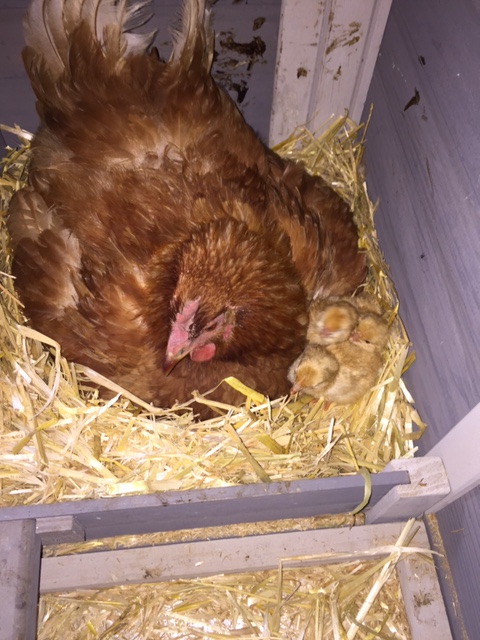
After Goldie sat on the nest for three weeks, the eggs began hatching. Eleven hatched, but one died. I called the remaining babies “Our ten chicklets.” I made sure I closed and latched the coop, but there was something else I didn’t know: the other hens would hurt or kill the babies.

Making the fatal mistake of allowing the hens to be in the same coop with the babies, the next morning I found eight dead chicklets. It was my fault, and I felt terrible. Even worse, while Goldie was trying to protect her young’uns, the other three hens attacked her. That broke our hearts, and I resolved to keep the hens away from Goldie and her remaining babies until they were older. Goldie recovered, but a week later, one of the chicklets died.

The remaining chicklet is nearly full-size now, and she has a name: Baby. So, we have Red Head, Whitey, Elona, Goldie, and Baby. Now the hens don’t attack Baby; it’s just the regular “pecking-order” that takes place.

As I’ve been thinking about all this, the Church came to mind. Too often, if someone’s theology differs from ours, they are labeled or branded as in error. Regardless of theology, if they tend to differ in other seemingly important areas, the church often tends to shun them or separate from them. We sometimes “kill” them socially by damaging their reputation. And if we allow our emotions to control us, we can even insult Jesus by splitting His Church. This ought not to be!

People who are made in the image of God should not act like animals. I Peter 4:8 informs us that we should look for ways to love and protect God’s flock.

Neither you nor I are perfect, so learn to accept others as they are. Love and honor God by loving and protecting His flock. Remember: you need their friendship as much as they need yours.

I’ll tell you more about the flock in the next three weeks.

Legislating Morality?

Some time ago, a friend and I were talking about our nation’s problems and how they could be solved. His position was that new laws need to be created for every new situation, and I said multitudinous comprehensive laws were already in place – but needed to be enforced.

When the discussion turned to morality, Henry became agitated and blurted out, “You can’t legislate morality!”

Surprised, I asked what he meant.

“Outlawing alcohol – you know, prohibition – in the 1920s didn’t work; outlawing gambling didn’t work; and outlawing prostitution, drugs, and other activities won’t work; so we need to change the laws. Those things should be legalized so the government can collect taxes on it all. You just can’t legislate morals!”

But the young man had no idea what he just said. It takes legislation to make something either legal or illegal, and our government has legislated morals since our nation’s founding.

Morals is defined as: relating to or concerned with the principles or rules of right conduct; the distinction between right and wrong; concerned with the judgment of right or wrong human action and character.

By the way, most verdicts that judges or juries give are comments on legislated morality. Who or what made the distinction between right and wrong? Let’s look into it.

What about taking a life? Homicide has commonly been called 1st, 2nd, or 3rd degree murder, and it’s against the law in the US to murder someone. What about theft? On the books we have petit larceny, then four degrees of grand larceny: also, against the law. What about lying? Perjury is spelled out in the US Code, Title 18, Part 1, Chapter 79, § 1621. You guessed it: illegal.

Nevertheless, lying is prevalent in our society – especially in government and the mass media. However, some rename it and call it disinformation.

Here are several disinformational methods:

Telling a big lie openly, then retracting it quietly. Giving erroneous reports as fact. In a valid report, omitting data needed to make a proper and correct evaluation. Quoting others out of context to give an erroneous viewpoint. Over-publicizing a news item in order to ignore or cover up something more important. Denigrating the integrity of one who is telling the truth. In all situations, disinformation is a means of hiding truth.

Let’s see now: morals is the distinction between right and wrong. And we just identified three moral activities which we have outlawed by legislation. Murder, stealing, and lying are also prohibited in the 6th, 8th, and 9th of the 10 Commandments (Exodus 34); so our government does agree with Scripture – sometimes.

Obviously, we can and do legislate morals; so the question is: what morals do we choose to legislate? The answer: many! We legislate (make law) many good, honorable ideas; but we also approve anti-Biblical and anti-American laws that nullify constitutional rights.

Ravi Zacharias, on his radio program titled Let My People Think, said, “The non-Christian world politicizes morality while they moralize politics.” He is correct. Some of our politicians favor good morality and truth while others outright disdain truth. What baffles me is that sometimes our leaders and judges listen to a small minority on the fringe of society and make or break laws that override the desires and morals of the voting majority. What kind of democracy is that?

We also have a built-in dichotomy in our government. Some well-known government officials can commit crimes and lie about it, and we overlook it; while other well-known officials commit crimes and lie about it, and are prosecuted. Yet other officials are prosecuted when there is no evidence for prosecution. The morality of the issue seems to depend on what side of the political fence the official is on. They moralize politics.

However, if it’s a hate crime, that is bad! Amazingly, that is a double-legislation of morals.

Friends, we legislate morals all the time. But we have a problem. Often we’re outlawing wholesome, healthy core values, while approving anti-Biblical values and morals. This goes against our national heritage and weakens our nation: both spiritually and politically.

Morals – right versus wrong – is both a Biblical and political issue. Galatians 6:7 says, “Don’t be misled. You can’t ignore or mock God and get away with it.” Therefore, if we don’t revert to using Scripture for our legislative standard as we formerly did, our national problems will become more profound than they are now. It’s time to wake up and turn back to God.